




Abstract
Abstract
Avatar creation is an interesting topic for both video game and social network studies. Research has shown that the creation of avatars is influenced by individual, contextual, and cultural features. Avatars are used to represent aspects of users' personality, but multiple avatars are used in different virtual contexts, as self-presentation strategies may vary according to the different “audiences” to be met online (say: friends, or strangers). Moreover, avatar creation is also influenced by cultural variables, such as gender, as avatars embody stereotypical aspects of being a woman or a man. This research tested whether avatars, as digital self-representations, may change depending on the above-mentioned variables. Ninety-four participants created two avatars to be used in different contexts (video game and job-themed social network). Moreover, two groups of participants were told that they would have met friends or total strangers within the two virtual contexts. Results showed that avatars changed from the game to the job context. Changes involved avatars' transient features (Clothes) more than physical (Body) and symbolic (Accessories) ones, and females changed accessories more than males. Moreover, females who expected to meet friends changed their avatars' bodies significantly more than males in both virtual contexts. The findings are discussed based on literature about computer-mediated communication and online self-disclosure. In conclusion, possible implications of the results for avatar-based interventions and the field of video games and social network design are reviewed.
Introduction
I
Moreover, video games and virtual worlds feature more and more sophisticated platforms for avatar customization, in that perceived avatar self-similarity appears to be an important prerequisite for users' engagement, both in entertainment and health-related digital products.9–12 For this reason, research attempting to better understand what factors intervene in avatar creation is more and more needed, to provide useful guidelines both for the design and development of avatar creation platforms and their use within health interventions.
People can use avatars to experiment with various aspects of themselves and their personality. The virtual context can serve as an “identity laboratory.” 13 According to projective identity theory, 2 an interface exists between the user and the avatar. This “space of liminality” 14 allows the users to strategically select and critically consider some aspects of their personality and self (e.g., personal values) to be possibly reproduced in the avatar. Specifically, avatar identity is created on the basis of the user's own characteristics and the roles the avatar is expected to assume.15–17 An avatar is not a random sum of physical and psychological features, rather it stands as a more or less accurate expression of one's own self or as a means for impression management. 18
Impression management refers to people attempting to control others' perceptions.19–21 People tend to build a favorable self-image, through the manipulation of their personal aspects 22 (e.g., in avatar customization 23 ) to the point that individuals' true physical appearance can remain completely hidden, so that only the desired avatar identity is visible. Also, during customization, people tend to vacillate between different types of selves (actual-self, ideal-self, ought-self, etc.), depending on the kind of message the avatar is meant to convey. 24 Nevertheless, projective identity is equally affected by social and contextual aspects so that avatar identity should be understood as the results of the agent's goals, the interface one uses for customization, and the social system he/she is in.2,25,26
Indeed, numerous studies found that users' self-perception was affected by social processes such as conformity and social influence.22–26 For this reason, people often use multiple avatars1,32 depending on the different virtual contexts. Vasalou and Joinson 24 demonstrated that participants entering specific contexts created avatars with features suited to them (e.g., more attractive avatars for dating-oriented contexts). However, especially within realistic virtual worlds, it seems that “transient” features of human figures (e.g., clothes and accessories) tend to be modified by users depending on context more than “permanent” ones (e.g., body features).4,28–30
However, there is limited research on the frequency of avatar changes by users: for example, Ratan and Hasler 31 found that it was not related to sense of presence inside virtual environments. Among the cultural factors involved in avatar customization, a major role is played by gender, or the cultural practices commonly attributed to the sexes.32,33 Gender is adopted and communicated by agents through “performative acts” or actions that are culturally recognized as gender related (e.g., putting on makeup for women and engaging in aggressive sports for men). Users tend to follow gender role expectations during avatar customization; studies34,35 revealed that people strategically choose impression management strategies to meet their personal goals and that females' and males' different impression management is based on gender role expectations.
For example, adolescent girls tended to customize avatars with objects (jewellery and make up) highlighting the characteristics typical of their gender 4 ; analogous results have been found for children. 36 Similarly, adult women were more likely to create thin avatars, 37 which is related to females being more exposed to social pressure for having “beautiful” physical appearance; indeed, in other studies on Virtual Worlds, women tended to engage in typically “feminine” activities such as shopping and improving their looks. 34
However, the interaction between contextual and cultural variables in avatar creation is less studied. As people may modify their behaviors because of feeling observed/judged by others, it is possible that females and males will differently manage avatar changes (regarding body appearance, clothes, or accessories) depending on the social context they expect to enter. For instance, both online social media and games feature the possibility of encountering friends and/or total strangers, implying the need for the users to adapt their self-presentation to different segments of the online audience.38,39 Previous research has shown that self-disclosure (the amount of information shared about oneself) is higher in computer-mediated than in face-to-face communication, especially when involving strangers40–42 ; thus, the expected online audience may possibly influence participants in adding more or fewer features to their avatars.
On this basis, we would like to test two hypotheses and propose an exploratory research question:
Methods
Participants
A total of 94 students were involved in this study (48 females; age: M = 24.07, SD = 3.61). All of them had an Italian background and reported having previously utilized personalized avatars within both social networks and video games. They responded to public advertisements and voluntarily participated in the study, and were randomly assigned to two different groups to assess differences in avatar changes based on different conditions (Table 1).
M, mean; SD, standard deviation.
Procedure
To investigate whether virtual self-presentation may be influenced by the online audience (RQ1), two balanced groups were created. Participants created avatars to meet Friends (Group 1) or Strangers (Group 2) in virtual contexts. Figure 1 depicts the entire procedure and research design. Participants used a free online program, WeeWorld (
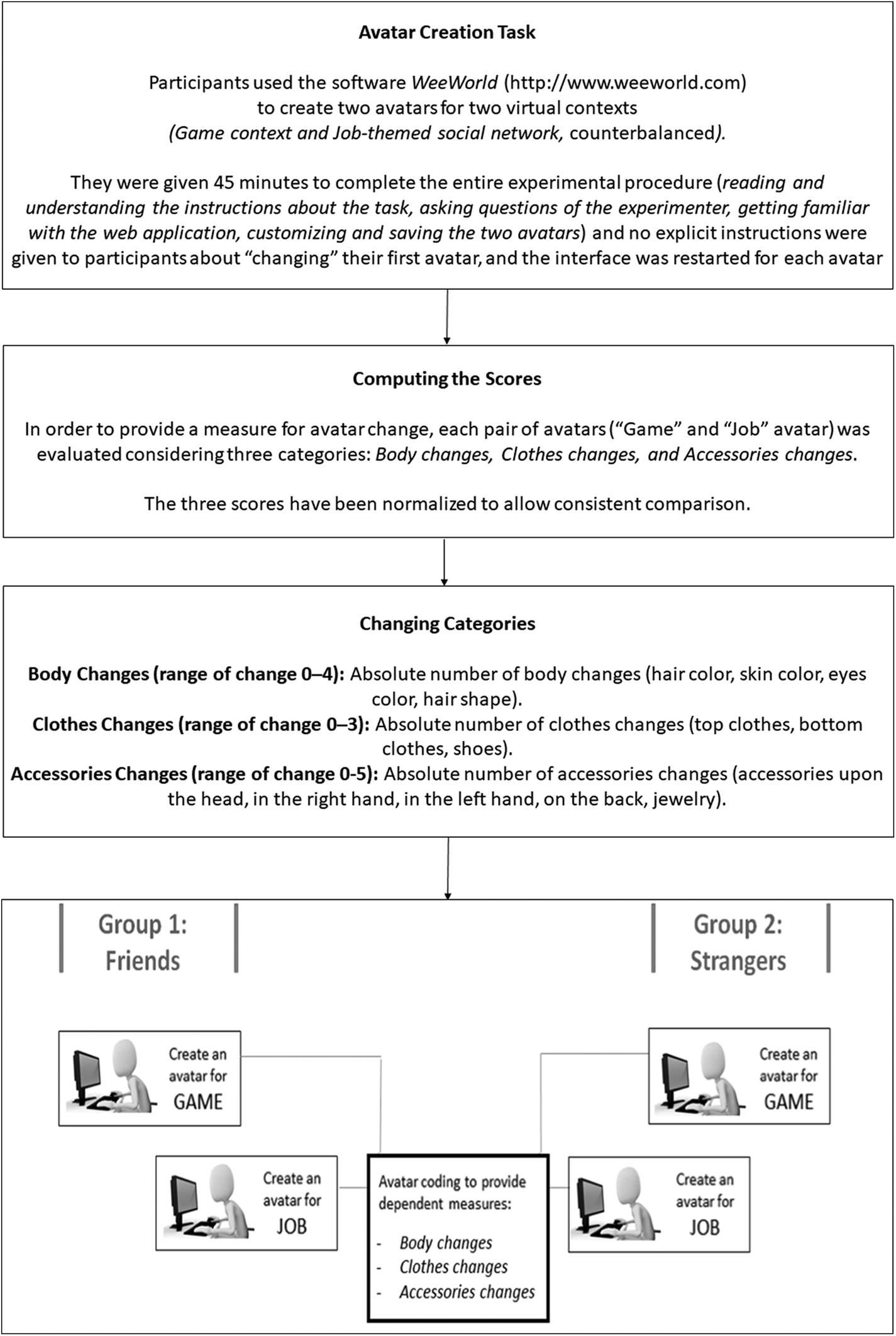
The procedure and the research design of the study.
In line with other studies coding avatars' features,3,4,37 the scores for avatar changes have been calculated as the number of changes between the two created avatars. Due to the goals of this study, we did not compute a score for Game and one for Job Avatar that have been compared, rather there was the counting of changes between the two avatars.
Results
Analyses are reported below:
p < 0.001.
ANOVA, analysis of variance; CI, confidence interval.

Two pairs of avatars created by two participants (Game avatars on the left and Job avatars on the right), that prominently show changes in clothes.
Levene's test for equality of variances was significant (F = 6.93, p = 0.010), hence degrees of freedom and results were adjusted for unequal variances.
p < 0.05.
p < 0.05.

Means and standard deviations of avatar changes (Body, Clothes, and Accessories) by audience condition (male participants on the left and female participants on the right). The three-way interaction effect regarding Body changes differed by gender (males on the left and females on the right).
Discussion
Hypothesis 1, stating that transient (Clothes, Accessories) avatar characteristics would have changed more than permanent characteristics (Body), was partially confirmed; greater changes were made to clothes than body and accessories, suggesting that participants were influenced by stereotypical representations of work contexts, dressing up their avatars appropriately (e.g., with suits); conversely, when entering the “game” context, they felt more free to experiment with fashion, funny or peculiar clothes.
This could be related to the different nonverbal communication properties of clothes that are more sensitive to cultural differences and social roles (e.g., job versus leisure) than body modifications or accessories choice. 44 Indeed, literature shows that clothes may be considered a “code” and are commonly used as a means for communication. 45 Especially in formal context, clothes are used to communicate information such as legitimation of roles or credibility of a message source.46,47 Accordingly, the literature states that avatar creators tend to change especially avatar clothes depending on virtual context.4,28–30
Hypothesis 2 was partially confirmed, supporting literature stating that women use avatar features to express their gender4,34; indeed, female participants created two avatars more different from each other than males, especially for what regard accessories. Discussing this result leads to the final research question: we wondered if participants' gender-related changes were different according to the audience of the virtual world. Results showed that female participants expecting to meet friends in virtual contexts changed their avatars' body features from Game to Job more than males.
In general, body modification is easier for females, due to widespread practices temporarily modifying women's outward appearance (e.g., makeup). 48 Literature on gender and social media use shows that women modify self-presentation features (e.g., profile) more often 49 and they use social media to manage affective relationships with friends and loved ones. 50 However, women also share less personal information than men and are more private when meeting new people online.49,51 If women experienced avatar customization features (especially body modifications) as a means to express themselves more than men, this could be the reason why such features were highly exploited in the secure context of friends' company, and kept to a minimum while having to deal with unknown people. 43
This interpretation of the result perfectly fits within the literature on psychological and cultural influences on avatar usage26,52: on the one hand, virtual world users make creative use of the platforms' customization options, but, on the other hand, they stick to cultural norms and unwritten rules to secure their membership inside social groups.
Conclusion
The avatar creation process entails not only a selection of self-properties but is also sensitive to users' expectations in terms of virtual context(s) to enter, and online audience. Avatar-based interventions assessing users' inner state and/or promoting behavior modification should take into account that providing a virtual context can externally influence avatar features (e.g., dressing in a certain way so as to receive social approval from the expected audience). A second implication concerns video games or social networks design. Consistent with other studies,19,44 we suggest to designers that they include in interfaces information about virtual context and the type of audience easy to meet inside.
This may help avoiding the possibility that one creates an avatar and then is prone to regret it because of unexpected aspects of its interaction with the digital environment. Of course, this is particularly important in the context of avatar-based health interventions: previous studies 6 show that avatars are more effective in modifying behavior when they resemble users; therefore, health professionals planning avatar-based interventions should be able to recognize contextual influences on avatar such as the ones highlighted in this study. Indeed, for example in video games, player–avatar identification is related to enjoyment and satisfaction.9,45
One limitation of this study regard the task, in that participants actually did not “change” a single avatar, rather they created two different avatars. Future research may more properly analyze dynamic change, namely providing users with an animate avatar entering multiple contexts, and observing how the user does or does not change its appearance over time. This would also help identifying possible differences related to specific context (e.g., Game or Job; formal or informal), which could be interesting for digital environment creators and designers. Moreover, motivation, personal traits, and previous experience orienting the changes analyzed in this research could be important for future research.
A second limitation may be related to the use of a cartoonish avatar platform. WeeWorld had already been used in scientific research 43 and, due to its simplicity, allowed us to rigorously monitor and analyze changes in different avatar features. A third limitation is related to the use of the cartoonish avatar platform WeeWorld.
Even if this program provides a basic design, its simplicity has been recognized as an opportunity to rigorously monitor and analyze changes in different avatar features by scientific research. 43 Moreover, as highlighted by the analysis of drawings of self-representation, 53 very simple drawings may contain very informative clues about one's personality. In the same way, digital figures created using basic platforms may give meaningful hints about self-perception in specific mediated contexts. Future studies are encouraged to explore more complex and realistic avatar creation systems.
Finally, given that sex differences and expected online audience demonstrated to influence the changes in avatar appearance, the role of other factors deserves to be deepened (e.g., previous experience with similar systems, or the subjective importance given to one's own appearance).
Footnotes
Acknowledgments
F.A. and D.V. received partial support in the preparation of this study by research grant D.1 from the Department of Psychology, Università Cattolica del Sacro Cuore, awarded to Andrea Gaggioli. Authors acknowledge Andrea Gaggioli for the revisions on a previous version of the article.
Author Disclosure Statement
No competing financial interests exist.