




Abstract
Abstract
This study aims to understand the impact of descriptive social norms on message believability and transmission and its underlying mechanism on Twitter. Using two types of information (i.e., news and rumor) presented as a tweet message, the influence of the number of retweets as a normative cue was tested. A result of an online experiment with 639 Twitter users suggests that regardless of the label of the information, message believability and intention to share were stronger for a tweet with a high number of retweets. The mediation test showed that the presumption that a message is believable to others mediates the relationship between a high number of retweets and message believability.
Introduction
I
Accordingly, people have a greater burden to judge the veracity of information than ever. However, people find it difficult to process information with sufficient time and effort, due to the information overload in online environments; people rather rely on heuristic cues available on social media to judge information credibility. 2
This study aims to identify a heuristic cue that influences message believability and the likelihood of message transmission on Twitter. In particular, this study investigates whether the number of retweets presented with a tweet message acts as a normative cue. Recognizing that other Twitter users are retweeting, some may perceive that the majority believes and shares the message, which leads to their own belief that the message is believable and intention to share the message.
Although previous studies have examined social influence on online behavior,3,4 few examined its underlying mechanism on Twitter. This study will contribute to our understanding of how a simple cue on the Twitter platform can trigger social norms and lead to an informational cascade, influencing public opinion. In addition, this study would help in understanding how unverified rumors are believed and shared on Twitter.
Normative cues
Descriptive social norms, defined as our perception on the prevalence of a behavior, provide guidelines on how to act appropriately. 5 They are powerful because people assume that if the majority is doing it, it should be sensible. 6 In the social media context, various normative cues, such as the number of responses to one's posting or star ratings, have been identified as factors influencing online behavior.7,8
The number of retweets can be thought of as a normative cue. When a person recognizes that other users actively retweet the message, he or she may perceive it desirable to share the information. A person would also expect that other Twitter users believe the information to be true. 9 This presumption of message believability among others can cause Twitter users to accept the tweet as true. People tend to believe what numerous others believe, particularly when there is no information otherwise. 10
Rumor versus news
Since rumor is unverified information, there is a risk of rumor not being true even when one judges that the rumor is plausible. Therefore, to avoid their responsibility for what is being said, people sometimes label information as rumors. 11 However, as time passes, rumors evolve into something trustworthy and are circulated with a label of news.12,13
Nevertheless, when a tweet message is labeled as rumor or news, people may refer to the category prototype of rumor or news using representativeness heuristics. 14 The representativeness heuristic explains how people look for traits that correspond to previously formed stereotypes and use this similarity when making a judgment about an object. 14
Because descriptive norms function as information, they are more powerful in uncertain situations when people do not know how to act appropriately. 5 On Twitter, descriptive norms (i.e., the number of retweets) can have strong effects on one's intention to share a message when its validity is uncertain. Likewise, people will depend on other users' beliefs in the message when the validity of the message is uncertain. Considering a rumor is unverified information, while news is verified information, 15 it is assumed:
Method
An online experiment was conducted with a 2 (Label: News vs. Rumor) by 2 (Number of Retweets: High vs. Low) between-subjects design. Using a survey panel of a Korean research company, 639 Twitter users were recruited to participate in the study for monetary incentive. a Two-thirds of the participants were male (66.2 percent), with an average age of 41 (min = 22, max = 67, standard deviation [SD] = 9.94). Table 1 shows the demographic characteristics of the participants. b
Stimuli
In tweet messages, two topics were introduced: (1) contaminated mineral water and (2) a robber disguised as a police officer. These topics were selected, because among eight pretested tweets, they had the smallest variances for topic importance. c
Stimuli for the experiment were created by integrating the label of the information and the number of retweets into the tweet messages. Figure 1 shows the stimuli for the topic of mineral water. The result of a manipulation check indicates that the conditions were successfully manipulated in both topics (Appendix Table A1).
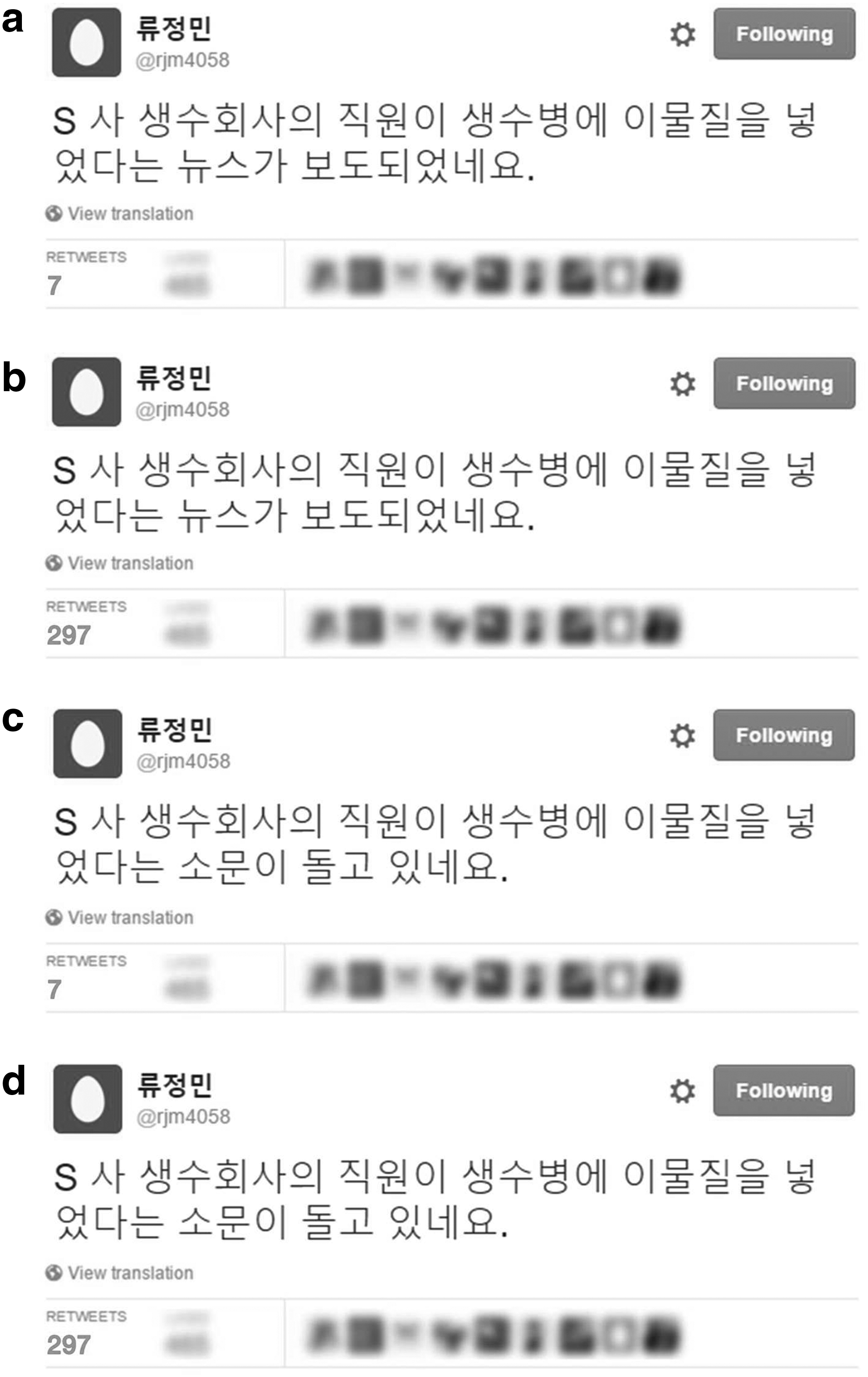
Stimuli for the Four Experimental Conditions.
Procedure
Upon giving consent, participants were randomly assigned to one of the four conditions and read two tweet messages in a random order. After reading each, participants indicated message believability and intention to share the message. Participants were also asked about their perceptions regarding others' evaluations of message believability and perceived descriptive norm of sharing the tweet. Participants, then, indicated their demographic information and usage of Twitter.
Measures
Message believability was measured with two items: “The information in the tweet is accurate” and “The information in the tweet is believable” (Inter-item correlations: water = 0.73; robbery = 0.70).
Intention to share the tweet was measured with three items, derived from Schultz, Utz, and Göritz's secondary communication intention scale. 16 Some items were modified to make the scale more relevant to sharing behavior (Cronbach's α: water = 0.89; robbery = 0.90).
Presumption of message believability to others was measured with two items: “I consider that most Twitter users believe the tweet message” and “I consider that most adults believe the tweet message” (Inter-item correlations: water = 0.80; robbery = 0.75).
Perceived descriptive norm of sharing the tweet was measured with two items: “I consider that most Twitter users actively share the tweet message with others” and “I consider that most adults actively share the tweet message with others” (Inter-item correlations: water = 0.74; robbery = 0.72). Table 2 shows descriptive information and reliability statistics of the measured items.
Note: aPearson's interitem correlation.
Cronbach's α coefficient.
SD, standard deviation.
Analytic strategy
Analyses were conducted using SPSS 22.0. 17 To test H1 and H2, Model 5 within Hayes' PROCESS macro was used. 18 The number of retweets was the independent variable (x), and intention to share the tweet and message believability were treated as separate dependent variables (y). The descriptive norm of sharing the tweet (H1) and the presumption of message believability to others (H2) were used as mediators (m). The indirect effects were verified with followup bootstrap analyses using 10,000 samples and 95 percentile confidence interval estimates. To test the moderated mediation in H3 and H4, Model 15 of the PROCESS macro was used. The label of the tweet served as a moderator (v) influencing the relationships between mediators and the dependent variables in H1 and H2.
Results
H1 proposed that the perceived descriptive norm of sharing the tweet would mediate the relationship between the number of retweets and intention to share the tweet. As shown in Table 3, the mediation models were overall significant [water: r2 = 0.38, F(2, 636) = 191.92, p < 0.001; robbery: r2 = 0.36, F(2, 636) = 175.34, p < 0.001]. The total effect model of the number of retweets (x) on intention to share the tweet (y) was not statistically significant [water: r2 = 0.08, F(1, 637) = 3.74, p = 0.05; robbery: r2 = 0.07, F(1, 637) = 3.42, p = 0.07]. There was a significant indirect effect of the number of retweets (x) on intention to share the tweet (y) through perceived descriptive norm of sharing the tweet (m) (water: b = 0.20, standard error [SE] = 0.05, 95 percent confidence interval [CI] [0.12, 0.29]; robbery: b = 0.17, SE = 0.04, 95 percent CI [0.08, 0.25]).
Note: a is the regression coefficient of the independent variable (x) on the mediator (m), c′ is the regression coefficient of the independent variable (x) on the dependent variable (y), and b is the regression coefficient of the mediator (m) on the dependent variable (y). i1 and i2 are intercepts of each regression line.
SE, standard error.
The two mediation models suggest that seeing a tweet with a great number of retweets (x) has a substantial impact (water: b = 0.31, SE = 0.07, p < 0.001, 95 percent CI [0.17, 0.45]; robbery: b = 0.26, SE = 0.07, p < 0.001, 95 percent CI [0.12, 0.40]) on the perceived descriptive norm of sharing the information (m) related to both issues [water: r2 = 0.03, F(1, 637) = 18.67, p < 0.001; robbery: r2 = 0.02, F(1, 637) = 13.56, p < 0.001]. Perceived descriptive norm of sharing the tweet (m), then, significantly influenced respondents' intention to share the tweet (y) (water: b = 0.66, SE = 0.03, p < 0.001, 95 percent CI [0.59, 0.72]; robbery: b = 0.64, SE = 0.03, p < 0.001, 95 percent CI [0.57, 0.71]). The mediation model indicates no direct relationship between seeing a high number of retweets (x) and intention to share the tweet (y) in either of the two issues. Instead, the relationship was indirect through perceived descriptive norm of sharing the tweet (m).
H2 proposed that the presumption of message believability to others mediates the relationship between the number of retweets and message believability. As shown in Table 4, the mediation models were significant [water: r2 = 0.42, F(2, 636) = 234.37, p < 0.001; robbery: r2 = 0.40, F(2, 636) =221.80, p < 0.001]. However, the total effect of the number of retweets (x) on message believability (y) was not significant [water: r2 = 0.00, F(1, 637) = 1.21, p = 0.27; robbery: r2 = 0.00, F(1, 637) = 0.53, p = 0.47]. An assessment of the direct and indirect effects showed a significant indirect effect of the number of retweets (x) on message believability (y) through the presumption of message believability to others (m) (water: b = 0.17, SE = 0.05, 95 percent CI [0.07, 0.26]; robbery: b = 0.11, SE = 0.04, 95 percent CI [0.03, 0.20]).
Note: a is the regression coefficient of the independent variable (x) on the mediator (m), c′ is the regression coefficient of the independent variable (x) on the dependent variable (y), and b is the regression coefficient of the mediator (m) on the dependent variable (y). i1 and i2 are intercepts of each regression line.
Thus, consistent with H2, seeing a tweet with a high number of retweets (x) appeared to have a significant impact (water: b = 0.27, SE = 0.07, p < 0.001, 95 percent CI [0.13, 0.42]; robbery: b = 0.17, SE = 0.07, p = 0.01, 95 percent CI [0.04, 0.31]) on the presumption of message believability to others (m) [water: r2 = 0.02, F(1, 637) = 13.69, p < 0.001; robbery: r2 = 0.01, F(1, 637) = 6.18, p = 0.01]. It can be seen from the model that message believability to respondents (y) was significantly associated only with the presumption of message believability to others (m) (water: b = 0.63, SE = 0.03, p < 0.001, 95 percent CI [0.57, 0.68]; robbery: b = 0.63, SE = 0.03, p = 0.01, 95 percent CI [0.57, 0.70]).
H3 proposed that the label of the tweet (v) would moderate the mediation effect of the descriptive norm of sharing the tweet (m). As shown in Table 5, the moderated mediation model was significant [water: r2 = 0.38, F(4, 634) = 98.51, p < 0.001; robbery: r2 = 0.36, F(4, 634) = 87.89, p < 0.001]. However, the interaction of the descriptive norm of sharing the tweet (m) and the label of the tweet (v) on intention to share the tweet (y) was not statistically significant in either issue (water: b = −0.06, SE = 0.07, p = 0.35, 95 percent CI [−0.19, 0.07]; robbery: b = 0.03, SE = 0.07, p = 0.68, 95 percent CI [−0.11, 0.16]). H3, therefore, is not supported.
Note: a is the regression coefficient of the independent variable (x) on the mediator (m), c′ is the regression coefficient of the independent variable (x) on the dependent variable (y). b1 is the regression coefficient of the mediator (m) on the dependent variable (y), b2 is the regression coefficient of the moderator (v) on the dependent variable (y), and b3 is the regression coefficient of the interaction term between the mediator (m) and the moderator (v) on the dependent variable (y). i1 and i2 are intercepts of each regression line.
H4 proposed a moderated mediation, such that the label of the tweet (v) would moderate the relationship between the presumption of message believability to others (m) and respondents' own believability of the tweet (y). The result of the PROCESS model (Model 14) shown in Table 6 indicates that the moderated mediation models were valid for both issues [water: r2 = 0.45, F(4, 634) = 130.35, p < 0.001; robbery: r2 = 0.43, F(4, 634) = 121.30, p < 0.001]. However, the interaction between the presumption of message believability to others (m) and the label of the tweet (v) was not significant (water: b = 0.03, SE = 0.06, p = 0.64, 95 percent CI [−0.09, 0.14]; robbery: b = 0.02, SE = 0.06, p = 0.73, 95 percent CI [−0.10, 0.14]) in either of the two issues. Thus, H4 is not supported.
Note: a is the regression coefficient of the independent variable (x) on the mediator (m), c′ is the regression coefficient of the independent variable (x) on the dependent variable (y). b1 is the regression coefficient of the mediator (m) on the dependent variable (y), b2 is the regression coefficient of the moderator (v) on the dependent variable (y), and b3 is the regression coefficient of the interaction term between the mediator (m) and the moderator (v) on the dependent variable (y). i1 and i2 are intercepts of each regression line.
Discussion
This study investigated how tweets gain credibility and popularity through normative influence. The result suggested that people use high number of retweets as a normative cue, interpreting that the majority believes and shares the message. This presumption of message believability to others and perceived norm of sharing the tweet influenced one's belief in the tweet and intention to share the tweet.
This finding provides evidence to support Sunstein's informational cascade claim. 10 Sunstein claimed that people share rumors if the majority shares them. Beyond this claim, this study found that people might believe rumors when the majority shares them, due to the presumption that the majority would share rumors because they believe them. This result suggests that a rumor should be managed before it gains popularity.
Furthermore, this study found that the informational cascade could also occur in news sharing. Offline-based studies suggested that people use descriptive norms as information in ambiguous situations. 5 Accordingly, this study predicted that people would use normative information more when judging rumors, as opposed to news. However, in this study, the influence of the number of retweets as a normative cue did not differ between the types of information.
This result suggests that people also consider news uncertain information, at least on Twitter. However, considering message believability was significantly higher when the tweet was labeled official news (water: M = 2.83, SD = 0.85; robbery: M = 2.97, SD = 0.85), as opposed to rumor (water: M = 2. 35, SD = 0.88; robbery: M = 2.55, SD = 0.87), we may rule out the possibility that the similarity between news and rumor in terms of message uncertainty caused no moderating effect.
Alternatively, no moderating effect of the label of information as news or rumor may be attributable to the nature of online communication. Due to a lack of nonverbal cues, people depend on all other types of cues available when communicating in the online context. In addition to the number of retweets as a normative cue, people might have referred to the category prototype of rumor or news as a representative cue to judge the information. In this study, message believability and intention to share were the highest when a message was labeled news and had a high number of retweets. This result suggests that the copresence of the representative cue (i.e., the label of information) and the normative cue (i.e., the number of retweets) might jointly influence message believability and sharing behavior. Prior research proposed that when the cues available to message recipients indicated the same direction, the cues would enhance positive effects. 19 Future studies may examine the power of normative cues and the cue-cumulative effects in a comparison between online and offline contexts. Furthermore, it would be valuable to explore various types of cues that people might use. Although this study showed the possibility of the information label as a representative cue, many tweet messages do not include such label. Future studies should explore how people judge the type of information when there is no label of the information. In addition, the influence of information source (e.g., news agency vs. passersby) or communicator (e.g., high- vs. low-profile Twitter users) should be studied.
This study also suggests that people may think of an online phenomenon as a reflection of the offline world. When people recognized that many Twitter users retweeted a message, they considered that not only Twitter users but also most adults believed and shared the message. Further investigation of the relationship between perceptions about online and offline worlds might be necessary.
Several limitations should be noted. First, the tweet stimuli presented to respondents displayed only one message. Respondents' attention to the message might have differed in this study from their attention level in a natural setting. Second, there is a likelihood that participants' intention to share the tweet was biased by topics of the tweet. Retweeting behavior is often content dependent, such that people are more likely to share messages that are relevant or interesting.20,21 Third, this study did not consider individual differences in the Twitter usage or attitudes toward rumors. Future studies should examine our hypotheses controlling these factors. Fourth, this study manipulated the number of retweets at two levels (high vs. low). Considering that people may stop sharing the information when they perceive that the majority already knows about it, future studies should examine the curvilinear relationship between the number of retweets and the likelihood of transmission.
Finally, although our finding suggests that the number of retweets function as a normative cue, it is beyond the scope of this study to identify the type of rumors that is likely to be accepted by one's social group. Given the extreme heterogeneity of social media networks, the same tweet can provoke entirely different reaction depending on the norms governing one's social network. Future research may explore how the nature of rumors interacts with the type of people in the social media circle to gain our insight into how rumors spread across different social networks.
Footnotes
Author Disclosure Statement
No competing financial interests exist.
Appendix
| Label of tweet | Number of retweets | |||
|---|---|---|---|---|
| News | Rumor | High | Low | |
| Tweet about contaminated mineral water | ||||
| This tweet is about a rumor. | 3.37* | 3.99* | 3.69 | 3.66 |
| This tweet is about an official news story. | 3.43* | 2.38* | 2.92 | 2.89 |
| This tweet is being actively retweeted. | 3.00 | 2.96 | 3.38* | 2.60* |
| Tweet about disguised robber | ||||
| This tweet is about a rumor. | 3.33* | 3.92* | 3.64 | 3.60 |
| This tweet is about an official news story. | 3.43* | 2.51* | 3.03 | 2.93 |
| This tweet is being actively retweeted. | 3.01 | 3.00 | 3.51* | 2.61* |
Note: Values are means of the five-pt Likert scale ranging from “not at all likely” to “very likely.”
p < 0.001.