




Abstract
Abstract
Video game addiction or Internet game disorder, as proposed by the DSM-5 (Diagnostic and Statistical Manual of Mental Disorders, Fifth Edition), has similar criterion characteristics to other impulse control disorders. There is limited research examining video game addiction within a behavioral economic framework using delay discounting. The current study evaluated delay-discounting patterns of money and video game play by usual weekly hours of video game play. A total of 104 participants were split into 1 of 3 groups of video game players (low, medium, and high) and were asked to complete a monetary and video game discounting procedure through an online survey. Results showed significant differences between groups within both the monetary (p = 0.003) and video game discounting procedures (p = 0.004). Additionally, a positive linear relationship was noted between the groups across both procedures. The results of the current article reinforce previous findings that more hours of video game use are associated with greater impulsivity and provide implications for future research.
Introduction
D
A delay-discounting program allows an experimenter to examine the interaction between the time delay and a value in a forced-choice paradigm. 2 Exposing participants to a series of choices that change systematically over pre-established time periods and values allows the experimenter to deem an individual more or less impulsive (e.g., a choice of 500 dollars now to that of 1,000 dollars later). Offering participants a forced binary choice removes other contextual variables from the equation and focuses on specific choice. The individual's choice of increased delayed value over the immediate value creates an indifference. Indifference points are determined by adjusting the immediate value until the immediate value is deemed equivalent to the later value. This process is repeated across several time periods until an indifference curve has been established.
Proposed in the Diagnostic and Statistical Manual of Mental Disorders, 12 Internet gaming disorder (IGD) is deemed to have similar etiology, symptoms, and criterion characteristics to other behavioral impulse control disorders such as pathological gambling. The diagnostic criteria for IGD are similar to other addictive behaviors and include tolerance and withdrawal, preoccupation, unsuccessful attempts to reduce or control use, continued use despite impact on daily functioning, and exclusion of other interests and hobbies. To date, only two published studies have examined delay discounting of individuals who engage in video game play.13,14 Saville et al. 13 found greater discounting of hypothetical money for individuals who engaged in high durations of video games played compared with nonvideo game players, although findings were limited to only individuals who played World of Warcraft. More recently, Irvine et al. 14 attempted to extend Saville's findings by comparing individuals considered pathological video game players to a nonpathological age-, gender-, and IQ-matched controls. Pathological video game players showed greater monetary discounting in addition to impulsive performance on other neuropsychological assessments. However, this study only utilized a single discounting procedure and failed to account for duration of video game play.
For the current study, we sought to extend this previous work (i.e., Saville et al. 13 and Irvine et al. 14 ) to evaluate discounting for different rewards (monetary and video gaming) and multiple levels of video game use, rather than only pathological use. By categorizing video game players into three groups (low, medium, high) based on their self-reported usage of video game play per week, we examined discounting difference between the two extreme use groups and if there is evidence of a graded relationship between use and discounting.
Methods
Participants
Individuals were recruited through multiple approved methods: (a) through online forums/blogs dedicated to video gaming or specific video games; (b) flyers distributed throughout Northern Illinois University; and (c) e-mail announcement to the undergraduate student body through the University Communication Director. Researchers obtained online forum/blog approval from forum/blog site administrators before posting of recruitment. The Northern Illinois University's Human Subjects Committee (HSC) approved the study, with a total of 155 individuals demonstrating initial interest in participating and 104 meeting eligibility criteria. Of the 104 individuals, 37 were females and the average age for all participants was 24.92 years with standard deviation of 5.09.
Inclusion criteria were (a) greater than or equal to 18 years of age, (b) active video game play in the last 3 weeks (i.e., >0 hours), and (c) able to read and comprehend English at a fifth grade level. Active video game play was defined as at least 1 hour of console, computer, mobile device, or online play within a 7-day period for at least three consecutive weeks. Exclusion criteria included (a) no access to the Internet through a laptop/desktop computer, (b) submission of incomplete data (e.g., provided demographics, but not outcome measures), and (c) submitted improper discounting answers, suggesting random or contrary responding indicated by the last three values having a higher value than the first three values. 7 Fifty-one individuals were ineligible, 37 submitted incomplete data and 14 had improper discounting responses. No individuals were excluded due to inability to gain access to the Internet or for not possessing a fifth grade reading level.
Individuals were placed into one of three groups (low, medium, or high) depending on the number of hours they self-reported playing video games per week. Consistent with other studies of amount of video game play, 15 we chose to trichotomize the gaming groups rather than use hours played as a continuous variable due to past research finding participants underreporting their usage, thus removing the stigma of perception.15,16 The low group was defined as greater than 0–5 hours, the medium group as 6–17 hours, and the high group as ≥18 hours. The original scale had five categories (0–5, 6–11, 12–17, 18–23, >24). Most participants reported between 12 and 17 hours (n = 31) or >24 hours (n = 29). We collapsed two categories because six participants reported 6–11 hours (medium group) and two individuals reported 18–23 hours (high group). Findings showed the same pattern of results if categories were not collapsed.
Measures
A demographic and video game questionnaire included the following measures: age, gender, ethnicity, hours played, type of game typically played, and day of week with most play. Participants were asked to complete these questions before the outcome measures.
Delay discounting (monetary)
A delay-discounting program allows an experimenter to examine the interaction between the time period and the value in a forced-choice paradigm. Exposing participants to a series of choices that change systematically over pre-established time periods and values allows the experimenter to deem an individual more or less impulsive (e.g., a choice of 500 dollars now to that of 1,000 dollars later). Offering participants, a forced binary choice removes other contextual variables from the equation and focuses one specific choice. 17 When an individual chooses the increased delayed value over the immediate value, an indifference point has been created. Indifference points are determined by adjusting the immediate value until the immediate value is deemed equivalent to the later value. This process is repeated across several time periods until several indifference points create an indifference curve.
Upon switching time delays, values were reset and time delays were maximized. Time delays included were 1 week, 2 weeks, 1 month, 6 months, 1 year, 3 years, and 10 years, while monetary values ranged from 1,000 dollars to 10 dollars. 17 All values were face values and did not mention or incorporate inflation. The choices provided to the participants followed these parameters: (a) the first choice was always between the larger delayed reward and half of the delayed reward available immediately and (b) subsequent choices adjusted the value of the immediate choice according to whether the participant chose the immediate (adjusted down) or delayed (adjusted up) reward. The indifference point is the proportion of the immediate reward subjectively deemed equivalent to the larger delayed reward. Based on the seminal research by Myerson et al., 18 area under the curve (AUC) was then applied to indifference points across the delays where the discounting AUC reflected the participant's degree of preference of the smaller immediate amount to the larger later amount. The AUC 18 value measures an individual's indifference point discounting curve without calculating the k in the typical regression formula. We chose this measure because it is a theoretically neutral metric of the subjective value of the delayed response to that of the immediate response and is calculated from the empirical discounting function rather than from a curve fit to the data. 18
Delay discounting (video gaming)
Participants made a maximum number of 63 decisions to complete the survey. The values were 1, 2, or 6 hours or 1, 2, 4, or 7 days. The first value presented was always between the larger delayed reward and half of the delayed reward available immediately. Subsequent choices adjusted the value of the immediate choice according to whether the participant chose the immediate (adjusted down) or delayed (adjusted up) reward.
Procedure
Eligible participants read and signed the consent form. After completing the demographic and video game questionnaire, individuals were counterbalanced to either the money or video game discounting procedures. The directions for the money discounting procedure were the following:
In this part of the study, you will be asked to make several hypothetical decisions about different amounts of money that you might receive. We are interested in which amount you would choose to receive if you were to be offered these choices for real. Two amounts of money will appear on the screen. One amount can be received right now. The other amount can be received later. The right now amount of money will change after each of your decisions. Choose the box on the left if you want the money NOW! Choose the box on the right if you want the money LATER!
The video gaming discounting directions were similar, but included the following introductory sentences. “You have started playing a new game that has caught your attention. The game has outstanding visual effects and graphics. You find it hard to stop playing the game.” Participants were then asked to choose between playing the video game for a sooner small amount (30 minutes now) of time to that of the larger later amount (60 minutes in an hour). The introductory statement purposely evaluated only two time choices. All individuals who completed the program were included in a random drawing to win one of four $50 gift cards to a large electronics chain store.
Data analysis
Univariate comparisons of demographic and baseline variables by video game duration group (low, medium, high) were conducted using χ2 tests for categorical variables and analysis of variance (ANOVA) for interval and continuous variables. For the delay-discounting measures, the AUC of the indifference points was calculated and ANOVAs provided both the overall comparison among groups and a linear trend contrast. Tukey procedures were used for post hoc pair comparisons. 19 Before any analysis, assumption of normality and homogeneity of variance were tested and met.
Results
Table 1 presents demographic and video game use characteristics by video game use category. Figures 1 and 2 display the normative data with the ordinate as proportion of the maximum choice, while the abscissa displays the time delay in either hours or weeks. Values range from 0 to 1.0, with lower scores corresponding to greater discounting.
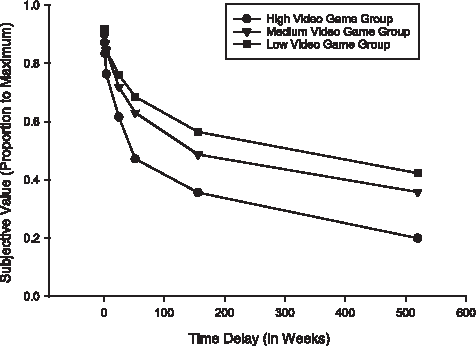
Normative values of monetary temporal discounting across the time delay in weeks within the three preidentified populations.

Normative values of video game temporal discounting across the time delay in hours within the three preidentified populations.
HVG, high video gaming group; LVG, low video gaming group; MVG, medium video gaming group; Sim, simulation.
The one-way ANOVA on the AUC for money discounting showed a significant difference among groups, F(2, 100) = 6.22, p = 0.003, η2 = 0.11, with a significant linear contrast, F(1, 100) = 12.00, p = 0.001, η2 = 0.11, indicating the relationship between video game use and discounting as predominantly linear. Tukey post hoc comparisons found that the high video game group (M = 0.35, SD = 0.20) had lower AUC scores than the low video game group (M = 0.55, SD = 0.27, p = 0.002) and the medium group (M = 0.48, SD = 0.24, p = 0.049).
A one-way ANOVA on the AUC of the video game discounting task found a significant difference among the three groups, F(2, 100) = 3.32, p = 0.04, η2 = 0.04, and a significant linear trend, F(1, 100) = 6.36, p = 0.01, η2 = 0.013. Tukey post hoc comparisons indicated that the high video game use group (M = 0.16, SD = 0.09) discounted more than the low video game use group (M = 0.12, SD = 0.06, p = 0.04), but neither differed from the medium group. The AUC values for the two discounting tasks were not correlated, r = 0.12, p = 0.22.
Discussion
The current study showed a positive linear relationship between duration of video game play and discounting rates with hypothetical money and video gaming, both replicating and extending the findings by Saville et al. 13 and Irvine et al. 14 These studies evaluated a single genre of video games (e.g., massively multiplayer online) or compared individuals with extremely high levels of play (e.g., <30 hours per week) with those with none. The current study addresses these limitations recruiting successfully across multiple genres of video gaming play (e.g., first-person shooters, MMORPG, and simulation) and utilizing three time increments to provide a more comprehensive evaluation of discounting within this population.
To the author's knowledge, the current study was the first to develop and examine a video game discounting procedure, which was initially developed to resemble a sexual discounting task. 20 Results yielded a linear relationship between groups and a statistical difference in AUC, as seen in Figure 2. The corresponding groups discounted similarly in the hypothetical monetary discounting task with the high duration group presenting as more impulsive compared with the low duration group. These initial findings are consistent with discounting research of substance use disorder,3,5,7 which have been shown across a range of substances, including opioids, tobacco,6,21 stimulants, marijuana, and alcohol, both for discounting money and the specific substance. Such findings have led researchers to argue that discounting is a defining characteristic of addictive behavior and extends to nondrug-related addictions such as gambling and binge eating. For example, problem gambler7,9 and obese individuals10,11 exhibit higher discounting than matched controls. The current findings are consistent with these other addictive behaviors, although we did not evaluate DSM-5 (Diagnostic and Statistical Manual of Mental Disorders, Fifth Edition) symptoms or problems associated with addictive video game play. While causality between amount of video game play and addictive behaviors cannot be assumed, such findings warrant further investigation of this novel discounting procedure in this subpopulation. Future research should also examine the comorbidity of video game use and substance use disorder to evaluate overlap.
The present findings have meaningful clinical implications. Video game addiction or IGD, as proposed by the DSM-5, 12 has become a salient issue, with an estimated five percent to eight percent of the population engaging in high durations of video game play. 22 Targeted behavioral therapies such as cognitive behavioral therapy (CBT) or acceptance and commitment therapy (ACT) have shown promising results within video gaming populations.23,24 Moreover, behavioral therapy research has utilized delay discounting as a treatment response assessment, providing clinically relevant information on poor impulse control and decision-making.25,26 Future research could compare pre/postvalues of delay discounting within video game addiction/IGD after an 8-week CBT or ACT session to assess if impulsive decision-making can be modified. Thus, this information could be used to inform high-risk individuals that they are engaging in impulsive decision-making and provide methods for altering their treatment.
The current study had some methodological limitations. Recruitment of video game players through online forums/blogs presented a challenge. Obtaining consent from forum/blog administrator and attracting interested potential participants were difficult. We utilized recommendations from Wood et al. 16 and Griffiths et al. 15 to address these obstacles; however, improved recruitment methods would likely have provided a larger sample. Additionally, the sampling distribution for the study had a low female response rate. However, the current study expanded upon previous research by evaluating different genres of video games and targeting individuals of different play durations per week. Another limitation of the study takes into account the participant's concept of inflation to the delayed value. This occurs when the participant adds equity to or takes into account the inflation of the delayed value. In the current study, we accounted for inflation of the delayed value by keeping all face values for all amounts the same across time intervals.
Finally, the current procedure did not evaluate the validity of the delay-discounting procedure for video game play. Participants may have believed that they could simply play the video game as long as they wished at another time, thus invalidating the forced-choice procedure. However, the results indicating a linear relationship between time of video game play and delay discounting suggest that participants regarded the task as a valid choice between options of the amount of access to the hypothetical game.
In conclusion, given the increasing popularity of video game play and the recent changes to the DSM-5, 12 a deeper understanding of how duration of video game play affects the decision-making process remains meaningful. The current study was the first to compare discounting patterns of individuals playing video games across total hours played per week and different discounting modalities. The results yielded a linear relationship between both discounting tasks across the durations of video game play and differences between the low and high duration groups. This reinforces and extends the current research on IGD. Future research should expand on the current findings by investigating if specific genres of games evoke different responding in delay-discounting measures (i.e., MMORPGs).
Footnotes
Acknowledgments
A part of the study was supported by NIH/NIDA RO1 DA034678 (PI: B.A.M.). Portions of this research were presented at the 76th annual scientific meeting of the College on Problems of Drug Dependence, Palm Springs, CA.
Author Disclosure Statement
No competing financial interests exist.