




Abstract
Abstract
Texting and alcohol have each been noted to increase perceptions of control, decrease behavioral inhibition, and modulate unpleasant emotions. While drunk texting is a well-known cultural phenomenon, it has received almost no attention in research. In a sample of 211 young adult women, and using a new measure to operationalize drunk texting, difficulty accessing strategies during moments of distress moderated the relationship between binge drinking and drunk texting. Difficulties accessing emotion regulation strategies were associated with drunk texting among those who reported binge drinking. Among nonbinge drinkers, deficits in emotion regulation strategies were not associated with drunk texting. In addition, drunk texting was associated with sex in bivariate correlations. Given the lack of research on the antecedents and consequences of drunk texting, this study suggests that drunk texting may be used as a strategy for emotional regulation and may be predictive of sexual behavior. Results inform several avenues for further inquiry into the motivations and expectations underlying drunk texting and also imply potential routes for intervention.
Introduction
T
States of intoxication are particularly likely to present a context for automatic, unconscious, and disinhibited uses of texting. For example, the term drunk dialing was coined to describe unintended phone calls resulting from the disinhibiting and socially lubricating effects of alcohol and feelings of decreased accountability for actions taken while intoxicated. 14 The related phenomenon of drunk texting has received almost no attention in research, despite findings that almost half (43.6%) of college students report having sent a text while drinking that they later regretted within the past 3 months. 15
The combination of alcohol use and emotional regulation is a well-studied phenomenon. One in four U.S. adults engages in binge drinking, or having five or more drinks in one sitting, 16 which is associated with a host of adverse emotional, physical, and social outcomes.17,18 Difficulty regulating negative emotions is a primary predictor of alcohol use, as evidenced by deficits in emotional regulation capacities in individuals diagnosed with substance use difficulties,19–22 and findings that intolerance or avoidance of negative emotional states predicts future alcohol use in individuals undergoing substance treatment. 20 Individuals with difficulties in overall self-regulation have more trouble checking in with themselves to monitor their level of intoxication, are more likely to disregard previously experienced negative consequences of alcohol use, and less likely to adjust future drinking patterns accordingly, all of which contribute to increased likelihood to become heavy drinkers. 23 Conversely, the capacity to regulate emotional states though self-awareness, controlling of impulses, and access to strategies that promote regulation24,25 act as a buffer against heavy drinking and its consequences.20,26
The self-medication hypothesis, 27 which suggests that alcohol and drugs are used to reduce the intensity of unpleasant emotions, 28 has been used to explain the high prevalence of comorbid mental health diagnoses (such as mood disorders, personality disorders, and post-traumatic stress disorder (PTSD) that accompany alcohol use. 29 In young women with PTSD, increased symptoms are associated with urges to drink and likelihood to drink 30 and moderate the relationship between drinking to cope with depression or anxiety and alcohol-related consequences. 31 Similarly, emotional dysregulation moderates the relationship between PTSD and substance abuse. 32
The rate of binge drinking in young adult females has risen significantly since the 1990s in the United States, 33 with a recent study finding that almost half of women ages 18–24 have engaged in binge drinking within the past 30 days. 34 Among the many consequences of binge drinking that impact young women in particular, 35 sexual and risky sexual activity carry significant health risks in increasing the chances of contracting sexually transmitted infections that negatively impact sexual and reproductive health.36–38 Women may also be at greater risk for developing addictive smartphone behaviors, related to their reliance on the phone to manage social stress. 3
The current study
Bringing these bodies of literature together, the current study aims to explore the relationship between heavy drinking, emotional regulation, and drunk texting, and between sex and drunk texting, conceptualized as texting while intoxicated that leads to thoughts and actions that one would not otherwise engage in. In a sample of young adult women, emotional regulation was expected to moderate the association between binge drinking and drunk texting. Secondarily, the study assessed whether drunk texting is associated with sexual behavior with male partners generally and sexual risk taking (condomless sex) specifically. Given the prevalence of this phenomenon and the many consequences that might arise from it, better understanding of the mechanisms at play is necessary for informing efforts at intervention.
Methods
Participants and procedures
Participants ages 18–29 living in the United States were recruited online through various social networking sites and listservs to complete a survey regarding thoughts and feelings related to phone use. The study received institutional review board approval at Pace University. A total of 276 individuals completed the survey. As all but 28 of these individuals were female, the sample was limited to females. An additional 42 individuals were removed due to being outside of the age limit defined in the eligibility criteria. Data cleaning resulted in an additional five participants being removed from the data set, two due to duplicate entries in terms of age and IP address and three due to patterned responding. The final sample thus included 211 young adult women ages 18–29 (Mage = 24.95; SD = 3.23) residing in 40 U.S. states. Demographics can be found in Table 1.
n = 211, Mage = 24.95, SDage = 3.23.
Measures
Sociodemographics
Participants self-reported age, race/ethnicity, gender, sexual orientation, education, and U.S. state of residence.
Emotional regulation
Participants completed the lack of emotional awareness, impulse control difficulties, and limited access to emotional regulation strategies subscales of the Difficulties in Emotional Regulation Scale. 24 Each subscale consisted of 6 items or statements about the extent to which individuals have access to and use strategies when distressed. Participants indicated their level of agreement on a Likert-type scale from 1 = almost never to 6 = almost always. Subscales demonstrated good reliability (Cronbach's α = 0.83; 0.83; and 0.91, respectively).
Drunk texting
This scale was developed for the current study to measure the impact of alcohol use on text messaging. Five items assessed the number of instances of a particular behavior in the past 30 days using a 5-point Likert scale with options, including zero; 1 or 2; 3–10; 11–19; and 20+. Beginning with the sentence stem, “How often, when under the influence of alcohol,” items included: Have you sent a text which led you to do something you wouldn't have done sober?; Have you sent a text to someone you would not have contacted otherwise?; Have you sent a message that you might not have sent when sober?; Have you used your phone to send a text?; Did you think about sending a text that you might not have sent when sober? The items demonstrated good reliability (Cronbach's α = 0.90). The factor structure of this new scale was evaluated using a principle components analysis with oblique rotation. The Kaiser-Meyer-Olsen statistic suggested the items were appropriate for factor analysis (KMO = 0.89). Using an eigenvalue >1.0 criteria, a single component was extracted, which accounted for 76.2% of the variance in item responses.
Binge drinking
Using a single item that utilized language from the Alcohol Use Disorders Identification Test (AUDIT), 39 participants reported the number of days during the past 30 days that they consumed six or more drinks on one occasion. Responses were dichotomized into the presence or absence of recent binge drinking. Half of the participants had not engaged in binge drinking, with 40% having engaged in binge drinking, and 10% missing data on this variable.
Analytic plan
Bivariate associations were assessed using metrics appropriate to variable distributions: φ coefficients (between dichotomous variables), point-biserial correlations (between dichotomous and normally distributed variables), and Pearson's product-moment correlations (between normally distributed variables). Subsequently, the hypothesis that emotional regulation would moderate the link between binge drinking and drunk texting was examined using a hierarchical linear regression. In an initial step, the main effects of demographic covariates were entered simultaneously. The second step incorporated the main effects of binge drinking and emotional regulation subscales among the predictors. Finally, the third step included three interaction terms, which were the product of each participant's binge drinking score and their score on each of the emotional regulation subscales. Finally, tests of analysis of variance (ANOVA) were used to examine differences in drunk texting frequency for individuals who engaged in sexual and risky sexual behavior (e.g., condomless sex) with no male partners, one male partner, or more than one male partner, followed by Bonferroni post hoc analyses to determine differences between the three groups.
Results
Predicting drunk texting behavior
Table 2 contains bivariate associations among demographic variables, emotional regulation difficulties, drunk texting, and binge drinking. Table 3 contains regression coefficients, confidence intervals, and standardized coefficients for models predicting drunk texting. In the initial step, the model containing only demographic covariates was nonsignificant. In step 2, the regression model was statistically significant. Both binge drinking and impulse control difficulties were positively associated with drunk texting. Age was negatively associated with drunk texting in this step. In the final step, the inclusion of interaction terms significantly increased the percentage of variance accounted for in the outcome. In this final model, binge drinking was significantly associated with drunk texting and there was a significant interaction between binge drinking and difficulty accessing strategies when distressed.
p ≤ 0.05; **p ≤ 0.01.
p ≤ 0.01.
Post hoc tests of simple main effects were subsequently conducted to better understand the interaction between binge drinking and difficulty accessing strategies. For these analyses, “high” and “low” levels of difficulty accessing strategies were set at 1 SD above and below the mean, respectively. Results are depicted in Figure 1. These tests revealed that, while the main effect of difficulty accessing strategies was nonsignificant among individuals who did not report binge drinking, it was positively associated with drunk texting among women who reported binge drinking (B = 0.15; 95% CI: 0.03, 0.28; β = 0.27, p = 0.02).
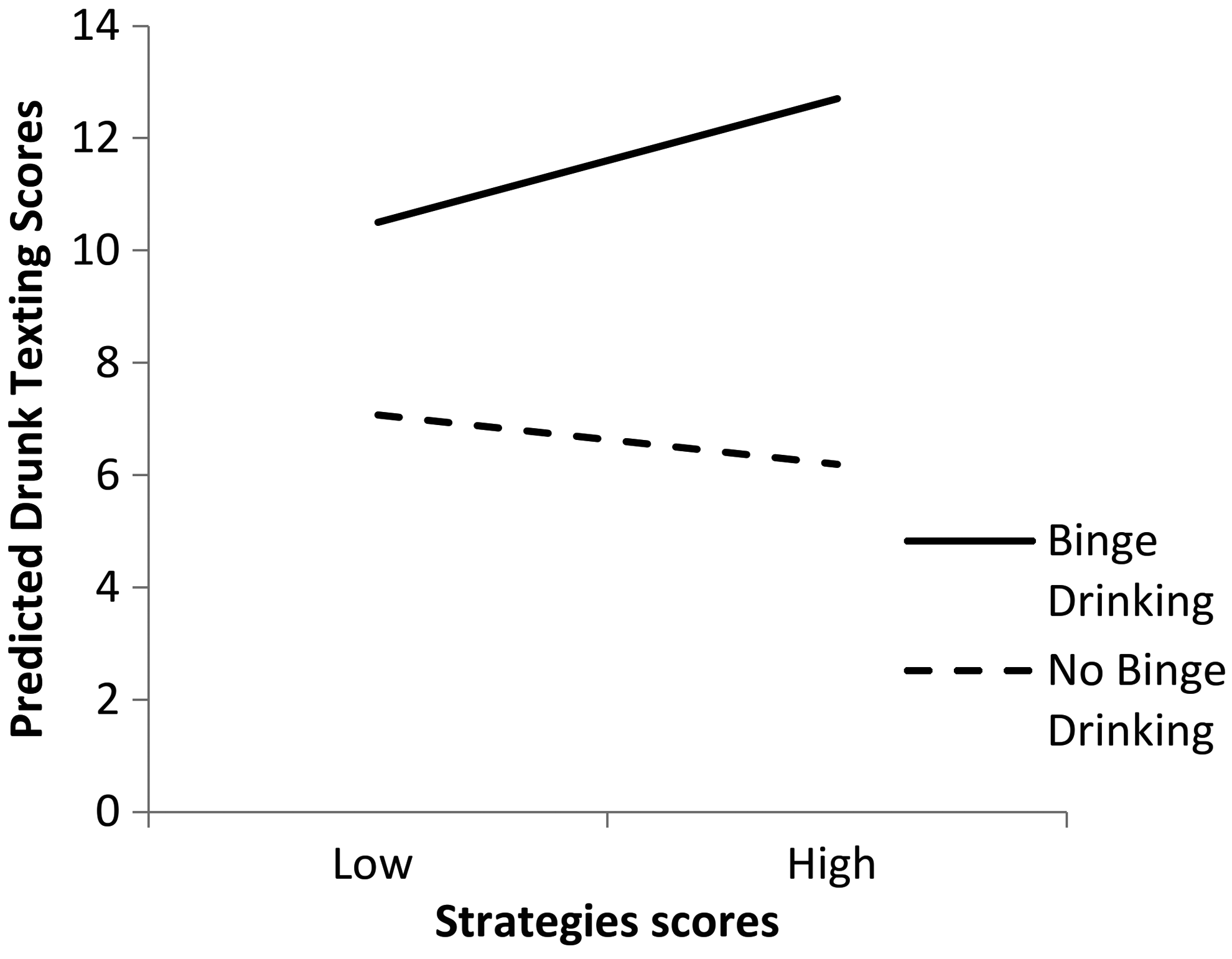
Emotion regulation and binge drinking interact in the prediction of drunk texting.
The association between binge drinking and sexual behavior
Table 4 contains the results from the ANOVA analysis examining the association between drunk texting and sexual behavior and risky sexual behavior with male partners. Post hoc analyses revealed that women who engaged in sexual behavior and condomless sex with more than one male partner engaged in more frequent drunk texting than those who engaged in sexual behavior and condomless sex with one partner or no partners.
Note: Within variables, groups with different superscripts differ at p < 0.05 by Bonferroni post hoc.
p ≤ 0.001.
Discussion
Findings suggest that drunk texting is associated with binge drinking and that deficits in emotional regulation strategies are uniquely associated with drunk texting for binge drinkers. Deficits in emotional regulation strategies were associated with drunk texting among binge drinkers, but not among nonbinge drinkers. While binge drinking was associated with drunk texting in the overall sample, people who also had difficulties accessing strategies when distressed were particularly likely to engage in drunk texting. In addition, the association between drunk texting and sexual behavior suggests that drunk texting may serve as an indicator of health risk behavior. Given the lack of research on the antecedents and consequences of drunk texting, this study offers preliminary insight into some of the factors that might predict drunk texting and informs several avenues for further inquiry.
The interaction effects of poor emotional regulation and binge drinking found in this study are consistent with findings that difficulties with appraising consequences and assessing long-term goal fulfillment versus short-term gratification are implicated both for individuals with difficulties in emotional regulation 40 and in states of intoxication.41,42 This study further suggests that when people are in states of intoxication and emotional dysregulation, the additional disinhibiting effects of texting9,10,43 add yet another layer to the challenge of regulating behavior and emotion. The current implications that binge drinkers engage in drunk texting to alleviate negative emotions may be explained by findings that perceptions of being able to control the outcome of text-based exchanges predict positive attitudes toward text messaging. 44 However, such perceptions of control over communication are often overstated and unrealistic 10 —a finding that also applies to states of intoxication.45–49 These processes may have particular implications for young adult women, given their increasing rates of binge drinking, 33 evidence of self-medication,30–32 and increased rates of problematic cell phone use. 3
The significant association between drunk texting and both sexual behavior and risky sexual behavior with men supports previous research suggesting that initiation of sex is a primary motivator of drunk dialing, 15 as well as associations between substance use, technology, and sexual hookups that have been found in research on sexting.50,51 In considering possible mechanisms underlying the current findings, research suggests that the apparent disinhibiting effects of alcohol on behavior are strongest in moments of emotional and behavioral conflict, in which two competing motivational drives are activated, 52 and that alcohol selectively reduces the weaker motivational drive. 53 As explained by the inhibition conflict model or “alcohol myopia,” intoxication increases perceptions of benefits and decreases perceptions of risk by undermining the ability to cognitively process inhibitory cues, which tend to be removed and abstract in comparison to the immediate, concrete, and permissive nature of instigatory consent cues.45–49
The current finding that women with two or more sexual partners (including condomless sex) have engaged in significantly more drunk texting than those with one or no partners supports previous findings that sexual and risky sexual activity are common consequences of intoxication and that in cases where women are ambivalent or unsure about engaging in sexual activity, being intoxicated may lead to increased likelihood of taking action that is consistent with the desire to engage in pleasurable but risky behavior.49,54 Several factors might explain the current finding that the use of texting may have additional influence in promoting this process. As with alcohol, inhibitory cues may be less obvious and influential due to the distance of texting, easing people into a position where their next action may be unwittingly impacted by previous decisions related to texting. Paradoxically, although perceptions of increased control are a primary motivator for text messaging, this medium is also particularly vulnerable to miscommunications. 10 People may send flirtatious text messages that seem innocuous to them, which the recipient may misinterpret as willingness or desire to engage in sexual activity. This may be implicated in findings that adolescent and young adult women sometimes report feeling pressured to engage in sexting,55,56 which is also associated with sex, risky sex, and substance use.57,58
Limitations and directions for future research
Generalizability of these findings is limited by the nature of the sample, which was composed of young adult women, a majority of whom were White. However, almost a third of the sample identified their sexual orientation as lesbian, bisexual, or questioning, suggesting that this model is relevant for women of all sexual orientations. In addition, it is unknown whether the text messages sent under the influence of alcohol were related to sexual activity, which should be examined more explicitly in future studies. It is also unknown how many individuals in the current sample consumed less than six drinks on a given occasion in the past 30 days versus those who did not consume any alcohol, making it difficult to interpret whether drunk texting is a concern for more moderate drinkers. In addition, while the current study examined associations between emotional regulation and texting, the use of alcohol to reduce negative emotions was not directly assessed and could benefit from future investigation.
Given the preliminary nature of research on drunk texting, this study suggests that future research examining motivations for drunk texting may make effective use of the self-medication framework. In addition, given associations between social facilitation expectancies and the sending of regrettable texts while drinking, 14 future studies might adapt the questions in the drunk texting scale to measure expectancies of texting while drunk, which could facilitate the application of expectancy theory to understanding associations among texting, drinking, and sex. Future research might use existing measures of substance use motivations examining social and emotional motivations, such as reduction of negative feelings 59 in identifying additional contexts in which drinking and texting are likely to occur together.
Implications and Conclusions
This study presents evidence that young adult women who engage in binge drinking are more likely to engage in drunk texting. Moreover, binge drinkers who also have deficits in identifying strategies for emotional regulation are at particularly heightened risk for texting while drunk. These findings suggest that both text messaging and alcohol can function to regulate emotions and enable disinhibition, with the potential to enhance the possibility of miscommunication and diminish the salience of inhibitory cues that may lead to activities—including sex and risky sex—which one would not necessarily engage in when sober. Thus, in combination, technology and alcohol use may complement each other in influencing a person's decision-making process to result in risky or regrettable behaviors. This study suggests that it may be important to develop and test interventions that specifically target the interaction between technology and risky behavior, such as the use of texting in individuals who engage in binge drinking and the use of texting when in a state of emotional distress. As technology continues to increase in its prevalence and influence in the lives of young people, these findings emphasize the need to better understand how its use can both enable risk taking and promote well-being.
Footnotes
Acknowledgment
The authors thank Matthew Berler and Sophia Braha for their contributions to this article.
Author Disclosure Statement
No competing financial interests exist.