




Abstract
Abstract
As technology's presence grows increasingly concrete in global societies, so too do our relationships with the devices we keep close at hand from day to day. Whereas research has, in the past, framed smartphone addiction in terms of possessional attachment, the present research hypothesizes that anxious smartphone attachment stems from human attachment, in which Anxiously attached individuals may be more likely to generalize their anxious attachment style to communication devices. In the present study, we found support for this hypothesis and showed that anxious smartphone attachment predicts (1) anthropomorphic beliefs, (2) reliance on—or “clinginess” toward—smartphones, and (3) a seemingly compulsive urge to answer one's phone, even in dangerous situations (e.g., while driving). Taken together, we seek to provide a theoretical framework and methodological tools to identify the sources of technology attachment and those most at risk of engaging in dangerous or inappropriate behaviors as a result of attachment to ever-present mobile devices.
W
We propose that the origins of these problematic behaviors stem from an almost human-like attachment to the devices we keep close at hand. Research has investigated the predictors and consequences of excessive smartphone use, which might range from intrusive thoughts to obsessive nightmares about one's smartphone. Thus far, this research has identified demographics (i.e., gender, age, cost of mobile carrier plan) and expected repercussions (insomnia, social anxiety) associated with smartphone overuse.3,4,5 What still remains to be investigated are the origins of problematic smartphone use or addiction, which we believe stem from a continuum of attachment to these mobile devices. Whereas Weller et al. 6 operationalize smartphone reliance as a form of Possession Attachment, as we might form to a favorite book or luxury car, we posit that our dependence on smartphones precipitates a more human-like attachment to these nonhuman devices. More specifically, we are not interested in the smartphone as an object but rather as an extension or overgeneralization of our social relationships, not unlike Belk's Extended Self Theory, in which humans tend to regard possessions as an extension of themselves. 7 In sum, we hypothesize that the attachment styles that we naturally exhibit with friends and family have the potential to generalize to the digital medium through which we communicate with these individuals, so that smartphones have—in the process—become an object of our human attachment.
Human Attachment
In a classic study, Ainsworth 8 separated infants from their mothers and observed their reactions to the presence of a stranger and, subsequently, to their mother's return. These observations distinguished three clear patterns of response: (1) Secure (∼55 percent of U.S. infants), in which infants respond with minimal distress to a mother's absence and warmth to her return; (2) Anxious/Ambivalent (25 percent), in which infants remain anxious on her return, as though wary of future abandonment; and (3) Avoidant (20 percent), in which infants display little emotional response to either stranger or mother. These attachment styles have been shown to generalize to other prominent relationships formed throughout the life span, including adult friendship 8 and romantic love; furthermore, their approximate distributions remain relatively stagnant into adulthood among nonclinical samples.9,10
Attachment relationships are, therefore, an amalgamation of distinct responses to separation, reunion, and loss—situations that not only define our ties with social contacts but also with the objects used to keep in touch with these individuals. By the same logic, our attachment to humans has the potential to generalize to smartphones; and as such, this work comprises an initial attempt to identify whether these forms of attachment share common origins.
However, we wish to be clear on two key points: first, that by smartphone attachment we refer to an extension of bonding and closeness with a device that symbolizes or generalizes actual human connection (rather than the nuanced and extensively researched topic of human-to-human interactions); and second, that we do not expect all human attachment styles to generalize to smartphones, particularly should an individual's human relationships be secure enough that a smartphone is not needed as a human-like replacement for communication and attachment. Our focus will, therefore, reside in insecure (i.e., Anxious) attachment due to its maladaptive responses to separation, reunion, and loss—responses that we believe underlie our problematic behaviors of interest.
Nonhuman Attachment
Past research has characterized Anxiously attached individuals as having low self-esteem and a strong fear of future abandonment. 11 These factors may contribute to a sense of compulsive reliance on (i.e., “clinginess” toward) friends and romantic partners, in which Anxiously attached individuals use close contact to keep worries of isolation at bay. It is possible that, to bolster feelings of closeness, Anxiously attached individuals are more likely to overestimate the importance of a beep or ring and to reach for their phone in inopportune situations (e.g., while driving, in a meeting).
Similar to Harlow's famous demonstration of nonhuman attachment in infant rhesus monkeys, 12 one might expect that in the absence of immediate friends or family, humans may also form child-like attachments to inanimate objects. Although research has not investigated whether this is the case, a growing area of work has found that humans do have a tendency to give human characteristics to nonhuman objects. This phenomenon, called anthropomorphism, addresses the autonomy that humans grant to pets, cars, and weather patterns.13,14 Of particular importance is the evidence supporting a continuum of anthropomorphic beliefs, in which humans may generalize or extend the characteristics they give to other humans to similar or related nonhuman actors.15,16 One might therefore expect a positive relationship between Anxious smartphone attachment and anthropomorphic beliefs due to a desire to maintain a sense of human connection even, or especially, when devoid of human contact.
Research Question and Hypotheses
The current research presents a theoretical framework and a novel measure of smartphone attachment to determine whether human users exhibit attachment patterns to smartphones that closely approximate existing patterns in human relationships. Furthermore, we explore the ramifications of such attachment patterns in smartphone-related behaviors, including reliance and a seemingly all-consuming urge to answer one's phone in inopportune situations.
We have no reason to expect Securely or Avoidantly attached individuals to generalize or extend their human attachment style to cellular devices. For one, our understanding of Fearful/Avoidant attachment is unlikely to exist in the typical population of smartphone users; furthermore, we do not believe that they will manifest in downstream behaviors, particularly if these individuals use smartphones as nothing more than a tool.
In sum, we predict the following:
Method
Participants
Two hundred sixty-two undergraduate students (65.1 percent female; mean age = 19.63 years) enrolled at a large, public university participated in an online survey for extra credit in Introductory Psychology. Of our respondents, 55.33 percent were white, 13.56 percent East Asian, and 11.98 percent Hispanic/Latino. All remaining ethnicities accounted for 19.13 percent of our sample (i.e., black, Middle Eastern, Native American, and other).
Measures
Human attachment
We measured human attachment styles through Bartholomew's Relationship Scales Questionnaire (RSQ 17 ), which refers to Hazan and Shaver's 18 paragraph descriptions of three basic attachment styles in romantic relationships. Within the RSQ, Bartholomew adapts these paragraph descriptions into single-sentence items that could be reworded to refer to either romantic partners or close friends as targets (e.g., I worry that [close friends/romantic partners] won't want to stay with me). In this research, we used the 25 items—7 Secure, 10 Anxious, and 8 Avoidant—that loaded most highly on Bartholomew's original scale.
Smartphone attachment
To develop a three-factor scale of smartphone attachment, we reworded our final 25 items of Bartholomew's RSQ to refer to smartphones as targets, rather than friends or romantic partners (i.e., the RSQ-SP, where SP indicates smartphone). Before viewing these items, participants were told to think only of their mobile devices themselves, and not of the people they might contact through those devices. For example, I am comfortable depending on other people, a measure of Secure attachment in the RSQ, was changed to I am comfortable depending on my phone. Three items that lost significant meaning when replacing a human target with a smartphone were removed from the scale, including items that tapped into the Fearfulness subset of Avoidant attachment (i.e., an almost clinical fear of one's smartphone). For example, I feel that [my phone] often wants me to be closer to it than I feel comfortable being may—if accurate for the individual—signal underlying stressors or situations in which we are not interested in the present study. After removing these items, we were left with a 22-item measure of smartphone attachment comprising 7 Secure items, 7 Anxious items, and 8 Avoidant items. We then returned to our scale of human attachment, removing all corresponding items that no longer appeared in the RSQ-SP. It is worth noting that we operationalize attachment styles along a continuum (rather than in a categorical manner) to preserve a wide degree of variation within and across styles; distinguishing between highly Anxious and only slightly Anxious individuals is important in regression design (e.g., mediation models). Existing attachment research has used both approaches in operationalizing style types.
Anthropomorphism
To gauge general anthropomorphic beliefs, we used the Individual Differences in Anthropomorphism Questionnaire (IDAQ 16 ). This 15-item scale captures the extent to which individuals give inanimate or nonhuman objects human-like characteristics on a 10-point Likert-type scale (e.g., To what extent does the average computer have a mind of its own?). Participants' final responses were averaged into a single index of anthropomorphic beliefs (α = 0.873; M = 4.09, SD = 1.53).
Smartphone reliance
We measured smartphone reliance, or the extent to which participants felt that they required a smartphone to connect with others, through three items that gauged participants' perceived importance of a smartphone in (1) communicating with friends (If I didn't own a cell phone, I would have a hard time communicating with friends), (2) staying informed of social events, and (3) connecting with other people (α = 0.801) on a 6-point Likert-type scale. These three items were averaged into a single index of smartphone reliance (M = 4.70, SD = 1.10).
Urge to answer
Participants read a short guided visualization scenario in which they are driving while alone in the car, and suddenly hear their text or e-mail tone. We used a single-item measure to quantify participants' self-reported urge to answer their phone in this (dangerous and inappropriate) situation, specifically answering the extent to which they felt the urge to check their phone on a 10-point Likert-type scale (M = 6.48, SD = 2.40).
Results
Scale validation: human and smartphone attachment
Relationship Scales Questionnaire
To form a valid three-factor scale of human attachment that equally weighed each style of attachment, we first ran a maximum likelihood exploratory factor analysis with direct oblimin rotation to allow for correlations between the factors, particularly because past research has consistently found a strong negative relationship between Secure attachment and both Anxious and Avoidant styles.17,18 Three coherent factors emerged with four items per subscale, supporting a priori groupings established in Bartholomew, 16 which jointly explained 63.72 percent of the total variance observed; furthermore, a Bartlett's test of sphericity yielded a significant χ2 (66) of 1191.95, p < 0.001, suggesting that there were interfactor correlations that were appropriate for factor analysis. We formed final, averaged indices of each attachment style, which were gauged on a 7-point Likert-type scale for each 4-item measure: Secure (α = 0.676; M = 4.41, SD = 1.16), Anxious (α = 0.852; M = 3.97, SD = 1.63), and Avoidant (α = 0.713; M = 5.26, SD = 1.11). Given the length of these scales, these Cronbach alphas suggest that these scales have satisfactory levels of internal consistency. A structure matrix of final loadings within this shortened version of the RSQ (RSQ-Short) can be found in Table 1. 1
Bold indicates significance.
RSQ, Relationship Scales Questionnaire.
RSQ-SP
For our scale of smartphone attachment, we again ran an exploratory factor analysis with direct oblimin rotation, which yielded a three-factor model. These factors fell along our a priori groupings (i.e., Secure, Anxious, Avoidant), which jointly explained 57.85 percent of our total observed variance. We found a significant Bartlett's test of sphericity (χ2[66] = 859.69, p < 0.001) to support our factor analysis. We formed final indices of each of the three factors: Secure (α = 0.675; M = 5.19, SD = 1.01), Anxious (α = 0.708; M = 3.77, SD = 1.12), and Avoidant (α = 0.779; M = 3.48, SD = 1.12). Table 2 depicts a structure matrix of these final loadings. 2
Bold indicates significance.
Correlation matrices of all RSQ-Short and RSQ-SP items are displayed in Tables 3 and 4, respectively. Table 5 depicts interitem correlations between all variables of interest.
260 ≤ n ≤ 262; ***p < 0.001, **p < 0.01, *p < 0.05, †p < 0.10.
RSQ-Short (Human): 4-item subscales for Sec(ure), Anx(ious), Av(oidant).
260 ≤ n ≤ 262; *** p < 0.001, ** p < 0.01, * p < 0.05, †p < 0.10.
RSQ-SP: 4-item subscales for Sec(ure), Anx(ious), Av(oidant).
260 ≤ n ≤ 262; ***p < 0.001, **p < 0.01, *p < 0.05, †p < 0.10.
RSQ, human attachment; RSQ-SP, smartphone attachment; types: Sec(ure), Anx(ious), Av(oidant); Anthropo(morphic beliefs), Smartphone reli(ance), Urge (to) Ans(wer).
Before testing our hypotheses, it is first important to examine the intercorrelation matrix found in Table 5. Similar to previous findings, Secure human attachment was negatively related to Anxious (r[260] = −0.249, p < 0.001) and Avoidant (r[260] = −0.367, p < 0.001) thoughts and behaviors. Regarding our scale of smartphone attachment (RSQ-SP), individuals who were Securely attached to their smartphones also displayed behaviors in common with Anxious smartphone attachment (r[258] = 0.321, p < 0.001), but held fewer behaviors in common with Avoidantly attached individuals (r[259] = −0.413, p < 0.001).
H1: overarching nature of Anxious attachment
We predicted that beyond what we might expect from shared method variance, the correlation between Anxious human attachment and Anxious smartphone attachment would be higher than that of Secure or Avoidant styles. To test this prediction, we standardized the correlations between all RSQ and RSQ-SP subscales to compare the resultant Z scores against one another while eliminating differences in scale or measurement. Table 6 shows a standardized correlation matrix between these subscales, bolding and italicizing our main Z score of interest (i.e., r[259] = 0.306 between Anxious human and smartphone attachment) and italicizing our two comparison correlation coefficients (r[259] = 0.124 between Secure styles, and r[259] = 0.138 between Avoidant styles). A simple comparison of each of these Z scores against one another indicated that our Anxious–Anxious correlation coefficient was significantly higher than both our Secure–Secure Z score (Z = 2.25, p = 0.02) and our Avoidant–Avoidant score (Z = 2.03, p = 0.04). In support of Hypothesis 1, the correlation between Anxious human and smartphone attachment was significantly higher than that of Secure and Avoidant styles.
n = 261; ***p < 0.001, **p < 0.01, *p < 0.05, †p < 0.10.
The bold correlation coefficient is significant at p < 0.001.
RSQ, human attachment; RSQ-SP, smartphone attachment; types: Sec(ure), Anx(ious), Av(oidant).
H2: Anxious smartphone attachment and anthropomorphism
Our second hypothesis predicted that there would be a positive relationship between Anxious smartphone attachment and general anthropomorphic beliefs. We first examined the simple prediction of anthropomorphism from Anxious smartphone attachment, which was—as predicted—positive (ß = 0.166, t = 2.717, p = 0.007). We next conducted a mediation analysis in which the relationship between Anxious human attachment and anthropomorphic beliefs was partially explained by Anxious smartphone attachment. This mediation model was significant (R2 = 0.030, F[2, 258] = 3.95, p = 0.021; Fig. 1).
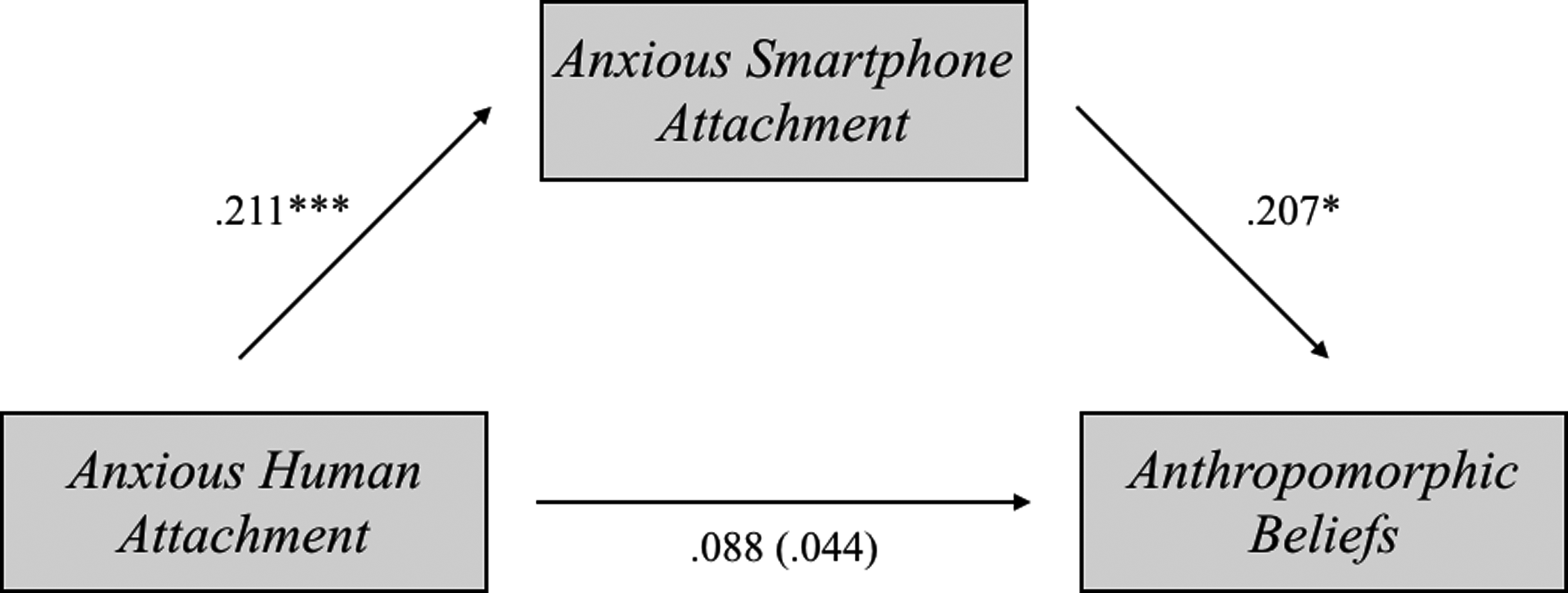
Mediation model of anxious attachment and anthropomorphic beliefs. ***p < 0.001, **p < 0.01, *p < 0.05.
H3: Anxious smartphone attachment and over-reliance
Hypothesis 3 predicted that Anxious smartphone attachment would predict smartphone reliance and an urge to answer texts or e-mails even in dangerous situations, which would indicate both an over-reliance on smartphones and a difficulty in discerning appropriate situations for smartphone use. Anxious smartphone attachment positively predicted feelings of smartphone reliance (ß = 0.309, t = 5.229, p < 0.001) and urge to answer (ß = 0.203, t = 3.330, p = 0.001). When holding Anxious human attachment constant, Anxious smartphone attachment still yielded significant, positive effects on smartphone reliance (ß = 0.288, t = 4.646, p < 0.001; Fchange[1, 258] = 21.582) and urge to answer (ß = 0.159, t = 2.500, p = 0.013; Fchange[1, 258] = 6.252).
And finally, we examined two mediation models in which the relationship between Anxious human attachment and both smartphone reliance and urge to answer was partially explained by Anxious smartphone attachment. These mediation models (Figs. 2 and 3) were significant (smartphone reliance: R2 = 0.010, F[2, 258] = 14.28, p < 0.001; urge to answer: R2 = 0.060, F[2, 258] = 8.21, p < 0.001). In the case of smartphone reliance, this effect is a full mediation—that is, Anxious smartphone attachment accounts for almost all of the relationship observed between Anxious human attachment and smartphone reliance.
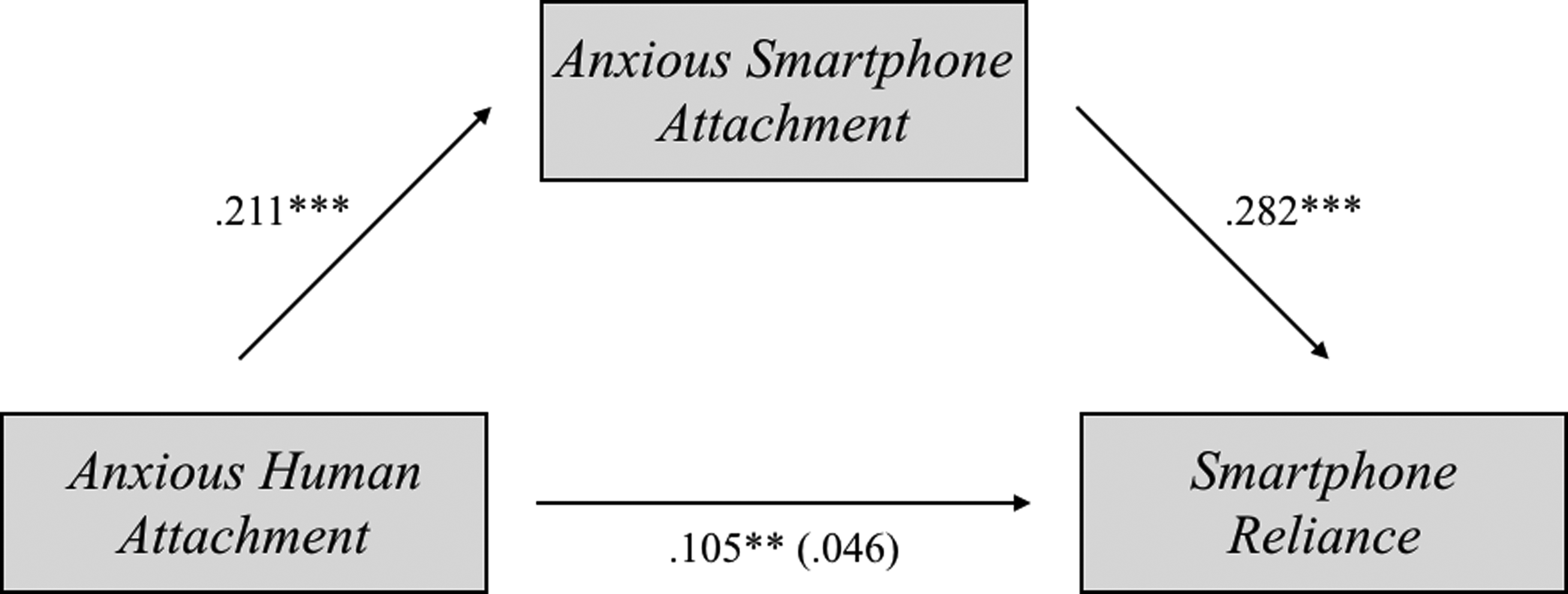
Mediation model of anxious attachment and smartphone reliance. ***p < 0.001, **p < 0.01, *p < 0.05.
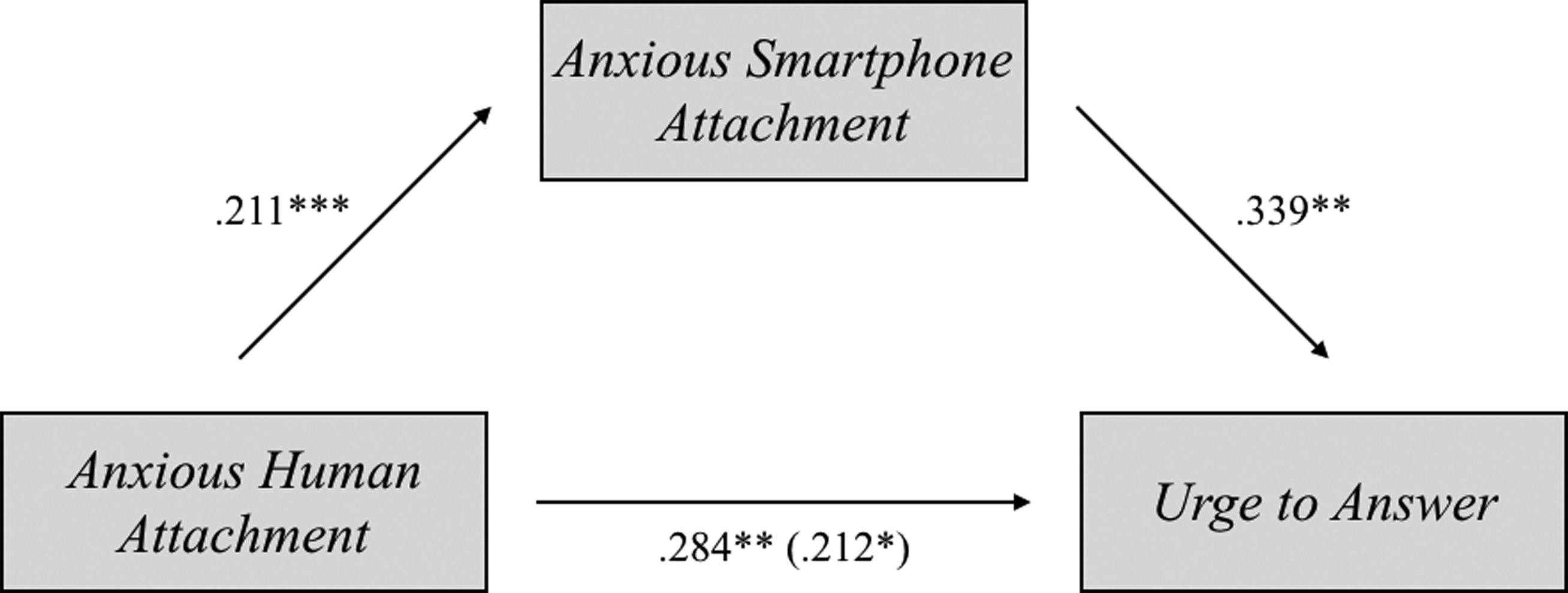
Mediation model of anxious attachment and urge to answer. ***p < 0.001, **p < 0.01, *p < 0.05.
Discussion
As predicted, the relationship between Anxious human and Anxious smartphone attachment was significantly stronger than correlations between Secure and Avoidant attachment styles across modalities. Furthermore, we observed significant mediation effects in which Anxious human attachment predicted these outcomes either partially or fully as a result of Anxious smartphone attachment. These findings suggest that those who are Anxiously attached to humans may be at an increased risk of forming an Anxious attachment to their digital representations of close others, even when controlling for human attachment. This “clingy,” reliance-based relationship with one's smartphone further predicted—uniquely and above the effects of human attachment—a difficulty in establishing boundaries for appropriate situations for smartphone use. Future research may wish to replicate these effects with validated, and potentially related, measures such as problematic smartphone use4,5 to better understand the overlap between such indices and our shorter scales of smartphone reliance and urge to answer. In addition, we recognize that our sample is relatively young, necessitating additional research into the generalizability of these findings to older generations. Further work should also aim to examine actual, rather than self-reported, smartphone use using a third-party app or similar “diary method” tools.19,20
Our early research is the first to our knowledge to conceptualize and operationalize smartphone attachment not as a form of possessional importance, but rather as if our relationship with smartphones may originate from an extension of our human attachment styles. As such, we second Belk's call for the adaptation and reformulation of his original Extended Self Theory into a digitally connected world, where such possessions pose considerable impact on our daily existence. 7 Although both humans and smartphones may be objects of our attachment, by examining origins of these relationships we may better understand the ways in which these attachment patterns—and consequent behaviors—manifest. Taken together, our research provides insight into the origins and ramifications of these societally relevant dangerous behaviors. Additional research is needed to predict and prevent the potentially negative consequences of high Anxious smartphone attachment in day-to-day life.
Footnotes
Author Disclosure Statement
No competing financial interests exist.