




Abstract
Abstract
Although research has explored the ways in which people form virtual communities to converse about media figures, television shows, and similar topics, little research has examined the link between virtual communities and the parasocial relationships (PSRs) that are often the focus of these conversations and users' experiences in those virtual communities. We examined sense of community (SOC) on Twitter and Instagram as a function of users' motives for use and users' PSR on the sites. In addition to examining the relative importance of different motives for using Twitter and Instagram, we predicted that PSR would mediate the association between motives for use and SOC. Results of an online survey revealed that Instagram users (n = 276) reported stronger social interaction motives than did Twitter users (n = 223). Social interaction and expressive information sharing motives were directly positively associated with SOC for users of both sites. Instagram users also exhibited indirect effects of expressive information sharing and companionship motives on SOC, through PSR. These findings suggest potentially influential differences between Twitter and Instagram, particularly regarding the role of PSR in fostering a general SOC.
S
SOC on Twitter and Instagram
Virtual communities have been a central focus of much research regarding online communication. These “communities of meaning” are characterized by shared meanings, values, and identification. 5 The affective bonds that differentiate virtual social groupings and true communities are often referred to as “sense of community” (SOC). McMillian and Chavis define SOC as “a feeling that members have of belonging, a feeling that members matter to one another and to the group, and a shared faith that members' needs will be met through their commitment to be together.” 6 (p9) Similarly, Baym described SOC as forming through “group-specific forms of expression” in virtual communities. 1 (p152) These group-specific forms of expression often emerge from interaction centered around a celebrity or media figure (i.e., discussing a celebrity). Community members observe and learn communal practices from those who desire to engage with or about that person (e.g., how and what to tweet). 7
PSR on Social Media
Social media allow users access to the targets of PSR in ways that traditional mass media do not. In many respects, social media allow celebrities to provide viewers insight into the “backstage” of their personal lives. 8 In addition to being able to view content posted by the target of the PSR, users can communicate with other users about the target of the PSR. Users may also signal their identification with the community related to the target of their PSR through their profile content or posts. For example, a user may post a hashtag commonly used by members of the online community or target of the PSR. In these ways, PSR could contribute to SOC among users who are engaged in PSR with a particular media figure. That is, the PSR serves as a connection to a broader group of users.
Although little research has examined predictors of PSR on social media, users' motives for using sites such as Twitter and Instagram are likely relevant. In regard to PSR facilitated through Twitter, Stever and Lawson argued that, “people who would persist in this kind of relationship are getting some kind of gratification from it that outweighs the negative aspects of it (i.e., lack of reciprocity).” 3 (p350) Thus, gratifications sought or motives for social media use could provide insight into how users' PSR might stimulate SOC on social media.
Motives for Twitter and Instagram Use
Uses and gratification theory proposes that media use is “goal-directed, purposeful, and motivated” and satisfies users' needs or desires. 9 (p420) Research focused on Facebook has identified the following gratifications of social media: relaxing entertainment (passive, entertainment-oriented uses), expressive information sharing (wanting to share general or personal information with others), escapism (avoiding tasks or individuals), cool and new trend (social desirability), companionship, social interaction, habitual pass time (ritualistic use), and professional advancement. 10 In the context of social media, motives such as social interaction and expressive information sharing have been positively correlated with using social media to interact with others who share similar interests. 11 Similarly, frequency of Twitter use has been positively associated with degree of connectedness to other users, 12 suggesting that connection-oriented motives might be fulfilled on social media. It is likely that socially-oriented motives (i.e., expressive information sharing, companionship, and social interaction) are particularly salient to PSR and SOC. If PSR can encourage SOC on Twitter and Instagram, then the link between these motives and a sense of connection or community might partially be explained by the motives' encouragement of PSR.
Social media go beyond traditional text-based communication technologies to provide visual content in the form of pictures and videos. Although research investigating the impact of visual content on social media is relatively limited, such content appears to reduce uncertainty 13 and induce emotional responses 14 in users. Channels that are interactive and immersive allow users to mentally experience environmental features within photographs, creating positive attitudes toward the image portrayed. 15 Thus, it is possible that motives for using Instagram (which is primarily visual) and Twitter (which is primarily text-based) differ. The extent to which motives, PSR, and SOC are related might also vary. To examine the associations outlined above, we propose the following research question and hypotheses:
Methods
Participants
Participants were students at a large Midwestern university who responded regarding the platform they used most frequently. Twitter users included 223 participants (112 male, 111 female) with a mean age of 21.86 (SD = 5.07) who reported using the platform for an average of 44.53 minutes per day (SD = 45.43) and 5.53 days per week (SD = 2.10). Instagram users were 276 participants (59 male, 217 female) with a mean age of 21.64 (SD = 3.18). Instagram users reported using the platform for an average of 54.91 minutes per day (SD = 136.71) and 6.07 days per week (SD = 1.63). Twitter and Instagram users did not differ in minutes per day of use, t (478) = −1.06, p = 0.29.
Procedure
Participants were recruited through messages posted on course websites for undergraduate Communication courses and offered extra credit in their course in exchange for participation. Participants were directed to a website containing informed consent documents and the questionnaire. A prerequisite for study completion was to have an active Twitter and/or Instagram account. Participants were asked to indicate which platform they used more often, with the intention of capturing regular users of the platforms. After being directed to the appropriate version of the questionnaire, participants were prompted to, “Please think about your favorite Twitter/Instagram media personality that you follow. It may help to access their page now as you will need more information about them at a later time during this survey.” Participants then responded to items regarding PSR, motives for social media use, and SOC for that site. Procedures were approved by the authors' Institutional Review Board (approval number 15.077).
Measures
PSR was assessed using Rubin, Perse, and Powell's 20-item Parasocial Interaction Scale, 16 which is the most widely used measure of PSR 4 and is designed to assess degree of connectedness, or social involvement (as opposed to the perception of the illusion of a conversation per se 4 ), with a media figure. Each of the 20 items was rated on a five-point Likert-type scale, with response options ranging from 1 (strongly disagree) to 5 (strongly agree). We adapted language on the scale to reflect social media figures. Items included, “I think my favorite media personality is like an old friend,” and “The social networking site my favorite media personality is on shows me what the person is like,” α = 0.89 (Twitter) and 0.91 (Instagram). An independent-samples t test indicated no difference in PSR reported by Instagram (M = 3.29, SD = 0.62) and Twitter (M = 3.25, SD = 0.60) users, t (479) = −0.70, p = 0.49.
Motives for Twitter and Instagram use were assessed using Papacharissi and Mendelson's 26-item measure of motives for social media use. 10 Reliability analyses are reported as Twitter and Instagram, respectively. Participants were asked to rate the extent to which they used Twitter or Instagram for activities related to seven gratifications as follows: relaxing entertainment (e.g., “Because it's entertaining,” α = 0.79, 0.77), expressive information sharing (e.g., “To provide personal information about myself,” α = 0.84, 0.85), escapism (e.g., “So I can forget about school, work, or other things,” α = 0.70, 0.71), cool and new trend (e.g., “Because it is the thing to do,” α = 0.73, 0.77), companionship (e.g., “So I won't have to be alone,” α = 0.77, 0.79), social interaction (e.g., “To keep in touch with friends and family,” α = 0.77, 0.78), and habitual pass time (e.g., “Because it passes the time away, particularly when I'm bored,” α = 0.82, 0.86). Professional advancement was omitted because it was not relevant to the current study. Possible responses ranged from 1 (strongly disagree) to 5 (strongly agree). An independent samples t test found no difference in SOC reported by Instagram (M = 3.62, SD = 0.72) and Twitter (M = 3.67, SD = 0.72) users, t (505) = 0.72, p = 0.47.
SOC was assessed using Chen's scale designed to assess SOC on Twitter. 12 Participants were asked to indicate the extent to which they agreed with the five statements (e.g., “I feel I am connected to other users on [Twitter/Instagram]”) on a scale of 1 (strongly disagree) to 5 (strongly agree). This scale exhibited excellent reliability for Twitter and Instagram, α = 0.90 and 0.91, respectively.
Analyses
Means, standard deviations, and correlations for the study variables are provided in Table 1. Research Question 1 asked whether motives for Twitter and Instagram use differ. This question was answered using multivariate analysis of covariance (MANCOVA). Social media site was the independent variable, and motives were the dependent variables. Participant sex, age, and minutes spent on the site per day were covariates.
Correlations for Twitter users are below the diagonal, and correlations for Instagram users are above the diagonal.
p < 0.05; **p < 0.01.
PSR, parasocial relationship; SOC, sense of community.
Hypotheses 1–3 predicted that the social motives of expressive information sharing, companionship, and social interaction would be associated with PSR (H1), that PSR would be positively associated with SOC (H2), and that PSR would mediate the association between social motives and SOC (H3). These hypotheses were tested using Hayes's PROCESS macro. 17 Confidence intervals were estimated using 1,000 bias-corrected bootstrapped samples. A separate model was calculated for each motive, with the other motives included in the model as covariates. 17 Participant age, sex, and minutes using the site per day were included as covariates.
Results
Motives for Twitter and Instagram use
The MANCOVA examining differences in motives for Twitter and Instagram use was significant, Wilks's Λ = 0.96, F (7, 417) = 2.65, p = 0.01. There was a significant effect of site used on social interaction, F (1, 461) = 9.48, p = 0.002, such that social motives were higher for Instagram users (M = 3.82, SD = 0.88) than for Twitter users (M = 3.42, SD = 0.92). Twitter and Instagram users did not significantly differ on any of the other motives.
Motives, PSR, and SOC
Twitter users
As shown in Table 2 and Figure 1, Twitter users' PSR was associated with the motive of expressive information sharing (b = 0.29, SE = 0.06, 95% CI [0.16–0.41]), but not with the motives of social interaction or companionship. There was no association between PSR and SOC for Twitter users. SOC was directly associated with the motives of expressive information sharing (b = 0.37, SE = 0.07, 95% CI [0.23–0.52]) and social interaction (b = 0.17, SE = 0.06, 95% CI [0.06–0.28]), but no indirect associations between SOC and motives through PSR were observed. In sum, expressive information sharing motives predicted PSR and SOC, and social interaction motives predicted SOC, but no indirect effects were observed, and PSR was not related to SOC.
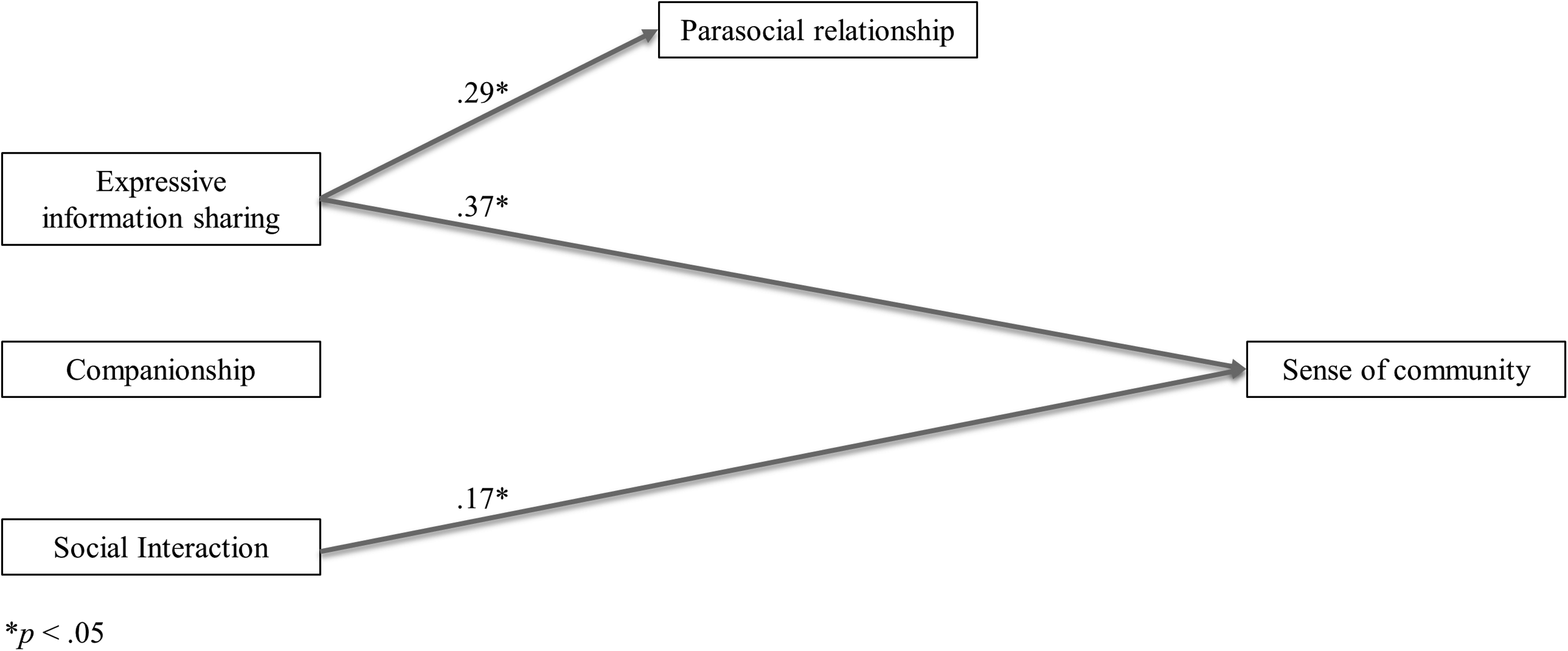
Mediation model (significant findings), Twitter users.
95% CI does not include 0.
Instagram users
As reported in Table 2 and Figure 2, Instagram users' PSR was associated with the motives of expressive information sharing (b = 0.16, SE = 0.05, 95% CI [0.06–0.26]) and companionship (b = 0.12, SE = 0.05, 95% CI [0.03–0.22]), but not social interaction. There was a positive association between PSR and SOC (b = 0.36, SE = 0.07, 95% CI [0.23–0.50]). Direct associations were found between SOC and motives of expressive information sharing (b = 0.27, SE = 0.06, 95% CI [0.16–0.38]) and social interaction (b = 0.21, SE = 0.05, 95% CI [0.12–0.30]), but not companionship. There were also indirect associations between motives and SOC for expressive information sharing (b = 0.06, SE = 0.03, 95% CI [0.02–0.12]) and companionship (b = 0.05, SE = 0.02, 95% CI [0.01–0.11]), but not for social interaction. Taken as a whole, SOC was associated with PSR, expressive information sharing and social interaction motives, and the indirect effects of expressive information sharing and companionship through PSR.

Mediation model (significant findings), Instagram users.
Post hoc analyses
To further examine the finding that the association between PSR and SOC was significant for Instagram but not Twitter users, we conducted a formal analysis of this difference by testing whether social media site moderates the association between PSR and SOC. The interaction between PSR and site used was significant (b = 0.24, SE = 0.11, p = 0.03), with the association between PSR and SOC being stronger for Instagram users (b = 0.52, SE = 0.07, p < 0.001) than for Twitter users (b = 0.28, SE = 0.08, p = 0.001).
Discussion
The aims of this study were to examine differences in motives for Twitter and Instagram use and to explore how those motives are associated with SOC, both directly and indirectly through PSR. Overall, there was more evidence for the role of motives in PSR and SOC among Instagram users than among Twitter users. We found that Instagram users reported stronger social interaction motives than did Twitter users. For Instagram users, SOC was positively associated with PSR, directly associated with the motives of expressive information sharing and social interaction, and indirectly (through PSR) associated with the motives of expressive information sharing and companionship. For Twitter users, SOC was directly associated with the motives of expressive information sharing and social interaction. Although PSR did not mediate the associations between motives and SOC for Twitter users, PSR was positively associated with the motive of expressive information sharing.
A key difference between Twitter and Instagram is that the former is primarily text-based, and the latter is primarily visual. The visual element prominent in Instagram provides the ability to elicit emotional responses from users. 14 The finding that social interaction motives were stronger for Instagram users than for Twitter users, combined with the finding that social interaction motives were positively associated with SOC for users of both sites, suggests that the visual focus of Instagram might promote more satisfying social interactions and, by extension, greater SOC. However, this mechanism appears to operate independently of PSR, which was not associated with social interaction motives.
In contrast, PSR was a factor in explaining the associations between SOC and both expressive information sharing and companionship motives for Instagram users. Users who reported these motives as being stronger reasons for using Instagram reported more PSR and, in turn, greater SOC. The desire to give and receive expressive information with others and feel a sense of companionship might drive Instagram users to connect with popular Instagram figures and participate in the community that surrounds those figures. For example, users can post pictures of themselves, which aligns well with the basic tenet of expressive information sharing. Instagram can be used as a tool for motivation and reinforcement of behaviors within like-minded networks of people, such as female college students participating in at-home workout regimens. 18 Posting images online of one's daily life might provide a heightened sense of expression that other channels, such as Twitter, are less able to provide to the users. Users are also able to view others' images and become involved in interaction surrounding the target of their PSR. A critical element of social media is the presentation of being sociable. 19 In short, Instagram's photo-centric model might encourage social behaviors and connecting with other members of the community as mediated by the PSRs.
Expressive information sharing motives were also associated with both PSR and SOC for Twitter users. However, unlike for Instagram users, PSR did not mediate the association between these motives and SOC. This finding suggests that while Twitter might fulfill important social or communicative motives for users and promote SOC through this fulfillment, Twitter “celebrities” or popular figures are not important to this process the way they might be on Instagram. As described above, this might be attributable to the visual nature of Instagram and its ability to depict everyday parts of one's life. For example, an athlete's Instagram posts can range from personal life to business, training regimen, and so on. Work by Guerin-Eagleman and Burch 20 suggests that athlete self-presentation on Instagram provides a backstage glimpse into their private lives, which appeals to a wide array of viewers. Other possible explanations center around the different ways in which Twitter and Instagram users use the site (e.g., for news or interpersonal communication, respectively).
Limitations and future directions
Perhaps the clearest direction for further investigation is the examination of real-life Twitter and Instagram posts. The self-report measures used in the current study tap into users' perceptions of their own behavior and attitudes, but examining actual content could add validity to the findings presented in this study and allow for an examination of how these processes show up in the actual communication that occurs on these sites.
Although we drew from previous research to hypothesize that motives are associated with SOC through PSR, the cross-sectional nature of this study does not allow us to determine causality. These associations should be examined longitudinally. Similarly, PSR is a multifaceted ongoing process. Longitudinal research could help add further nuance to this area of research.
Conclusion
This study explored differences between Twitter and Instagram from the perspective of uses and gratifications and examined the role of users' motives in their perceptions of PSR and SOC. The findings suggest that people use the sites for slightly different reasons and that these reasons are associated with their experience of SOC and, in some cases, PSR. Understanding how one-sided PSR can foster two-sided relationships with other users in online communities could help both users and developers better leverage the features of those communities.
Footnotes
Author Disclosure Statement
No competing financial interests exist.