




Abstract
Abstract
As it becomes common for Internet users to use hashtags when posting and searching information on social media, it is important to understand who builds a hashtag network and how information is circulated within the network. This article focused on unlocking the potential of the #AlphaGo hashtag network by addressing the following questions. First, the current study examined whether traditional opinion leadership (i.e., the influentials hypothesis) or grassroot participation by the public (i.e., the interpersonal hypothesis) drove dissemination of information in the hashtag network. Second, several unique patterns of information distribution by key users were identified. Finally, the association between attributes of key users who exerted great influence on information distribution (i.e., the number of followers and follows) and their central status in the network was tested. To answer the proffered research questions, a social network analysis was conducted using a large-scale hashtag network data set from Twitter (n = 21,870). The results showed that the leading actors in the network were actively receiving information from their followers rather than serving as intermediaries between the original information sources and the public. Moreover, the leading actors played several roles (i.e., conversation starters, influencers, and active engagers) in the network. Furthermore, the number of their follows and followers were significantly associated with their central status in the hashtag network. Based on the results, the current research explained how the information was exchanged in the hashtag network by proposing the reciprocal model of information flow.
Introduction
I
Since IBM's Deep Blue defeated a human chess champion, Garry Kasparov, in 1997, it was the first time that a computer algorithm defeated a human player in another complex board game. 1 All five games between AlphaGo and Lee were live streamed on YouTube and attended by 60 million spectators worldwide. The match also generated incessant discussions about the players and the game results on social networking sites, including Facebook and Twitter. 2 Among the various social networking sites, Twitter was most actively employed by users to share the up-to-the minute information regarding the games, creating a large-scale information network with a hashtag called #AlphaGo. In the hashtag network, popular media (e.g., the New York Times) and experts in the tech industry (e.g., CTOs of well-known tech companies) posted messages about the games and their followers reposted the content (i.e., retweeting). Not only the high-profile users but also many general users jumped into the mediated communication. They shared their thoughts about the match and retweeted dozens of posts from the popular users to their Twitter friends. 3 In all, Twitter played an important role in circulating information about the AlphaGo-Lee match, 1 generating a massive network comprising 21,870 (English) tweets (the size of the network might be bigger if the match-related tweets posted in other languages than English were included).
As it becomes more common for Internet users to use hashtags when posting and searching information on social media these days, it is important to understand who builds a hashtag network and how information is circulated within it. 4 Analyzing a hashtag network may advance our understanding of who or what generates original information and how it is actively shared among users in the network. Specifically, analysis of a hashtag network may reveal whether the traditional opinion leaders or the ordinary users lead the flow of information exchange. In addition, it may uncover unique patterns of information dissemination in a network, as well as characterize users who play an important role in distributing information.
In the following sections, this article focused on unlocking the potential of the #AlphaGo hashtag network by addressing the following questions. First, this study examined whether traditional opinion leadership (i.e., the influentials hypothesis) 5 or grassroot participation by the public (i.e., the interpersonal hypothesis) 6 drove dissemination of information within the hashtag network. Second, unique patterns of information distribution by key users were identified. Finally, the association between attributes of key users who exerted great influence on information distribution (i.e., the number of followers and follows) and their central status in the network was tested.
Literature Review
As the importance of social media as a major information source grows, researchers have put more attention to exploring who takes a lead in information sharing and in what pattern information is exchanged among users.7,8 In traditional communication research, scholars have argued that a small number of individuals such as opinion leaders in society (e.g., journalists, politicians, and educators) dominate the information distribution process by serving as gatekeepers between mass media and the general public. They have access to original media content and interpret it based on their own opinions. Opinion leaders then infiltrate their opinions through the public by directly controlling what information to distribute to the public and how it is presented.
Katz and Lazarsfeld 9 explained that opinion leaders first select information from various media sources and then relay the selected information to the public. This stepwise process of information dissemination is called the two-step flow model of communication (TFMC). Rogers 5 defined “opinion leaders” as individuals who serve as intermediaries, passing over information from mass media to their opinion followers. 6 They have expertise in specific domains and are ranked high in social status. The TFMC 9 has been widely tested and supported by many empirical studies in various fields, including sociology,10,11 marketing,12,13 and communication.14,15 The studies showed that most people were not directly affected by mass media. Rather, they tended to form their opinions based on a few influential social actors in society.16–19
As opposed to the TFMC, there is a growing argument among researchers that the general public, not the social elites, decide what information to distribute to their peers, and the self-selected information influences the opinion followers' thoughts. 20 Watts and Dodds explained about such different ways of information distribution, using the model of interpersonal influence (MII), 21 highlighting the minimal role of traditional opinion leaders. The model contends that ordinary people set a new trend themselves by choosing what information to consume and share with their peers. In such voluntary decision-making processes, social influence is created and adjusted by the opinions of the general public. The MII also argues that grassroot sharing of information is more influential in shaping public opinion. Researchers have added more evidence that supports what the MII contends (i.e., collaborative filtering).20,22 In all, the studies have suggested that peer-to-peer or interpersonal information distribution undermines the power of traditional opinion leadership on public opinion. Rather, it closely connects the general public and empowers them.23,24
In addition to identifying key users who exert great influence in information flow in a hashtag network, it is also important to understand in what pattern information is distributed by the influential users. As a recent study 25 found, the leading actors in the information network tended to send and receive information in different patterns. As Feng 25 reported, some users served as an original source of information (i.e., conversation starters), while other users shared thought-provoking information with other users (i.e., influencers). Or, some focused on posting their personal opinions rather than objective information (i.e., active engagers). Of relevance to the context of this study, the influential users in the AlphaGo hashtag network may also show several unique information exchange patterns.
Based on the findings from previous research, the following research questions were drawn: (1) Which theoretical hypothesis (i.e., the influentials vs. the interpersonal) fits the pattern of information flow in the AlphaGo hashtag network? and (2) In what pattern does the information flow in the network?
Moreover, it is worth testing what attributes make certain users more influential in the AlphaGo hashtag network. In effect, there have been only a few studies that examined what makes some users central figures in the network. 26 They only tested the impact of user demographics and total number of tweets on central status of the users. 25 Therefore, this study further examined the impact of other characteristics of influential users (i.e., the number of follows and followers) on their central status in the network (which was operationalized as the number of in-degree links [IL],a out-degree links [OL],b and between centrality [BC]c). Specifically, the following hypotheses were proposed based on previous literature on information network development and opinion leadership.25,27–29
First, if a user followed a number of other users on Twitter, then the user would receive a lot of information from them. Consequently, more tweets (i.e., high OL) would be posted based on the information the user received 27 (H1-a). If the user posted many tweets, he or she would play an important role in distributing information in the network 28 (i.e., high BC) (H1-b). Second, if a user followed many Twitter users, he or she would receive many messages from his or her followers (i.e., high IL) (H2-a). Such a high volume of incoming messages from the followers would render the user central in the network 25 (H2-b). Third, if a user was followed by many Twitter users, he or she would post a lot of messages to keep his or her information network 28 (H3-a), leading him or her to exert great influence on the flow of information in the network 25 (H3-b). Finally, if a user had a high number of followers, the user would receive a lot of messages from his or her followers 29 (H4-a), making the user an influential player in the network (H4-b).
Materials and Methods
Data source
To address the research questions and test the hypotheses, social network analysis (SNA) was conducted. SNA is an analytical method to examine social and informational structures based on networks and graph theories.
30
SNA was conducted in this study using NodeXL, the open-source software developed by the Social Media Research Foundations (
Data analysis
To answer RQ1, key metrics of the AlphaGo network were calculated using NodeXL such as the number of people that a user followed, the number of people that followed a user, and the number of IL, OL, and BC. Using the key metrics, the hashtag network was visualized to examine the flow of information between users. If the visualization showed a pattern that information was sent unidirectionally from a few high-profile users to their respective followers, it would demonstrate the existence of traditional opinion leadership in the network. Meanwhile, if the visualization revealed multiple small- or mid-sized networks in which ordinary users exchanged information between themselves without intervention of the high-profile users, it would prove the interpersonal hypothesis.
To answer RQ2 and RQ3, all of the users were ranked based on their central status metric (i.e., BC), meaning that the rank of “1” indicated the user who had the most central status in the network (i.e., highest BC). Given the massive size of the network, only the top twenty users (i.e., those who contributed substantially more to information exchange than others) were identified and then the pattern of information flow of each top user was visualized using the Fruchterman–Reingold algorithm in NodeXL. When each visualization was examined, Feng's typology of the information distribution patterns on social media was used to identify different patterns of information exchange in the AlphaGo network (Table 1). 25 Finally, a general linear model was run to test H1–H4, using the PROCESS macro (Model 4). 31 A bootstrapping approach was used to obtain 95% bias-corrected confidence intervals (BcCI) with 5,000 resamples. Statistical significance at the 0.05 level was indicated by BcCI excluding 0.
IL, in-degree links; OL, out-degree links.
Results
The entire network was visualized to answer RQ1, which showed the unidirectional flow of information (Fig. 1) revolving around several high-profile users. Specifically, the vast majority of tweets were directed toward the high-profile users who are traditional opinion leaders in society (e.g., CEO/CTO of tech companies, media companies) (Table 2). To take a closer look at the flow, the network was visualized in a way that users were clustered based on the frequency of message exchange. As a result, the visualization revealed that the high-profile users were located at the center of each information cluster with the heavy traffic of information influx toward them. This result implies that the traditional opinion leaders were not relaying information “to” ordinary users (see the OL data in Table 2). Rather, they were receiving a myriad of messages “from” ordinary users (see the IL data in Table 2). Specifically, the visualization of the network showed that users tended to cite tweets of the high-profile users (e.g., @DemisHassabis who is a principal researcher in the AlphaGo development team) and it resulted in the high number of unidirectional information traffic from ordinary users to the high-profile users. Another observation from the network visualization was that ordinary users sent many questions and personal opinion messages to the high-profile users, which created a lot of information traffic. Taken together, the TFMC received evidential support as the network revealed the existence of traditional opinion leadership. Interestingly, however, it also showed other evidence to support the MII since ordinary users actively engaged in relaying information within the network by retweeting the high-profile users' messages and sending personal messages to the popular users. The observation of this unique pattern of the information flow suggests that the hashtag network operates differently from other forms of information exchange theorized in the literature. Such a different pattern of information exchange is described using the reciprocal model of information flow (RMIF).
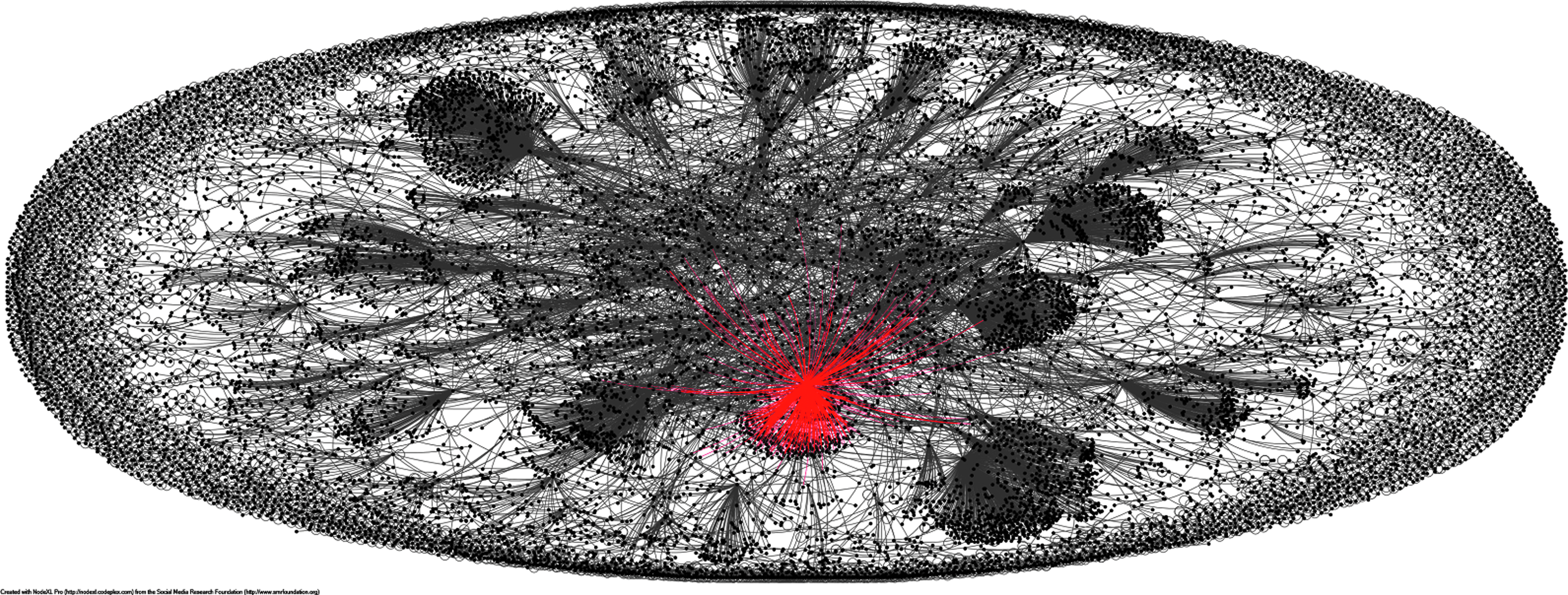
Visualization of the #AlphaGo hashtag network (n = 21,870). The user (@DemisHassabis) with the highest impact in the network was highlighted in this figure.
Note: Some user IDs were partially anonymized to protect their privacy unless they are already publicly known.
AE, active engagers; CS, conversation starters; IN, influencers.
To answer RQ2 and RQ3, subgraph analyses of the top 20 users' information exchange patterns were conducted. 28 The subgraph analyses showed different information distribution patterns by the high-profile users: first of all, some influential users (e.g., Google, the AlphaGo research team, and the American Go Association) served as “conversation starters” who provided new topics for discussion to ordinary users, while other influential actors played the role of “influencers” whose messages were frequently cited by ordinary users (e.g., the Wired magazine). In addition, some technology experts (e.g., power users who have expertise in AI) contributed to the flow of information as “active engagers” by posting their personal opinions about the match. Finally, there were no “network builders” or “information bridges” identified in the network.
To test H1–H6, the PROCESS macro (Model 4) was run (Fig. 2). Rejecting H1-a, the number of followers was not significantly associated with the number of OL (β = −0.03, 95% BcCI [−0.12, 0.05]). But, supporting H1-b, the number of OL predicted greater BC (β = 0.16, 95% BcCI [0.12, 0.16]). Supporting H2-a/b, the greater the number of people a user followed, the greater the number of IL (β = 0.11, 95% BcCI [0.08, 0.15]). The high number of IL in turn translated into greater BC in the network (β = 0.69, 95% BcCI [0.67, 0.71]). Rejecting H3-a/b, the number of followers predicted the lower number of OL (β = −0.69, 95% BcCI [−0.83, −0.55]), which was associated with greater BC (β = 0.16, 95% BcCI [0.15, 0.16]). Supporting H4-a/b, the more followers a user had, the higher the number of IL (β = 0.53, 95% BcCI [0.48, 0.59]), which was associated with greater BC (β = 0.69, 95% BcCI [0.67, 0.71]).

The effects of key attributes of users on their central status in the #AlphaGo network. *p < 0.05, Numbers in parentheses are standardized regression coefficients (beta).
Discussion
This study showed that the patterns of information exchange in the AlphaGo hashtag network could not be simply explained by the existing network theories. The unique patterns of information exchange in the network did not perfectly fit with either the TFMC or the MII. Specifically, the AlphaGo network showed different forms of information exchange that the opinion leaders served as not only gatekeepers but also as active receivers of information. Moreover, the data showed that ordinary users did not passively receive information, but they proactively expressed their opinions and shared them with the opinion leaders. That is, the information flow in the hashtag network was reciprocal among media sources, opinion leaders, and the public.
The current study also examined what factors contributed to the central status of the influential users in the hashtag network. Consistent with the findings from previous research,16,25 the mediating effect of the number of IL was significant (H1, H2, and H4). However, rejecting H3, the more a user had Twitter followers, the less he/she sent information to their followers. A possible explanation for the unexpected finding is that users with great followership may be careful about what they post on their social media account because any small mistake may substantially impair their reputation. Another alternative account for the finding is that the number of OL only includes the number of messages that specify a recipient's Twitter ID, which could be one of their followers or a random user. Hence, if a user had a lot of followers, the user might be hesitant to tweet to a specific user because their conversation on Twitter would be posted on their followers' Twitter feed as well (unless they use the direct messaging feature). Therefore, users with a high number of followers may tend to post tweets that do not pinpoint a specific user or simply use direct messaging to have a private conversation with others, if needed.
Despite the original findings of this study, it has several shortcomings that should be addressed in future research. First, since NodeXL can collect network data from Facebook and YouTube, researchers should also examine whether the same reciprocal patterns of information exchange can be found when different social media data sets are used. Moreover, NodeXL can only collect social media posts in English and thus this study could not test if the different patterns of information distribution would be found if non-English tweets were used for analysis. For instance, the defeat of Lee might be perceived differently for Korean spectators since the champion is Korean. Hence, researchers may examine if the same patterns of information flow would be identified when tweets in other languages are used. Furthermore, this study analyzed the network data during the exact match period. Given that the match was held for about 1 week, the patterns of information flow might be different if the long-term data were analyzed, including several days before and after the match. Therefore, future research may investigate whether similar patterns would be captured using the pre- and postmatch network data.
Footnotes
Author Disclosure Statement
No competing financial interests exist.