




Abstract
Abstract
The present study investigated the relationships between (exposure to) sexy self-presentations on social network sites (SNSs) and adolescents' sexual self-concept over time. Results from a three-wave panel study among 1,288 Dutch adolescents (aged 13–17 years) showed that more frequent engagement in sexy self-presentation, rather than exposure to sexy self-presentations of others, on SNSs positively predicted the importance of being sexually outgoing (e.g., sexy, seductive, and wild) in adolescents' self-concept 6 months later.
Introduction
I
Consistent research evidence has emerged that visual sexy self-presentations in social media are typically characterized by being flirty, wild, and seductive, and by giving the impression that one is sexually available.7,8,20–23 These attributes may be related to what we call a sexually outgoing self-concept in this study (i.e., the degree to which a person feels that attributes related to being sexually outgoing, such as being sexy, flirtatious, and seductive, are an important part of who they are). During adolescence, individuals become more sexually confident, less sexually reserved, and start to explore sexual matters. 24 Being sexually outgoing may thus start to become more important for adolescents' sense of self. As adolescents use SNSs to validate their self-concepts,1,2 this sexually outgoing self-concept may be further strengthened by sexually outgoing self-presentations on SNS.
Against this background, the main aim of the present study was to investigate the relationship between SNS use and adolescents' sexually outgoing self-concept. More specifically, the present study distinguishes between two separate ways, in which SNS use may influence one's sexual self-concept, namely by engaging in visual sexy self-presentation and by looking at the sexy self-presentations of others.
Differential Relationships Between Self- and Other-Generated Sexy Self-Presentations and Adolescents' Sexual Self-Concept
It has been argued that engaging in online sexual self-expression, such as sexy self-presentation, may reinforce the salience of sexual self-concepts within young people's broader identity.9,25 This can be explained by self-perception theory, 26 which states that when people engage in self-presentation, they infer beliefs about themselves and their behavior by observing themselves from an audience perspective. Thus, by more frequently presenting a sexually outgoing image of oneself to others, adolescents may start to perceive themselves as more sexually outgoing. Research based on self-perception theory has focused on two other mechanisms that can explain how, in particular, the importance of certain attributes to one's self-concept is influenced by one's own self-presentation, namely biased scanning and public commitment. 27
With regard to biased scanning, presenting oneself in a certain way (e.g., sexually outgoing) requires a biased search through memory for information about compatible attributes of the self.27,28 After the biased search, the found attributes (e.g., sexually outgoing attributes) become more salient in one's memory and more likely to be activated during subsequent self-evaluations. 27 Thus, when adolescents think about which attributes are important to their sense of self, they are more likely to think of sexually outgoing attributes (such as being flirty, sexy, and seductive) if these have been activated by recent engagement in sexy self-presentation. As a result, these attributes may become more important to one's sense of self.
With regard to public commitment, individuals generally strive for consistency between their self-concept and the impressions they create toward others in a public setting.29,30 Thus, individuals commit to the attributes and behaviors that they have made publically and integrate them into their self-concept.27,29 For example, research on online communication has shown that when individuals are asked to publically present themselves as more extroverted online, they subsequently see themselves as a more extroverted person. 29 Similarly, when adolescents present themselves in a sexually outgoing way they may integrate their sexually outgoing attributes more strongly to their identity to achieve consistency between their self-presentation and their identity. Based on self-perception theory and the related mechanisms of biased scanning and public commitment, we thus hypothesized:
Next to engaging in self-presentation, adolescents also use SNSs to look at pictures of peers.3,4,12 Despite some initial studies on the influence of exposure to sexy self-presentation of others on adolescents' sexual attitudes and behaviors,31,32 research on the influence of such exposure on adolescents' sexual self-concept is still lacking. There is reason to believe that the sexually outgoing images of peers on SNSs influence adolescents' self-concept. For instance, it has been argued that when media messages emphasize the importance of certain attributes, viewers can internalize this message and find these attributes more important within their own self-concept.33,34 Most work in this area has focused on mass media messages about importance of attractiveness 33 or social media use in general. 34 However, peers' sexy self-presentations on social media may also affect adolescents' self-concept. In fact, adolescents often look at what is valued by peers to form their own self-concept and identify what's important to them. 35 When adolescents look at sexy self-presentations of peers in social media that emphasize the importance of being sexually outgoing, they may thus internalize the importance of being sexually outgoing, which, in turn, impacts their sexual self-concept. To investigate the relationship between exposure to sexy online self-presentations of others and adolescents' sexual self-concept, we thus hypothesized:
Finally, the literature on expression effects suggests that the content that one expresses or presents oneself online generally has a stronger influence than perceiving content expressed by others.36–38 This can be explained by the idea that the anticipation, composition and sending of a message to others increases attention and elaboration toward the content that one wants to express. Such cognitive elaboration connects the content more strongly to one's personal beliefs and attitudes 36 To see whether the same holds for sexy self-presentation versus exposure to sexy self-presentation of others, we posed the following research question:
Methods
Sample and procedure
We analyzed data from a three-wave longitudinal panel survey that was conducted among a sample of Dutch adolescents aged 13–17 years, between May–June 2013 and May–June 2014, with 6 months between waves. Respondents were asked to complete an online survey at home, which is a suitable alternative to other survey modes for sensitive issues such as sexuality. 39 We used a randomly selected sample taken from the respondent pool of the Dutch research company Veldkamp, which is representative of the Dutch population in terms of gender, age, educational level, family size, and residential area. Response rates showed a total attrition of 31% between the first and the third wave, resulting in a sample of 1,467 adolescents that participated in all three waves (for more information on the sample and procedure). 32 Our analytical sample consisted only of adolescents who used SNSs, resulting in a final sample of 1,288 adolescents, with a mean age of 15 years (SD = 1.41), and of which 47.5% was male.
After obtaining ethical approval from the University of Amsterdam informed consent was asked from the parents before the adolescents were invited to participate via e-mail, and the adolescents had to give informed consent themselves before starting the questionnaire. Both adolescents and their parents were notified that the study was about sexual issues, that they could stop at any time they wished and that the principal investigators could not trace identifying information. After completion of each wave, the respondents received a voucher worth five euro.
Measures
Sexy self-presentation and exposure to sexy self-presentations of others
Respondents were told that “some teenagers use social media sites (e.g., Facebook, Twitter, Instagram) to show sexy pictures of themselves, whereas some teenagers do not,” and were then asked how often in the past 6 months they had posted pictures on SNSs of themselves (a) with a sexy gaze, (b) with a sexy appearance, (c) scantily dressed (e.g., bathing suit or underwear), and (d) in a sexy pose. Respondents were subsequently asked to think about pictures of others on SNSs and to indicate how often in the past 6 months they had looked at such pictures (same four items were used). These items were based on previous research on what characterized sexy self-presentation19–22 and have been used in other research of the first author.31,32 Response options for both measures ranged from 1 (always) to 7 (never). Items were recoded such that higher scores indicated more frequent sexy self-presentation or exposure to sexy self-presentations of others.
Principal components analyses (separately for the items of sexy self-presentation and the items of exposure to sexy self-presentation of others, and for each wave separately) showed that the four items formed a unidimensional scale for both engaging in sexy self-presentation and exposure to sexy self-presentations of others in all three waves, with an explained variance of 70% or higher for sexy self-presentation and 86% and higher for exposure to sexy self-presentations of others. Both scales showed good reliability (Cronbach's α >0.85 for sexy self-presentation and Cronbach's α >0.94 for exposure to sexy self-presentations of others) in all three waves. We therefore calculated the mean score of the items to construct the “sexy self-presentation” variable (M = 1.36, SD = 0.69 in wave 1; M = 1.36, SD = 0.72 in wave 2; and M = 1.39, SD = 0.73 in wave 3) and the “exposure to sexy self-presentations of others” variable (M = 3.06, SD = 1.45 in wave 1; M = 3.16, SD = 1.43 in wave 2; and M = 3.11, SD = 1.40 in wave 3).
Sexual self-concept
To create a scale that measured the importance of a sexually outgoing self-concept for one's overall identity, we based our procedure on Aquino and Reed's 40 development of a scale to measure the self-importance of a moral self-concept. Respondents were presented with six traits describing a sexually outgoing person (“dressed sexy,” “outgoing,” “flirtatious,” “popular,” “seductive,” and “wild”), derived from a pilot study,a and given the following instructions: “Read this list of traits and think about how important these traits are for determining who you are.” They were then asked to answer the following questions on a scale from 1 (totally agree) to 7 (totally disagree): “These characteristics are an important part of who I am,” “Having these characteristics is an important part of my sense of self,” and “These characteristics determine a large part of who I am.” These questions were based on the items with high factor loadings in the measure by Aquino and Reed. 40 Items were recoded such that a higher score indicated a greater importance of being sexually outgoing for one's overall identity. The items formed a unidimensional and reliable scale with an explained variance of 93% or higher and a Cronbach's alpha of 0.96 or higher in all three waves. The mean score of the three items formed the “importance of a sexually outgoing self-concept” construct (M = 3.09, SD = 1.54 in wave 1; M = 2.96, SD = 1.50 in wave 2; and M = 2.88, SD = 1.51 in wave 3).
Data analyses
The hypotheses were tested with structural equation modeling (in AMOS 21), using autoregressive models that included levels of the dependent variables at waves 1 and 2 to eliminate potentially confounding influences. 41 We tested our hypotheses in a reciprocal model because, according to selective exposure theory 42 and the two-component model of impression management, 43 the alternative direction of the relationships is also theoretically plausible (i.e., people's sexual self-concept predicts the type of content they expose themselves to online, as well as the type of pictures they post of themselves).
The latent variables frequency of sexy self-presentation, exposure to others' sexy self-presentations, and sexual self-concept were created by having each latent variable load on the manifest items used to measure that construct. Control variables (gender and age at wave 1) were drawn as manifest variables in the model and were regressed on the dependent variables at waves 2 and 3. The control variables and the independent variables at wave 1 were allowed to covary with each other, as were the disturbance terms of the variables at waves 2 and 3 and the error terms of the identical items between the first, second, and third wave.
To account for the violation of the normality assumption in our variables, we used the bootstrap method in addition to our parametric tests. 44 We estimated 95% bias-corrected confidence intervals (95% BCIs) of the standardized estimates on the basis of 1,000 bootstrapping samples (N = 1,288 each). When the 95% BCI does not include zero, the effect can be assumed to differ significantly from zero, and thus refers to a statistically significant relationship.
Results
To test hypotheses 1 and 2, we analyzed the model in Figure 1 (Fig. 1 shows a simplified model with only the main latent variables, represented as ellipses, and without the control variables). The model showed a good fit to the data, χ2 (487, N = 1,288) = 2243.90, p < 0.001, comparative fit index = 0.96, root mean square error of approximation = 0.05 (90% CI: 0.051/0.055). The more adolescents engaged in sexy self-presentation on SNSs in wave 1 and in wave 2, the more important their sexually outgoing self-concept became for their overall identity in wave 2, β = 0.12, B = 0.21, SE = 0.05, p < 0.001 (95% BCI: 0.06/0.18) and in wave 3, β = 0.15, B = 0.27, SE = 0.05, p < 0.001 (95% BCI: 0.08/0.22), respectively. Hypothesis 1 was thus supported. In contrast to hypothesis 2, exposure to others' sexy self-presentations on SNSs in wave 1 and in wave 2 did not predict adolescents' sexual self-concept in wave 2, β = 0.05, B = 0.05, SE = 0.03, p = 0.07 (95% BCI: −0.001/0.10) and in wave 3, β = 0.01, B = 0.01, SE = 0.03, p = 0.74 (95% BCI: −0.04/0.06), respectively. The variance in the sexual self-concept construct that was explained by our predictors was 35% in wave 2 and 38% in wave 3.
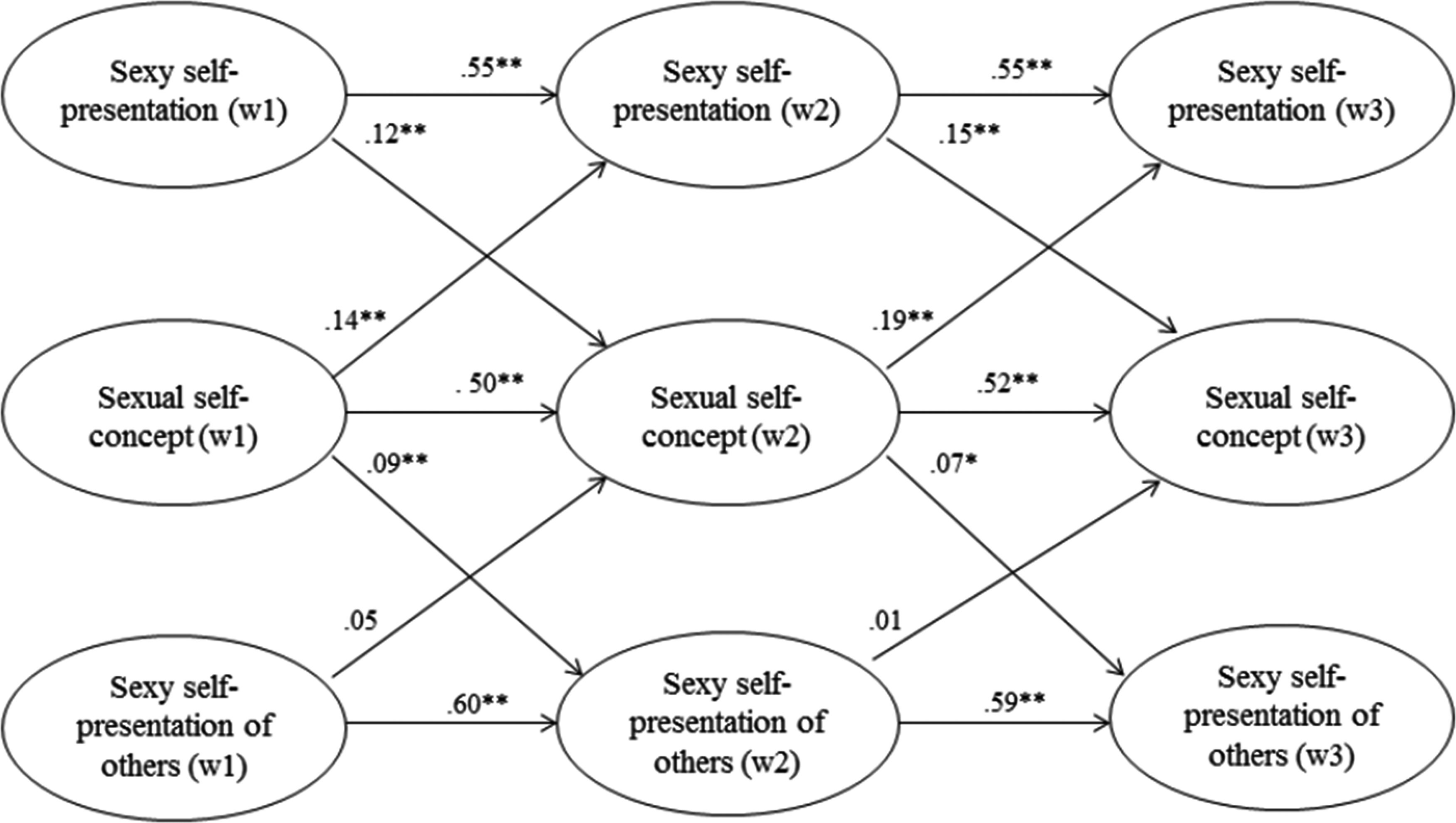
Standardized estimates of the relationships between sexy self-presentation and sexual self-concept as well as exposure to sexy online self-presentations and sexual self-concept. *p < 0.01; **p < 0.001.
To fully answer our research question (RQ1), whether the influence of adolescents' own sexy self-presentation on their sexual self-concept was stronger than an influence of exposure to sexy self-presentation of others, we compared a model in which the coefficients for the association between sexy self-presentation and sexual self-concept (from waves 1 to 2, and from waves 2 to 3) and the coefficients for the association between exposure to sexy self-presentations of others and sexual self-concept (from waves 1 to 2, and from waves 2 to 3) were constrained to be equal with a model, in which the coefficients were allowed to vary. Modeling equal coefficients for adolescents' own sexy self-presentation and exposure to sexy self-presentations of others significantly changed the fit of the model, Δχ (1, N = 1,288) = 5.81, p = 0.016 for waves 1 to 2, and Δχ (1, N = 1,288) = 16.68, p < 0.001 for waves 2 to 3. Thus, the path coefficients of adolescents' own sexy self-presentation and exposure to sexy self-presentations differed significantly.
Discussion
The present study investigated longitudinally how visual sexy self-presentation and exposure to such self-presentations by others on SNSs were related to the importance of adolescents' sexually outgoing self-concept over time. Previous research has shown that online self-presentation predicts individuals' self-views45,46 and that expression effects are often stronger than reception effects.36–38 In line with these previous studies, we found that only adolescents' own sexy self-presentation, but not the exposure to others' sexy self-presentation, predicted the importance of a sexually outgoing self-concept for adolescents' identity.
The lack of a relationship between exposure to sexy self-presentations of others and adolescents' self-concept runs somewhat counter to previous research on mass media effects on attitudes and behaviors. However, this finding is in line with previous research that showed that exposure to sexy self-presentation of others in social media does not predict sexual stereotypical attitudes 31 and only indirectly predicts the willingness to engage in sexual behavior, through descriptive peer norms. 32 In addition, previous research found that exposure to sexual media content can predict adolescents' online self-presentation 47 and online self-presentation, as evidenced by the current study, in turn predicts self-concept. Thus, although there seems to be no direct influence of exposure to others' sexy self-presentation in social media on sexual outcomes, such as the sexual self-concept, there may be an indirect relationship. Alternatively, exposure to others' self-presentations may moderate effects of self-presentation on the self-concept. In an experiment, exposure to sexy pictures of others moderated the effect of online self-presentation on self-objectification. 48 More generally, the literature shows that reception effects can enhance expression effects and vice versa. 38 Thus, future research should focus on how both the online expression and reception of online sexual media content may contribute to adolescents' sexual identity development through differential underlying mechanisms and mutually reinforcing processes.
Our findings have several implications for research on the use of SNS in adolescents' sexual self-concept development. The increased importance of a sexual self-concept in adolescents' identity may be problematic when adolescents end up being primarily focused on their sexual self-concept, especially when this occurs at the expense of their self-concept in other domains, such as their academic self-concept. 49 Moreover, a recent study has shown that sexy self-presentation on SNSs can result in a greater willingness to engage in more explicit forms of sexy self-presentation (i.e., “sexting”) among adolescent girls, which could be explained by processes similar to the ones found in the present study. 50 On the contrary, having a sexual self-concept that is strongly linked to one's overall identity could also encompass having high sexual self-esteem and agency, which can be considered a positive development in adolescents' lives.11,51,52 Although the current study is an important first step toward improving our knowledge on the role of SNSs in adolescents' sexual self-concepts, more research is needed on how sexy self-presentations ultimately affect (sexual) health and wellbeing through its effects on sexual self-concept before we can provide specific recommendations for parents, educators, and policymakers.
Moreover, although not part of our hypotheses, the reciprocal model showed that the prediction of sexy self-presentation by the sexual self-concept was similar to the prediction of the self-concept by sexy self-presentation. This suggests that, in line with theoretical models on young people's sexual media use, 53 relationships between identity and media use are likely cyclical. This could imply the occurrence of reinforcing spirals, 54 where, despite the low frequency of sexy online self-presentation among adolescents, the engagement in such behavior may increase over time due to its reinforcing relationship with the sexual self-concept.
As a potential limitation of the present study, it should be noted that our measure of sexy self-presentation contained several subjective items (e.g., “sexy gaze”, “sexy posture”), which may have led to different interpretations of “sexy” by the respondents. At the same time, the more subjective items loaded as strongly on the same factor as more objective sexy self-presentation items (i.e., “scantily dressed”), which attests to the validity of our measure of sexy self-presentation.
In sum, this study shows that adolescents' use of SNSs to express themselves in a sexual way may be a relevant contributor to adolescents' sexual self-concepts. It calls for further investigations of adolescents' SNS use in relationship to their sexy self-presentations and sexual development, particularly of SNSs such as Instagram that emphasize visual self-presentation.
Note
a. We presented respondents (N = 58, mean age = 28.33, SD = 7.80, 45% male) with a list of 19 traits that may describe a sexual person (i.e., “dressed sexy,” “extroverted,” “enjoying life,” “free,” “hot,” “independent,” “passionate,” “pretty,” “self-confident,” “relaxed,” “nice body,” “spontaneous,” “you-only-live-once,” “mature,” “outgoing,” “flirtatious,” “popular,” “tempting,” and “wild”), as well as 23 filler items. Respondents had to indicate to what extent each trait was typical of a sexual person, on a scale from 1 (not at all typical) to 5 (very typical). We conducted a principal component analysis with varimax rotation on the 19 sexual items, which resulted in four factors. Upon inspection, we removed four items (“enjoying life,” “extroverted,” “you only live once,” and “mature”) because they did not cluster with the two main factors. A principal component analysis with varimax rotation on the remaining 15 sexual items resulted in two factors. One factor showed the highest face validity to describe a sexually outgoing person. This factor explained 25% of variance and consisted of the traits “dressed sexy” (M = 3.62, SD = 0.91), “outgoing” (M = 3.86, SD = 0.69), “flirtatious” (M = 4.21, SD = 0.81), “popular” (M = 3.30, SD = 1.09), “tempting” (M = 4.09, SD = 0.66), and “wild” (M = 3.63, SD = 0.99).
Footnotes
Acknowledgment
This research was supported by a Vidi grant from the Netherlands Organization for Scientific Research (NWO) to the third author.
Author Disclosure Statement
No competing financial interests exist.