




Abstract
Abstract
Research is increasingly revealing that adolescents utilize electronic technologies to promote and/or maintain their social standing among their peer group. Little is known about whether adolescents' perceptions of popularity-motivated behaviors, characteristics, and relationships in cyberspace are associated with popularity-motivated cyber relational aggression. It is also unclear how gender might impact these associations, especially considering that adolescent girls and boys differ in regard to the type of behaviors, characteristics, and relationships they believe contribute to popularity. To this end, this study examined the potential moderating effect of gender on the association between adolescents' perceptions of popularity-motivated behaviors, characteristics, and relationships in cyberspace and their engagement in popularity-motivated cyber relational aggression over 1 year, from seventh to eighth grade. There were 217 eighth graders (51 percent female; M age = 12.13) from three middle schools in a large Midwestern city in the United States included in this research. They completed questionnaires on their popularity-motivated behaviors, characteristics, and relationships in cyberspace and their perpetration of popularity-motivated cyber relational aggression during the seventh grade. One year later, they completed the perpetration of popularity-motivated cyber relational aggression questionnaire. The results revealed that the association between popularity-motivated behaviors, characteristics, and relationships in cyberspace and the perpetration of popularity-motivated cyber relational aggression was stronger for girls, while such an association was not found for boys. These findings indicate the importance of considering cyberspace as an environment in which adolescents can enhance their social standing among peers from their school.
Introduction
R
Many adolescents utilize electronic technologies, with 92 percent going online at least once a day. 9 Due to high prevalence of electronic technology use, many researchers have argued that these technologies serve an important role in adolescents' lives. One function of electronic technologies in adolescents' lives might be to achieve a higher social standing in the peer group. 10 Little attention has been given to this premise, despite adolescents' increased desire for a higher peer status than in childhood and adulthood.4,11 Wright 12 found that high perceived popularity (i.e., a reputational form of popularity characterized by high social prestige and social centrality in the peer group) was related positively to cyber aggression perpetration 6 months later. Similar results were found by Schoffstall and Cohen. 13 They found that engaging in cyber aggression related to social acceptability and popularity. Research evidence suggests that adolescents' offline lives mirror their online lives. 12 Therefore, popular adolescents who frequently engage in face-to-face relational aggression might also extend their use of this behavior to cyberspace.
Although Wright 12 and Schoffstall and Cohen 13 did not examine gender differences in the association between cyber aggression perpetration and popularity, the literature on face-to-face aggression reveals some differences. Rose et al. 14 found that the association between face-to-face relational aggression (i.e., harming others through purposeful manipulation and damage of peer relationships) and perceived popularity was strongest for adolescent girls and the association between overt aggression (i.e., intended to harm others physically through pushing, kicking, or punching) and perceived popularity was strongest for adolescent boys. These studies11–14 provide preliminary evidence for understanding the relationships between popularity and adolescents' perpetration of cyber aggression, and how gender moderates these associations
Although previous research12,13 has found associations between popularity types and cyber aggression, little attention has been given to the ways that adolescents utilize electronic technologies to specifically promote their popularity within their peer group. In one study on this topic, Wright 15 identified four dimensions of adolescents' popularity-related behaviors and characteristics in the cyber context, including antisocial behaviors, sociability, prosocial behaviors, and technological accessibility skills. She found that popularity-related antisocial behaviors were related positively to perceived popularity, while social preference (i.e., a type of popularity based on how well-liked one is among the peer group) was associated positively with popularity-related prosocial behaviors, sociability, and technology accessibility skills. Other research has linked what children and adolescents believe makes someone popular to these children’ and adolescents' involvement in aggressive behaviors. In particular, Xie et al. 11 found that children and adolescents who believed deviance contributed to popularity reported higher levels of aggressive behaviors. Gender also influences adolescents' descriptions of what it means to be popular. Boys considered being cool, athletic, funny, and defiant/risky as characteristics of popularity, while girls identified wearing nice clothes, being attractive, mean, snobby, rude, and sociable as descriptors of popularity. 16 These studies highlight the importance of understanding adolescents' popularity-related behaviors, characteristics, and relationships in association with their engagement in aggressive behaviors, and how gender might impact these relationships.
Little attention has been given to how adolescents' perceptions of popularity-motivated behaviors, characteristics, and relationships in cyberspace relate to their perpetration of cyber aggression. Considering findings from Wright's 12 and Schoffstall and Cohen's 13 studies, it might be expected that adolescents use electronic technologies to promote their social standing among their peer group. Although these researchers found links between popularity and cyber aggression, they considered cyber aggression as a general type of negative, online behavior, without considering adolescents' motivation for the behavior. Researchers have explored adolescents' underlying motivation for engaging in offline aggressive behaviors, such as for reactive or proactive reasons.17,18 Reactive aggression involves an angry response in retaliation to provocation or perceived threat, while proactive aggression occurs when adolescents are interested in obtaining a reward or dominance over others.18,19 Only a few researchers have focused on reactive and proactive forms of cyber aggression, with findings revealing that adolescents often engage in both forms of these aggressive behaviors.20,21 More attention should be given to examining cyber aggression as a proactive form of aggression, carried out specifically for becoming more popular among peers. In addition, Wright's 15 and Xie et al.'s 11 findings highlight the importance of investigating adolescents' perceptions of popularity-motivated behaviors, characteristics, and relationships in cyberspace. Some forms of cyber aggression are typically conceptualized as relational aggression, such as spreading rumors. Face-to-face relational aggression is usually carried out more often by adolescent girls when compared to adolescent boys,22–24 although gender differences in cyber aggression are mixed.25–30
The aim of this study was to investigate the association between adolescents' perceptions of popularity-motivated behaviors, characteristics, and relationships in cyberspace, and their popularity-motivated cyber aggression over 1 year among early adolescents. Another aim was to examine how gender might moderate this association, while controlling for previous levels of popularity-motivated cyber aggression and face-to-face relational aggression. Accounting for adolescents' face-to-face relational aggression is important as this form of aggression is correlated with cyber aggression. 12 The following research question was addressed by this study:
(1) What moderating effect, if any, does gender have on the association between adolescents' perceptions of popularity-motivated behaviors, characteristics, and relationships in cyberspace and their popularity-motivated cyber relational aggression 1 year later, while controlling for popularity-motivated face-to-face relational aggression and cyber aggression?
Methods
Participants
Participants were 217 adolescents (51 percent female; M age = 12.13) in the eighth grade from three middle schools in the Midwestern United States. The majority of adolescents self-identified as white/Caucasian (80.2 percent), followed by Latino/a (12.1 percent), Asian (4.3 percent), black/African American/Caribbean (2.5 percent), and other (0.9 percent). Demographics of the area surrounding the schools are predominantly middle class.
Procedures and measures
Adolescents were introduced to the study through a classroom announcement, which described the purpose of the study and what adolescents would be asked if they were to participate. After the classroom announcement, letters and parental permission slips were sent home with adolescents. Approximately 324 letters and parental permission slips were passed out, and, of these, 243 were returned. From the 243 returned parental permission slips, eight parents did not give their child permission to participate in the study. Data were collected from 235 adolescents during the fall of seventh grade (Time 1). Adolescents completed the study online in their school's computer laboratory during regular school hours. Before starting the questionnaires, adolescents were informed that their participation was voluntary, their answers were private, and they could stop participating in the study at any time without any negative consequences. After these explanations, adolescents read the assent document and then indicated their desire to participate. All adolescents agreed to participate in the study. After giving their assent, adolescents completed measures in the following order: background information (i.e., age, gender, grade, ethnicity, and technology use), self-reported popularity-motivated face-to-face relational aggression and cyber relational aggression, and perceptions of popularity-motivated behaviors, characteristics, and relationships in cyberspace.
One year later, during the fall of eighth grade (Time 2), reminder letters were sent home to parents. Parents who did not want their child to participate in the second wave were asked to write their child's first and last name on the letter and then send it back to their child's homeroom teacher. No reminder letters were returned to school. Fifteen students had moved away at the second wave of data collection. Another three students were absent on the day of data collection and the makeup day. This resulted in a total final sample of 217 in the second wave. Similar to the procedure at Time 1, adolescents provided their assent before completing the questionnaires. All adolescents agreed to participate in the study again. Adolescents completed the self-reported popularity-motivated cyber relational aggression questionnaire.
Self-reported popularity-motivated face-to-face relational aggression
Adolescents self-reported how often they engaged in face-to-face relational aggression to become popular in the offline environment on a scale of 1 (Never) to 5 (All the time). 31 Before answering the items, adolescents read the following description: “Sometimes you may act in certain ways toward your peers to fulfill a goal. Think about these times and select how often you acted in these ways to become more popular among your peers.” Nine items were included, such as left peers out of a group, told lies about peers, and ignored or stopped talking to a peer. Cronbach's alpha was acceptable (α = 0.90).
Self-reported, popularity-motivated cyber relational aggression
This questionnaire was similar to the previous one on self-reported face-to-face relational aggression, except that adolescents self-reported how often they engaged in popularity-motivated relationally aggressive behaviors through electronic technologies, such as social networking sites, email, text messages, gaming consoles, and chat programs. 30 There were seven items rated on a scale of 1 (Never) to 5 (All the time), and sample items included the following: left peers out of an online group, told lies online or through text messages about peers, and ignored or stopped talking to a peer online or through text messages. This questionnaire was administered at both waves. Cronbach's alphas were acceptable (α's = 0.89 at Time 1 and Time 2).
Popularity-motivated behaviors, characteristics, and relationships in cyberspace
Before completing this questionnaire, adolescents read the following: “Some behaviors, characteristics, and relationships in cyberspace might make someone popular with his or her peers at school. How popular do you think the following makes you?” This questionnaire was adapted from Li and colleagues et al. 11 who developed a questionnaire to assess children's perceptions of what behaviors, characteristics, and peer relationships would make a peer popular. The measure was modified to indicate that the behaviors, characteristics, and peer relationships were specific to cyberspace. There were 10 items, which were rated on a scale of 1 (Very unpopular) to 5 (Very popular). Sample items included the following: having popular students as one's friends on social networking sites, having many friends as his/her friend on social networking sites, looking good in pictures posted online, and leaving a lot of comments on peers' social networking websites. Cronbach's alpha was acceptable (α = 0.86).
Results
Before testing the study's hypotheses, descriptive statistics were computed for all variables (Table 1). For Time 1 popularity-motivated aggression, the mean was 1.36 (SD = 0.51) for cyber relational aggression and 1.89 (SD = 0.90) for face-to-face relational aggression. The mean was 1.50 (SD = 0.69) for Time 2 popularity-motivated cyber relational aggression. Overall, most adolescents did not engage in popularity-motivated aggression in either context. Popularity-motivated behaviors, characteristics, and relationships in cyberspace variable had a mean of 3.55 (SD = 0.76), suggesting that adolescents believed many of the behaviors, characteristics, and peer relationships in cyberspace contributed to popularity with one's peers at school. Correlations were also performed (Table 1).
Time 1 = fall of seventh grade; Time 2 = fall of eighth grade.
p < 0.05, **p < 0.01, ***p < 0.001.
To test for potential gender differences in Time 2 popularity-motivated cyber relational aggression, a hierarchical multiple regression analysis was performed (Table 2). Block 1 included popularity-motivated face-to-face relational aggression and Time 1 popularity-motivated cyber relational aggression. Block 2 included popularity-motivated behaviors, characteristics, and relationships in cyberspace. Block 3 included gender. Block 4 included an interaction between gender and the popularity-motivated behaviors, characteristics, and relationships in cyberspace variable. As continuous predictors, factors contributing to popularity and Time 1 popularity-motivated aggression were centered. To test for multicollinearity, the variance inflation factor (VIF) was examined. Values of VIF exceeding 10 are thought to indicate issues with multicollinearity. None of the variables had a VIF exceeding 1.76, suggesting no issues with multicollinearity.
The term “Interaction” is to represent the interaction between gender and popularity-motivated behaviors, characteristics, and relationships in cyberspace.
p < 0.05, **p < 0.01, ***p < 0.001.
Gender was a significant predictor of Time 2 popularity-motivated cyber relational aggression, β = 0.17, p < 0.05, indicating that girls were more likely to engage in this behavior when compared to boys. Time 1 popularity-motivated cyber relational aggression was related positively to Time 2 popularity-motivated cyber relational aggression, β = 0.16, p < 0.05. On the other hand, it was unrelated to Time 1 popularity-motivated face-to-face relational aggression, β = 0.09, p = n.s. Popularity-motivated face-to-face relational aggression was associated positively with Time 2 popularity-motivated cyber relational aggression, β = 0.16, p < 0.05. Furthermore, the popularity-motivated behaviors, characteristics, and relationships in cyberspace variable were related positively to Time 2 popularity-motivated cyber relational aggression, β = 0.23, p < 0.01.
An interaction was found between the popularity-motivated behaviors, characteristics, and relationships in cyberspace variable and gender, β = 0.20, p < 0.05 (Fig. 1). To probe the interaction further, the Interaction program was used, which provides a graphical representation and values of simple slopes. The finding revealed that the association between the popularity-motivated behaviors, characteristics, and relationships in cyberspace variable and Time 2 popularity-motivated cyber relational aggression was stronger for girls, while such an association was not found for boys. Such a finding revealed that beliefs about popularity-motivated behaviors, characteristics, and relationships were more strongly linked to Time 2 popularity-motivated cyber relational aggression among girls.
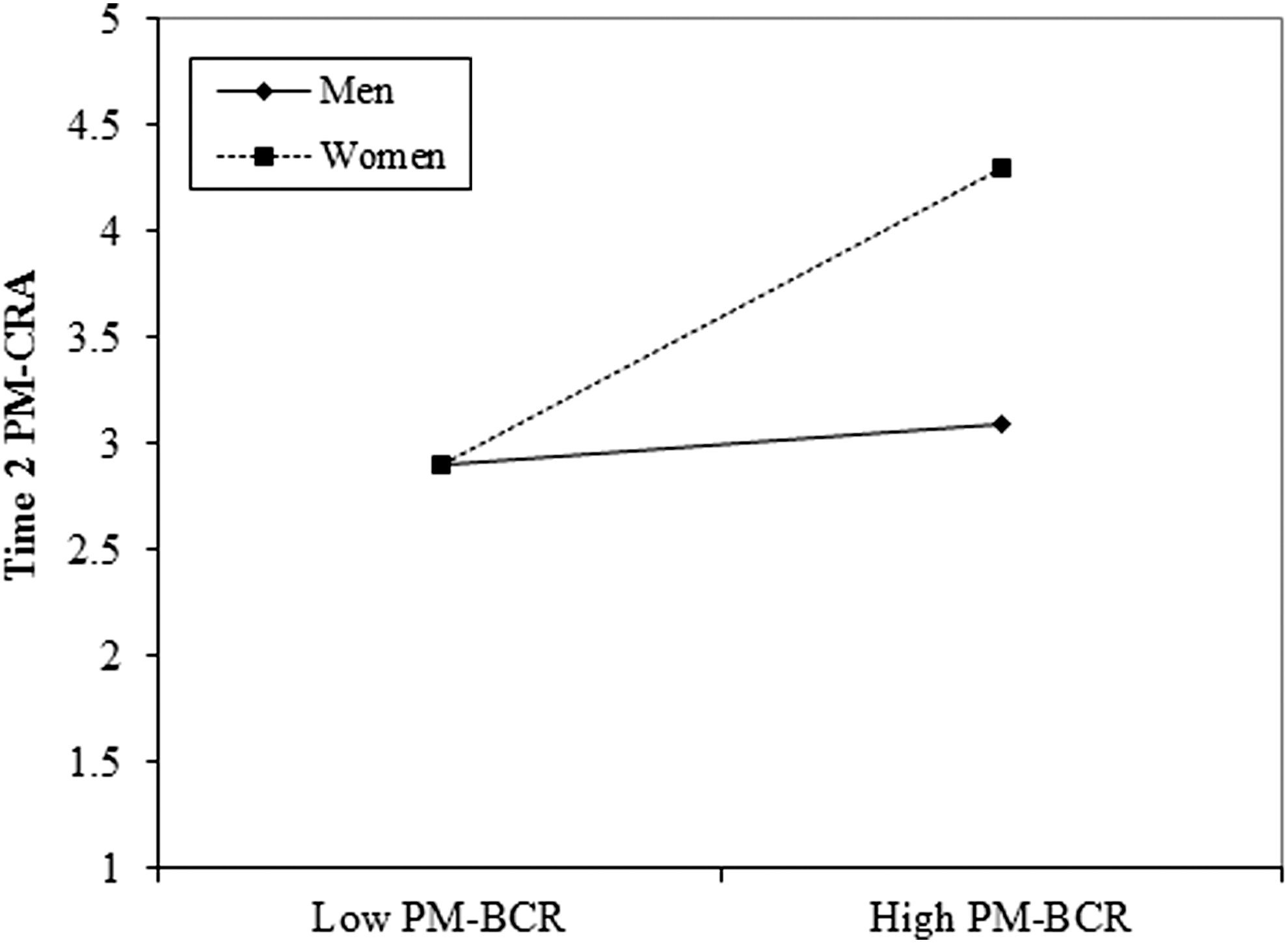
Graphical representation of the interaction. PM-BCR, popularity-motivated behaviors, characteristics, and relationships in cyberspace; PM-CRA, popularity-motivated relational aggression.
Discussion
This study aimed to answer the following research question: What moderating effect, if any, does gender have on the association between adolescents' perceptions of popularity-motivated behaviors, characteristics, and relationships and their popularity-motivated cyber aggression 1 year later, while controlling for popularity-motivated aggression? Results from this study indicated that gender moderated the relationship between these variables. These findings increase our knowledge concerning adolescents' perceptions of how cyberspace might help advance and/or maintain their social standing among their peers and how such perceptions are associated with their cyber aggression perpetration 1 year later.
The association between perceptions of popularity-motivated behaviors, characteristics, and relationships in cyberspace and popularity-motivated cyber relational aggression 1 year later was stronger among girls, while such an association was not found for boys. These findings are aligned with research conducted by Closson 16 concerning gender differences in adolescents' descriptions of what it means to be popular. In particular, girls usually associate popularity with wearing nice clothes, being attractive, mean, snobby, rude, and sociable. The popularity-motivated behaviors, characteristics, and relationships questionnaire focused specifically on sociability by including the following items: having popular peers as friends on social networking websites, being friends with a variety of people on social networking websites, and leaving various comments on peers' social networking websites. The questionnaire also reflected the belief that popularity in cyberspace meant looking attractive in one's picture posted online. The descriptions assessed by this questionnaire might have resonated more with girls regarding their perceptions of popularity-motivated behaviors, characteristics, and relationships in cyberspace. Additional attention should be given to developing this questionnaire to include descriptions that might apply to boys as well. For example, sample items might ask adolescents whether being funny online or posting pictures of engaging in sports are considered online activities that might promote popularity among one's peers. These items might provide a better representation of factors boys consider as promoting and/or maintaining one's popularity in cyberspace. It could also allow researchers to explore differential associations in these popularity descriptions on cyber aggression perpetration among adolescent girls and boys.
Girls' popularity is linked more to face-to-face relational aggression when compared to boys' popularity,3,4 and they are generally more likely to engage in face-to-face relational aggression.17–19 Consequently, girls' beliefs about popularity-motivated behaviors, characteristics, and relationships might more strongly relate to their relational aggression. Although support for this proposal has not been examined regarding face-to-face relational aggression, there is evidence from this study that such associations are found concerning cyber relational aggression. A unique contribution of this study was the investigation of popularity-motivated cyber relational aggression, a type of proactive relationally aggression in which the adolescent engages in these behaviors with the motivation to improve and/or maintain one's social standing in the peer group. Gender differences in cyber aggression perpetration are often mixed, with some studies reporting girls being more likely to be perpetrators, other studies indicating that boys are, and yet a handful of studies find no gender differences.25–30 It might be likely that considering the motivational context of cyber aggression perpetration could provide a better understanding of how gender might impact these behaviors. Only a handful of studies have been published on instrumental forms of cyber aggression. In their study, Shapka and Law 31 found that East Asian adolescents from Canada were more motivated to engage in cyber aggression for proactive reasons, whereas Canadian adolescents of European descent were more likely to perpetrate these behaviors for reactive reasons. These findings were much more pronounced for East Asian boys when compared to East Asian girls. A potential explanation for the differences found for gender between this study and Shapka and Law's 31 study might be the different samples and the investigation specifically of popularity-motivated cyber relational aggression, while Shapka and Law focused on general reactive cyber aggression.
Limitations and future directions
This study is among a handful of studies focusing on how adolescents' perceptions of various behaviors, characteristics, and relationships in cyberspace relate to their engagement in popularity-motivated cyber relational aggression over 1 year, while controlling for previous levels of popularity-motivated face-to-face and cyber relational aggression. Exploring how electronic technologies can enhance adolescents' social standing among their peer group is important as they frequently utilize these technologies and such technologies are particularly significant to them. Follow-up research should continue to expand on how utilizing electronic technologies might be used to enhance adolescents' social standing. This research should also account for differences in what boys and girls consider as contributing to their popularity by further developing the popularity-motivated behaviors, characteristics, and relationships in cyberspace questionnaire. Furthermore, such research is important because the technology that adolescents use and their behaviors can change abruptly.
Despite such promising research, there are a few limitations and recommendations that should be noted to advance our knowledge of adolescents' popularity-related behaviors, characteristics, and relationships in cyberspace. Thus far, research12,13,15 on this topic has utilized quantitative research designs. Follow-up research should use interviews and focus groups to understand more about adolescents' perceptions of the behaviors, characteristics, and relationships in cyberspace, and how adolescents believe these factors contribute to their popularity among their peer group. Such research might also be valuable for providing additional knowledge to the field of cyberpsychology on adolescents' popularity-motivated cyber behaviors and the circumstances under which adolescents will engage in such behaviors. It is also unclear whether certain behaviors, characteristics, and relationships in cyberspace might be contributors to peer rejection and unpopularity among one's peers. Research should also be conducted on what factors in cyberspace might relate to rejection by adolescents' peers.
Except for Wright's 12 study, previous research13,15 on popularity and cyber aggression have utilized cross-sectional research designs. Wright's 12 research focused on the connection between popularity and cyber aggression over 6 months. This study examined popularity-motivated behaviors, characteristics, and relationships in cyberspace over 1 year, from seventh to eighth grade. Despite such strength of this research, it is not possible to draw conclusions regarding the temporal ordering of these associations. Consequently, follow-up research should be conducted to better understand the nature and extent of the associations investigated in this study. This research might also help provide more knowledge on whether popularity-motivated behaviors, characteristics, and relationships in cybersepace increase adolescents' social standing in the future. Furthermore, follow-up research should focus on adolescents' social goals and whether these goals align with adolescents' perceptions of popularity-motivated behaviors, characteristics, and relationships over time. Another aim of future research should be to consider whether the associations examined in this study differ in other cultures, as many cultures have different norms than those in the United States.
Conclusion
This research provided an initial examination focused on understanding adolescents' perceptions of how cyberspace could be used to boost or maintain their social standing among their peers at school. Adolescents will continue to embrace electronic technologies, potentially increasing their daily use. Researchers are beginning to recognize the important role of electronic technologies in adolescents' lives, especially their peer relationships. Adolescents keep in contact with their friends through various electronic technologies and it is reasonable to believe that they might also utilize these technologies to promote their peer status. Furthermore, these findings also underscore the importance of designing prevention and intervention programs aimed at diminishing adolescents' beliefs about cyberspace being used to promote one's social standing through engaging in harmful and hurtful behaviors.
Footnotes
Author Disclosure Statement
No competing financial interests exist.