




Abstract
Abstract
Little attention has been given to adolescents' experience of cyberstalking and how such experiences relate to their depression and academic performance. It is less clear how other variables, such as perceived social support, might impact these associations. Addressing these gaps in the literature, this study investigated the potential moderating effect of perceived social support from parents on the association between cyberstalking victimization and depression and academic performance, each assessed 1 year later, from 11th to 12th grade. Participants were 413 adolescents (ages 17–19 years old; 54 percent female; M = 17.39 years, SD = 0.53) in the 12th grade from a Midwestern city in the United States. They completed questionnaires on their self-reported face-to-face and cyberstalking victimization, depression, and perceived social support from parents. Adolescents' academic performance was also assessed using their school records. During the 12th grade, depression and academic performance were examined again. The findings indicated that the association between cyberstalking victimization and Time 2 depression was much more positive at lower levels of perceived social support, while such an association was more negative at higher levels of perceived social support. Opposite patterns were found for Time 2 academic performance. The results indicate the need for additional research focused on cyberstalking about adolescents.
Introduction
S
Little is known about cyberstalking victimization among adolescents, particularly youths in high school. Such a focus is important as high school victims of cyberstalking are at risk of experiencing cyberstalking in college. 11 In a review of the literature on face-to-face stalking among adolescents, Roberts et al. 12 identified three peer-reviewed studies of stalking. Rates of face-to-face stalking victimization are currently unknown, although stalking perpetration was about five percent in Fisher et al.'s 13 study. Based on these few studies, adolescents are at risk for cyberstalking.
Cyberstalking victimization is associated with a variety of negative psychological consequences, including suicidal ideation, posttraumatic stress disorder, and depression.14,15 Victims also report more fear and anger and have poorer well-being than uninvolved individuals. 16 It is unknown whether cyberstalking victimization relates to academic difficulties. In the literature on cyberbullying, academic difficulties are often reported by cyberbullying victims.17,18 Similar patterns might be expected for cyberstalking victims because research indicates that cyberbullying and cyberstalking victimization are correlated.11,19
An underresearched area in the cyberstalking victimization literature is the role of social support in mitigating the negative effects associated with this experience. Focusing on social support might help to understand factors that mitigate the negative outcomes of cyberstalking victimization. Social support is defined as the knowledge that someone is cared for, respected, and is part of a social network of people who are concerned with one's safety.20–22 Receiving support during a negative event has positive effects, such as increasing feelings of security and self-worth. Parents often serve as social support for their children, diminishing the risk of bullying.23–25 Thus far, no research has focused on the association between social support and cyberstalking victimization. In the cyberbullying victimization literature, some research has focused on social support as buffering against the negative consequences associated with this form of vicitmization.25,26–29 Adolescents with high levels of social support report lower levels of cyberbullying victimization, with the strongest associations found for parental support. 27 Furthermore, Wright 25 found that perceived parental support lessened the effects of cyberbullying victimization on adolescents' substance use. Given that perceived parental support reduces the negative consequences associated with cyberbullying victimization, followup research examining these relationships for cyberstalking victimization is warranted.
This Study
The purpose of this study was to examine the moderating effect of perceived parental social support on the associations between cyberstalking victimization and depression and academic performance, both assessed 1 year later, among high school students, while controlling for face-to-face stalking victimization and previous levels of depression and academic performance. It is important to account for adolescents' face-to-face stalking victimization because it is correlated with cyberstalking victimization.11,30,31 There were four hypotheses investigated in this research:
(1) Cyberstalking victimization will relate positively to Time 2 depression and negatively to perceived parental social support and Time 2 academic performance. (2) Perceived parental social support will relate negatively to Time 2 depression and positively to Time 2 academic performance. (3) The association between cyberstalking victimization and Time 2 depression will be more positive at lower levels of parental social support, while such associations will be more negative at higher levels of parental social support. (4) The association between cyberstalking victimization and Time 2 academic performance will be more negative at lower levels of parental social support, while such associations will be more positive at higher levels of parent social support.
Methods
Participants
Participants were 413 adolescents (M age = 17.39 years; SD = 0.53; age ranges from 17 to 19 years; 54 percent female) in the 12th grade from a Midwestern city in the United States. Most participants self-identified as Caucasian (61 percent), Latino/a (28 percent), Black/African American/Caribbean (9 percent), Asian (1 percent), and biracial (1 percent).
Procedure
After receiving Institutional Review Board ethical approval from the university to conduct the study, five high schools were chosen at random from a list of 85 high schools by using an online dice rolling program. Recruitment e-mails were sent to school principals. Two school principals expressed their desire to have their students participate in the study. Classroom announcements were made to adolescents' homerooms and parental permission slips were distributed to all students, except those who were already 18 years old (n = 28). These students were given an adult consent document and informed that if they wanted to participate, then they would receive the document again on the day of data collection. Any questions that adolescents had during the classroom announcements were also answered. There were ∼503 parental permission slips passed out, along with 28 adult consent documents for students who were already 18 years old. Of these parental permission slip, 444 were returned to adolescents' homeroom teachers. Ten parents did not provide their child with permission and the rest of the parental permission slips (n = 59) were unreturned. Twenty 18-year-old participants provided their consent on the day of data collection. The total sample at Time 1, during the fall of 11th grade, was 454. Participants completed assent first and then questionnaires on their demographic information (e.g., gender, age, and ethnicity), self-reported face-to-face and cyberstalking victimization, depression, and perceived parental social support. On the parental permission slips and adult consent documents, parents and nonminor adolescents were asked if they agreed to have the study's personnel access school records at the end of 11th and 12th grade.
At Time 2, during the fall of 12th grade, a reminder letter was given to adolescents. Those adolescents who were under the age of 18 brought the reminder letter home to their parents/guardians. If parents/guardians did not want their child to participate, they were asked to write their child's name on the letter and return it to their child's homeroom teacher. Six parents opted their child out of the study at Time 2. Fifteen adolescents had moved away at Time 2 and 20 were unavailable during the 2 days of data collection. This resulted in 41 students not participating in the study at Time 2. The final sample size was a total of 413 participants at Time 2. At Time 2, adolescents completed questionnaires on depression. Academic performance was also assessed during 12th grade. Comparisons were made between participants who completed the questionnaires at Time 1 only and those who completed both Time 1 and Time 2 on all Time 1 measures. No differences were found between both groups.
Measures
Time 1 self-reported face-to-face stalking victimization
Adolescents were instructed to think about instances in which someone pursued them to start or continue a relationship that was not wanted within the past 12 months. The items used for this questionnaire were compiled from various studies on stalking.13,14 Some samples items include the following: Follows you around, Watches you, Gets too close to you physically or touching you even when you do not want to be touched, Invades your personal property/space, and Spreads false rumors about you. These items were rated on a scale of 1 (never) to 5 (all of the time). Items were averaged to form a final score of Time 1 self-reported face-to-face stalking victimization, with a Cronbach's alpha of 0.90.
Time 1 self-reported cyberstalking victimization
This questionnaire was like the self-reported face-to-face stalking victimization questionnaire, except that in the directions, adolescents were asked about how often the following happened to them within the past 12 months through digital technologies, including cell phones for text messages and the Internet. There were seven items for this questionnaire, each rated on a scale of 1 (never) to 5 (all of the time). Sample items include the following: “Sends you unwanted text messages or instant messages,” “Tries to be friends with your friends online or through text messages,” “Tries to get to know your family online or through text messages without your permission,” “Posts on the same Web sites, blogs, or social networking pages as you (while making it obvious that he/she is posting there), although he/she has not posted there before you started using the Web site, blog, or social networking page,” and “Spreads false rumors about you online or through text messages.” Items were averaged to form a final score of Time 1 self-reported cyberstalking victimization, with a Cronbach's alpha of 0.84.
Time 1 perceived parental support
This questionnaire assessed adolescents' perceived parental social support. The parent subscale from The Child and Adolescent Social Support Scale was used. 32 There were 12 items included from this subscale, which were rated on a scale of 1 (never) to 6 (always). A sample item includes the following: My parent(s) show they are proud of me. All items were averaged to form a final score for perceived parental support. This questionnaire was administered at Time 1 only. Cronbach's alpha was 0.86.
Depression
Depression was assessed using The Center for Epidemiological Studies Depression Scale. 33 This questionnaire included 20 items, which were rated on a scale of 0 (rarely or none of the time) to 3 (most or all of the time). Sample items included the following: I was bothered by things that usually do not bother me and I did not feel like eating; my appetite was poor. All items were averaged to form final scores on depression at Time 1 and Time 2, and had acceptable Cronbach's alphas (α = 0.84 for Time 1; α = 0.80 for Time 2).
Academic performance
Report card grades were requested to assess adolescents' grade point averages (GPAs) in reading, math, science, and social studies at Time 1 and Time 2. GPAs from each subject area were averaged to form a final score for GPA. GPAs for each class ranged from 0.00 (F) to 4.00 (A+). Higher scores on GPA indicated an overall better academic performance. GPAs were assessed at the end of 11th grade (α = 0.91) and at the end of 12th grade (α = 0.89).
Analytic plan
Before examining the study's hypotheses, correlations were conducted among all variables (Table 1). The measurement model was examined using confirmatory factor analysis in Mplus 7.4. The model fit was adequate (x 2 = 989.13, df = 689, p < 0.001, comparative fit index [CFI] = 0.99, Tucker-Lewis index [TLI] = 0.98, root-mean-squared error of approximation [RMSEA] = 0.03, standardized root mean of the residual [SRMR] = 0.04; see Fig. 1) and all standardized factor loadings were significant (p's < 0.001). Items were used as indicators of the latent variables in the structural regression model. A structural regression model was conducted to model the associations of cyberstalking victimization to perceived parental support and Time 2 depression and Time 2 academic performance. Paths were added from cyberstalking victimization to perceived parental social support, from perceived parental social support to Time 2 depression and Time 2 academic performance, and from cyberstalking victimization to Time 2 depression and Time 2 academic performance. Moderation effects were also included between cyberstalking victimization and perceived parental social support for Time 2 depression and Time 2 academic performance. Face-to-face stalking victimization, Time 1 depression, and Time 2 academic performance were also included as covariates. Face-to-face stalking was allowed to predict cyberstalking victimization, Time 1 depression was allowed to predict Time 2 depression, and Time 1 academic performance was allowed to predict Time 2 academic performance. Significant interactions were probed using the Interaction program, which provides a graphical representation of the interaction and values of the sample slopes.

Structural regression model of the moderation of perceived social support from parents in the associations between Time 1 cyberstalking victimization and Time 2 depression and Time 2 academic performance. Moderation terms and covariates were omitted to facilitate reading of the figure. The interaction term for the interaction between Time 1 cyberstalking victimization and Time 1 perceived social support from parents was β = 0.03, p < 0.05 for Time 2 depression and β = 0.04, p < 0.05 for Time 2 academic performance. Disturbance correlations were also omitted to facilitate reading. The covariate of Time 1 face-to-face stalking victimization was related positively to Time 1 cyberstalking victimization, β = 0.26, p < 0.01. Time 1 depression was related positively to Time 2 depression, β = 0.29, p < 0.001. Time 1 academic performance was related positively to Time 2 academic performance, β = 0.32, p < 0.001. *p < 0.05; **p < 0.01.
p < 0.05, **p < 0.01, ***p < 0.001.
T1, Time 1; T2, Time 2.
Results
Concerning the correlations, face-to-face stalking victimization was related positively to cyberstalking victimization and Time 1 and Time 2 depression, while it was associated negatively with perceived parental social support. In addition, cyberstalking victimization was related positively to Time 1 and Time 2 depression and negatively to perceived parental social support and Time 2 academic performance, although it was not associated with Time 1 academic performance. Perceived parental social support was related positively to Time 1 and Time 2 academic performance, but it was associated negatively with Time 1 and Time 2 depression. Time 1 depression was related negatively to Time 1 academic performance and positively to Time 2 depression. Time 1 depression was not associated with Time 2 academic performance.
For the structural regression model, the model demonstrated adequate fit, x 2 = 1013.24, df = 729, p < 0.001, CFI = 0.98, TLI = 98, RMSEA = 0.04, SRMR = 0.04. Cyberstalking was related positively to Time 2 depression, while it was associated negatively with perceived parental social support and Time 2 academic performance. Perceived parental social support was related positively to Time 2 academic performance and negatively to Time 2 depression. Furthermore, perceived parental social support moderated the association between cyberstalking victimization and Time 2 depression, and between cyberstalking victimization and Time 2 academic performance. Probing the interaction further revealed that the association between cyberstalking victimization and Time 2 depression was more positive at lower levels of perceived parental social support (Fig. 2). On the other hand, such an association was more negative at higher levels of perceived parental social support. Opposite patterns were found for Time 2 academic performance such that the relationships were more negative at lower levels of perceived parental social support (Fig. 3).
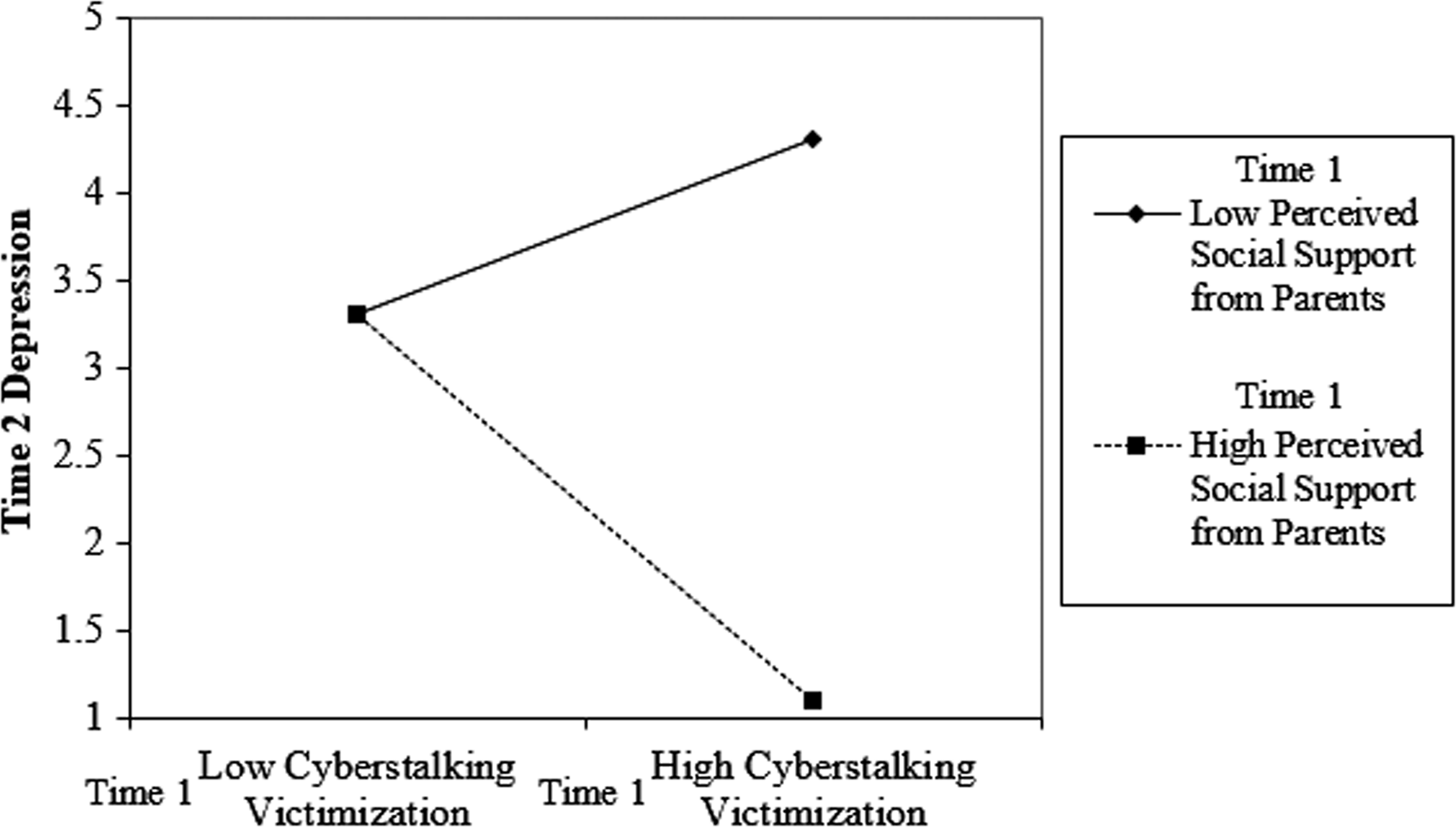
Graphical representation of the interaction between Time 1 cyberstalking victimization and perceived social support from parents for Time 2 depression.
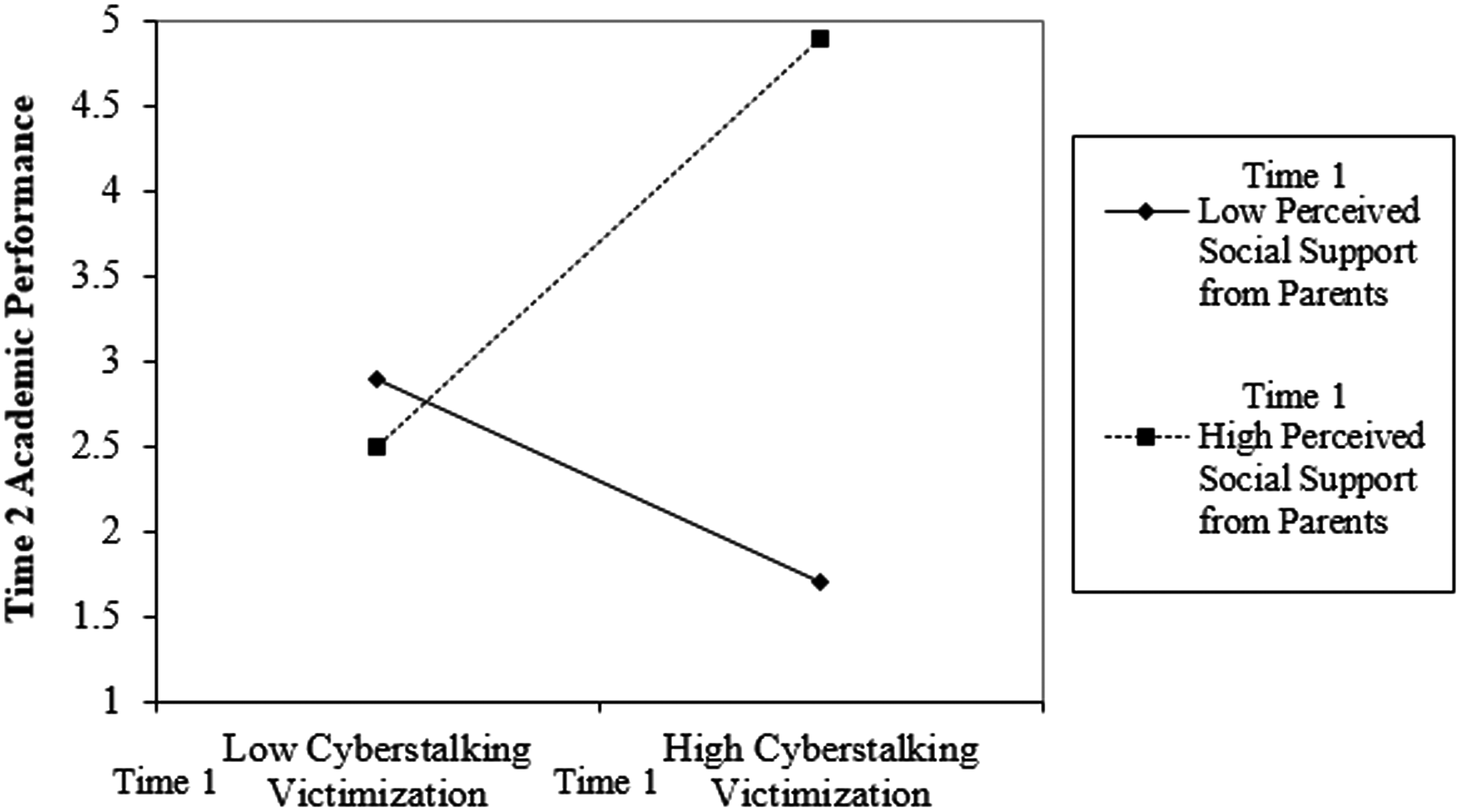
Graphical representation of the interaction between Time 1 cyberstalking victimization and Time 1 perceived social support from parents for Time 2 academic performance.
Discussion
The purpose of this 1-year longitudinal study was to examine the potential buffering effect of perceived parental social support in the associations between cyberstalking victimization and depression and academic performance, assessed over 1 year, among adolescents in high school. Findings from this research contribute to a growing literature focused on investigating cyberstalking victimization among adolescents and how perceived parental social support might buffer against the negative effects associated with this form of victimization.
Cyberstalking victimization was associated positively with Time 2 depression and negatively with Time 1 academic performance, providing support for Hypothesis 1. The findings concerning cyberstalking and Time 2 depression are aligned with previous research on this topic. 15 It is difficult to reconcile the current findings on cyberstalking and academic difficulties with the literature as there is no research conducted on the associations between these variables, although research on this topic concerning cyberbullying victimization indicates that these victims are at risk for academic difficulties.17,18 Because cyberstalking victims report poorer well-being than uninvolved individuals, it might be likely that their concentration is diminished, reducing their ability to perform well at school. 16
Providing additional support for Hypothesis 1, cyberstalking victimization was associated negatively with perceived parental social support. Parents serve an important role in their children's lives, providing support, advice, and guidance.21,25,29,34 When parents are there for their children, they might also be more likely to discuss the possible risks that their children might encounter. Research evidence indicates that parents discuss their children's potential exposure to unpleasant and problematic online situations.35–37 Parents might provide solutions and more mature conceptualizations of what behaviors are considered stalking. Adolescents who have frequent conversations with their parents might discuss what is going on in their lives. Such conversations make adolescents feel supported, even if they do not experience cyberstalking or other risks. Just perceiving that one's parents are there can help reduce adolescents' risk of negative experiences. 25 Although no previous research has been conducted on cyberstalking and perceived parental social support, similar patterns from research on cyberbullying victimization might apply to cyberstalking and perceived parental social support.
Perceived parental social support was related negatively to Time 2 depression and positively to Time 2 academic performance, providing support for Hypothesis 2. Ample research evidence supports the negative correlation between perceived social support and depression. 38 ,39 Social support functions as a network of individuals that adolescents can turn to when they experience negative situations. Such support helps adolescents deal with negative events and has the potential to reduce the negative effects of the events.21,25,29,34
Hypotheses 3 and 4 were also supported. The association between cyberstalking victimization and Time 2 depression was more positive at lower levels of parental social support, while such associations were more negative at higher levels of parental social support (Hypothesis 3). In addition, the association between cyberstalking victimization and Time 2 academic performance was more negative at lower levels of parental social support and more positive at higher levels of parental social support (Hypothesis 4). Due to a lack of research on this topic, it is difficult to determine how these findings align with previous research. Because social support can buffer against depressive symptoms, it is possible that its effect extends to cyberstalking victimization as well.21,25,29,34 High-quality social support helps adolescents feel more confident when dealing with negative events, like cyberstalking. By feeling more confident in these situations, adolescents might turn to effective coping strategies, which reduce their risk of experiencing depression. Poor social support might lead adolescents to choose poor coping strategies, making them more vulnerable to depressive symptoms.
Implications
Within the broader literature, the findings from this study indicate the importance of considering how social support might buffer against the negative consequences associated with cyberstalking victimization, particularly depression and academic performance difficulties. Furthermore, these results also highlight the longitudinal associations among these variables. These findings fit well within the literature attempting to determine the academic and adjustment difficulties associated with cyberstalking victimization among adolescents, and how perceived social support might have a protective role in mitigating these effects. These results have implications for schools and parents. Schools might use this information to teach adolescents about the behaviors associated with cyberstalking victimization and the consequences of this form of victimization in health classes or other courses. Parents can also use this information as an opportunity to talk to their children about the negative consequences of cyberstalking victimization.
Limitations
This study employed a 1-year longitudinal design, with two waves of data collection. Because of this design, it is difficult to understand the temporal ordering of variables examined in this study. Future research should employ longer term designs, incorporating more waves of data collection to better understand the potential of perceived social support to buffer against the negative consequences associated with cyberstalking. The cyberstalking questionnaire was worded to be more general versus referencing cyberstalking perpetrated by different people in adolescents' lives. Followup research should be conducted, which examines whether the specific relationship between the victim and perpetrator might impact perceived social support, depression, and academic performance. Given that this research was preliminary and research on cyberstalking victimization-perceived social support is lacking, parental social support was examined as much of the empirical support for the mitigating effects of social support is found with parents. However, perceived social support should also be expanded to include peers, who are highly valued during adolescence. The self-reported cyberstalking victimization measure was created using items from various face-to-face stalking victimization measures.13,14 Additional research should be conducted to test the reliability and validity of the self-reported cyberstalking victimization measure.
Conclusions
This study investigated the role-perceived parental support in the relationships between cyberstalking victimization and depression and academic performance among adolescents. These associations were assessed over 1 year. Findings from this study underscore the importance of considering the role of social support in helping to mitigate the negative effects associated with cyberstalking victimization.
Footnotes
Author Disclosure Statement
No competing financial interests exist.