




Abstract
Abstract
Commercially available virtual reality (VR) exercise systems are extensively used in many health domains among clinical populations. However, evidence regarding the efficacy of this technology on healthy adults' health-related outcomes is unknown. This pilot study compared physiological and psychological responses following exercise on a VR-based exercise bike (VirZoom) and traditional stationary exercise bike. Twelve healthy college students (9 females; Mage = 25.01, SD = ± 4.74; MBMI = 22.84, SD = ± 3.68) completed two separate 20-minute exercise sessions on the VR-based exercise bike and traditional stationary exercise bike. Blood pressure (BP), ratings of perceived exertion, self-efficacy, and enjoyment were assessed as primary outcomes. Dependent t-tests indicated no significant differences in mean systolic or diastolic BP changes from pre to postexercise between the VR-based exercise and traditional stationary biking sessions (all p > 0.05). Notably, participants reported significantly higher ratings of perceived exertion (p < 0.05, Cohen's d = 0.68) during the traditional exercise biking session compared with VR-based exercise biking session. However, participants had significantly higher self-efficacy (p < 0.05, Cohen's d = −0.83) and enjoyment (p < 0.05, Cohen's d = −0.89) during the VR-based exercise biking session compared with traditional stationary biking. The commercially available VR-based exercise bike (VirZoom) may be considered an effective, enjoyable, and motivating physical activity tool. Further interventions with larger and more diverse samples and examinations of more health-related outcomes are warranted to determine optimal application of VR-based exercise programming among various populations.
Introduction
D
VR applications are currently in development and used for a variety of clinically based applications—primarily rehabilitation medicine and behavioral medicine.2–4 Yet, VR technology has seen less use and investigation as a PA and health promotion tool among healthy populations. Notably, with the development of commercially available VR exercise apparatus, such as the VirZoom, a VR-based exercise bike compatible with most VR headsets, the potential of VR technology to aid in promoting health is great. Therefore, we conducted a pilot study investigating the efficacy of the VirZoom VR exercise bike on physiological and psychological outcomes compared with a traditional stationary exercise bike in healthy young adults.
Materials and Methods
Participants
A convenience sample of 12 healthy college students (9 females, Mage = 25.01, SD = ± 4.74; MBMI = 22.84, SD = ± 3.68) were recruited from an urban public University in the Midwest region of the U.S. Complete participant demographic characteristics are available in Table 1. Informed Consent and University Institutional Review Board approval was obtained before data collection.
Data are presented as mean ± standard deviation.
VR, virtual reality.
Procedures
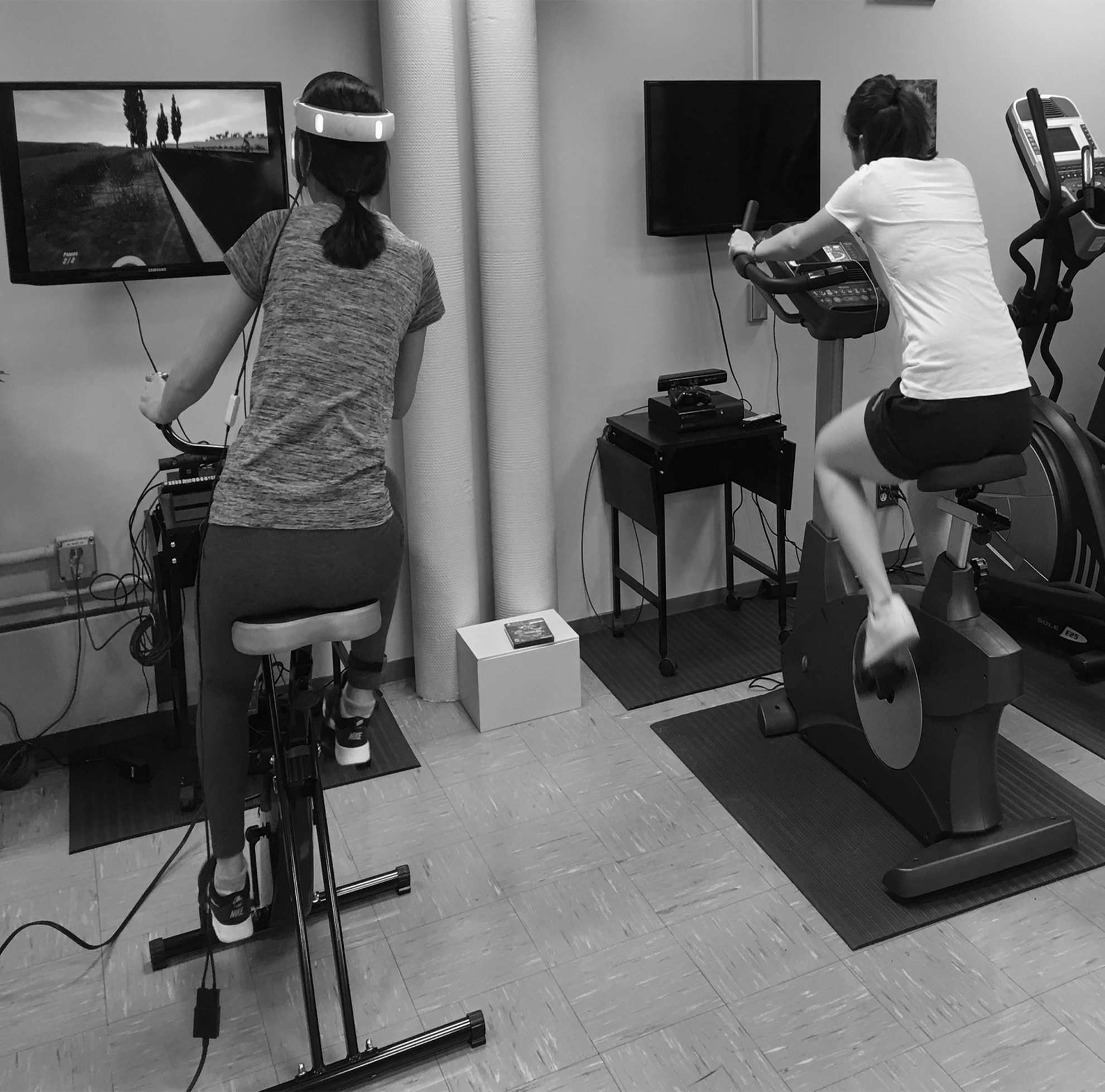
Participants completed two 20-minute exercise sessions—one on the VirZoom VR exercise bike and the other on a traditional stationary exercise bike—in a randomly allocated order. The VirZoom VR exercise bike (Fig. 1) is equipped with integrated sensors, which sync with a computer or gaming console, allowing the players to control their actions during VR gameplay. When paired with a VR headset (e.g., PlayStation VR), players can download the VirZoom Arcade Game and play the game by pedaling and steering their game character by leaning their body to the left and right. 5 The VirZoom Arcade Game includes several different minigames such as: “Race Car” (Fig. 2), which requires players to race other virtual racecars around a track at high speeds and “Le Tour” (Fig. 3), which requires players to race other virtual cyclists through a series of timing gates located on a scenic mountain road. These two games were used in this study as they were observed to be the most intense PA. Pedaling resistance was set at the same moderate-intensity level for all participants during VR gameplay.
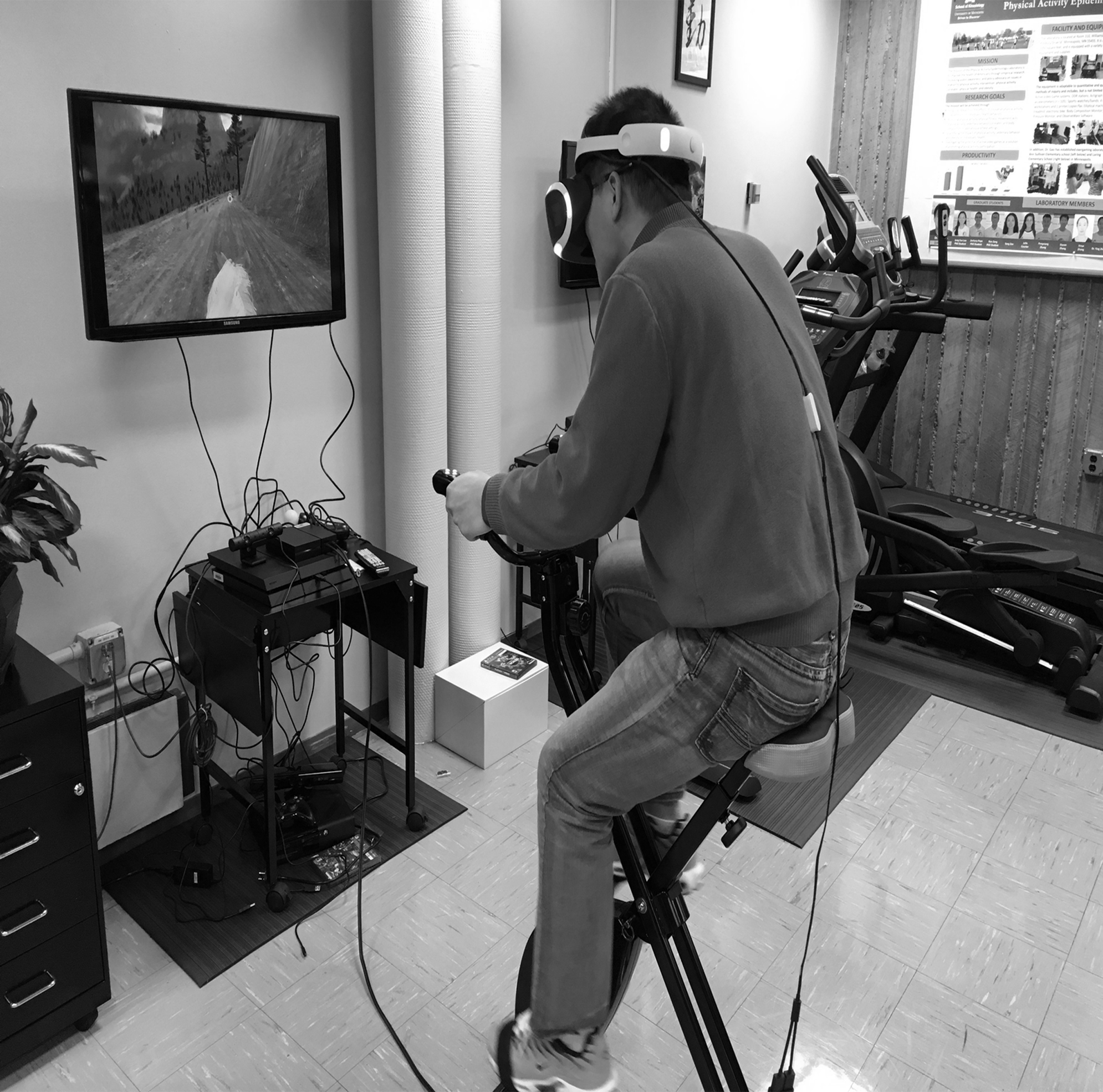
VirZoom VR exercise bike. VR, virtual reality.

Race Car.
Le Tour.
A Sprit Fitness XBU55 (Spirit Fitness, Jonesboro, AR) was used during the traditional stationary bike exercise session. Participants were required to keep their heart rate assessed through the bike's built-in heart rate monitor, between 65% and 85% of age-predicted maximum heart rate. Researchers monitored the participants during the exercise session, adjusting the bike's resistance to ensure participants stayed within the target heart rate zones. Notably, to create a comparable exercise environment and reduce the impact on environment due to different exercise conditions, participants were allowed to either listen to music or watch videos using their own phones or iPads during the stationary bike exercise.
Outcome measures
Participants' VR experience was measured before testing through a dichotomous survey question asking, “Have you played VR exercise games before?” If the participant responded “Yes,” then she/he was asked to answer, “How good are you at playing the VR exercise games?” on a 5-point Likert-type scale (1: not good at all to 5: very good).
Blood pressure
Blood pressure (BP) was recorded before and following the two exercise sessions, through occlusion of the brachial artery by an automatic Omron HEM-705CP Automatic BP Cuff (Omron Healthcare, Lake Forest, IL). All participants had a 10-minute rest in the seated position between each exercise session to allow BP to return to baseline levels.
Rating of perceived exertion
Participants provided an assessment of their subjective exercise intensity every 4 minutes during each 20-minute exercise session. Rating of perceived exertion (RPE) measurements were completed on the Borg Scale with six representing no exertion and 20 representing maximal exertion. 6
Self-efficacy
Participants responded to a three-item self-efficacy survey 7 after each exercise session using a 5-point Likert-type scale (1: strongly disagree to 5: strongly agree), with the item “With regard to the [VR exercise bike or traditional stationary exercise bike], I have confidence in.…” The answers were: (a) my ability to do well in this activity; (b) my ability to learn skills well in this activity; and (c) my performance in this activity. The item mean was calculated and used as a measure of participants' respective self-efficacy toward the two types of exercise.
Enjoyment
Participants responded to a five-item enjoyment survey 8 after each exercise session using a 5-point Likert-type scale identical to that of self-efficacy (1: strongly disagree to 5: strongly agree). The five items were: (a) I have more fun playing this activity than doing other things; (b) Playing this activity is the thing I like to do best; (c) I wish I could play this activity more than I get chance to; (d) I usually prefer to watch rather than play this activity; and (e) I really like playing this activity. Item “d” was first reverse coded, then the mean of items was calculated as a measure of participants' perceived enjoyment toward the two types of exercise.
Data analyses
Using IBM-SPSS 22.0 (IBM, Inc., Armonk, NY), descriptive statistics were calculated after which dependent t-tests evaluated differences in mean systolic and diastolic BP changes from pre to postexercise, and differences in mean for RPE, self-efficacy, and enjoyment between the two exercise sessions for each participant. The significance level was set at 0.05. Finally, Cohen's d was determined using the G*Power program, 9 which uses the standard effect size definition on the basis of mean and standard deviations of difference scores—regardless of whether the statistic employed is parametric or nonparametric. An effect size of 0.2 was considered small, 0.5 medium, and 0.8 large. 9
Results
All participants completed two exercise sessions. Table 2 provides mean, standard deviations, and Cohen's d for all outcomes. Dependent t-tests indicated no significant differences in systolic or diastolic BP changes from pre to postexercise between two exercise sessions (all p > 0.05). Notably, participants reported significantly higher RPE (p < 0.05, Cohen's d = 0.68) during traditional stationary biking sessions compared with VR-based biking session. However, participants had significantly higher self-efficacy (p < 0.05, Cohen's d = −0.83) and enjoyment (p < 0.05, Cohen's d = −0.89) during the VR-based biking exercise compared with traditional stationary biking exercise.
*p < 0.05.
DBPC, diastolic blood pressure change (calculated by diastolic _after–diastolic _ before); RPE, rating of perceived exertion; SBPC, systolic blood pressure change (calculated by systolic_after–systolic_ before); SD, standard deviation; TB, traditional bike; VRB, virtual reality bike.
Discussion
To date, the potential of VR in PA and health promotion has seen some application, with improved motor functioning and rehabilitative outcomes observed among clinical populations.10–12 Yet, few studies have been conducted using VR-based exercise systems to promote PA and health among healthy populations. To our knowledge, this is the first study investigating the feasibility and effectiveness of a commercially available VR exercise system on college students' physiological and psychological outcomes. Significant differences between two exercise sessions were noted for some primary outcome measures, with medium to large effect sizes observed. Specifically, findings demonstrated the feasibility of using a VR-based exercise bike to improve participants' PA self-efficacy and enjoyment. Notably, despite similar BP change trends, participants who performed VR-based biking exercise reported lower RPE levels than observed during traditional stationary biking exercise.
Enjoyment has been found to be an important PA determinant and, when increased, can promote increased PA participation.13,14 Additionally, the reciprocal relationship between PA and self-efficacy has been documented, with higher self-efficacy for PA found to increase PA participation as well. 15 Therefore, researchers must consider enjoyment and self-efficacy when designing exercise programs to promote PA. Fortunately, VR-based systems have been proven to increase patients' PA enjoyment and self-efficacy during exercise.16–20 However, most of these studies have only used researcher-developed VR apparatus, with the investigation of commercially available VR exercise systems and apparatus scarce to nonexistent. The current study used a commercially available VR exercise system (i.e., PlayStation 4 VirZoom Arcade Game) and apparatus (i.e., VirZoom VR exercise bike), which resulted in participants' greater PA enjoyment and higher self-efficacy after participating in VR-based biking as compared with traditional stationary biking exercise. Not only are these findings congruent with aforementioned clinical studies, but the findings are also novel in that the VR system and apparatus were not research developed and are commercially available to any health-conscious consumer. Thus, the findings provide noteworthy evidence that a commercially available VR system and apparatus might be used to reach a broader population of individuals to promote improvements in important psychological determinants, indicating its potential in producing sustainable PA behavior change.
As increased BP during exercise is important to good health, proving that this novel VR-based biking apparatus stimulates a similar physiological response compared with traditional stationary biking exercise is vital in exploring a body of evidence regarding the feasibility of using this type of VR apparatus for health promotion. It is not surprising that no significantly different BP changes were observed between the two exercise modalities as both sessions placed pedaling resistance at a level necessary to promote moderate-intensity PA. However, participants still reported significantly lower RPE during VR-based biking exercise. This key finding could be attributed to the unique characteristics of the VirZoom VR exercise bike. Notably, the VirZoom VR exercise bike and associated VirZoom Arcade Game are the first commercially available VR bike and game specifically designed to require pedaling to participate in immersive VR gameplay 5 —games designed with the player's enjoyment as a desired outcome. The VirZoom Arcade Game provided several games of varying intensity and time—all of which were engaging and enjoyable for the player. While the two most intense games were chosen for this pilot study, it is promising that the requirement of pedaling the VirZoom VR exercise bike during gameplay elicited similar BP changes from pre to postexercise as traditional stationary exercise biking, but with participants perceiving lower RPE. As no participant had prior experience with the VirZoom VR exercise bike or VirZoom Arcade Game, this suggests that the lower RPE scores observed during VR gameplay are likely attributable to the enjoyable nature of this novel exercise experience. Namely, this type of VR experience has the potential to motivate individuals to exercise. It is worth noting that the act of wearing the helmet being a motivating factor may have an effect on outcomes such as enjoyment. Moreover, other psychological factors, such as exercise mode preference and familiarity, may influence the RPE scores. 21 The preceding finding has implications when seeking to promote PA among individuals who perceive PA as too demanding.
Although the current study's strength lies in the provision of the first known investigation regarding the effectiveness of a commercially available VR-based exercise apparatus on college students' health-related outcomes, the study is not without limitations. To begin, the relatively small sample lowers the study's statistical power and limits the generalizability of the findings. Notably, to ensure that the power of the study did not reduce the trustworthiness of the findings, we calculated Cohen's d to observe the effect size of the study's findings. Second, participants may not have interpreted the RPE scale as it was designed to be used. 22 Although the researchers provided a detailed explanation of the scale before testing, participants may have still provided inaccurate estimates of RPE during testing. Third, random placement may cause a carryover effect. Counterbalancing, therefore, might be a better choice for controlling order effects in a repeated measures design such as that employed in the current study. Fourth, lack of assessment regarding individuals' physical fitness levels may affect both psychological and physiological measures. Finally, lack of objective PA measurement restricts our ability to analyze the actual energy expenditure and PA intensity of two exercise sessions.
Conclusion
This pilot study suggests that a commercially available VR-based exercise bike (VirZoom) appears to be an effective, enjoyable, and motivating PA tool for college students—potentially acting as tool health professionals can use to promote PA participation among various populations. Yet, the results must be corroborated in future larger trials to discern the proper application of this technology in PA promotion. More research is warranted to compare the VirZoom VR exercise bike with traditional exercise bikes, which projects virtual cycling videos. Furthermore, future investigation of commercially available VR-based exercise should include more health-related outcome measures, and, if available, other exercise apparatus.
Footnotes
Acknowledgments
The author would like to thank the coauthors for their generous support to conduct this study. During the construction of this study, Nan Zeng played a role in data collection, sorting, analysis, and writing the article. Zachary Pope played a role in data collection, helping write the article. Zan Gao played a role in developing the idea, overseeing data collection, and analysis.
Author Disclosure Statement
No competing financial interests exist.