




Abstract
Abstract
Although studies have shown that Instagram use and young adults' mental health are cross-sectionally associated, longitudinal evidence is lacking. In addition, no study thus far examined this association, or the reverse, among adolescents. To address these gaps, we set up a longitudinal panel study among 12- to 19-year-old Flemish adolescents to investigate the reciprocal relationships between different types of Instagram use and depressed mood. Self-report data from 671 adolescent Instagram users (61% girls; MAge = 14.96; SD = 1.29) were used to examine our research question and test our hypotheses. Structural equation modeling showed that Instagram browsing at Time 1 was related to increases in adolescents' depressed mood at Time 2. In addition, adolescents' depressed mood at Time 1 was related to increases in Instagram posting at Time 2. These relationships were similar among boys and girls. Potential explanations for the study findings and suggestions for future research are discussed.
Introduction
T
However, during adolescence, teens are not only starting to use social media, they are also facing various developmental changes, such as the struggle for independence and autonomy. 4 As a result, adolescents' mental health is particularly at risk during this stage of life; 13% of European teens report symptoms of anxiety and depression. 5 Scholars therefore agree that it is highly important to identify risk factors of depressive symptoms in adolescence.
Despite the scholarly call to detect factors that may contribute to this increase in adolescents' depressive symptoms, and the growing popularity of Instagram especially among adolescents, up until now it is unclear whether using Instagram may affect adolescents' depressed mood over time. The first aim of this study is therefore to fill this critical gap by investigating the role of Instagram as a predictor of depressed mood among adolescents. As prior studies mainly focused on Facebook 6 or were correlational in nature, 7 the present study is believed to offer an important contribution to the existing literature.
Second, although mood management theory8,9 gives us reasons to expect that depressed mood may motivate adolescents' Instagram use, no attention in the literature has yet been given to this reverse relationship. However, it is important to increase insight into the predictors of specific types of Instagram use, given the potential detrimental outcomes of using SNSs. 10 The second aim of this study is therefore to fill this lacuna by exploring the role of depressed mood as a predictor of adolescents' Instagram use.
SNSs, however, offer their users a wide range of activities. As a result, various scholars classified users' SNS activities into different categories. For instance, Burke et al. 11 differed between three types of SNS use: passive consumption (e.g., browsing through SNS content), broadcasting (e.g., posting SNS content), and directed communication (e.g., liking SNS content). In line with this categorization, the present study differs among Instagram browsing, posting, and liking. Although previous studies mainly looked at the influence of SNS browsing 12 and posting, 13 we believe that it is equally important to examine the impact of Instagram liking for at least two reasons. First, Instagram users can easily express a positive attitude toward any content by simply clicking the Like button. As a result, liking is a popular SNS activity. 14 In addition, Lee et al. 15 recently revealed that participants who more frequently use the Like button reported greater bonding social capital, suggesting that liking may be beneficial for users' mental health.
To sum up, the present study aims to enhance our understanding of the reciprocal relationships between different types of Instagram use (i.e., browsing, posting, and liking) and adolescents' depressed mood.
Different types of Instagram use and adolescents' depressed mood
The majority of prior research examined the relationship between general Facebook use (e.g., time spent on Facebook) and young people's mental health. These studies, however, revealed both positive 16 and negative associations. 17 Regarding the impact of general Instagram use, similar inconsistent findings have been reported; one study revealed a marginal positive association between Instagram use and depressive symptoms in 18–29 year olds, 6 whereas another study found no relationship between Instagram intensity and young people's self-esteem. 18 Scholars argue that this variability of findings might be explained by the fact that the relationship between online social networking and individuals' mental health is complex and involves various factors that may mediate or moderate this relationship.
One factor that may explain this relationship is type of SNS use. Various studies indeed found that directed communication and broadcasting of SNS content relates to positive mental health outcomes, whereas passive consumption of SNS content relates to negative ones. 6 Directed communication and broadcasting may be beneficial for youngsters' mental health, because SNS use involving social interactions may result in social benefits, such as increases in social support perceptions, 19 relational closeness, 20 and social capital. 21 Passive consumption, however, may be particularly detrimental for young people's mental health, because SNS users tend to portray themselves in their best possible way. Researchers argue that exposure to overly flattering images of peers and celebrities on SNSs may increase users' (negative) comparison behaviors 22 which, in turn, may result in detrimental outcomes for adolescents' mental health. 23
In relation to specific types of Instagram use, empirical evidence, however, is more scarce and less consistent; one study found that exposure to celebrity and peer images increased women's negative mood, 24 whereas another study revealed that browsing on Instagram was associated with lower loneliness among undergraduates. 25 These mixed findings, however, might be explained by (1) the use of different dependent variables, that is, one study focused on mood, the other on loneliness, and (2) the use of a different research design, that is, one study set up an experiment, the other a cross-sectional survey study.
Building, however, on the consistent findings regarding the impact of specific types of Facebook use on depressed mood and the theoretical indications in the literature that propose positive outcomes of directed communication and broadcasting and negative outcomes of passive consumption, we hypothesize that Instagram browsing (∼ passive consumption) at Time 1 will relate to increases in adolescents' depressed mood at Time 2 (
Adolescents' depressed mood and different types of Instagram use
Various studies have already investigated loneliness and depressive symptoms as predictors of adolescents' Facebook use.26–30 For instance, Scherr and Brunet 30 found that individuals with more depressive symptoms showed more Facebook activity, that is, they posted more status updates on Facebook. However, while there is growing amount of interest in this relationship, no study thus far explored the predictive influence of depressed mood on the use of Instagram, particularly in an adolescent sample. Nonetheless, we have reasons to expect that depressed mood may predict adolescents' Instagram use.
The idea that individuals' moods may drive their media use is grounded in Mood Management Theory.8,9 This theory suggests that individuals may select certain media to distract themselves from negative moods or to maintain positive moods. In line with this theory, various empirical studies revealed that individuals in negative moods seek media that are capable to improve their mood.31–33 Recently, however, scholars 34 argue that SNSs can also be used for purposes of mood management. More specifically, Johnson and Knobloch-Westerwick 34 found that participants appeared motivated to repair their affective states through selective exposure to downward comparisons on SNSs that could restore their mood. Against this background, this study will explore whether adolescents' depressed mood at Time 1 is predictive of different types of Instagram use at Time 2 (RQ1).
The current study hereby extends prior research in three important ways. First, this study is the first to use a longitudinal design to examine the reciprocal relationships between Instagram use and adolescents' depressed mood. Second, this study focuses on adolescents, as this age group may be particularly at risk for the impact of Instagram use, given Instagram's enormous popularity among adolescents 3 and the increase of depressive symptoms during this stage of life. 35 Third, this study investigates the impact of different types of Instagram use, rather than general Instagram use, on adolescents' depressed mood.
Method
Procedure
Two-wave panel data (Time 1 = March 2014; Time 2 = October 2014) were obtained from 15 high schools in [region], [country]. These data were part of a large-scale longitudinal panel study on the relationships between social media use and adolescents' mental health. During the researchers' school visits, students (ages 12–19) filled out paper-and-pencil questionnaires. Informed consent was obtained in accordance with the customary guidelines in [country]. Participants were informed that the study investigated their social media use and emotions. To ensure that participants were unable to discuss or view the answers of peers, they were instructed to place their questionnaire in a closed envelope after completing. Strict confidentiality of the answers was assured. The institutional review board of the host university approved the study procedures.
Participants
In total, 1,840 participants filled out the questionnaire at Time 1; 1,577 filled out the questionnaire at Time 2; and 1,235 filled out the questionnaire at both time points (i.e., 67% of total). More importantly, a total of 671 Instagram members filled out the questionnaire at Time 1 and 622 at Time 2; 440 Instagram members filled out the questionnaire at both time points (i.e., 66% of total). The mean age of those participants with an Instagram account at Time 1 was 14.96 (SD = 1.29) and 39% of this sample were boys. As this study aims to investigate the impact of Instagram use, we only included those participants who had an Instagram account at Time 1 or Time 2 in our analyses.
Differences were explored between those who filled out one questionnaire and those who filled out both questionnaires with regard to all relevant Time 1 variables. Using Pillai's trace, a multivariate analysis of variance showed significant differences (V = 0.02, F(4, 628) = 2.57, p < 0.05, hp2 = 0.02). Followup univariate analyses revealed that adolescents who participated in both waves scored lower on Instagram posting Time 1 (M = 3.65; SD = 0.07 vs. M = 3.92; SD = 0.10, F(1, 653) = 4.58, p < .05) and depressed mood Time 1 (M = 1.80; SD = 0.04 vs. M = 1.94; SD = 0.05, F(1, 650) = 3.30, p = 0.01).
Measures
Control variables
Participants responded to questions about gender and age.
Different types of Instagram use
Using a seven-point Likert scale (1 = never to 7 = several times per day), participants were asked (1) “How often do you look at photos posted by other Instagram users?” (i.e., browsing), (2) “How often do you post a photo on Instagram?” (i.e., posting), and (3) “How often do you ‘like’ a photo on Instagram?” (i.e., liking).
Depressed mood
To assess participants' depressive symptoms, we used The Center for Epidemiological Studies Depression Scale for Children (CES-DC). Using a four-point Likert scale (1 = not at all to 4 = a lot), participants rated the frequency of 20 statements for the past 2 weeks. Olsson and von Knorring investigated the psychometric properties of this measure in a Swedish adolescent sample. 36 They found support for one strong underlying factor, that is, depressed mood (e.g., “During the past week, I wasn't able to feel happy, even when my family or friends tried to help me feel better”) (αTime1 = 0.87; αTime 2 = 0.88). Based on the average of these six items, an estimate of adolescents' depressed mood was created.
Data analysis
The hypothesized relationships were tested using structural equation modeling (SEM) in AMOS (SPSS, IBM). We decided to include all participants, also those that did not complete the survey at both time points, (1) to increase statistical power 37 and (2) to reduce the risk of problems encountered in SEM when sample sizes are small (e.g., nonconvergent solutions, incorrect standard errors, and so on).38–40 The full information maximum likelihood procedure was used to estimate missing data. The chi-squared to degrees of freedom ratio (χ 2 /df), the root-mean-squared error of approximation (RMSEA), and the comparative fit index (CFI) were used to determine the goodness-of-fit of the models. 41
To investigate the reciprocal relationships between different types of Instagram use and adolescents' depressed mood, we computed an autoregressive cross-lagged panel model.
All variables at Time 2 were predicted by their preceding values at Time 1 and by the value of the respective independent variables at Time 1. We further allowed covariances between our control variables and the study variables at Time 1 and by estimating paths from these control variables to each of the study variables at Time 2. In addition, we modeled covariances between study variables measured at the same time point and allowed covariances between the error terms of the same indicators. 42
To test whether the relationships differed between boys and girls, we performed a multiple group comparison test. This test compared a model in which all structural paths were allowed to vary across groups with a model in which all structural paths were fixed to be equal across groups. If Δ χ 2 was significant (p < 0.05), we conducted a path-by-path analysis to examine whether the hypothesized relationships differed significantly between the two groups.
Results
Preliminary analyses
The descriptive statistics for and zero-order correlations between all relevant variables is presented in Table 1.
p < 0.01.
ns, nonsignificant; T1, Time 1; T2, Time 2; NTime1 = 671.
Cross-lagged model
The cross-lagged model, presented in Figure 1, showed a good fit of the data and yielded a chi-square value of 391.87 with 131 degrees of freedom, p < 0.001, RMSEA = 0.06; CFI = 0.96; χ
2
/df = 2.99. Results revealed that Instagram browsing at Time 1 positively predicted adolescents' depressed mood at Time 2, β = 0.16, B = 0.04, SE = 0.02, p < 0.05. Instagram posting and liking at Time 1, however, were not related to depressed mood at Time 2. Thus, results support
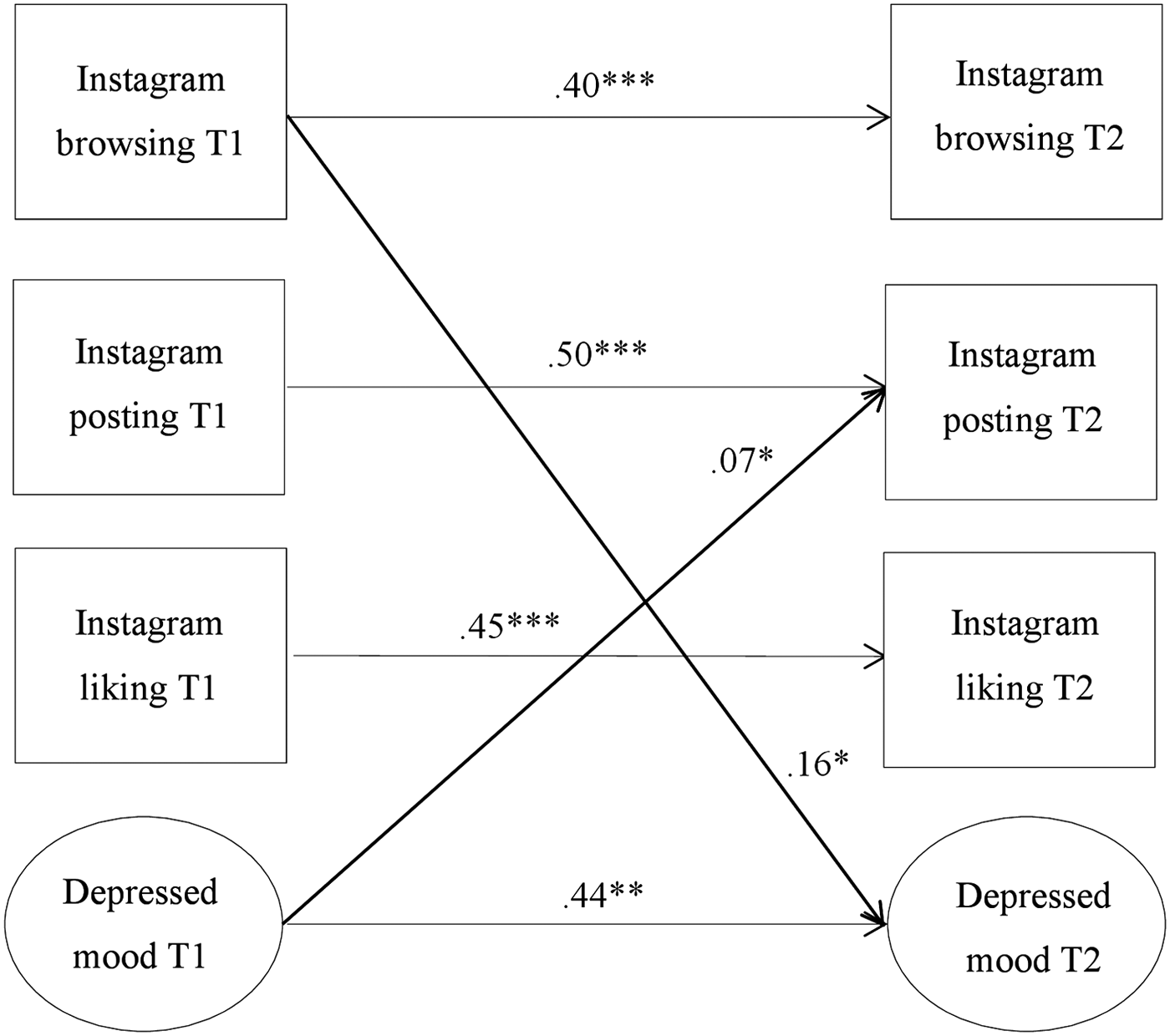
Model examining the reciprocal relationships between different types of Instagram use (i.e., browsing, posting, and liking) and adolescents' depressed mood.
In addition, our research question examined whether adolescents' depressed mood was related to Instagram browsing, posting, or liking. Results showed that depressed mood at Time 1 positively predicted Instagram posting at Time 2, β = 0.08, B = 0.10, SE = 0.05, p = 0.05. Depressed mood at Time 1, however, did not predict Instagram browsing and liking at Time 2.
Furthermore, the predictors in the model collectively explained 28% of the variance in adolescents' depressed mood (R2 = 0.28), 35% of the variance in Instagram posting (R2 = 0.35), 20% of the variance in Instagram browsing (R2 = 0.20), and 24% of the variance in Instagram liking (R2 = 0.24).
Gender differences
To test whether these relationships were moderated by gender, we conducted a multiple group comparison test. Results revealed that the model was different for boys and girls, Δ χ 2 (11) = 28.15, p < 0.01. However, a path-by-path analysis revealed that none of the hypothesized relationships accounted for this difference, as all hypothesized relationships were similar for boys and girls.
Discussion
The results of this study showed that Instagram browsing at Time 1 was related to greater depressed mood at Time 2. In addition, depressed mood at Time 1 was related to more Instagram posting at Time 2. The present study has important implications for future research.
Different types of Instagram use and adolescents' depressed mood
In line with our expectations (i.e.,
This harmful impact of Instagram browsing on adolescents' depressed mood might be due to the large number of strangers that adolescents follow through Instagram. Lup et al. confirm this suggestion; their study findings revealed that at the highest levels of strangers followed, more frequent Instagram use had direct associations with greater depressive symptoms. 7 In addition, similarly to Facebook use, 22 Instagram use might stimulate negative comparison behaviors, which in turn may increase young people's depressed mood. Future research is thus needed (1) to test the moderating role of strangers followed through Instagram and (2) to examine the mediating role of negative comparison behaviors on Instagram in the relationship between Instagram browsing and adolescents' depressed mood.
Contrary to our expectations (i.e.,
Adolescents' depressed mood and different types of Instagram use
Regarding the opposite relationships, our results revealed that depressed mood is related to increases in Instagram posting. This finding is in line with prior studies that revealed positive associations between depressive symptoms and Facebook status updating, 30 but extend prior research by showing that depressed mood may also be predictive of broadcasting Instagram content. In addition, this finding is also in line with Mood Management Theory,8,9 which argues that media are purposively used for coping with moods. However, by revealing that a specific type of media use (i.e., Instagram posting), instead of the choice of a certain medium, may be used to manage moods, our study extends Mood Management Theory. Based on these insights, we therefore recommend that future research that aims to test this theory should not only address the choice of media to manage moods but also how media are used for reducing negative and enhancing positive moods.
Furthermore, adolescents with greater depressed mood may be more likely to post images or videos on Instagram, perhaps, to enhance their image in the eyes of other social network members. Instagram is a visually centered platform that allows their users to easily edit and filter their photos and videos; it is thus an ideal medium to present oneself in their best possible way, even a false way. This strategic self-presentation on Instagram may especially attract adolescents with high levels of depressed mood, because it not only allows them to enhance their image in the eye of others but also to find encouragement (e.g., through likes and positive comments). In line with this suggestion, Mehdizadeh found that college students lower in self-esteem engaged more often in self-promotional behaviors on Facebook. 43 Future research is however needed to further enhance our understanding of how depressed mood relates to increases in adolescents' posting behavior on Instagram.
Gender differences
A path-by-path analysis revealed that the reciprocal relationships between different types of Instagram use and adolescents' depressed mood were similar for boys and girls. This lack of moderation contrasts previous cross-sectional studies that found support for a moderating role of gender in the association between specific types of Facebook use and young people's depressive symptoms.44,45 This lack of gender difference, however, may be partly due to the fact that female Instagram users (61%) were overrepresented in our sample. Perhaps gender differences did not emerge because there were not enough boys to test for them. Nonetheless, this study is the first to examine gender differences in the reciprocal associations between Instagram use and adolescents' depressed mood. More research is thus needed to further test the role of gender in these relationships.
Limitations
Although the present study is the first to explore important reciprocal associations between different types of Instagram use and adolescents' depressed mood, it is not without limitations. A first limitation refers to the fact that we relied on single-item measures to assess different types of Instagram use. Although we believe these single-item measures are more meaningful than general measures such as time spent on Instagram, we recommend that future research should rely on multi-item measures when assessing specific types of Instagram use. Second, this study is limited by the important dropout of participants between Times 1 and 2. Although this dropout limits the study findings, our current associations between different types of Instagram use and adolescents' depressed mood would likely be even stronger when attrition would be absent because the participants who dropped out posted more on Instagram and felt more depressed. To provide a more correct understanding of the actual strengths of these associations, future research should try to minimize dropout of participants.
Conclusion
Despite these limitations, the present study provides insight into the reciprocal relationships between different types of Instagram use (i.e., browsing, posting, and liking) and adolescents' depressed mood. Overall, we can conclude (1) that adolescents have a higher chance to develop a greater depressed mood when they browse more often through Instagram and (2) that adolescents have a higher chance to post more on Instagram when they have higher levels of depressed mood.
These results have important implications that warrant consideration. More specifically, adolescents, but also parents and clinicians should be made aware of the harmful impact of passive consumption of SNS content, as looking at photo's on Instagram (i.e., Instagram browsing) may increase teens' depressed mood 6 months later. Future prevention and intervention programs aimed at reducing passive consumption on SNSs are therefore particularly needed. Thus, our findings not only offer important insights for teens and practitioners but also useful guidance for future prevention and intervention programs.
Footnotes
Acknowledgment
This research was funded by a grant from the Flemish Fund for Scientific Research (FWO).
Author Disclosure Statement
No competing financial interests exist.