




Abstract
Abstract
Architectural and psychological theories posit that built environments have the potential to elicit complex psychological responses. However, few researchers have seriously explored this potential. Given the increasing importance and fidelity of virtual worlds, such research should explore whether virtual models of built environments are also capable of eliciting complex psychological responses. The goal of this study was to test these hypotheses, using a church, a corresponding virtual model, and an inclusive measure of state spirituality (“spiritual feelings”). Participants (n = 33) explored a physical church and corresponding virtual model, completing a measure of spiritual feelings after exploring the outside and inside of each version of the church. Using spiritual feelings after exploring the outside of the church as a baseline measure, change in state spirituality was assessed by taking the difference between spiritual feelings after exploring the inside and outside of the church (inside-outside) for both models. Although this change was greater in response to the physical church, there was no significant difference between the two models in eliciting such change in spiritual feelings. Despite the limitations of this exploratory study, these findings indicate that both built environments and corresponding virtual models are capable of evoking complex psychological responses.
Introduction
E
Research on the impact of built environments typically focuses on the impact of certain physical features, with much of our understanding coming from studies performed before 1980. 27 However, renewed research attention in recent years has revealed that physical characteristics of built environments have a potentially great impact on a variety of outcomes related to social, psychological, and physical well-being. For example, the condition of school buildings is associated with student attendance, academic achievement, and the school's social climate. 11 Similarly, the design of workplaces impacts employees' health and ability to conduct cognitively demanding tasks, with employees in small, open-plan office spaces faring better than those in larger spaces. 12 Focusing on physical and psychological well-being, a recent systematic literature review indicates that certain physical characteristics of residential care facilities for the elderly (e.g., better lighting; larger facility and room size and easy-to-navigate layout) are associated with higher quality of life and overall health. 13
Explanations for the impact of built environments on overall well-being span the breadth of individual, interpersonal, and community-level variables. Recent neuroscientific research indicates that spaces that are perceived as more open are judged as beautiful, elicit approach behaviors, and activate neurological structures associated with attention and visuospatial processing, but not structures associated with affect, emotion, pleasure, and reward. In contrast, spaces that are perceived as enclosed are judged as less beautiful, elicit avoidance behaviors, and activate brain regions associated with processing fear. 14 Social psychological research demonstrates the interpersonal impact of such neurological responses, with the perceived spaciousness of built environments being positively associated with self-disclosure in interviews. 15 Further, feelings of attachment to physical spaces (e.g., buildings; neighborhoods) are associated with a range of potential benefits, including relaxation, feelings of belonging, comfort-security, positive emotions, positive memories, vocational and avocational benefits, and personal growth. 16 Such findings extend beyond individual buildings, with neighborhood design associated with outcomes including psychological sense of community and social capital. 17
Research focusing on virtual environments indicates that they are experienced in a manner similar to built environments, with the potential impact of virtual environments also similar to built environments. For example, specific features of virtual environments, such as warmer colors and better lighting, are associated with more positive psychological responses.18,19 Research directly comparing real and virtual environments demonstrates that the perception of spaciousness in both settings is determined more by the manner in which the space is experienced than its apparent size. 20 In fact, perceptions of size, distance, and several key variables related to architectural experience (e.g., spaciousness, brightness, beauty) do not seem to differ significantly between built and corresponding virtual environments. 18 Although these similarities are more pronounced for higher-fidelity virtual environments that allow for a greater degree of interaction, multisensoriality, and feelings of presence, even relatively simplistic virtual environments can evoke complex psychological responses (e.g., phobic reactions). 18
The ability of virtual and built environments to evoke such complex responses seems to extend to the domain of spirituality. In fact, some researchers argue that, given the importance of aesthetics to religious experience, well-designed virtual models should be able to evoke spiritual feelings similar to those experienced in response to physical houses of worship. 28 Research on virtual churches supports this argument, indicating that greater visual similarities between virtual and built churches facilitate behaviors in the virtual environment that more closely resemble behaviors in the built environment. 29 Although preferences for religious environments are associated with a variety of architectural variables (e.g., well-maintained; visually rich; spacious),30–32 the architectural style of such environments seems to have little impact on their potential to evoke spiritual responses (e.g., sense of tranquility). 31 Instead, the potential impact of religious spaces seems to arise more from one's motivations for visiting the space. Specifically, individuals who visit religious spaces for religious reasons (e.g., worship; being close to God) tend to benefit from doing so, whereas those who visit for nonreligious reasons (e.g., obligation; guilt) tend to experience negative outcomes. 33
Although such evidence suggests that religious spaces can evoke complex psychological and spiritual responses,31–36 research directly comparing such responses in virtual and built environments is lacking. As a result, this study aimed at demonstrating not only that physical places of worship have an impact on complex psychological responses but also that virtual models of these environments can potentially be used to evoke the same responses. Specifically, on the basis of limited past research,18,26,29 it was expected that exploring a church and its corresponding virtual model would lead to increases in levels of state spirituality. Moreover, although spiritual responses to the physical church were expected to be stronger, comparing the increases in state spirituality experienced in both conditions should reveal that virtual and physical versions of the church do not differ significantly in their ability to evoke spiritual feelings.
Methods
Participants
N = 33 participants were recruited from Carleton University's undergraduate student research pool and completed both conditions (i.e., exploring the virtual model and the physical church). On signing up for the study, participants were asked whether they were familiar with the church or had a background in architecture or design. On the basis of past research,18,24,37–39 participants were excluded if they answered “yes” to either question. The final sample consisted of n = 23 women and n = 10 men. On the basis of self-reported non/religious affiliation, n = 20 participants identified as nonreligious and n = 13 identified as religious (Table 1). The sample had a median age of 21, with a mean of M = 24.8 (range: 18–51).
(Non)religious identities were provided by participants in response to an open-ended question.
One participant identified as “agnostic/humanist.” As a result, the total number of nonreligious identities exceeds the number of nonreligious participants.
Materials
The materials for this study consisted of a brief demographics questionnaire (assessing age, gender, non/religious affiliation, importance of religion/spirituality, and frequency of spiritual practice) and four identical questionnaires assessing spiritual and affective responses. One questionnaire was given to participants after exploring the outside, then another after exploring the inside of each version of the church (i.e., physical and virtual). These pen-and-paper questionnaires were completed on-site, immediately after exploring the outside or inside of the (virtual or physical) church.
These questionnaires consisted of three parts, two of which are included for their relevance to, or use in, past research in this area. The first asked participants to estimate the size of the church, with three separate estimates for its height, width, and length. The second consisted of eight 5-point Likert-type semantic differential questions 18 assessing the primary dimensions contributing to affective responses to architecture 3 (Table 2).
p < 0.05; **p < 0.01; ***p < 0.001; ****p < 0.10.
More germane to this study's aims, the third part of the questionnaire was a 20-item scale assessing state spirituality after exploring the church. To develop this scale, prominent scales used to assess religiosity/spirituality were compiled into a list of possible items. 40 Items focusing on trait spirituality (i.e., one's broader spiritual orientation) were then removed to maintain focus on state spirituality in response to the stimuli (i.e., one's spiritual feelings in the moment). Further, items with an explicitly religious focus were adapted or removed (when they could not easily be adapted) in an effort to create a transfaith measure of spirituality (i.e., one that applies equally to religious and nonreligious individuals). Guided by Hill's categorization of such scales, 40 a second, targeted review was conducted in an effort to identify additional items that would help to ensure adequate coverage of the various major facets of spiritual feelings.
The resulting scale consisted of items adapted from four separate scales: three items from the Mysticism Scale41,42 (e.g., “I currently feel a sense of awe or awesomeness”) and seven items from the Spiritual Transcendence Scale 43 (e.g., “I currently feel like there is a larger meaning to life”; “At the moment, I feel as though all life is interconnected”), both of which assess feelings of awe and transcendence; seven items from the Daily Spiritual Experience Scale, 44 which assesses spiritual feelings more broadly (e.g., “I currently feel deep inner peace or harmony”; “I currently feel the presence of God or another power greater than myself”); and three items from the State-Trait Spirituality Inventory, 45 which is designed to assess both one's immediate spiritual reactions to a stimulus and one's more general spiritual orientation (e.g., “I currently feel complete joy and ecstasy”). The resulting 20-item scale was found to reliably assess state spirituality in all conditions, with Cronbach's alphas ranging from alpha = 0.87 (virtual-outside) to alpha = 0.94 (physical-inside).
Procedure
To ensure that all participants could adequately explore the church in the amount of time provided, a small, wheelchair-accessible church located in downtown Ottawa, Ontario, was chosen for this study (i.e., Church of St. Barnabas, Apostle and Martyr). On the basis of feedback from pilot testing, minor adjustments were made to the virtual model of the church. Specifically, there was an increase in lighting and altering the speed at which the participant moved around the outside (decrease in speed) and inside of the church (increase in speed). Aside from these minor adjustments, no changes were made to the measures, model, or procedure of the study after pilot testing.
Participants signed up to explore the virtual model or physical model first, after which they were asked whether they had a background in architecture or design or were familiar with the church being used. Those who answered “yes” to either question were excluded from the study. All participants then explored both versions of the church, resulting in a 2 (inside vs. outside) × 2 (virtual vs. physical) within-subjects design. Demographics, spirituality, and non/religious affiliation were assessed only at the end of the study. As gender, age, and the order in which participants experienced the virtual and physical models were not expected to affect the change in participants' spiritual feelings in each condition (or the difference between conditions), no efforts were made either to counterbalance the order in which participants experienced the two conditions or randomly assign participants on the basis of demographic characteristics.
Aside from the order in which they experienced each version of the church, the same procedure was followed for all participants. For ease of explanation, the procedure outlined here uses those who experienced the virtual model first as an example. On arriving at the lab, participants were asked to read and sign an informed consent form that detailed the purpose and aims of the study. After indicating their consent, participants were brought to a large-screen display with a virtual depiction of the external entrance of the church (Fig. 1). The researcher explained to participants that this is a virtual model of a local church and allowed participants time to adapt to using the mouse and keyboard to move in the virtual environment.
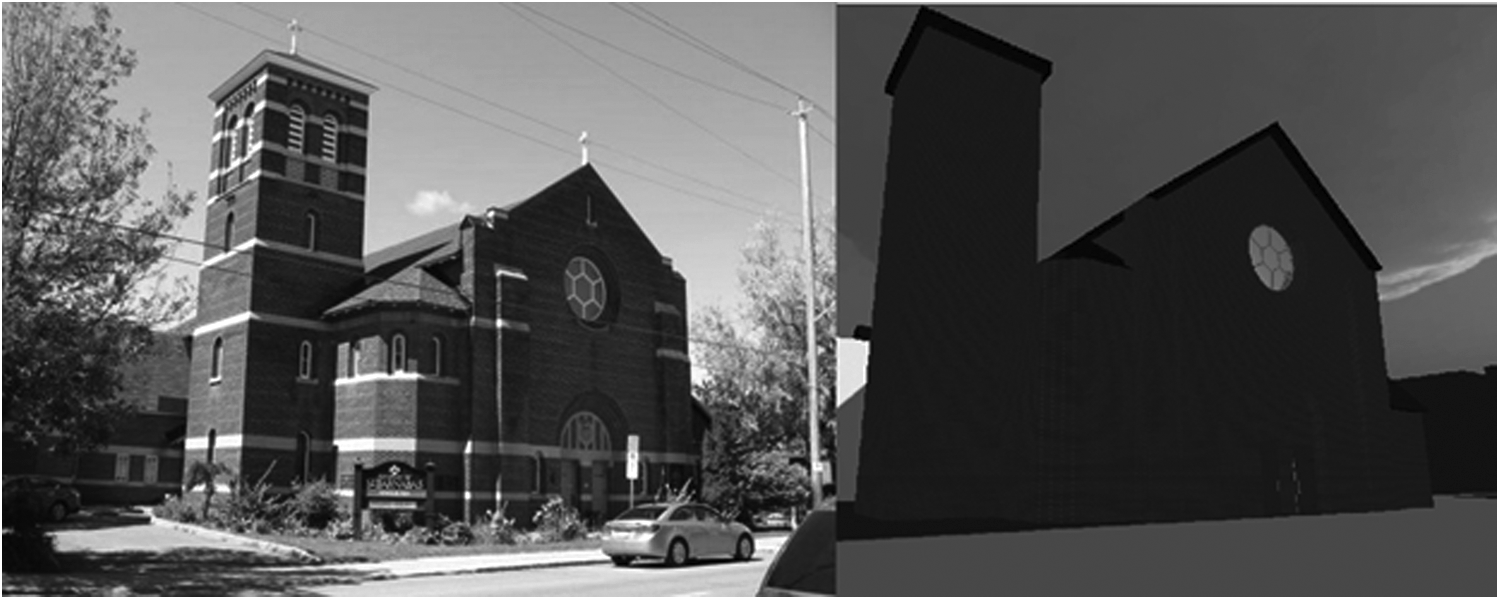
Exterior view of St. Barnabas Church (left) and the virtual model used in this study (right).
The researcher then explained the format of the study session, specifically noting that participants have a maximum of 5 minutes to explore only the outside of the church, then 10 minutes to respond to a brief questionnaire (with the outside of the church visible on screen), after which they have another 5 minutes to explore the inside of the church, and finally another 10 minutes to complete a second brief questionnaire (with the inside of the church visible on screen; Fig. 2). Participants were asked to attend specifically to the size of the building, their feelings about the building, and any other feelings that came up while exploring the building. After exploration of the inside of the church and completion of the second questionnaire, a time and date to visit the physical church was arranged to take place within 2 weeks of the first session.

Interior view of St. Barnabas Church (left) and the virtual model used in this study (right).
The same procedure was followed for the physical church, with the researcher waiting at the church's side entrance (not visible to participants) throughout in an effort to minimize any observer effects. After exploring the inside of the church, participants were asked to fill out the demographics questionnaire, after which they were provided with a verbal and written debriefing explaining the goals and expectations of the study. After this, the researcher collected all materials from participants and thanked them for their time. After completion of the study, participants were provided with course credit equivalent to 1 percent of their final grade.
Results
Preliminary and exploratory analyses
Aside from non/religious affiliation, none of the demographic variables had an effect on spiritual feelings. In addition, none of the demographic variables (including non/religious affiliation) had any notable effect on size estimates or ratings of the affective components of architecture. There were no notable differences in size estimates between any of the conditions. Variability in external conditions experienced by participants (e.g., weather) was similar within all conditions. Finally, there were no notable differences, either in demographics or on any of the outcome measures, between participants who experienced the virtual church first (n = 20) and those who experienced the physical church first (n = 13). As a result, both groups were combined for all analyses.
Given the low-fidelity virtual model used, it was expected that the physical church would be rated significantly higher on several of the affective components of architecture. As a result, one-tailed paired samples t tests were used to compare the physical and virtual models on all eight affective components. Both the outside and inside of the physical church were rated significantly higher than the virtual church on pleasantness, beauty, interestingness, and impressiveness. In addition, the outside of the physical church was rated as significantly lighter than the outside of the virtual church, whereas the inside of the physical church was rated as significantly more spacious and open than the inside of the virtual church (Table 2).
Although there was generally no relationship between spiritual feelings and affective components of architecture, spiritual feelings after exploring the outside of the virtual church were significantly correlated with ratings of the pleasantness (r = 0.57, p < 0.001), beauty (r = 0.67, p < 0.001), interestingness (r = 0.52, p = 0.002), impressiveness (r = 0.49, p = 0.004), lightness (r = 0.55, p < 0.001), and openness (r = −0.36, p = 0.039) of the outside of the virtual church. Ratings of impressiveness of the inside of the virtual church were significantly correlated with spiritual feelings after exploring the inside of the virtual church (r = 0.36, p = 0.043), whereas spiritual feelings after exploring the inside of the physical church were significantly correlated with ratings of its pleasantness (r = 0.40, p = 0.021) and excitingness (r = −0.36, p = 0.041).
Main analyses
The physical church elicited significantly stronger spiritual feelings than the virtual model, with paired-samples t tests showing this effect to be stronger for the inside, t(32) = 4.89, p < 0.001, than the outside, t(32) = 3.12, p = 0.004. When compared with their spiritual feelings after exploring the outside of the church, participants experienced an increase in spiritual feelings after exploring the inside of both models of the church. This difference was stronger and significant only in the physical condition, t(32) = 3.44, p = 0.002. As a result, participants' spiritual feelings after exploring the outside of the church were used as a baseline level of state spirituality, with the difference in spiritual feelings (i.e., spiritual feelings inside − spiritual feelings outside = difference) used for all further analyses.
The same pattern of spiritual feelings was observed for all participants, with significant changes only in response to the physical church. However, only the religious participants experienced a significant increase in spiritual feelings after exploring the inside (vs. the outside) of the physical church, t(12) = 3.01, p = 0.011, with this difference approaching significance for the nonreligious participants, t(19) = 1.95, p = 0.066.
Comparing the virtual and physical models on change in spiritual feelings, a paired-samples t test indicated that this change was stronger in response to the physical than the virtual church, t(32) = 2.50, p = 0.018. However, the overlapping 95 percent confidence intervals (CIs) around the mean change in spiritual feelings (inside-outside) indicate that the physical church (MD = 0.25, CIs = 0.105 to 0.386) and virtual model (MD = 0.03, CIs = −0.043 to 0.110) were statistically equivalent in evoking spiritual feelings. 46
To limit the potential impact of pre-existing differences in spirituality, self-reported importance of spirituality was then controlled in additional analyses. On a scale from 1 (not at all important) to 5 (very important), a median of 3 was observed for participants' self-reported importance of spirituality (M = 3.24). A median split resulted in n = 20 “not spiritual” (3 religious, 17 nonreligious) and n = 13 “spiritual” (10 religious, 3 nonreligious) participants. This new categorical variable was entered as a covariate in a one-way repeated-measures analysis of covariance (ANCOVA). Again comparing the change in spiritual feelings experienced in each condition, the results of this ANCOVA indicated that controlling for self-reported importance of spirituality reduced the difference between the two models in evoking spiritual feelings to nonsignificance, F(1, 32) = 0.01, p = 0.91.
Discussion
This study was designed to test two relatively unexplored areas in environmental psychology. First, building on prior research exploring basic affective components of, and responses to, architecture, the goal of this study was to explore whether virtual and built environments are capable of eliciting more complex feelings. Given the very complex nature of spirituality,40,43 a church and a measure of state spirituality were chosen for this study to test how broad of a psychological impact virtual and built environments might have. Compared with exploring the outside of a church, the results of this study demonstrate that exploring the inside of a church results in an increase in state spirituality, regardless of whether it was a physical church or virtual model.
The second goal of this study was to explore whether virtual models are capable of eliciting the same complex feelings as their corresponding built environments. Although the findings reported here demonstrate that built environments have a stronger impact on psychological states than virtual models, the pattern of findings was in the same direction for all conditions and groups of participants. More importantly, controlling for pre-existing differences in spirituality reduced the difference between the physical and virtual conditions to nonsignificance.
Similar to past research, 18 the physical and virtual models were perceived as being of a similar size. However, the two models were experienced differently on most of the affective components of architecture, with the physical church generally evoking more positive feelings. Interestingly, size estimates and the affective components of architecture generally had little relationship to participants' spiritual feelings, indicating that any change in spiritual feelings was not a result of more mundane responses to the environments. Taken together, these findings suggest that participants experienced an increase in state spirituality after exploring the inside versus the outside of a church (whether virtual or physical), and this effect was unrelated either to the perceived size of the church or to more mundane affective responses to it.
Limitations
First, although the sample size used in this study was adequate for a preliminary, repeated-measures study on affective responses to virtual and built environments, 18 a larger sample is needed to explore more fully any potential between-group differences. As past research and survey data indicate that religiosity and spirituality are not necessarily related,40,47 it would be helpful for future research to use sufficient sample sizes to explore the impact of trait spirituality and irreligion/religion independently.
Second, no measures were used to assess level of presence in the virtual model. Research on virtual environments consistently demonstrates a relationship between feelings of presence and psychological responses to virtual environments. 48 As a result, it is possible that any differences between participants' experiences of the virtual and physical churches arose from low feelings of presence in the virtual model. This is supported by the significantly lower ratings of the virtual model on many of the affective components of architecture, as past research demonstrates that even relatively low-fidelity virtual models are experienced in a manner similar to their corresponding built environments on the affective components of architecture when feelings of presence are high. 18
A third limitation is the virtual model used for this study. This relatively low-fidelity model was presented on a large computer monitor with no sound and the ability to move only (i.e., no other interaction with the environment). As emotional responses and feelings of presence are enhanced by multisensoriality, interactivity, and immersion in virtual models,18,49–53 it is likely that the use of immersive technology (e.g., head-mounted displays [HMDs]) and a high-fidelity, interactive model that incorporates some degree of multisensoriality (e.g., adding sound) would allow for a more accurate comparison of virtual and built environments.
Finally, the finding that there was no significant difference between the virtual and physical churches in evoking spiritual feelings is not a true indicator of equivalence. Although the use of overlapping CIs can be taken to demonstrate statistical equivalence, 46 the lack of research in the areas under exploration in this study severely limited our ability to determine a suitable acceptance criterion for proper equivalence testing of the effects of virtual and physical environments on spiritual feelings. 54
Conclusion
Our hope is that these preliminary findings provide direction for future researchers and lend enough support to the phenomena under investigation to allow for further research that more sufficiently explores the psychological impact of physical and virtual environments. Despite the several limitations noted here, this study demonstrates that architecture can be used to elicit complex affective responses, particularly changes in spiritual feelings. Moreover, this study demonstrates that virtual environments can be used to elicit similar feelings. If virtual environments are sufficiently able to evoke complex feelings similar to corresponding built environments, these findings have implications for such diverse topics as conservation (of heritage sites), accessibility, tourism, architecture, and design. Although more research is needed, these findings provide hope that the use of virtual environments may help to address several research and real-world problems.
Footnotes
Acknowledgments
This work would not have been possible without the invaluable contributions of Gerry Chan, Mario Santana Quintero, and Ali Navidbakhsh. The authors also extend their most sincere gratitude to The Reverend Canon Stewart Murray for allowing them to use St. Barnabas Church. This work was supported by a grant from Carleton University.
Author Disclosure Statement
No competing financial interests exist.