




Abstract
Abstract
This study investigated the relationship between adolescents' problematic Internet use (PIU) and demographic characteristics such as age, gender, and information and communication technology (ICT) literacy and the moderating effect of geographic area on this relationship using a cross-sectional research design. The study sample comprised 2160 adolescents from the Chongqing area of China and consisted of 47.3 percent boys (N = 1022) and 52.7 percent girls (N = 1138). Participants anonymously completed a 38-item questionnaire that examined their Internet use, behaviors, and attitudes, ICT literacy, parents' education level, and other demographic information. The results showed that the geographic area in which respondents lived (urban vs. rural), gender, age, father's education, mother's education, and ICT literacy had significant relationships with PIU. Moreover, hierarchical multiple regression analyses indicated that geographic area was found to be a significant moderator for both age and gender in their relationship with PIU. These findings suggest that it is essential to address differences between urban and rural areas when seeking to mitigate PIU among adolescents.
Introduction
T
China, like many areas around the world, has a rapidly growing base of Internet users. At the same time, there is increasing concern about rising levels of PIU among youth. To investigate this issue, we present results from a 38-item questionnaire completed by 2160 Chinese adolescents that examines what demographic and individual characteristics might be predictive of PIU. Moreover, because in China, the geographic area in which youth live (urban vs. rural areas) is strongly associated with economic status, we also focus on the role that it plays in moderating these influences.
Literature Review
Numerous studies have been carried out examining PIU around the world in recent years. Results have shown that students with PIU often suffer from poor academic performance,12,13 a decline in family relationship,14,15 and low levels of well-being.2,16,17 Previous research has also indicated that many factors could predict PIU, such as preference for online social interaction, 18 parenting style,19–21 personality type,22,23 and family.24–26 Finally, a number of studies have examined the relationship between PIU and demographic variables.3,4,23,27–29
Adolescence is one of the most rapid phases of human physical and mental development. Adolescents are less susceptible to guidance provided by social figures (e.g., parents, teachers, and friends) as they grow older. Several studies found no significant relationship between adolescents' age and PIU,30–32 whereas others have found PIU significantly higher in older teenagers.33–35
Previous research has also found that there is significant difference between boys and girls in Internet use. Playing games is the most common online activity for males, whereas females most often use the Internet for chatting and blogging.36,37 Moreover, numerous studies examined the relationship between gender and PIU. Some of them showed that males had a greater risk of PIU than females,31,33–35,38,39 whereas others reported that there was no significant difference between males and females.40,41
Information and communication technology literacy (ICTL) is the ability to use digital technologies, communication tools, and/or networks to solve information problems to function in an information society. This includes the ability to use technology as a tool to research, organize, evaluate, and communicate information, as well as having a fundamental understanding of the ethical/legal issues surrounding the access and use of information. 42 The International Society for Technology in Education (ISTE) developed the ISTE Standards for Students (Standards•S) known as the ICTL standard. Standards•S emphasizes the skills and qualities needed for students to engage and thrive in a connected and digital world. Standards•S has been adopted all over the world and used by educators across the curriculum, with every age of student, with a goal of cultivating these skills throughout a student's academic career. Previous studies have examined the correlation between ICTL and PIU and revealed that the higher the students' ICTL skills, the more likely they will have PIU.43–45 However, other research showed that the adolescents with higher ICTL had lower PIU and suggested that ICTL curricula should be improved to prevent them from developing PIU. 46 In sum, research results examining variables affecting PIU are mixed and sometimes contradictory.
Moreover, little research has examined the possible moderating effect of economic status. 9 There is an evident gap of economic development between urban areas and rural areas in developing countries, which accounts for uneven living standards, education level, and infrastructure. In China, economic growth has fueled a large increase in national income and living standards in recent years, but the distribution of wealth and national resources remains unevenly distributed between urban and rural areas, with the latter generally being less wealthy. Previous studies have shown that economic status significantly influences Internet use 47 and even PIU48,49 among adolescents. Therefore, the geographic area in China is an important proxy variable for its population's economic status.
Thus, the aim of this study was to examine the relationship between PIU and demographic characteristics such as age, gender, and ICTL and the moderating effect of geographic area on this link. The study was guided by the following research questions: Does age, gender, and ICTL significantly predict adolescents' PIU? Does geographic area have a moderating effect on the relationship between age, gender, and ICTL and adolescents' PIU?
Methods
Participants
Chongqing, the site of this study, is located in the southwest of China, and is a developing province with 9.5 million people living in urban areas and 23.3 million people in rural areas. 50 The economic, education, and infrastructure development gap in this city between urban and rural areas is also distinct, with a higher standard of living in urban areas. This gap may lead to some differences in the Internet use of adolescents.
A total of 2272 students participated in this study from 11 schools in Chongqing: 6 middle schools, 5 high schools, with 6 schools in rural areas and 5 schools in urban areas. All schools and students were randomly selected for the research. Because of missing data, 112 students were excluded, resulting in the inclusion of 2160 students: 47.3 percent males (N = 1022) and 52.7 percent females (N = 1138). The mean age was 15.09 years (SD = 1.70 years). Of the 2160 respondents, 51.3 percent were from urban areas (N = 1108), 48.7 percent were from rural areas (N = 1052); 53.2 percent were from middle schools (N = 1149), whose ages were in a range from 11 to 15 years generally, 46.8 percent were from high schools (N = 1011) with ages ranging from 15 to 19 years.
Measures
Problematic Internet use
PIU was assessed using the Adolescent Pathological Internet Use Scale, developed by Lei and Yang (2007). 51 It consists of 6 dimensions (salience, tolerance, compulsive surfing the Internet/withdrawal symptoms, mood change, social comfort, and negative consequence) and 38 items (e.g., “If I cannot access the Internet, I am in a terrible mood.”). Respondents were asked to rate how true each item was on a 5-point scale ranging from 1 (“never true”) to 5 (“always true”). Therefore, higher scores represent higher levels of PIU. The internal consistency coefficients of this scale were >0.95 in previous studies.29,51,52 Cronbach's alpha as a measure of internal consistency was 0.97 for this study.
ICT literacy
One item elicited students' perceptions of their ICT literacy: “What is your level of ICT literacy?” on a scale of 1–5 (1, beginner; 2, fair; 3, good; 4, very good; 5, expert).
Parental education
The respondents were asked to report their fathers' and mothers' education level on a scale of 1–4 (1, completed elementary school; 2, completed middle schools; 3, completed high schools; 4, completed college and above).
Demographic information
Participants' demographic information was collected, including gender, age, grade, and geographic residence area (rural vs. urban). Grade point average (GPA) was measured using a 1–5 scale (1, above or equal to 90; 2, below 90 and above 80; 3, below 80 and above 70; 4, below 70 and above 60; 5, below 60).
Procedure
The survey was administrated in classrooms by trained teachers or graduate research assistants. First, they explained requirements and procedures to the students. Second, the students completed the questionnaires within 20 minutes. Third, all of the completed questionnaires were mailed to the researchers.
Statistical analysis
Descriptive statistics for all variables were computed and Pearson's correlational analysis examined correlations between demographic variables and PIU, whereas Cramer's V correlational analysis was used to test the relationship between two categorical variables: geographic area and gender.
Multiple linear regression analysis was used to analyze whether geographic area, gender, age, father's education, mother's education, GPA, and ICTL were related to PIU. A hierarchical regression model was conducted to investigate the effects of the control variables, including father's education, mother's education, and GPA in step 1, the independent variables (gender, age, and ICTL) and the moderator (geographic area) in step 2, and their interaction in step 3. Finally, simple slope effect tests were used to examine the effect of age and gender on PIU in rural and urban areas. Statistical Package for the Social Sciences (SPSS), version 23.0, was used for all data analysis.
A result verification check was conducted by GPower to examine whether the sample size had an impact on the hierarchical multiple regression when geographic area was the moderating variable.
Results
The effects of age, gender, ICTL, and demographic variables on PIU
We dummy coded geographic area (1, rural; 0, urban) and gender (1, male; 0, female). As shown in Table 1, the correlations between PIU and geographic area, gender, father's education, mother's education were significant, with generally small r values. ICTL had the highest positive correlation (r = 0.278) and geographic area the highest negative correlation (r = −0.194).
N = 2160.
p < 0.01.
FE, father's education; ME, mother's education; GPA, grade point average; ICTL, information communication technology literacy; PIU, problematic Internet use.
Multiple linear regression analysis was used to analyze whether geographic area, gender, age, father's education, mother's education, GPA, and ICTL were related to PIU. No multicollinearity problems were detected since VIF values ranged from 1.03 to 1.90.
The multiple regression was significant (F(7, 2159) = 41.796, R = 0.346, R2 = 0.120, p < 0.001), explaining 12 percent of the total variance and results are given in Table 2. The following predictor variables were significant: geographic area, gender, age, ICTL, and GPA. Geographic area had the highest negative standardized regression coefficient (β), whereas ICTL had the highest positive standardized regression coefficient. The t-test results revealed that all the variables except father's education (p = 0.335) and mother's education (p = 0.178) were significantly related to PIU.
R = 0.346, R2 = 0.120, p < 0.001, F(7, 2159) = 41.796
The moderating effect of geographic area on the relationship between gender, age, and ICTL and PIU
A hierarchical multiple regression was conducted to explore the moderating effect of geographic area on the relationship between gender, age, and ICTL and PIU with age and ICTL being centralized. The control variables, including FE, ME, and GPA, were entered in step 1. In step 2, geographic area, gender, age, and ICTL were added. Lastly, the interaction of gender × area, age × geographic area, and ICTL × geographic area were entered in step 3.
As given in Table 3, the interaction between gender and geographic area was significant (β = −0.08, p < 0.05). A simple slope effect test was conducted to further investigate the effect of gender on PIU in rural and urban areas. Figure 1 shows that gender significantly predicted PIU (β = 4.61, t = 4.59, p < 0.001) for the group in rural areas, whereas gender did not have a significant effect on PIU (β = 1.40, t = 1.44, p = 0.15) for the group in urban areas.
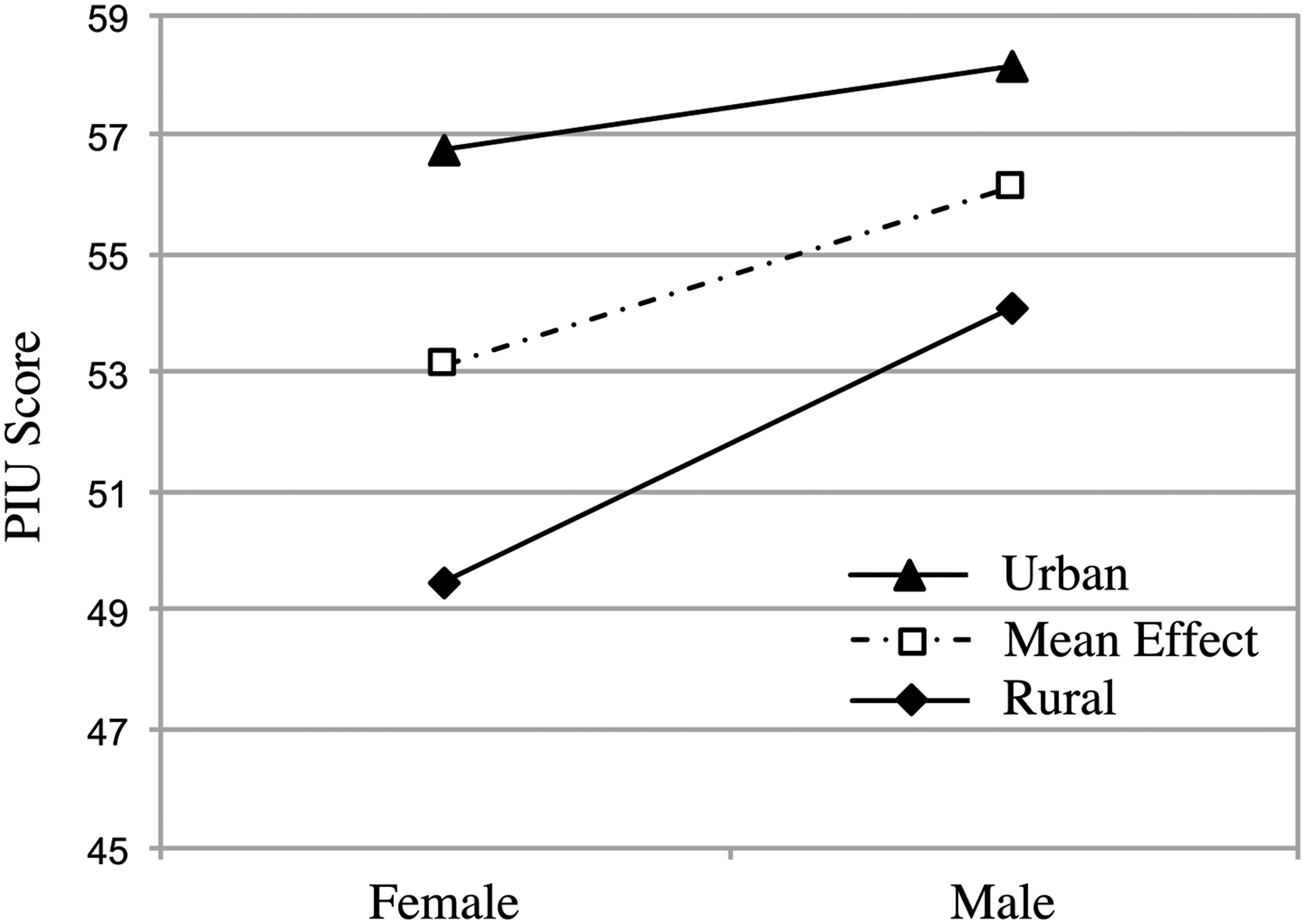
The interaction between gender and geographic area.
p < 0.001.
p < 0.01.
p < 0.05.
Table 3 also shows that the interaction between age and geographic area was significant (β = 0.08, p < 0.05). A simple slope effect test was conducted to further investigate the effect of age on PIU in rural and urban areas. Figure 2 shows that age significantly predicted PIU (β = 1.83, t = 3.20, p < 0.01) for the group in the rural area, whereas age did not have a significant effect on PIU (β = 0.91, t = 1.00, p = 0.32) for the group in urban areas.

The interaction between age and geographic area.
To do the result verification check, a subsample of 436 adolescents, accounting for 20 percent of the overall sample, was randomly extracted to conduct hierarchical multiple regression. We found that step 3 was not significant (ΔR2 = 0.02, p = 0.08) with low statistical power (1−β = 0.42, α = 0.05), calculated using GPower, and that the interaction between age and geographic area was not significant (p > 0.05). However, step 3 conducted with the overall sample of 2160 adolescents was significant with high statistical power (1−β = 0.93, α = 0.01). Therefore, the sample size had a large impact on the moderating effect of geographic area.
Discussion and Conclusion
This study investigated the relationship between PIU and demographic characteristics such as age, gender, GPA, parents' education, and ICTL and the moderating effect of geographic area on this relationship using a relational screening model and a cross-sectional research design.
Results from multiple linear regression analysis revealed that the relationship between PIU and age, gender, GPA, and ICTL was significant except for parents' education. Our results contradict those of Kabasakal's (2015) who found that students with highly educated parents were more susceptible to PIU. 24 Results also indicated that older adolescents reported higher PIU scores than younger adolescents. This result is similar to the finding of previous studies,33,35 but contradicts findings from Poli and Agrimi, 32 who found that age was not a significant factor predicting PIU. We also found that male students were at higher risk for PIU than female students, which was consistent with the results of many previous studies.18,24,31,33–35,38 This result could be partially explained by the gender difference in physiological transmitter, and the fact that male students often have a more impulsive and curious nature. 53 Therefore, they are more likely than female students to be unable to restrain their excessive behaviors and to be at higher risk of PIU. 18 However, other studies have reported no significant differences in gender for PIU.40,41 The variation of the relationship between age, gender, and PIU might be moderated by other factors, for example, geographic area.
The hierarchical multiple regression revealed that geographic area was the most critical predictor of PIU, followed by ICTL, gender, age, and GPA. It also showed that adolescents with higher ICTL more easily developed PIU, which was consistent with the idea that as students gain technological skills, they have a higher likelihood of PIU. 44 This result may be explained by the fact that adolescents with higher ICTL spend more time on the Internet, which would then raise these skills. Nevertheless, the results suggest that the more time students spend on the Internet, the more likely they may be susceptible to PIU.
There were also significant differences in PIU score among adolescents with different GPA levels, and the adolescents with lower GPA were at higher risk of PIU than those with higher GPA. This aligns with results from previous research.54–58 This finding might be due to the greater amount of time spent online in nonschool-related activities rather than studying.
Study results found that adolescents from urban areas were more susceptible to PIU than those from rural areas, which was in agreement with findings from previous studies.31,59 There are two possible explanations for this result. First, adolescents living in urban areas may have more access to the Internet than those living in rural areas. Second, parents living in rural areas may be more susceptible to the negative news about Internet use and, therefore, are stricter regarding their children's access to the Internet. 60
Moreover, we found that the moderator effect of geographic area on the relationship between age, gender, and PIU was significant except for ICTL. The results also revealed that older adolescents were at higher risk of PIU than younger adolescents in rural areas, but this difference is not evident in urban areas. In rural areas of Chongqing, nearly 240,000 of 80 percent of high schools students attend boarding school. 61 Thus, older adolescents are much more likely to attend boarding school, whereas younger adolescents from the countryside are mainly commuter students living with their families. Boarding school students may feel social isolation 62 and thus spend more time on the Internet, which then raises their risk of PIU.
As for urban areas, the results showed no significant association between age and PIU, which is consistent with previous studies.30,31 It also highlighted that in urban areas and developed areas, all students appear to have equal access to the Internet where it became a basic element of social life.
Another finding was that male adolescents reported higher PIU than female adolescents in rural areas, whereas it was not significant in urban areas. It is difficult to explain this result, but one possibility might be that due to the Confucian patriarchal tradition marked by son preference and female subordination 63 that is more common in rural areas. In the Confucian patriarchal culture, when a woman and a man get married, she moves to his family. In this society, women are mainly considered as a way to continue the lineage, and they are subordinate to men who constitute the social order. As a consequence, it is preferable for families to have sons instead of daughters, as they believe that the lineage will be maintained. Hence, boys typically receive more financial and material support from parents and have more access to the Internet, therefore, putting them at higher risk of PIU than girls. However, parents from urban areas holding a weaker idea of son preference over daughter than those from rural areas may be inclined to invest their resources in their only child (because of China's one-child policy), regardless of gender. Therefore, there was no apparent difference between boys and girls regarding material support from parents. Another possible explanation is that computers and Internet are easier to access in urban areas because of better networking infrastructure.
The findings of this research suggest that it is better to attach importance to the difference between urban and rural areas when taking measures to prevent PIU among adolescents. In urban areas, the study found no significant difference of PIU between boys and girls as well as between the younger adolescents and older adolescents. Therefore, general instructions addressing on how to use the Internet in a healthy and safe way are needed for all adolescents. Adolescents need to be provided with clear Internet-specific rules and guidelines to reduce their tendency for PIU. 29 In contrast, in rural areas, male boarding school students may be at higher risk for PIU than other adolescents, and tailored education may be needed. Parents can also be asked to keep in good contact with their children in boarding school to help reduce the feeling of social isolation. Schools can orientate these students toward different activities, such as sports, arts, and contests so as to reduce the amount of time they spend on the Internet by diverting attention away from gaming, watching movies, chatting, etc.
There are several limitations to this study. First, as a cross-sectional study, causality between demographic variables and adolescents' PIU and the effect of geographic area cannot be asserted and may be confounded by cohort effects. Hence, longitudinal research should be conducted in future studies. Second, adolescents were requested to self-report their GPA and ICTL, which may have been influenced by social desirability even in anonymous questionnaires. Future studies can examine scores from the standardized test to better measure ICTL level. Third, the sampling groups were all from Chongqing, located at southwest part of China, limiting the generalizability of the findings. Future researchers may conduct broader sampling groups from other developing regions and countries.
Footnotes
Acknowledgments
This research was supported by The Fundamental Research Funds for the Central Universities under Grant No. XDJK2014A002 and the Project of Postgraduate Education Reform of Chongqing under Grant No. YJG20163068.
Author Disclosure Statement
No competing financial interests exist.