




Abstract
Abstract
The effect of smartphone use on cognitive function was quantified using measures of neural activity called event-related potentials (ERPs). Participants engaged in a primary task (Exp. 1a: executive function; Exp. 1b: gambling) with no distraction and while using their smartphone to read online news articles. Smartphone use slowed behavioral responses and reduced the P300 ERP amplitudes by ∼50 percent and provides evidence that smartphones have a large distracting effect. Experiment 2 compared executive function ERPs from smartphone-experienced users (Exp. 1a) with those collected on smartphone-naive subjects (collected in late 2006 and early 2007; Scisco et al.). This comparison provides preliminary evidence that smartphone use may be improving visual spatial attention. Collectively, the data highlight some costs and benefits of smartphone use.
Introduction
M
Electroencephalogram (EEG) is brain electrical activity recorded at the scalp. ERPs are EEG time-locked to the presentation of a stimulus and averaged to extract neural signals that correlate with different cognitive functions. 8 The P300 is a positive ERP component peaking ∼300 ms after the stimulus. The P300 amplitude has been associated with attention allocation to discriminate between different environmental stimuli, and it can provide electrophysiological evidence of distraction. 9 For example, P300 amplitude elicited by car brake lights in a driving simulator was reduced by 50 percent when people were distracted by hands-free cellphone conversations. 10 Similar results were reported when the primary task required detecting targets. 11 These studies measured P300 amplitude during hands-free phone conversations, which is only one of millions of applications that can be performed on a smartphone. 12 To our knowledge, no study has measured the effect of smartphone use on P300 amplitude.
The research objective was to quantify smartphone distraction effects during an executive function task that elicited P300 amplitude. 13 Participants in Experiment 1a completed the executive function task by itself (no distraction) while using their smartphone (distraction). Smartphone distraction was expected to slow executive function and decrease P300 amplitude. Furthermore, the size of P300 amplitude was used to quantify the smartphone distraction effects to provide a concrete measure of mental resources siphoned by the smartphone.
Experiment 1a
Method
Participants
Thirty-eight undergraduates volunteered for a “brainwaves and multitasking” experiment to earn partial course credit. A $25 award explicitly incentivized multitasking performance because it was given to the participant with the fastest responses on the primary task and most accurate responses on both tasks. Participants were right-handed 14 and reported no history of neurological disorders. The data from four participants were excluded because of EEG recording problems (n = 2), reading all of the online articles one-third of the way into the task (n = 1), and very poor recollection of the online articles (n = 1). The final sample was 33 participants (11 males; aged 18–22 years old; M = 18.42, SD = 3.25).
Procedure
Three online articles from
One participant in Experiment 1b did not complete the phone use survey. The numbers reflect percentages with this person's data excluded from the total.
After the electrode cap was attached, the participant moved to the testing room and placed his/her smartphone in a cradle on the desk. Participants completed 10 practice trials of the primary task with experimenter feedback. The primary task was an executive function task that has been fully described elsewhere. 13 Participants decoded the specific task instruction from the stimulus and then made a mental judgment regarding the two-digit number in the center of the display. There were four different mental operations: (1) deciding whether the number was even or odd, (2) deciding whether the number was greater than or less than 50, (3) deciding whether the sum of the two digits was odd or even, or (4) deciding whether the sum of the two digits was greater than or less than 10.
The experimental phase consisted of one block of 200 trials (50 of each mental task randomly ordered) with no-distraction and another distraction trial block where participants used their smartphone to navigate to the article links and read them. The order of the trial blocks was counterbalanced across participants. Before the distraction trial block, the experimenter sent an e-mail to the participant that contained hyperlinks to the online articles, asked the participant to open the e-mail before the task began, and explained that general knowledge of these articles would be tested at the end of the experiment. Participants were told that both tasks were equally important. After both blocks were completed, participants provided verbal answers to the article questions while the experimenter scored responses.
Because streaming data on a smartphone might produce some electrical interference, the device was muted and placed screen down on the cradle while it streamed a video during the no-distraction block; therefore, the device was streaming data during both experimental phases. In addition, the Wi-Fi router operated at a much higher frequency (≥2.4 GHz) than the upper frequency bands filtered by the EEG equipment (40 Hz). Interference from cellular tower signals was not possible because cellular service was blocked by the copper mesh encapsulation of the ERP laboratory.
ERP procedures
EEG signals were sampled from 29 Ag/AgCl electrodes mounted in an elastic cap and positioned at standard electrode sites (Fp1, Fp2, F7, F3, Fz, F4, F8, FT7, FC3, FCz, FC4, FT8, T7, C3, Cz, C4, T8, TP7, CP3, CPz, CP4, TP8, P3, Pz, P4, O1, and O2). The right mastoid electrode was an active electrode. Vertical electrooculogram (EOG) was recorded bipolarly using two Ag/AgCl electrodes affixed above and below the participant's left pupil. Horizontal electrooculogram was recorded bipolarly from electrodes attached to the outer canthi of both eyes. Interelectrode impedance was below 5 kΩ. EEG and EOG signals were recorded continuously during the task using a Contact Precision Instruments amplifier at a sample rate of 150 Hz with filters set to a 0.03–40 Hz frequency range (−3 dB attenuation).
Offline, the continuous data file was divided in epochs that began 300 ms before the probe and continued for a total of 1,500 ms. Electrode data were baseline corrected to the average activity 300 ms before the probe and digitally filtered using a 30 Hz low-pass filter (−3 dB/oct). Ocular artifacts on accurate trials were corrected using an algorithm 16 and any trials with ERPs that exceeded ±150 μV were excluded from the analyses. The number of trials in each epoch was sufficiently large to ensure an adequate signal-to-noise ratio (Distraction: M = 158 trials, range = 70–199; No-distraction: M = 173, range = 85–197).
The P300 was measured at two different intervals (i.e., 300–450 and 475–525 ms) to match Scisco et al. 13 ERP amplitudes were analyzed using a repeated measures ANOVA with factors of Distraction (smartphone use, no smartphone use), anterior/posterior (AP) electrode position (five levels front to back), and left/right (LR) electrode position (five levels left to right). All ERP analyses incorporated the Geisser-Greenhouse correction for nonsphericity, and significant effects are reported with corrected degrees of freedom when applicable.
Results
Smartphone use
Table 1 presents self-reported smartphone use, which was similar for both participant samples (Exp. 1a and 1b). Participants reported frequent, daily smartphone use (Exp. 1a: M = 306.97 minutes, SD = 218.35; Exp. 1b: M = 345, SD = 162.71).
Behavioral data
Accuracy did not differ between distraction (M = 0.97, SD = 0.03) and no-distraction trials [M = 0.95, SD = 0.06; F(1, 32) = 1.6, p = 0.215]; however, response times (RTs) were slower during distraction trials (M = 3,859 ms, SD = 1,447) compared with no-distraction trials [M = 2,490, SD = 929; F(1, 32) = 21.79, p < 0.001]. Participants demonstrated good content knowledge of the online articles (Accuracy: M = 75 percent, SD = 20 percent).
ERP data
Figure 1 shows the grand-average ERP data for the P300 at midline frontal–central (FCz) and central–parietal (CPz) electrodes and the topographic maps indicate the expected CPz maximum. 9 Distraction reduced P300 amplitude during both the 300–450 and 475–525 ms time intervals (Table 2).

Grand-average ERP data at midline FCz and CPz electrode sites during distraction and no-distraction trials for Experiment 1a (left side) and Experiment 1b (right side). Topographic maps plot the no-distraction minus distraction ERP differences across the scalp. CPz, central-parietal; ERP, event-related potential; FCz, frontal-central. Color images available online at
p < 0.05, **p < 0.01, ***p < 0.001
D, distraction; AP, anterior/posterior electrode position; LR, left/right electrode position.
Distraction effects
Figure 2 displays the P300 smartphone distraction effect measurement averaged across the three electrodes (CP4, CPz, and P4) that exhibited the largest distraction differences (both Exp. 1a and 1b). The distraction P300 amplitude was reduced to 45–48 percent of the no-distraction amplitude.
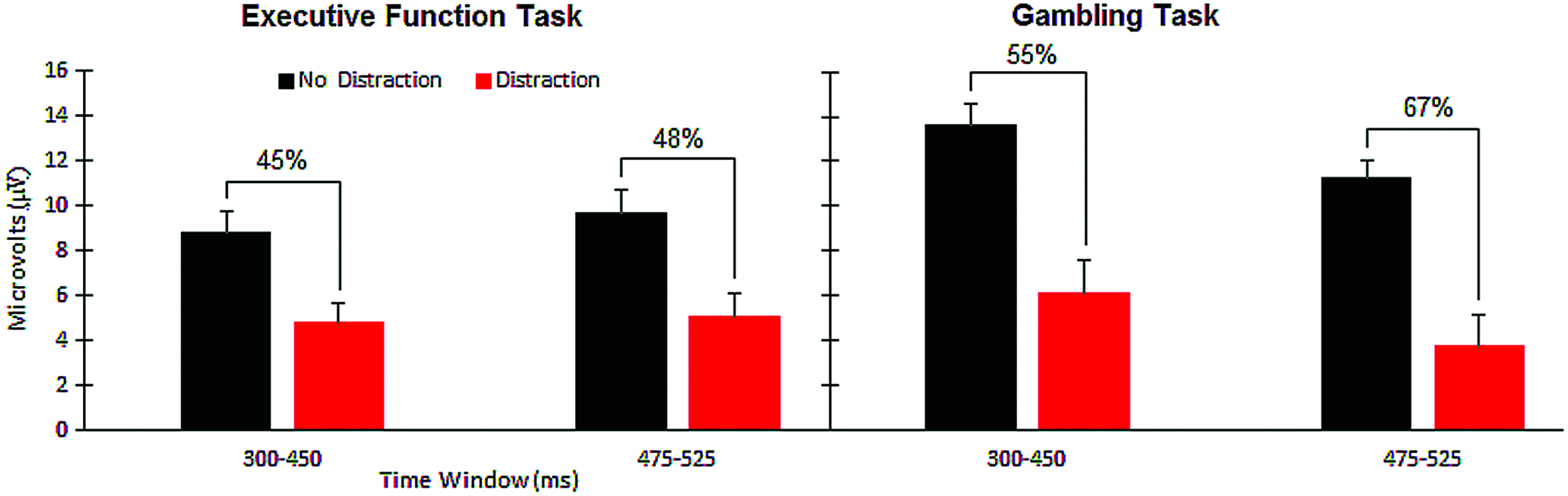
Mean ERP amplitudes averaged across selected CPz electrode sites (i.e., CP4, CPz, P4) for distraction and no-distraction trials during both Experiment 1a (left side) and Experiment 1b (right side). Color images available online at
Experiment 1b
The primary task was switched to a self-paced, gambling task to replicate and extend the smartphone distraction effects observed during Experiment 1a. The self-paced task examined whether distraction effects would be mitigated when participants controlled the primary task timing (vs. the computer-paced task in Exp. 1a). The outcome stimulus in this gambling task was expected to elicit larger P300 amplitudes than the executive function task (Exp. 1a) 17 to determine whether smartphone distraction effects varied as a percentage of the primary task P300 amplitude.
Method
The procedures were identical to those used in Experiment 1a with the following exceptions: twenty-three undergraduate students (aged 18–20 years old; M = 18.90, SD = 0.79; 8 males) participated for partial course credit and earnings from the gambling task (M = $11.83; range: $10.20–$13.80). The ERP data for three participants were excluded because of EEG recording problems (final sample, n = 20).
The primary task was a simple gambling task modeled after Kamarajan et al. 17 On each trial, participants saw a wager screen that had $0.05 on the left side of the screen, a $0.25 bet on the right side of the screen, and an arrow in the middle that varied depending on trial type. A double-sided arrow (“↕”) indicated that the outcome was unknown (gamble trial). An upward arrow indicated that the participant would win, and a downward arrow indicated that the participant would lose. ERPs were averaged across gamble and known trial types for analyses because this variable was part of another investigation. Win probability was set to 0.5 across all trials. The experimental phase consisted of one block of 120 (60 gamble and 60 known-outcome trials) randomly ordered trials, and one block of 120 no-distraction trials (i.e., no phone use).
Participants completed 12 practice trials to ensure that they understood the task, and they were given a $10.00 balance to start. Participants bet $0.05 by pressing the left response key (“/”) or $0.25 by pressing the right response key (“-”) on the keypad. After the bet, there was a black screen for 700 ms that was followed by the outcome screen. The outcome screen indicated a win (e.g., “WIN + $0.25”) or a loss (e.g., “LOSS − $0.05”) and updated the participant's pot total. A black screen filled the 1,000 ms intertrial interval.
ERPs were time-locked to the presentation of the outcome screen. Both experimental conditions had large signal-to-noise ratios (Distraction: M = 106 trials, range: 50–120; No distraction: M = 115, range: 91–120).
Results
Behavioral data
The time between the onset of the wager screen and the participant's key-press to place his or her bet revealed slower responses during distraction (M = 2,099 ms, SD = 1,032) than during nondistraction trials [M = 954, SD = 187; F(1, 19) = 24.12, p < 0.001]. Participants demonstrated good content knowledge of the online articles (Accuracy: M = 59 percent, SD = 18 percent).
ERP data
The P300 amplitude (Fig. 1) was smaller during distraction for both the 300–450 and 475–525 ms time intervals (Table 2). Figure 2 shows that reduction of the P300 amplitude during the gambling task (range: 55–67 percent) was larger than during the executive function task (Exp. 1a).
Experiment 1 discussion
Both experiments provide clear evidence that smartphone use is distracting. Response times were slower and P300 amplitudes were dramatically reduced (45–67 percent). The ERP distraction-effect measurement was conservative because ERP amplitudes were calculated over a time interval (vs. peak picking), and they were averaged across three electrode sites (vs. selecting one electrode with the largest difference). The distraction effects persisted when the primary task was self-paced (Exp. 1b), which adds electrophysiological support to the behavioral evidence that people are unable to effectively multitask when using a smartphone. 3
Despite these contributions, the present research only begins to understand how smartphone use affects cognition. For example, the present studies examine distraction from one smartphone task (reading online articles) when the device can be used for many different types of functions. Some tasks might be more engaging (text conversation, playing a game, etc.) and produce more distraction, whereas other tasks (scanning for new alerts) might be less engaging and produce less distraction.
Experiment 2
Learning and performing repetitive tasks is known to alter brain structure 18 and brain function. Therefore, it is likely that repeated smartphone use has an impact on our cognitive processing. Experiment 2 explored this possibility by comparing the ERPs from the Scisco et al. 13 sample to the sample tested in Experiment 1a (no-distraction condition). Both samples completed the same task without distraction, but the data for Scisco et al. 13 were collected in early 2007 before smartphone ownership was widespread,19,20 whereas Experiment 1a participants adopted smartphones around age 10 years old 21 and had several years of experience using these devices. ERP differences between the two groups would be preliminary evidence that smartphone use alters cognitive processing. There are obvious confounding variables when comparing two samples drawn from the same pool a decade apart (e.g., the emergence and use of social media). However, this is a worthwhile exploratory comparison because the institution has been relatively stable during this time (see Table 3 for key institution statistics).
AFAM, African American; AI/AN, Nonresident alien and American Indian/Alaskan Native categories made up <1 percent of the population; HIS/LAT, Hispanic/Latino; Percent Admit, percentage of applicants accepted; Retention, percentage of first-year students who return for their second year; SAT, 75th percentile SAT score; Top10%, percentage of students in the top 10 percent of their high school class.
Method
Procedure
The no-distraction trial block described in Experiment 1a (i.e., smartphone-experienced group) was identical to the switch-trial task in Scisco et al. 13 (i.e., smartphone-naive group). The naive group had extensive practice with the individual tasks 13 ; therefore, the naive group sample was compared with a subset (n = 17) of the experienced group selected because they completed the distraction trial-block first in the sequence. This selection procedure controlled for practice effects because both samples had extensive practice with the executive function task. After visual inspection of the ERP traces elicited by both groups, the N100 ERP component was analyzed in addition to the P300.
Results
Behavioral data
Accuracy on the executive function task did not differ between the experienced (M = 0.971, SD = 0.043) and naive groups [M = 0.975, SD = 0.027; F(1, 67) < 1, p = 0.608]. In addition, RTs did not differ between experienced (M = 2,094, SD = 495) and naive groups, M = 2,319, SD = 1,024; F(1, 67) < 1, p = 0.387.
ERP data
Figure 3 shows the N1 for naive group was significantly larger (more negative) than that of the experienced group [Group × AP: F(1.06, 70.90) = 10.55, p = 0.001; Group × LR: F(2.5, 167.24) = 5.10, p = 0.004; Group × AP × LR: F(4.26, 285.29) = 5.90, p < 0.001]. The P300 was significantly larger (more positive) for the naive group compared with the experienced group [300–450 ms: Group × AP × LR, F(6.20, 415.51) = 4.28, p < 0.001; 475–525 ms: Group × AP × LR, F(6.40, 428.95) = 4.55, p < 0.001].

Grand-average ERP data recorded during an executive function task. The blue lines represent ERPs recorded during late 2006 and early 2007 Scisco et al., and capture smartphone-naive processing. The black lines represent ERPs recorded during 2016 (Experiment 1a) and capture smartphone-experienced processing. The ERP traces at left (i.e., P7) and right (i.e., P8) parietal electrode sites depict the N100 ERP (150–200 ms). The right ERP trace depicts the midline parietal electrode (i.e., Pz) activity to highlight the P300 component. Topographic maps plot the naive minus the experienced ERP differences across the scalp. Color images available online at
Experiment 2 discussion
The task performance was similar for both the smartphone-experienced and smartphone-naive groups, whereas N1 and P300 amplitudes differed. Tasks with greater visual-spatial attention demands elicit larger lateral occipital N1 amplitudes. 8 The experienced group had a smaller N1 amplitude than the naive group, which provides evidence that they needed less visual-spatial attention to decode the stimulus display. Similarly, the experienced group had a smaller P300 amplitude, suggesting that the mental operations required less cognitive resources. We speculate that regular smartphone use (about 5 hours/day) develops visual-spatial attention because the complex, visual display of the smartphone contains many features to scan and attend or ignore. The enhanced visual feature detection (reflected in the reduced N1 amplitude) facilitates the mental judgment, which is captured by an attenuated P300 amplitude. These exploratory results point to the strong possibility that long-term smartphone use can alter cognitive processing. Given that people are using smart technology more than ever, a major research objective of psychology and neuroscience should be to determine exactly how, when, and to what degree smart technology usage affects processing.
Conclusion
The present research studies uncovered evidence of both positive and negative effects associated with smartphone use. Experiment 2 provided evidence that long-term smartphone use might develop visual-spatial skills that increases cognitive efficiency and suggests that smart technology use might have some beneficial effects on our brains. However, Experiments 1a and 1b provided evidence that smartphones are very distracting and consume about half of our limited cognitive resources (i.e., P300). When the primary task is critical, smartphone use might lead to serious, even deadly, consequences. We hope that people engaging in important tasks will turn off their smartphones until they can be used safely, because the evidence presented in this study suggests that your smartphone leaves you with only “half a brain.”
Footnotes
Acknowledgments
The authors thank Anna Abriman, Nabila Anika, Alex Batterman, Sabrina Bogovic, Kelly Cantwell, Maria Ciccone, Danny Gallagher, Rachel John, Julia Lester, Suma Mallepeddi, Cristina Nardini, Kalyani Parwatkar, and Megan Vantslot for their help with collecting the data.
Author Disclosure Statement
No competing financial interests exist.