




Abstract
Abstract
The purpose of this study was to analyze the temporal and reciprocal relationships between depression and online child sexual victimization, including both online sexual solicitations and interactions of minors with adults. Gender differences in these relationships were also examined. A total of 1,504 adolescents (52.4 percent girls; mean age = 13.11; SD = 0.79) completed measures at T1 and at T2, 1 year apart. The relationship among variables was analyzed using structural equation modeling. The prevalence for sexual solicitation and interactions was 7.1 percent and 3.6 percent at T1 and 15.1 percent and 8.2 percent at T2, respectively. More depressive symptoms by minors at T1 predicted an increased online sexual solicitation and interaction with adults at T2. However, T1 sexual solicitation and interaction were not related to T2 depression. These results were equivalent for both girls and boys. Moreover, the findings showed considerable stability of online sexual child victimization over time. Intervention efforts (i.e., preventative actions) should consider the depressive symptomatology among adolescents. Similarly, interventions should focus on monitoring victims to reduce the likelihood that they will be victimized in the future.
Introduction
I
Depression is also one of the most frequent problems during adolescence, with prevalence rates that increase progressively from 3 percent to 18 percent. 12 It is reasonable to infer that online child sexual victimization can increase the likelihood of depression during adolescence. In fact, longitudinal studies have associated victimization by offline child sexual abuse with greater rates of depression. 13 When studying community samples and clinical samples, depression is one of the most common consequences of past sexual abuse.13,14 Moreover, according to the stress-generation model of depression, stress not only increases the risk of depression but also may contribute to the generation of additional stress in depressed individuals' lives15,16; these effects appear to be strongest for dependent, interpersonal events, including victimization. 17 According to the stress generation perspective, people with depressive symptomatology are active agents in the creation of depressogenic life stressors. 15 In this perspective, the person's characteristics (e.g., cognitions that influence behavior, including values, beliefs, and expectations; traits and dispositions; learned behaviors; and problem-solving styles) and the context of the person's life (e.g., educational attainment, income and health) affect the likelihood of exposure to stressful life events. 18 Stress generation's effects appear to be equivalent for girls and boys, although evidence has been mixed. 19
Empirical studies have associated depressive symptoms with greater sexual exploitation online at the cross-sectional level, including sexual solicitation, sexual interaction, and grooming.3,20–22 In a study of maltreated girls from the Child Protective Services between 12 and 17 years old, Noll et al. 23 found that the maltreated girls showed significantly higher levels of depressive symptoms and a greater propensity to receive unwanted sexual requests; likewise, 30 percent of these girls reported meeting at least one person offline whom they had first met online. Nur Say et al. 24 found that, comparing youth victims of online sexual exploitation with youth with other Internet-related problems, the first had more co-occurring issues (e.g., depression, sexual victimization, and sexual acting out). In addition, de Santisteban and Gámez-Guadix 9 found that depressive symptoms were related to both higher sexual solicitation by adults and more sexual interaction among adolescents.
Nevertheless, to our knowledge, no previous studies have assessed longitudinal relationships between online child sexual victimization and depression. Moreover, to date, there is no empirical information on bidirectional relationships between online child sexual victimization and depression, so it is unclear whether depressive symptoms are antecedents or consequent of online child sexual victimization. There have been a few studies which assessed longitudinal relationships between other types of online victimization and depression that suggest that the relationship could be reciprocal. 25 For example, Gámez-Guadix, Orue, Smith, and Calvete 26 analyzed the bidirectional relationships between cyberbullying and depressive symptoms among adolescents. This study reported that cyberbullying victimization leads to an increase in depressive symptoms, and in turn, depressive symptoms increase the probability of cyberbullying.
The current study
The aim of the present study is to analyze the longitudinal relationships between online child sexual victimization and depression in a large sample of adolescents between 12 and 15 years old. Given the limited information on the directionality of these relationships, we also analyze the possible reciprocity between them. It is our aim to examine whether depressive symptoms increase the likelihood of sexual solicitation and interactions of an adult with a minor over time. Moreover, we examine whether a minor who has been sexually solicited by adults or has interacted sexually with adults experiences an increase in depression over 1 year. Finally, given the consequences of children's sexual abuse and stress generation effects that could differ among girls and boys, that is,19,27 this study aims to explore the possible sex differences in the relationships among depressive symptoms and sexual solicitation and interactions.
Our hypotheses are the following. First, based on the stress generation model, we hypothesize that the presence of depressive symptoms at T1 will increase the probability of being a victim of sexual solicitation and sexualized interactions with adults at T2. Second, based on previous studies of offline sexual abuse 10 and studies of other types of online victimization, 26 we hypothesize that being a victim of sexual solicitation and sexualized interaction at T1 will increase the probability of presenting at T2 with depressive symptoms.
Methods
Participants
The initial study sample at T1 consisted of 1,924 adolescents between 12 and 14 years old. The participants were recruited from 108 classrooms located in 11 secondary schools in a region of central Spain. As an inclusion criterion, minors must have been 14 years old or younger at T1 (and, therefore, 15 years old or younger at T2) because Spanish legislation establishes 16 years old as the minimum age of sexual consent. 28 The schools were randomly selected and included both public and private educational institutions. Of the 1,924 participants, 1,504 completed the measures of the two waves of the study (mean age = 13.11, SD = 0.79; female: 52.9 percent; male: 46.1 percent; not reported: 1.1 percent), which involved a 1-year time interval between T1 and T2 (permanence rate = 78 percent).
Measures
Questionnaire of sexual solicitation and interactions with adults 29
This instrument measures two dimensions of online sexual victimization: sexual solicitation and sexualized interaction. Adolescents were asked how often they experienced a particular sexual solicitation or interaction with a person who was aged 18 or older during the past year, using a 4-point Likert scale: 0 (never), 1 (once or twice), 2 (3–5 times), and 3 (6 or more times). The Sexual Solicitation Scale was made up of five items (e.g., “An adult asked me for pictures or videos of myself containing sexual content”; “An adult has asked me to have cybersex [e.g., via a webcam]”). The Sexual Interaction Scale was made up of five items (e.g., “I have sent an adult photos or videos with sexual content of me”; “We have met offline to have sexual contact”). This questionnaire has shown good psychometric properties (e.g., content, factorial, concurrent validity, and reliability) among adolescents. 29 The internal consistencies were α = 0.86 and 0.61 in T1 and α = 0.86 and 0.70 in T2 for the sexual solicitation subscale and the sexual interaction subscale, respectively, in this sample.
Depression
We used the depression subscale of the Brief Symptom Inventory 30 (BSI) to assess the presence of depressive symptoms. Participants were required to indicate how frequently they had experienced each symptom (e.g., “Feeling sad” or “Feeling no interest in things”) during the past 2 weeks. The scale included six items with a response format that ranged from 1 (not at all) to 4 (extremely). The BSI has shown good psychometric properties in the Spanish population. 31 Internal consistencies in the present study were 0.86 in T1 and 0.88 in T2.
Procedure
The Autonomous University of Madrid Ethics Committee reviewed and approved the study. Participants' responses were kept anonymous to promote honesty, and participation was voluntary. Parents were notified and given the option of not allowing their children to participate in the study, and they were informed that the study would be repeated the following year under the same conditions; subsequently, 85 parents (4.42 percent) declined participation at T1. All adolescents who had participated in the T1 study gave their consent for the T2 study. The adolescents completed the questionnaire in their classrooms with a study assistant present. Participants were encouraged to ask questions if they had trouble responding to any of the items. After completing the questionnaire, participants were given a sheet informing them of related resources in the community and the researchers' e-mail contacts. T1 sample was collected between March and May of 2016, and T2 sample was collected between March and May of 2017.
Statistical analysis
We used path analysis to test our hypotheses using the EQS software. 32 Goodness of fit was assessed by the non-normed fit index (NNFI), the comparative fit index (CFI), the root-mean-square error of approximation (RMSEA), and the standardized root-mean-square residual (SRMR). NNFI and CFI values of 0.90 or higher indicate a good fit. RMSEA values of less than 0.06 and SRMR values less than 0.08 reflect an adequate fit. 33
Results
Descriptive analysis
Table 1 shows the total prevalence of sexual solicitation and sexual interaction in T1 and in T2. We found significant differences between males and females in the total prevalence of sexual solicitation in T1, with a prevalence of 4.0 percent for boys and 9.8 percent for girls, χ2 (1, n = 1,504) = 18.64, p < 0.001. In addition, 3.6 percent and 3.8 percent of boys and girls, respectively, reported some type of sexual interaction at T1, χ2 (1, n = 1,504) = 0.06, ns. Regarding T2, there are significant gender differences in sexual solicitation, with a prevalence of 7.6 percent in boys and 21.5 percent in girls, χ2 (1, n = 1,504) = 55.63, p < 0.001. In regard to sexual interactions in T2, there were also significant gender differences, with a prevalence of 4.6 percent in boys and 11.3 percent in girls, χ2 (1, n = 1,504) = 22.10, p < 0.001.
p < 0.05, **p < 0.01, ***p < 0.001.
Analysis of the longitudinal model
Table 2 shows the bivariate correlations between variables in the study. As displayed, all the correlations were significant and in the expected directions.
p < 0.05, **p < 0.01, ***p < 0.001.
First, an initial model was estimated that included all the longitudinal and bidirectional relationships of sexual solicitation and sexual interaction with depression; thus, the hypothesized model included paths from T1 sexual solicitation and sexual interaction to T2 depression and paths from T1 depression to T2 sexual solicitation and sexual interaction. The model also included the autoregressive paths from each variable in T1 to the same variable at T2. This approach allowed us to examine the extent to which T1 predictors accounted for a change in T2 variables over time.
The initial estimated model showed that some paths were not statistically significant. For example, the paths from T1 sexual solicitation to T2 depression were not statistically significant. These paths were removed from the model, which was then reestimated based only on the significant paths (Fig. 1). In addition, the modification indices provided by EQS (i.e., LM test statistics) suggested adding the residual covariance between T2 sexual solicitations and T2 sexual interactions. Given the substantive rationality of this covariance, the model was specified, adding this parameter.
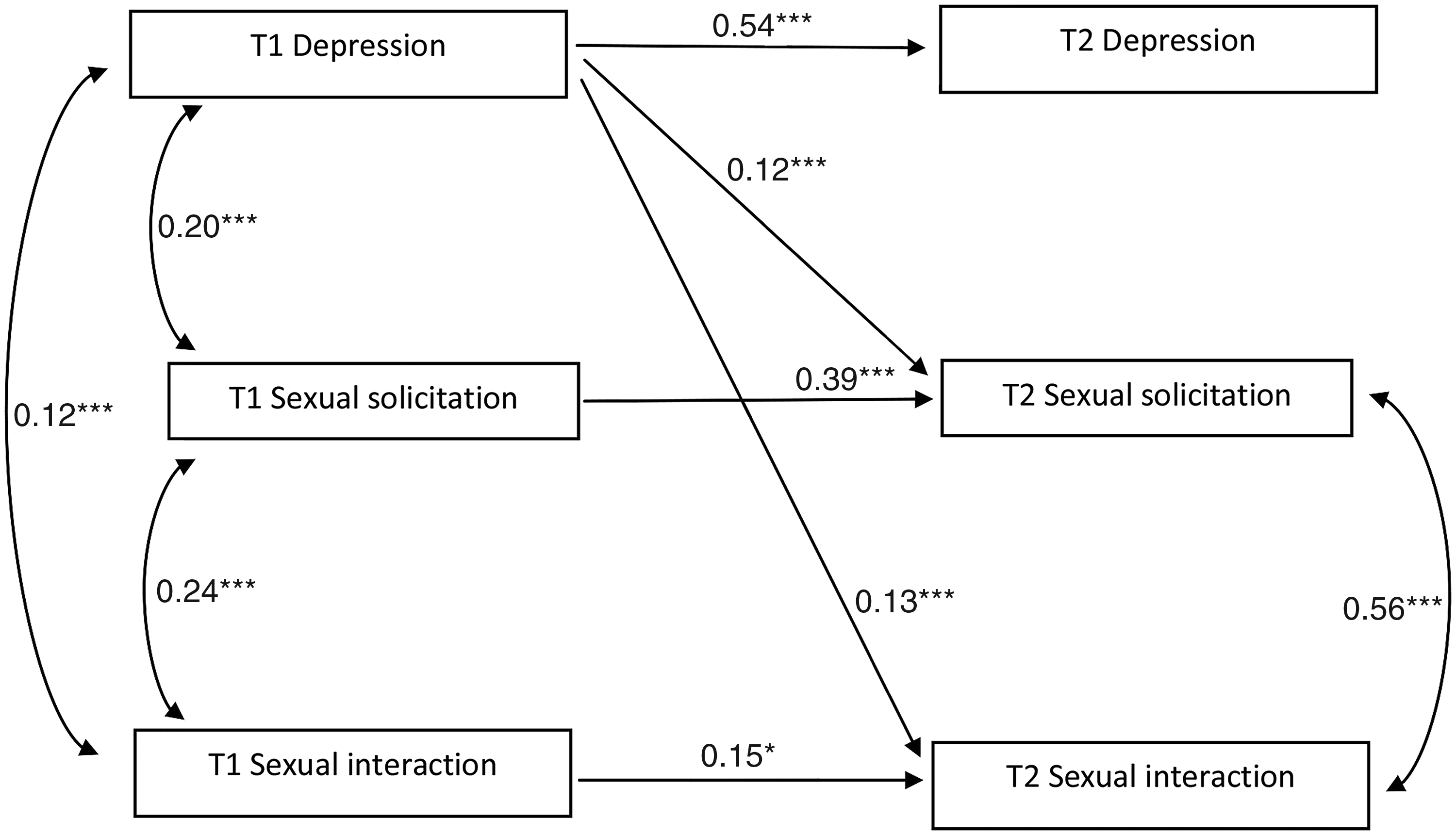
The estimated model in the relationships between sexual solicitation, sexual interaction, and depression (standardized parameters). Note: *p < 0.05. **p < 0.01. ***p < 0.001; SBχ2 (6, n = 1,503) = 12.07, NNFI = 0.94, CFI = 0.98. RMSEA = 0.026 (90 percent CI: 0.000–0.047), SRMR = 0.027. CFI, comparative fit index; NNFI, non-normed fit index; RMSEA, root-mean-square error of approximation; SRMR, standardized root-mean-square residual.
The fit indexes for the final were satisfactory for the model: SBχ2 (6, n = 1,503) = 12.07, NNFI = 0.94, CFI = 0.98, RMSEA = 0.026 (90 percent CI: 0.000–0.047), SRMR = 0.027. As shown in Figure 1, results revealed several significant relationships. At the cross-sectional level, all the relationships between the variables were significant, ranging from 0.12 (for the relationship between depression and sexual interaction) to 0.24 (for the relationship between sexual solicitation and sexual interaction).
Longitudinally, depressive symptoms at T1 increased the probability of reporting more sexual solicitation T2. Similarly, T1 depressive symptoms significantly increased the likelihood of sexual interactions with an adult at T2. Nevertheless, neither T1 sexual solicitation nor T1 sexual interaction increased the probability of reporting more depressive symptoms at T2. Finally, the autoregressive paths for sexual solicitation, sexual interaction, and depression between T1 and T2 were all highly correlated and significant.
Gender differences
Finally, we examined whether the relationships between the variables in the model were different as a function of the participants' gender. A multigroup analysis was conducted using the steps outlined by Byrne (2006). First, we analyzed whether the model fit was adequate for each gender separately [Girls: SBχ2 (6, n = 795) = 12.83, NNFI = 0.90, CFI = 0.96, RMSEA = 0.038 (90 percent CI: 0.005–0.067), SRMR = 0.033; Boys: SBχ2 (6, n = 693) = 12.07, NNFI = 0.99, CFI = 0.99, RMSEA = 0.000 (90 percent CI: 0.000–0.037), SRMR = 0.028]. Second, we estimated a model, in which all the factor loadings and structural relationships were freely estimated for each gender (i.e., an unrestricted model). This model provided an adequate fit to the data: SBχ2 (12, n = 1,488) = 7.52, NNFI = 0.99, CFI = 1.00, RMSEA = 0.00 (90 percent CI: 0.000–0.017), SRMR = 0.028. Finally, the unconstrained model was compared with a model that constrained the pattern of paths between the variables to make them equal for both subsamples (i.e., girls and boys). This imposition did not increase the value of the chi-square significantly, Δχ2 (9, n = 1,488) = 4.48, p = 0.87, indicating that the general pattern of relationships was equivalent for girls and boys.
Discussion
The purpose of this study was to provide evidence of the temporal and reciprocal relationships between online sexual victimization and depression among adolescents. This study shows that online sexual victimization is a significant problem during early adolescence, with prevalence that reaches 15 percent for sexual solicitation of minors and 8 percent for sexualized interactions, in which the adult exploits the minor.
Findings showed that depression predicted increased online sexual solicitation and interaction 1 year later. The results regarding depressive symptoms as precursors of sexual solicitation and interaction are consistent with the stress generation model of depression.16–18 It is possible that adolescents with depressive symptoms have fewer coping skills to identify potential sexual offenders in their social media interactions. It is also possible that adolescents who are more depressed have more difficulties learning to socialize and to establish adequate relationships in their online environment; thus, they are more vulnerable to online predators. These findings suggest that adult offenders could target especially vulnerable minors to persuade and victimize them online. Moreover, this is consistent with the literature of sexual grooming that informs that offenders seek and prepare vulnerable victim to perpetrate sexual abuse. 6 This relationship between depression and online sexual victimization is congruent with previous cross-sectional findings.3,9,20,21,23
Contrary to our hypotheses, however, sexual solicitation and interaction did not increase the probability of depressive symptoms. This finding could be due to several factors. First, it is important to note that absence of evidence does not mean absence of relationship. 34 In this sense, it is possible that the consequences of online victimization appear at longer time intervals than those analyzed in this study. Future studies should examine longer time periods. Second, although studies on other types of online victimization (e.g., cyberbullying) have found a bidirectionality between victimization and depression, 26 it is possible that online sexual victimization made by adults leads to more covert and progressive processes than peer harassment. An adult offender may initially appear as a bonding figure for the child, rather than as a hostile figure as it happens in cyberbullying. In this sense, previous literature reports that the processes in online sexual abuse by adults to minors (e.g., grooming) often present subtle psychological manipulation.6,7 In fact, many children claim to be “voluntarily” with the adult. 23 This could cause that abuse typical of sexual solicitation and interactions may be more difficult to identify than the direct aggression typical of cyberbullying, and that the consequences on the child's mood may take longer to appear. Also, this tendency to minimize the abuse could cause the minors to also deny the negative consequences of it. Future studies should explore these hypotheses. In addition, other possible consequences not evaluated in this study could be derived from online victimization (e.g., increased anxiety or worse academic performance); therefore, future studies should explore additional negative outcomes of online child sexual victimization.
Finally, it is important to note the considerable stability of the sexual solicitation and interactions over time. This stability indicates that those adolescents who were victims in T1 also tend to be victims in T2. These results are congruent with studies on traditional sexual abuse, which show that sexual revictimization is relatively common in offline childhood sexual abuse.13,14 This is also consistent with previous studies that pointed to a greater vulnerability of youth who were victims of online sexual exploitation compared to youth with other Internet-related problems (e.g., harassment, isolative-avoidant behavior, fraud or deception, exposure to harmful material that is nonsexual in nature), showing victims of online sexual exploitation more co-occurring problems such as depression, sexual victimization, and sexual acting out.22,24 These co-occurring issues may have developed earlier in adolescents with histories of maltreatment and previous abuse, as observed in some studies. 23 This situation of greater vulnerability can lead to later difficulties in identifying inappropriate relationships with potential offenders.6,23
Finally, we analyzed the possible gender differences in the model relationships. Findings showed that the associations between depressive symptoms and online sexual solicitations and interactions were equivalent for both girls and boys. In other words, depression symptoms increase the risk of online sexual victimization regardless of the gender of the victim. This is congruent with previous findings on offline sexual abuse showing that gender did not moderate the association between youth psychological adjustment and abuse. 27 This also supports the idea that stress generation effects operate for both girls and boys. 19
Conclusion
This study contributes to better understanding of the relationships between online sexual victimization of adolescents and depression. Findings have several implications for interventions. First, as depressive symptoms appear to predict online sexual victimization, prevention programs should focus on the promotion of psychological well-being, self-esteem and self-confidence, and increasing social support strategies. Likewise, intervention efforts should pay attention in detecting depressive symptomatology among adolescents to work on elements of vulnerability and reduce them. It is also important to educate minors about the risks of contacting unknown adults through the Internet, as well as the importance of developing age-appropriate relationships in the online and offline social contexts. Also, although this study did not support the argument that sexual solicitation and sexual interaction predict an increase in depression over time, this should not discourage attention to possible consequences among victims, such as low self-esteem, anxiety, substance use, or worse academic performance. It is also important to examine the level of justification that the victim makes for the abuse due to the psychological manipulation that characterizes the processes of online grooming and online sexual victimization. Finally, given that the results show stability in online victimization, both in sexual solicitation and in sexual interaction, interventions should focus on tracking victims to reduce the likelihood that they will be victimized in the future.
Footnotes
Author Disclosure Statement
No competing financial interests exist.