




Abstract
Abstract
The present study investigates the characteristics of discussion of conspiracy theories about the Zika virus outbreak of 2015–16 on Twitter. Content and social network analysis of a dataset of 25,162 original Tweets about Zika virus conspiracy theories showed that relative to debunking messages, conspiracy theories spread through a more decentralized network, are more likely to invoke supposedly knowledgeable authorities in making arguments, and ask more rhetorical questions. These trends can be understood in the context of previous work on conspiracy theories, including the “just asking questions” style of rhetoric, the importance of sourcing and authority, and the tendency to simultaneously consider many different potential conspiracies that might underlie an important topic or event.
Introduction
R
Precisely because they help to make sense of the world, rumors tend to arise in crisis situations, where the world does not otherwise make much sense in its usual way. 2 These same situations also give rise to conspiracy theories, which, much like rumors, can help people make sense of ambiguity. Defined as suspicions that powerful people or organizations are secretly carrying out sinister plans by deceiving the public at large, conspiracy theories can provide an immediately understandable picture of a situation: why something happened, who benefits from it, and who should be blamed. It makes sense to ask whether conspiracy theories are just another kind of rumor, and indeed some scholars have reached conclusions along those lines. 3
There are certainly some conceptual similarities between rumors and conspiracy theories. However, are they psychologically different? Do people believe or reject these things for the same reasons? Previous work has defined rumors as unverified propositions that make claims to truth and that generally have personal relevance to the people who spread and consume them. 4 In that sense, at least some conspiracy theories fit the definition of rumors. For example, conspiracy theories alleging secret government persecution of African-Americans (e.g., HIV/AIDS as a bioweapon created for racial genocide) were popular in African-American communities, particularly among people who felt victimized by and alienated from institutions like government and politics. 3 Experimental research has shown that conspiracy theories about a particular event arise specifically from a need for sense-making, 5 and that this need is strongest when the event in question is both severe and self-relevant—essentially the same conditions under which rumors tend to arise.
Recently, the research literature on rumors and conspiracy theories have begun to converge. In part, this seems to have been driven by the quantity and visibility of online discourse around conspiracy theories and the combination of qualitative content analysis and big-data analytics that have come to define the study of rumors.2,6–10 This recent research has produced a few key results. First, conspiracy theories are like rumors in that they act as an ongoing sense-making procedure. They are constructed and spread discursively, evolving and changing over time as new information comes along. 10 Second, at least three predictors of rumor-mongering match correlates of conspiracy theory: uncertainty, personal involvement or relevance, and anxiety or stress.5,7,11 Finally, even though both conspiracy theories and rumors can be seen as ways of dealing with uncertainty, they are characterized by uncertainty themselves. For instance, work on Twitter rumors about disaster events has shown that rumor-spreading messages frequently demonstrate uncertainty, for instance via the use of leading questions or expressions of incredulity. 9 Psychological research has shown that conspiracy theories are often vague and uncertain, perhaps better understood as manifestations of broad suspicions than as definitive, free-standing beliefs.6,12,13
The present study seeks to use some of the tools common to the rumor literature and apply them to conspiracy theories with a psychological lens. Through the analysis of social networks and quantitative content, the present study examines several questions regarding the spread of conspiracy theories on Twitter. As part of a case study, the analyses will focus on conspiracy theories about the 2016 Zika virus outbreak, with a particular eye toward comparing tweets that propagate these theories with those that debunk them.
The Zika virus and its conspiracy theories
The mosquito-borne Zika virus was the subject of international media coverage starting in early 2016, when it was linked to a rapid rise in microcephaly cases in Latin America. The expert consensus was, and continues to be, that the virus originated in Africa, is carried by the Aedes aegypti mosquito, and can cause microcephaly and other fetal abnormalities if a woman is infected early in pregnancy. 14
Conspiracy theories about Zika take issue with these ideas. One theory is that the virus is a bioweapon rather than a natural occurrence. Another is that the virus is actually harmless and the microcephaly epidemic is instead caused by pesticides, genetically modified mosquitoes, or vaccine side effects. Yet another claim is that Zika vaccine development efforts are part of a broader plan for global depopulation. Numerous other theories exist as well.10,15 The words “hoax” and “false flag” appear often. Many of these claims have clear links to other conspiracy theories—for instance, the biotechnology corporation Monsanto or the Rockefeller business empire are sometimes presented as the most likely perpetrators of the conspiracy, a typical pattern in conspiracy discourse. 12 In general, these theories spread on social media and through discussion websites like Reddit, 10 where they, and the bits of evidence supporting or contradicting them, were discussed and elaborated upon. This discussion is the focus of the present study.
Network characteristics of propagation versus those of debunking
Online discussion on social network services such as Twitter and Facebook takes place, obviously, in networks. Someone's immediate network consists of his or her friends or followers, but each of those friends has his or her own connections. In this way, content can spread across the service via personal connections: Person A posts a tweet which is then seen and retweeted by Person B, then by Person C (who saw it through his or her connection with B), and so on. The propagation of information in this way can be analyzed by means of social network analysis, which maps out the connections of each member of the network and produces summary statistics describing the network's characteristics. What similarities and differences might we expect between the networks of those who propagate conspiracy theories and those who debunk them?
One important characteristic of any network structure is its degree of centralization, and for this factor, we might expect to see a difference between propagators and debunkers. Conspiracy theories are generally seen as counter-narratives that arise in opposition to official or mainstream accounts, and these theories generally exist in many competing variants.12,16 This would suggest that a propagator network might be less centralized than a debunker network, which might “follow the leader” in spreading official information from recognized authorities. On the other hand, belief in a given conspiracy theory is often provisional. A person's endorsement (for example, via retweeting) of a particular conspiracy theory does not preclude that person from doing the same for a different, contradictory theory—if anything, it makes it more likely.13,17 Conspiracy theory networks may have a few central nodes acting as clearinghouses of many different, competing suspicions. Because of this tendency, networks of propagators might be more centralized than those of debunkers.
Message content
The Rumor Interaction Analysis System (RIAS) allows quantitative classification of rumor-spreading messages according to a few different criteria. 1 Among other things, RIAS examines messages for the expression of belief or disbelief in a rumor, whether that message contains a directive (e.g., “We need to stop this”), and whether that message shows an attempt to authenticate the information within (e.g., by referring to a trusted source). This study uses an adapted version of RIAS to examine the characteristics of conspiracy theory tweets. Previously, conspiracy theories were found to emerge in opposition to particular mainstream or official accounts, and it was thought that rumors were often accompanied by expressions of uncertainty.9,17 On the basis of these characterizations, it was expected that tweets propagating conspiracy theories would contain fewer authentications and would use more rhetorical questions.
Method
Data collection
An archive of public tweets was solicited from Twitter by using the Historical PowerTrack API. The data set comprised 88,523 tweets posted from September 1, 2015 through March 31, 2016. Each mentioned either Zika or microcephaly as well as one of several keywords common to the various conspiracy theories regarding the virus, such as “Monsanto” or “false flag” (see the Supplementary Data for the full query used; Supplementary Data available online at
Coding
RIAS 1 represents a good initial approach to coding Twitter data, as the short messages lend themselves well to simple coding. However, several of the original RIAS coding categories were not well suited to the present dataset, perhaps because of the discrepancies in rumor types or lengths of outputs. As such, a modified version of RIAS was used for the present study (Table 1).
The content of posted links was taken into account in coding reference, belief, and disbelief. Initial coding was conducted on a randomized subsample of 99 tweets by two independent raters. Interrater agreement across all variables was good to excellent, with the exception of directives, for which there were no exemplars in the subsample (Table 1). Overall chance-corrected multivariate interrater reliability (iota) for all other variables was nearly perfect, 18 with ι = 0.853.19,20 All remaining tweets were single coded.
Account-level analysis
The retweet network structure was analyzed by using the R package igraph. 21 First, the conspiracy orientation of each user account was determined by its proportion of belief tweets to the sum of its belief and disbelief tweets (either authored or retweeted). Therefore, accounts with an orientation score of 1 only expressed belief in Zika conspiracy theories, while accounts with an orientation score of 0 only expressed disbelief. Accounts were then organized into a network graph in which vertices represented accounts and edges represented retweet relationships.
Results
Overall sample characteristics and RIAS analysis
The sample encompassed 25,162 original tweets that referred to at least one Zika conspiracy theory. Of these, 17,421 expressed belief; 6,555 expressed disbelief; and 1,186 were ambivalent or ambiguous.
Analysis of the modified RIAS categories revealed significant differences between belief and disbelief tweets in terms of authenticating (belief 25.56 percent, disbelief 5.80 percent, χ2[1] = 1,155.48, p < 0.001, φ = 0.22), and rhetorical questions (belief 14.90 percent, disbelief 9.37 percent, χ2[1] = 125.82, p < 0.001, φ = 0.073). Directives were equally uncommon across both categories: belief 0.51 percent, disbelief 0.53 percent, χ2(1) = 0.08, p = 0.781. Figure 1 shows a wordcloud 22 of the most popular words in the corpus of all tweets and retweets, colored according to their relative prevalence in belief and disbelief tweets.
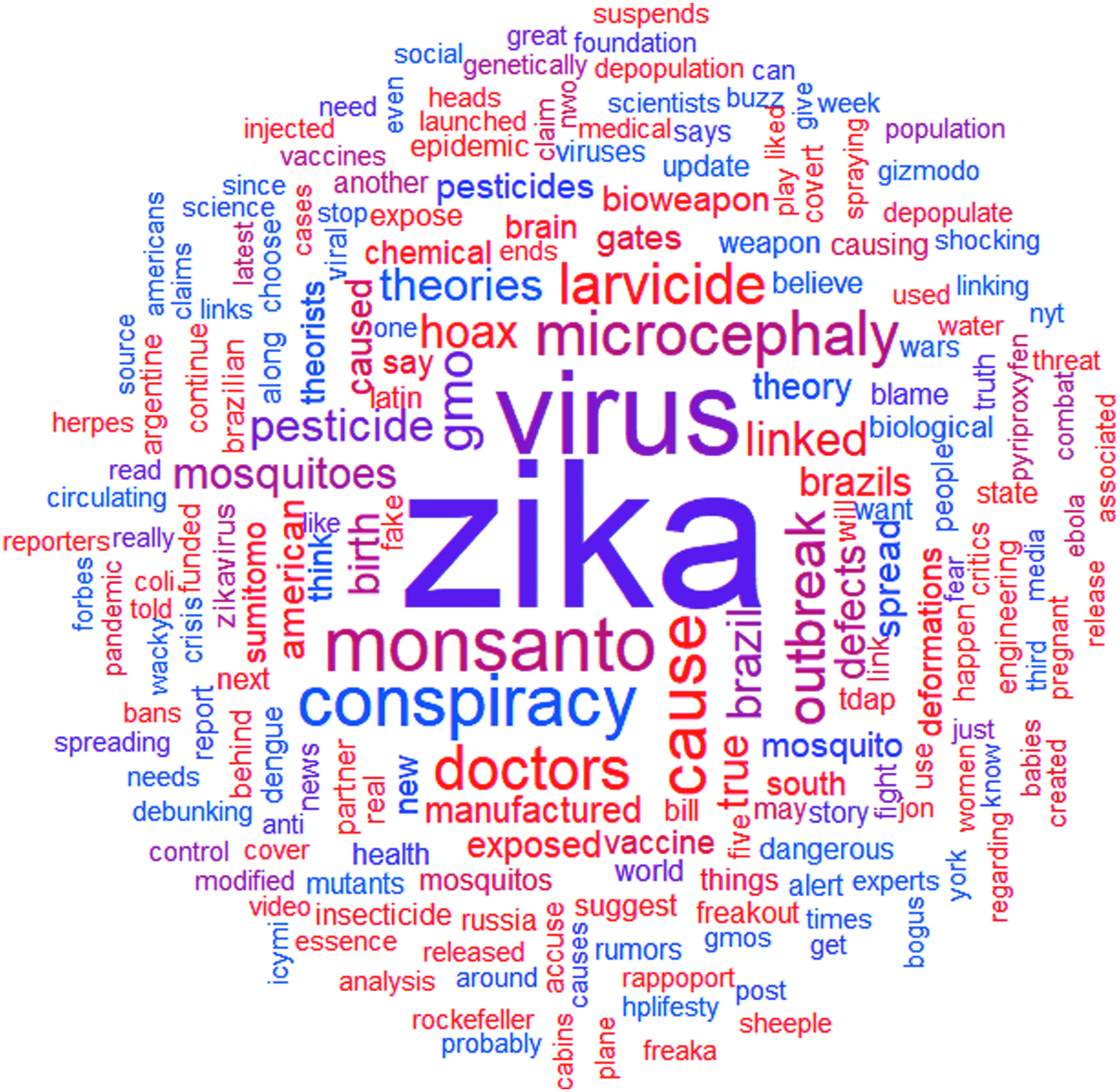
The 200 most frequent words across all tweets and retweets that expressed belief or disbelief in Zika virus conspiracy theories. Size represents frequency of appearance, and color represents the belief orientation of tweets containing that word. Redder words were used proportionately more often in tweets expressing belief in Zika conspiracy theories, and bluer words were used proportionately more often in disbelief tweets.
Retweet network analysis
Sixteen thousand five hundred eighty-seven accounts expressed belief in Zika conspiracy theories in over half of their tweets and were thus classified as propagators, while 7,449 expressed disbelief in over half of their tweets and were thus classified as debunkers. Two separate subnetworks were analyzed: one of propagators retweeting propagators, and one of debunkers retweeting debunkers (Fig. 2).
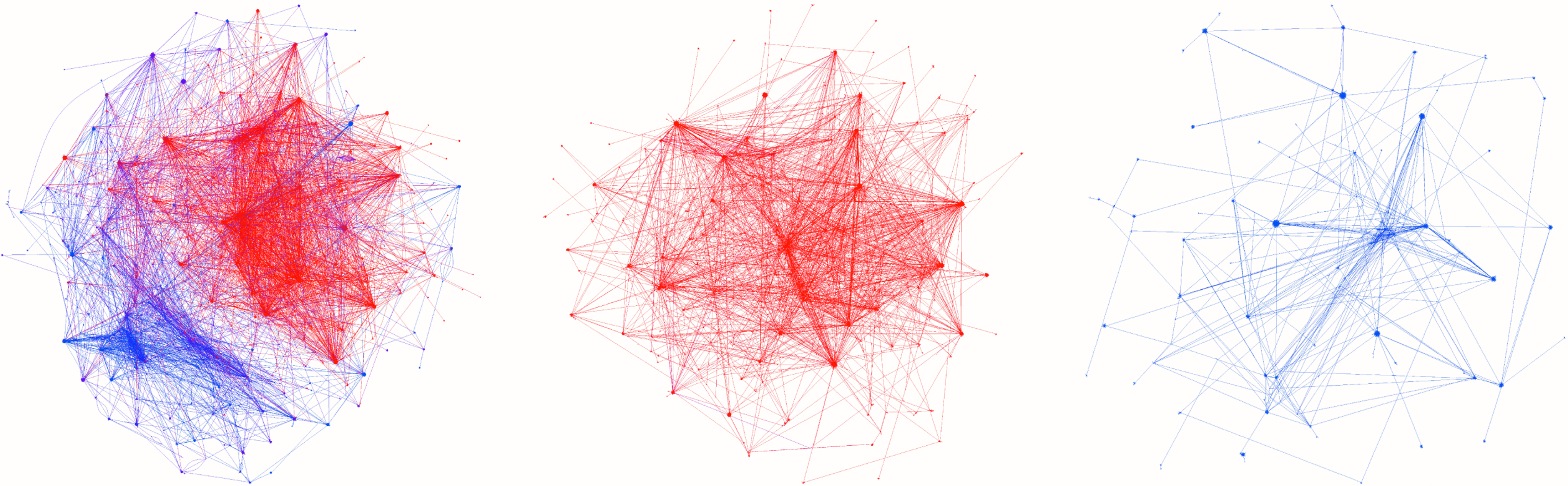
Fruchterman-Reingold plots of the retweet networks formed by all accounts (left), conspiracy theory propagator accounts (middle), and debunker accounts (right). Nodes are colored in accordance with their conspiracy orientation on a gradient from red (propagator) to blue (debunker). Vertices are colored as the midpoint between the two connected nodes.
Freeman centralization was calculated separately for each subnetwork on the basis of undirected degree centrality. Freeman centralization is a measure of the degree to which the most central node of a network is more central than the other nodes; values can range from 0 (completely interconnected) to 1 (completely centralized). Consistent with the hypothesis, the propagator network was less centralized than the debunker network (0.0365 vs. 0.0820). The analysis produced the same general pattern of results when centrality calculations were based on a directed graph, so that accounts that retweeted prolifically but were rarely retweeted were given low centrality values.
Discussion
The present study set out to investigate the characteristics of conspiracy theory discussions on Twitter through the lens of rumor theory and through social network analysis. The results showed that in propagator tweets, more rhetorical questions were asked and a greater number of claims included explicit references to authorities. In addition, the propagator network was relatively more decentralized (and considerably larger) than the debunker network.
The greater prevalence of rhetorical questions in propagator tweets matches the previous observation that rumor spread is often accompanied by disclaimers of uncertainty, 9 as well as the pattern of “just asking questions” as a common rhetorical characteristic of conspiracy theory. 23 This style of argument uses leading questions to undermine rival explanations without opening oneself up to criticism by providing an alternative. Surprisingly, and contrary to predictions, propagator tweets also made more explicit references to sources for their claims. A great deal of these referred to a single entity: Physicians in the Crop-Sprayed Towns (PCST), an Argentine anti-pesticide activist group alleging that the mosquito larvicide Pyriproxyfen was the true case of the microcephaly outbreak. 24 This version of the insecticide conspiracy theory was very popular: 14 percent of the original tweets in the dataset contained the word “doctors,” which almost always referred to PCST. While the importance of authenticating statements in the spread of conspiracy theory has not yet been observed in the empirical literature, there is some precedent for it in theoretical work on conspiracy theory. Several scholars have noted that conspiracy texts often overuse citations, allegedly as a way of seeming more respectable, academic, or well-grounded. 23 Given the overrepresentation of the PCST/Pyriproxyfen conspiracy theory in this dataset, it is not clear whether this is a general tendency or a peculiarity of the Zika virus conspiracy theories themselves.
The difference in centralization is in line with previous findings of a distributed (though interconnected) alternative media ecosystem involved in the manufacture and promotion of conspiracy narratives. 8 In contrast to this decentralized propagator network, the debunker network was more heavily centralized around a few highly influential mainstream media accounts (PolitiFact and The New York Times were the most widely retweeted debunkers). Intuitively, “official” explanations are the purview of highly influential epistemic authorities, while the conspiracy theories that challenge them are the product of a relatively decentralized, “grassroots” sense-making effort. Here, we see that debunking conspiracy theories rely on a few highly influential official or authoritative sources, while the conspiracy theories themselves arise in a broader fashion without such centralized information. Yet the opposite pattern was observed in the data here: the propagator network was more heavily centralized around a few highly influential accounts. Still, as is clear from the graphs, influential accounts exist within the propagator sphere. Many of the more successful conspiracy theories were disseminated widely by some highly influential users. The diversity of conspiracy theories is not an obstacle here, either. While Zika cannot be both a deadly bioweapon and a harmless scapegoat for pesticide side effects, these conflicting theories found traction within the same networks (and often the same accounts). Future research could focus further on the role of the influential propagators that shape the dynamics of their network, as well as their more powerful counterparts in the debunking network.
The conclusions drawn here are limited somewhat because data collection was limited to messages written only in English. Although there have been cases of Zika in English-speaking countries, the epidemic primarily affected Latin American countries, particularly Brazil. The threat and uncertainty produced by the virus might therefore have been much stronger and more visible in Portuguese or Spanish messages, and future research on Zika rumors could compare how these ideas spread across cultural, national, and linguistic boundaries (with the necessary care taken to use appropriate data pre-processing25,26).
For much of the present sample, the risk of infection was mostly theoretical. However, it is unclear whether this would have meaningfully affected the pattern of results. A higher degree of threat may have accentuated the differences observed between conspiracy theory propagators and debunkers in this sample. Still, non-English-language research on conspiracy theories is generally underrepresented in the current canonical work on the subject;, and psychological research in particular has been criticized for overreliance on samples from the United States. 27
It is not clear whether the current findings generalize well across cultural contexts—or indeed across conspiracy theories. Future research on this issue should examine conspiracy theories regarding other topics. In particular, conspiracy theories with clearer partisan or ideological divisions 28 or about singular events (rather than an ongoing epidemic) might give rise to different network structures. Finally, while much research has been done on what prompts rejection or acceptance of conspiracy theories, there has been relatively little work on the moderating role of elites or trusted sources. 29 On the basis of our study results, it would make sense to examine how the particularly influential individuals and organizations at the centers of their respective networks cultivate influence over and the trust of their audiences. 30
The present study has shown that conspiracy theories can be considered a form of rumor and analyzed on that basis: the patterns of behavior in propagator messages matched the predictions from prior research on conspiracy belief. The structure of the retweet network reinforces the essential and decentralization of conspiracy theories and the importance of influential individuals in spreading and debunking rumors and misinformation.
Footnotes
Acknowledgments
This study was funded by the British Academy/Leverhulme Trust Small Grants Scheme, grant number SG161736. The author would like to thank Kiia Huttunen for her hard work on coding the data set.
Author Disclosure Statement
No competing financial interests exist.
References
Supplementary Material
Please find the following supplemental material available below.
For Open Access articles published under a Creative Commons License, all supplemental material carries the same license as the article it is associated with.
For non-Open Access articles published, all supplemental material carries a non-exclusive license, and permission requests for re-use of supplemental material or any part of supplemental material shall be sent directly to the copyright owner as specified in the copyright notice associated with the article.
