




Abstract
Abstract
This article reviews the 6-month followup data of a randomized, multicenter, parallel-group study conducted at five clinical sites in three European cities, which compared two second-level treatments for bulimia nervosa (BN) and binge eating disorder (BED): virtual reality-based cue exposure therapy (VR-CET) versus additional cognitive behavioral therapy (A-CBT). Post-treatment outcomes of this study were previously published and details of its design can be found at clinicaltrials.gov (identifier: NCT02237300). This article focuses on the evolution of symptoms assessed after 6 months of followup in a subgroup of 58 patients from the original study. In this study 64 patients with eating disorders (EDs) (35 with BN and 29 with BED), who still showed active episodes of binge eating by the end of a structured CBT program (first-level treatment), were randomly assigned to one of two second-level treatments (A-CBT or VR-CET). Frequency of binge and purge episodes, and attitudinal features of binge-related EDs (bulimia, drive for thinness, and body dissatisfaction) were assessed before starting the second-level treatment (n = 64), at the end (n = 64), and at 6-month followup (n = 58). Mixed between-within subject analyses of variance were used to compare outcomes of both second-level treatments over time. Although both treatment conditions showed statistically significant improvements at the end and after 6-month followup, obtained reductions were greater after VR-CET, regarding binge and purge episodes, as well as the decrease of self-reported tendency to engage in overeating episodes. Accordingly, abstinence from binge episodes were higher in VR-CET than A-CBT at followup (70 percent vs. 26 percent, respectively; χ2 = 11.711, p = 0.001). These results provide further support for the use of VR-CET as an effective second-level intervention for BN and BED treatment-resistant patients.
Introduction
Considerable evidence from reviews and meta-analyses of clinical trials supports cognitive behavioral therapy (CBT) as the first-choice treatment for both bulimia nervosa (BN) and binge eating disorder (BED).1–4 Overall, outcomes obtained after CBT point to significant improvements in terms of behavioral and psychological features of these disorders. 5 However, a high percentage of BN and BED patients do not improve after a first-level intervention (i.e., CBT)6,7 and the short- and long-term rates of remission from eating disorder (ED) cognitions and behaviors range from around 37 to 69 percent across trials. 8 Given the high prevalence 9 and the considerable long-term morbidity of these disorders, the development of new efficacious treatment options is a research priority.8,10
Therefore, when the first-level treatment (i.e., CBT) fails or when symptoms do not remit completely, two main approaches have been proposed: either extending CBT with additional sessions 11 or conducting second-level treatments12,13 targeting specific features related to the patient's history, their clinical or psychopathological features, and/or their response to previous treatments. Several techniques have been proposed to target specific features associated with poor response, such as cognitive dysfunction, 14 emotional dysregulation,15,16 or the urge to binge in response to food-related cues 17 (i.e., food craving).
In this regard, cue exposure therapy (CET), aims to extinguish/habituate craving and anxiety responses to food-related cues,18,19 and thus reduce the associated risk of overeating. Several studies, including case reports,20–24 and nonrandomized 25 and randomized26,27 controlled studies, have reported the efficacy of CET in reducing food craving and anxiety, and the positive results in terms of reducing episodes of binge eating and associated purging behaviors. However, several logistical constraints of CET (e.g., in vivo exposure requires patients to bring sufficient quantities of binge foods to the therapy sessions, and it is usually limited to specific/proximal cues), have led to the use of virtual reality (VR).
VR technology shows several advantages over the traditional exposure procedures 28 of in vivo or imagery exposure. Although in vivo exposure, when possible, is usually the best option, it sometimes presents major problems, such as patients' refusal to participate, difficulties in maintaining the necessary levels of confidentiality and safety (when exposure is conducted in the real situation), the time taken to travel to the exposure situation, and low control. These limitations can be partially overcome when in vivo exposure is conducted in the clinician's office; however, this option only allows exposure to proximal cues (e.g., foods), not to contextual cues (e.g., kitchen). As for imagery exposure, it resolves some of drawbacks mentioned above, but, in turn, requires a significant cognitive effort and causes considerable fatigue; these drawbacks increase the risk that patients will use avoidance strategies, as clinicians cannot fully control the scenario that patients are imagining.
VR technology, on the other hand, allows us to develop virtual simulations of everyday life scenarios, where exposure to food-related stimuli is conducted in more controlled and ecological conditions. Compared with in vivo exposure, VR provides a greater degree of confidentiality and safety, allows the inclusion of both contextual and proximal cues, and prevents unforeseen events during exposure; it also helps to adapt exposure to the needs of each patient, thus reducing any resistance to treatment and increasing motivation. Compared with imagery exposure, VR stimulates several sensory modalities (e.g., auditory and visual), facilitating the involvement of participants who have trouble imagining scenes, and helps therapists identify the stimuli causing a specific emotional response, as they know what the patient is seeing at each particular moment.
VR-based cue exposure therapy 29 (VR-CET) has been reported to reduce food cravings and anxiety,30,31 as well as eliminate episodes of binge eating31,32 after systematic exposure to virtual food-related contexts and cues. There is also evidence of the ability of food-related VR-based environments to elicit anxiety and craving responses similar to those expected in real life in both healthy and clinical (i.e., patient with BN and BED) groups.33–40
As previously described, 32 a randomized controlled trial was conducted to assess the efficacy of VR-CET as a second-level treatment for BN and BED patients. The study showed that both second-level treatments (VR-CBT vs. additional cognitive behavior therapy [A-CBT]) improved all dimensional measures of outcome (i.e., clinician-rated frequency of episodes of binge eating and purging, self-reported tendency to engage in episodes of uncontrollable overeating, drive for thinness (DT), body dissatisfaction [BD], anxiety, and food craving), but a better overall short-term outcome (i.e., at post-treatment) was observed in the VR-CET group, 32 with a significantly higher reduction in number of binge and purge episodes and self-reported tendency to engage in episodes of overeating, food craving, and anxiety than the A-CBT group. Furthermore, binge-purging abstinence rates were also significantly higher in VR-CET. 32
This study addressed whether these positive outcomes were maintained in the long term (i.e., at 6-month followup) in a subgroup of 58 patients who participated in the original study.
Specifically, we aimed to assess whether outcomes at the 6-month followup of the two second-level treatments (VR-CET vs. A-CBT) were maintained and to determine whether binge/purge abstinence rates in the VR-CET group (who received an intervention focused on the reduction of anxiety and craving associated with food-related stimuli) were lower than the binge/purge abstinence rates in the A-CBT group.
Methods
Participants and procedure
In this study, we analyze and discuss the 6-month followup outcomes of the abovementioned randomized, multicenter parallel-group study
32
that was conducted at five clinical sites in three European cities (Barcelona and Tarragona, Spain, and Milan, Italy) between February 2015 and March 2016. The study protocol was approved by the ethics review board of each local institution (clinical site) and of the University of Barcelona, and written informed consent was obtained from all participants after the procedure was fully explained. Details about the design of the study can be found at clinicaltrials.gov (identifier: NCT02237300,
Second-Level Treatments' Main Characteristics
A-CBT, additional cognitive behavioral therapy; CBT, cognitive behavioral therapy.
Virtual Reality System's Main Components
Note: Given that previous research 30 showed that prolonged exposure to food-related virtual environments decreased the craving initially reported in a nonclinical sample both when using a head mounted display and when using a 3D laptop, the second option was chosen so as to reduce the technological complexity and the risk of simulator sickness 28 (i.e., nausea, disorientation, headache, sweating, dizziness, general fatigue, eye strain, and blurred vision).
3D, three-dimensional; CET, cue exposure therapy.

Picture of the virtual bedroom.
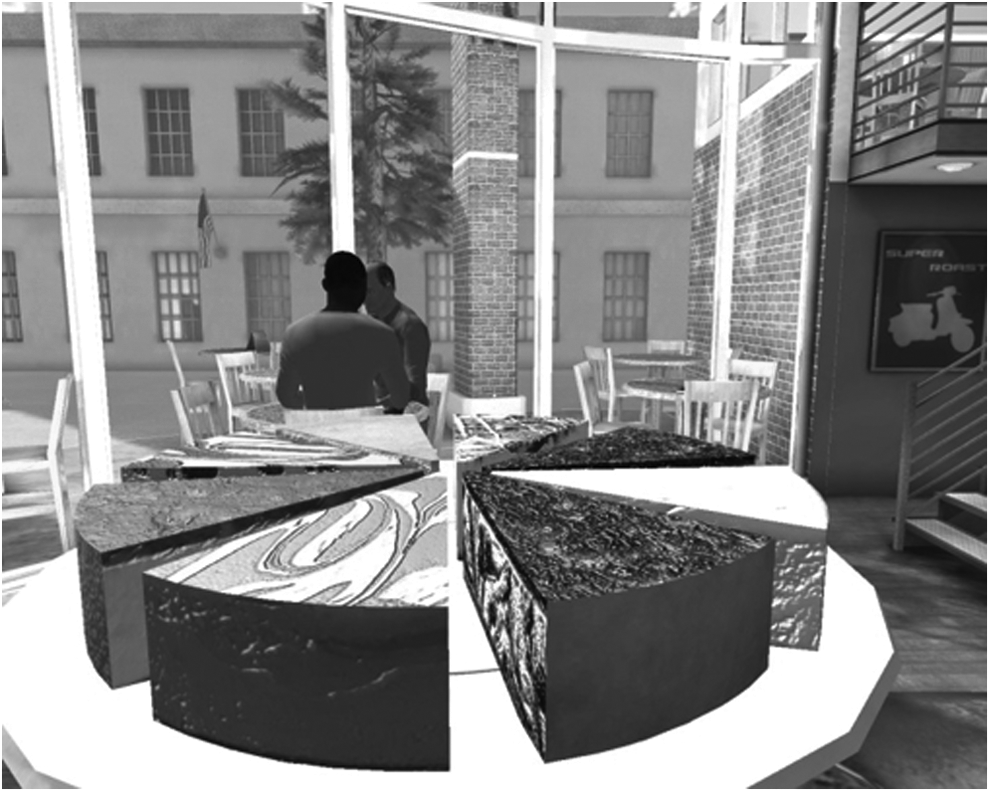
Picture of the virtual bakery-café.
The initial sample consisted of 35 patients with BN and 29 with BED, who showed active episodes of binge eating during the last 2 weeks of a structured program of CBT (first-level treatment), and who agreed to participate in the study. The presence of current comorbid severe mental disorders (substance use disorders, bipolar disorder, and psychosis) was considered an exclusion criterion, but not the use of antidepressant medication.42–44 Participants were randomly assigned to one of two second-level treatments (A-CBT or VR-CET) using Biased Coin Randomization developed by Efron, 32 and were assessed in the prerandomization phase (i.e., at the end of treatment with the structured CBT program), at the end of the second-level treatments, and at a 6-month followup session.
All randomized participants (N = 64) finished the second-level treatments and completed the post-treatment assessment. 32 However, only 58 patients completed the 6-month followup assessment (9.4 percent dropout rate). It was not possible to reestablish contact with four participants and, among those who agreed to attend the followup session, two did not attend the appointment and did not wish to arrange another one. Thus, in the final sample, there were 27 patients in the A-CBT group (15.6 percent dropout rate) and 31 patients in the VR-CET group (3.1 percent dropout rate).
Table 3 contains descriptive data on these groups. There were no significant differences between the groups in the prerandomization phase in terms of gender (χ 2 = 0.037, p = 0.781) or diagnosis (χ 2 = 0.318, p = 0.573). The A-CBT group consisted of eight men (29.6 percent) and 19 women (70.4 percent) and the VR-CET group consisted of 11 men (35.5 percent) and 20 women (64.5 percent). As regard to diagnosis, the A-CBT group included 16 patients with BN (59.3 percent) and 11 patients with BED (40.7 percent), and the VR-CET included 15 patients with BN (48.4 percent) and 16 patients with BED (51.6 percent).
Outcome Measures in A-CBT and VR-CET Groups at Pretest, Post-Test and Six-Month Followup
Note: Only participants who completed the assessment at followup are included.
Number of binge episodes during the last 2 weeks
Number of purge episodes during the last 2 weeks (only BN patients, n = 16 in A-CBT group and n = 15 in VR-CET group).
n = 26.
n = 24.
ED duration, eating disorder duration in years; BMI, body mass index; EDI, eating disorders inventory; DT, drive for thinness; B, bulimia; BD, body dissatisfaction; BN, bulimia nervosa; STAI, State-Trait Anxiety Inventory; FCQ, Food craving questionnaire; T, trait; S, state.
There were no significant differences found in the prerandomization phase in terms of age, body mass index, duration of the ED, clinician-rated frequency of episodes of binge eating and purging, self-reported tendency to engage in episodes of uncontrollable overeating (i.e., bulimia subscale on the EDI-3), self-reported measures of attitudinal features of EDs (i.e., DT and BD subscales on the EDI-3), anxiety, or food craving (p > 0.05).
Measures
The ED Examination-Interview 45 12.0D adapted to cover the specified time frame, that is, past 2 weeks, 12 was used to assess the core behavioral features of BN and BED, specifically the frequency of binge eating episodes and purging (i.e., self-induced vomiting and laxative and diuretic use, in the case of patients with BN). Attitudinal features of BN and BED were assessed using the eight-item bulimia subscale (B), the seven-item DT, and the 10-item BD scales of the ED Inventory-3 46 ; all EDI-3 scales (α's ≥ 0.87) are rated on a five point scale (ranging from 0 to 4). Finally, the State-Trait Anxiety Inventory 47 (STAI) 47 and the Food Craving Questionnaire 48 Trait (FCQ-T) and State (FCQ-S) were also included to assess specific variables targeted by VR-CET. 30 The STAI consists of two 20-item scales (rated on a four-point scale from 1 to 4) for measuring the level of anxiety as a state (STAI-S; i.e., at the time of evaluation) and trait (STAI-T) (α's ≥ 0.89). The FCQ-S (consisting of 15 items rated on a five-point scale, ranging from 1 to 5) and the FCQ-T (consisting of 39 items rated on a six-point scale, ranging from 1 to 6) were designed to assess state (i.e., at the time of evaluation) and trait food craving (α's ≥ 0.92).
Statistical analyses
Mixed between-within subject analyses of variance were used to compare the outcomes of both second-level treatments over time, with the treatment group (VR-CET vs. A-CBT) being the between-subject factor and the time (prerandomization/pretest, end-of treatment/post-test, and 6-month followup) being the within-subject factor. Frequency of binge eating and purge episodes (rated by the clinicians), self-reported tendency to engage in episodes of uncontrollable overeating (assessed using the EDI-3 bulimia scale), and attitudinal ED features (assessed using the EDI-3 DT and BD scales) were the outcomes included in the analyses. In those analyses in which the sphericity assumption was violated (Mauchly's test p < 0.05), degrees of freedom were corrected using Greenhouse-Geisser estimates of sphericity (ɛ).
Although the analyses in this study were consistent with those carried out in our earlier research, 31 the interpretation of results is focused on effect sizes and confidence intervals (CIs) around these effects. Since the traditional null hypothesis significance testing shows important limitations, the use of effect sizes and CIs has previously been proposed as a more accurate interpretation approach.49–51 Accordingly, Cohen's d was used to assess the effect of pairwise comparisons found when combining the outcomes of both A-CBT and VR-CET interventions across the three assessment sessions (pretreatment, post-treatment, and 6-month followup).
Interpretation of effect sizes was based on Cohen 52 for Cohen's d, considering values <0.20 as an indicator of nonexistence of effect, values between 0.21 and 0.49 as an indicator of a small effect, values between 0.50 and 0.70 as an indicator of moderate effect, and values equal to or >0.80 as an indicator of large effects; and on eta squared (η 2 ) values, considering 0.01 a small effect size, 0.06 a moderate effect size, and 0.14 a large effect size. Finally, χ 2 tests were conducted to compare abstinence from the pathological behavior (i.e., no episodes of binge eating and purging) at the end of the second-level treatment and at 6-month followup in both groups. Given that, by definition, BED patients do not engage in purging behaviors, 44 all the analyses conducted with this variable only included BN patients. Analyses were conducted using SPSS Statistics for Windows version 23.
Results
Patients in both second-level treatment groups (A-CBT and VR-CET) showed a significant reduction in symptomatology post-treatment that was maintained at 6-month followup. However, overall improvement was greater in the VR-CET group than in the A-CBT group. This was particularly evident in the rates of abstinence from binging and purging. At the 6-month followup, the percentage of binge abstinence increased (from 53 percent at the post-treatment) 32 to 70 percent in the VR-CET group (22 of the 31 patients), while in the A-CBT group, it was maintained (25.9 percent, 7 of the 27 patients) (χ 2 = 11.711, p = 0.001).
Among BN patients, the percentage of participants who achieved abstinence from purging episodes at followup was also higher in the VR-CET group (11 of the 15 patients, 73.3 percent) than in the A-CBT group (5 of the 16 patients, 31.3 percent) (χ 2 = 5.490, p = 0.019). Consistent with these results, the VR-CET group showed a lower self-reported tendency to engage in episodes of uncontrollable overeating (assessed using the bulimia scale of the EDI-3) than the A-CBT group at the end of the second-level treatment and, again, at the 6-month followup, even when no differences were found among groups pretreatment. Most importantly, differences between the A-CBT and VR-CET groups post-treatment and at followup showed very large effect sizes for binge episodes (d = 1.381 and d = 1.078, respectively), purge episodes (d = 1.051 and d = 0.840, respectively), and the bulimia scale of the EDI-3 (d = 1.888 and d = 1.426, respectively), as shown in Table 4.
Within- and Between-Group Effect Sizes (Cohen's d) and 95 Percent Confidence Intervals from Pretreatment to Six-Month Followup on All Outcome Measures
Note: Only participants who completed the assessment at followup are included.
Number of binge episodes during the last 2 weeks.
Number of purge episodes during the last 2 weeks (only BN patients, n = 16 in A-CBT group and n = 15 in VR-CET-group).
CI, confidence interval.
Table 5 summarizes the results of mixed between-within subject analyses of variance. The effect of time (pretreatment, post-treatment, and 6-month followup) was large for all measured variables (η 2 ranging from 0.291 to 0.619), meaning that all patients showed a significant reduction in behavioral (binge and purge episodes) and attitudinal (DT, bulimia, and BD assessed using the EDI-3) features of ED, as well as food craving and anxiety, across assessment sessions. On the other hand, the interaction between time and group showed moderate to very large effects only on frequency of binge and purge episodes, bulimia scale of the EDI-3, trait/state food craving, and trait/state anxiety reported by participants. On the whole, the reduction of scores in these variables was significantly higher in the VR-CET group than in the A-CBT group at post-treatment, despite the fact that no difference between groups had been found at pretreatment. These improvements were maintained at 6-month followup without great changes in either group.
Mixed Between-Within Subject Analyses of Variance Comparing Treatment Groups on Behavioral (Number of Binge Eating and Purge Episodes) and Attitudinal Eating Disorder Features (Bulimia, Drive for Thinness, and Body Dissatisfaction), and Cue Exposure-Related Variables (Food Craving and Anxiety) at Pretreatment, at Post-Treatment, and at Six-Month Followup
Note: Only participants who completed the assessment at followup are included.
Number of binge episodes during the last 2 weeks.
Number of purge episodes during the last 2 weeks (only BN patients, n = 16 in A-CBT group and n = 15 in VR-CET-group; df = 29).
Table 4 provides more detailed information about the differences in outcomes over time and between treatment groups. As mentioned above, all participants showed a significant reduction in symptom severity (based on self-reported frequency of binge and purge episodes and questionnaires) post-treatment. However, effect sizes in the A-CBT group ranged from small to moderate, while effect sizes in the VR-CET group ranged from moderate to very large (with one exception: Cohen's d for EDI-DT was 0.290, a small effect).
When comparing measures pretreatment and at 6-month followup, the effect sizes in the VR-CET group were even larger, ranging from 0.648 (moderate effect) to 1.578 (very large effect). Nevertheless, comparisons between the outcome post-treatment and at 6-month followup showed nonsignificant small or very small size effects in both the A-CBT and VR-CET groups, providing support for the continued maintenance of improvements achieved post-treatment after 6 months.
Finally, between-group comparisons (Table 4) revealed that the frequency of binge and purge episodes (d = 1.078, and d = 0.840, respectively), self-reported tendency to engage in overeating episodes (assessed with the bulimia scale of the EDI-3; d = 1.426), food craving (assessed as a trait and as a state; d = 1.120, and d = 1.002, respectively), and anxiety (assessed as a trait and as a state; d = 0.741, and d = 0.589, respectively) at 6-month followup were significantly lower in patients in the VR-CET group than in patients of the A-CBT group, as also found post-treatment, with most of the effect sizes of these differences being large or very large.
Discussion
Followup data collected in this study showed that outcomes after two second-level treatments (A-CBT or VR-CET) applied to patients with BN and BED resistant to standard treatment (i.e., structured CBT intervention) were maintained for at least 6 months. Most importantly, abstinence from binge episodes increased to 70 percent in the VR-CET group. Recovery rates (understood as the elimination of binge behavior) used to be low (from 11 percent to 26 percent) in treatment-resistant patients with BN and BED. 53
Previous research found that the addition of CET sessions, as a second-level treatment, to a CBT-based intervention produced a binging abstinence rate (assessed for the last year) of 54 percent at 5-year followup. 17 So, rates around 20 percent in the A-CBT group and around 50 percent in the VR-CET group would be expected. Results obtained at the end of second-level treatment 32 were consistent with the abovementioned data (53 percent in the VR-CET group and 25 percent in the A-CBT group). However, the fact that the percentage abstinence from binging increased even more during followup in the VR-CET group provides support for those models that associate food craving and anxiety with binge behavior, and that predict that lower levels of food craving and food-related anxiety reduce the risk of binge behavior.19,22
VR-CET is focused on reducing craving and anxiety responses in patients when they are exposed to food-related cues (e.g., pizza) and contexts (e.g., bakery), with the aim of reducing the risk of engaging in binge behaviors (and, consequently, the risk of purging). Consistent with this objective, self-reported food craving (assessed using the FCQ-T/S) and anxiety (assessed using the STAI-T/S) in this group were greatly reduced post-treatment and at the 6-month followup, compared with pretreatment scores (with very large effects for FCQ scores and moderate-to-large effects for STAI).
Furthermore, both post-treatment and at 6-month followup, levels of food craving and anxiety reported by the A-CBT group were much higher than in the VR-CET group (with very large effects for FCQ scores and moderate-to-large effects for STAI). Differences in food craving and anxiety may explain the superiority of VR-CET in the maintenance and even improvement of binge episode abstinence rates at followup. Coherent with abstinence from binging, the rate of abstinence for purge episodes in BN patients was higher in the VR-CET group (73.3 percent vs. 31.5 percent). As purge episodes are aimed at counteracting the caloric intake and weight gain from binge eating,54,55 a reduction in binge episodes would be expected to lead to a reduction in purge episodes.
As previously reported, 32 all patients in both second-level treatments showed a significant reduction in self-reported tendency to engage in uncontrollable overeating episodes, DT, and BD (assessed using the B, DT. and BD scales of EDI-3) post-treatment. However, scores on the DT and BD scales still fitted the clinical range (EDI-DT scores between 9 and 22 and EDI-BD scores between 13 and 28, according to Elosua et al. 56 ) in both groups. Thus, we hypothesized that normalization of eating patterns may improve attitudinal features of EDs, such as DT and BD, in the long term.57–60
The 6-month followup data did not support this statement. Even though DT and BD scores were lower at the 6-month followup than post-treatment, the effects of the differences were small and scores remained in the clinical range (although near the lower end of the range). On the other hand, the bulimia scale scores in VR-CET patients were almost in the range of nonclinical significance (≤4, according to Elosua et al. 56 ) at the 6-month followup, whereas the scores of participants in the A-CBT group still fell within the clinical range. The EDI-3 bulimia scale assesses the tendency to engage in episodes of uncontrollable overeating. As mentioned above, the main objective of VR-CET is to reduce cue-elicited food craving and anxiety responses to prevent binge behavior, so our results were consistent with the efficacy of intervention.
The limitations of the randomized controlled trial were summarized in a previous publication, 32 the most relevant being the following: the lack of supervision of the structured CBT first-level intervention at the different participating sites and not having controlled for a possible placebo effect from switching treatment in the VR-CET group. Furthermore, while VR-CET focused on CET, the A-CBT did not include this component. Consequently, an in vivo and/or photograph-based CET condition should be added in future research to assess the benefits of VR over other exposure methods.
Despite these drawbacks, our followup data provide added support to the use of VR-CET as an effective second-level intervention for BN and BED treatment-resistant patients, as previously suggested.18,22,24 Patients in the VR-CET group not only showed a huge improvement after only six VR-CET sessions but also the outcome was maintained and even improved at followup. Although treatment-resistant patients assigned to A-CBT also benefitted from additional CBT sessions, 11 the results of this study show that the use of VR for targeting specific features associated with poor response,13,42,43,61 such as urge to binge in response to a cue 26 and anxiety experienced simultaneously in the presence of binge-related cues,22,24,26,30,31 is a better strategy for treating resistant BN and BED patients. 62
Consequently, future research should focus on the underlying conceptual model and mechanisms of action of VR-CET29,61,62 to strengthen its rationale and optimize its clinical application.
Footnotes
Acknowledgments
This study was supported by the Spanish Ministry of Science and Innovation (MINECO/FEDER/UE; project PSI2011-28801: “Virtual Reality Cue-Exposure Treatment for Bulimia Nervosa”) and by a scholarship granted to one of the authors (J.P.-S.) (Grants for the recruitment of early-stage research staff FI-DGR 2014 supported by the Ministry of Economy and Knowledge, Generalitat de Catalunya). A.D., M.C., and G.R. are supported by a grant (PRIN; project 201597WTTM: “Unlocking the memory of the body: Virtual reality in anorexia nervosa”) from the Italian Ministry of Education, Universities and Research. F.F.-A. is supported by FIS PI14/290. CIBEROBN is an initiative of ISCIII.
Author Disclosure Statement
No competing financial interests exist.