




Abstract
Abstract
While virtual humans are increasingly used to benefit the elderly, considerably little is still known about older adults' virtual experiences. However, due to age-related changes, older adults' perceptions of virtual environments (VEs) may be unique. Hence, our objective was to examine possible gender differences in immersion, flow, and emotional states as well as physical and social presence in elderly males and females interacting either with a computer-controlled agent or a human-controlled avatar. Seventy-eight German-speaking older adults were randomly assigned to an avatar or an agent condition and were exposed to a brief social encounter in a virtual café. Results indicate no overall gender differences, but a significant effect of agency on social presence, physical presence, immersion, and flow. Participants in the avatar condition reported higher levels in all measures, except for involvement. Furthermore, significant gender × agency interactions were found, with females showing more social presence, spatial presence, and flow when interacting with a human-controlled avatar and more realism when conversing with an agent. Also, all participants showed significant changes in their affect post exposure. In sum, older adults' virtual experiences seem to follow unique patterns, yet, they do not preclude the elderly from successfully participating in VEs.
Introduction
V
Presence, immersion, and flow
Presence, immersion, and flow have been suggested to crucially shape virtual experiences. Although they share common characteristics, it has been argued that they constitute conceptually distinct phenomena.6–8
Presence is generally divided into two concepts 9 : physical presence and social presence. While the former describes a sense of being located in a VE, 10 the latter may be defined as the attribution of sentience to an artificial being and a sense of engagement with it. 11 VEs usually evoke both social and physical presence, however, reciprocal social interaction only defines social presence; hence, the two concepts are usually evaluated separately. 12
In contrast, immersion refers to the experience of being “in the game.” 6 It describes a psychological state which is accompanied by (cognitive and emotional) involvement with the activity, yet not with the environment. Accordingly, Jennett et al. 6 argue that while a person may indeed be present in a VE s/he may not at all be immersed in a task (e.g., if it is boring).
Finally, the holistic experience of flow involves an intense state of absorption in an activity, which is accompanied by heightened attention and positive emotional states.13,14 Unlike immersion, however, flow also implies clear goals, immediate feedback, and congruence between skills and the task. 6 Hence, a VE user who does not receive direct feedback and is challenged beyond his/her abilities will most likely not experience flow, but may still report high immersion. Presence is also conceptually distinct from flow: While the latter constitutes an immersion into an activity, presence is a spatial immersion into an environment. 8 A plethora of research has examined presence, immersion, and flow in younger and middle-aged adults using VEs, yet, studies including elderly participants are still scarce.
Agency and gender
In social VEs, virtual humans are divided into two groups: whether they are controlled by a human (avatar) or a computer algorithm (agent). 15 Agency, in this context, refers to the perception or belief of a user that the virtual other is steered either by another human (through an avatar) or by a computer (through an agent). 15 Several studies have underlined the differential effect of agency on user experiences: Gamers who play against humans report to be more immersed in the game 16 and to experience higher levels of flow and enjoyment, 17 physical presence17,18 and social presence 15 than those who play against the computer. Other studies,19,20 however, failed to support these findings.
This contradictory outcome is reflected in two opposing theories: The Media Equation Concept, 21 which assumes that we are evolutionarily prepared to react socially toward virtual entities regardless of whether they are controlled by humans or computers, and the Threshold Model of Social Influence, 22 which states that a virtual character's behavioral realism and agency influence our perceptions of it. To our knowledge, no study has to date evaluated this possibly differential effect of avatars and agents (i.e., their perceived agency) in a group of elderly participants. However, regarding the effects of age on a multiplicity of functions and their impact on handling technologies, 5 it is reasonable to assume that an elderly person's perception of virtual others may differ from those of a younger adult.
Similarly, gender has been suggested as a factor possibly shaping the virtual experience. 12 Prior research has found different levels of social presence 15 and physical presence23–25 in men and women using VEs. However, findings are inconsistent, and only one study has to date evaluated gender differences in elderly users 23 : it found older males to experience more spatial presence, involvement, and sense of being there than older females, yet, there were no gender differences in social presence toward an agent.
In sum, research on older adults' perceptions of social VEs and especially their interactions with virtual others is still scarce. While some researchers have examined isolated aspects of elderly's experiences in VEs, no study has, to our knowledge, comprehensively evaluated all key factors (physical presence, social presence, immersion, and flow), let alone put them in relation with agency and gender. Hence, the main objective of the current study is to examine whether there are differences in immersion, flow, and emotional states as well as physical and social presence between elderly males and females who interact either with a computer-controlled agent or a human-controlled avatar.
Methods
Participants were recruited using mailing lists or through retirement homes. Upon arrival to the laboratory, participants signed a written form stating their consent to participate without monetary compensation.
Participants
Seventy-eight German-speaking older adults (60 percent female) with a mean age of 67.65 years (standard deviation [SD] = 8.36, range: 54–90) were randomly assigned to an avatar (n = 39, 69 percent female) or agent condition (n = 39, 51 percent female). Age did not differ across genders [t(76) = −0.66, p = 0.514] and the overall sample was highly educated with an average of 13.58 years of education [SD = 2.90; no gender difference, t(76) = −1.54, p = 0.128]. A majority of participants reported to be at least a little experienced with computers [χ2(2) = 1.51, p = 0.470], and more than two-thirds played computer games regularly [χ2(1) = 0.39, p = 0.535; Table 1]. There were no differences between the two conditions regarding age [t(76) = −0.47, p = 0.639], gender [χ2(1) = 2.62, p = 0.105], education [t(76) = 1.21, p = 0.229], computer experience (p = 0.319, Fisher's exact test), or gaming [χ2(1) = 0.70, p = 0.402]. All participants had normal or corrected-to-normal vision and had not had any experience with VEs before this experiment.
Procedure
Upon arrival, participants filled out a demographic survey and questionnaires and were randomly assigned to either the avatar or the agent condition. Depending on the condition, they were instructed that they would either interact with an associate from the research team (avatar condition) or with the computer (agent condition). Shortly after, a head-mounted display (Sony HMZ-T1 3D Visor; Tokyo, Japan) with an attached head tracking system (TrackIR 5; NaturalPoint, Corvallis) was donned. Participants used a smart phone (HTC Desire SV, Taoyuan) to navigate through the VE. This device was chosen to decrease demands on participants' fine motor skills as movement was initiated simply by tiling the phone downward. After the experimental manipulation (5 minutes) participants were asked to fill out the remaining questionnaires and were debriefed.
The VE
This study's VE represents a park with an adjacent café (Fig. 1). To generate3D models, Blender 3D was used, textures were processed with GIMP, and real-time rendering was achieved through the OGRE3D graphics engine. Verbal interactions were controlled by the experimenter, who chose among a range of prerecorded answers. First, participants familiarized themselves with navigation (1 minute); then an off-stage male voice instructed them to enter the café and sit down at a marked table. After another minute, a male waiter appeared and asked the participant for his/her order (coffee or tea), which the participant had to approve verbally. In minute 4 the waiter returned with the drink and handed it over; shortly after, the simulation ended.
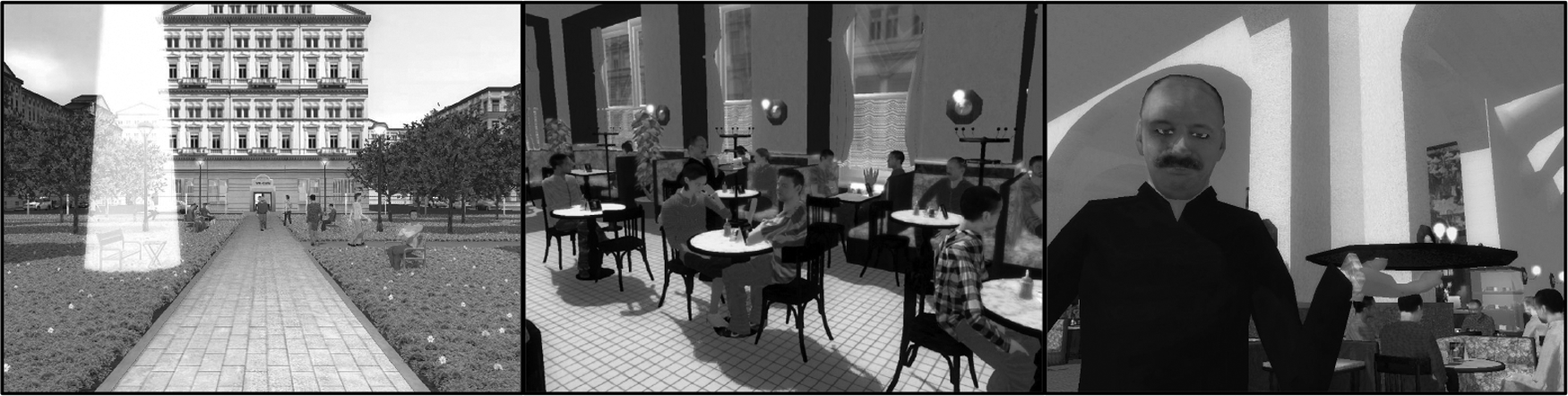
The virtual café scenario.
Measures
Manipulation check
To check whether the participants' believed they were interacting with another human or a computer, we introduced two manipulation check questions on a 5-point-Likert scale: (a) How did you perceive the interaction with the virtual character (1: as controlled by a computer, 5: as controlled by a human) and (b) Do you think the virtual character reacted to you? (1: no reaction, 5: strong reaction).
Social presence
The five item Social Presence Survey (SPS15,23) was used to assess social presence experienced during the interaction with the virtual waiter (e.g., “The person appears to be sentient, conscious, and alive to me”). Responses were measured on a 7-point Likert scale (strongly agree–strongly disagree) and internal consistency was acceptable with α = 0.62.
Physical presence
The German iGroup Presence Questionnaire (IPQ 26 ) was used to assess physical presence. It comprises 14 items on a 7-point Likert scale (strongly agree–strongly disagree), which add up to three scales: Spatial Presence (α = 0.82) evaluates the sensation of physically being in the VE (e.g., “I did not feel present in the virtual environment”), Involvement (α = 0.81) assesses the amount of attention devoted to the VE (e.g., “I was completely captivated by the virtual world”), and Realism (α = 0.87) reflects the perception of the VE as real (e.g., “The virtual world seemed more realistic than the real world”). An additional single item assesses the Sense of Being There (“In the computer-generated world I had a sense of being there”).
Immersion
The 31-item Immersion questionnaire 6 assesses the experience of immersion, including both person factors (e.g., cognitive and emotional involvement) and game factors (e.g., challenge, control); item examples are: “To what extent did you feel consciously aware of being in the real world whilst playing?” and “To what extent did you find the game easy?” Responses were measured on a 5-point Likert scale (not at all–a lot) and the internal consistency was α = 0.84.
Flow
The 17-items Flow experience questionnaire 27 was used to evaluate the experience of flow on a 7-point Likert scale (not at all–entirely). Items were back-translated into German and two items were altered to be applicable to VEs (e.g., “I felt that using the virtual reality made me forget where I was”). Internal consistency was α = 0.82.
Positive and negative affect scale
The positive and negative affect scale (PANAS28,29) consists of 10 positive and 10 negative affect items (e.g., “excited” or “nervous”), which are measured on a 5-point Likert Scale (not at all–extremely). To quantify the change in affect, a difference score was calculated by subtracting the negative/positive mean prescore from the positive/negative mean postscore. 30 The two scores were multiplied with −1 for ease of interpretation; positive values, hence, represented an increase and negative values a decrease in positive/negative affect.
Results
Statistical analyses were carried out using SPSS Version 23 (SPSS, Inc., Chicago). Analysis of variance (ANOVA) was conducted using Bonferroni-adjusted pairwise comparisons. Levene's test for homogeneity was acceptable for all dependent variables (ps > 0.05). Regarding some self-reported measures, the following data had to be excluded due to incomplete answers (as a criterion for exclusion, a threshold of 50 percent missing items was chosen): SPS: one participant (female, agent condition), Flow experience questionnaire: four participants (three females, one male; two in the avatar condition, two in the agent condition), and Immersion questionnaire: three participants (two females, one male; one in the avatar condition, two in the agent condition).
Manipulation check
There was no difference between male and female participants [F(1, 74) = 1.123, p = 0.293], but between the two conditions [F(1, 74) = 72.095, p < 0.001], with participants in the avatar group stating that they interacted with another human (M = 3.949, SD = 1.050) as opposed to participants in the agent group who thought it was a computer (M = 1.897, SD = 1.071). Regarding perceived reactivity of the virtual character, there was no significant difference neither for gender [F(1, 74) = 0.392, p = 0.533] nor for agency [F(1, 74) = 1.304, p = 0.257].
Agency differences
The 2 × 2 ANOVA revealed significant differences in agency regarding Social Presence [F(1, 73) = 21.43, p < 0.001, ηp 2 = 0.227], Spatial Presence [F(1, 74) = 8.17, p = 0.006, ηp 2 = 0.099], Realism [F(1, 74) = 15.43, p < 0.001, ηp 2 = 0.173], Sense of Being There [F(1, 74) = 6.05, p = 0.016, ηp 2 = 0.076], Flow [F(1, 70) = 11.53, p = 0.001, ηp 2 = 0.141], and Immersion [F(1, 71) = 9.35, p = 0.003, ηp 2 = 0.116]. All dimensions, except for Involvement [F(1, 74) = 0.625, p = 0.432, ηp 2 = 0.008], were rated higher by participants who believed that the waiter was steered by a human.
Gender differences
There was no main effect of gender for Social Presence [F(1, 73) = 1.33, p = 0.252, ηp 2 = 0.018] or for Spatial Presence [F(1, 74) = 0.768, p = 0.384, ηp 2 = 0.010], Involvement [F(1, 74) = 2.32, p = 0.132, ηp 2 = 0.030], Realism [F(1, 74) = 1.42, p = 0.237, ηp 2 = 0.019], and Sense of Being There [F(1, 74) = 1.24, p = 0.269, ηp 2 = 0.016]. Similarly, neither Flow [F(1, 70) = 3.89, p = 0.053, ηp 2 = 0.053] nor Immersion [F(1, 71) = 0.80, p = 0.374, ηp 2 = 0.011] revealed any gender differences (Figs. 2 and 3).
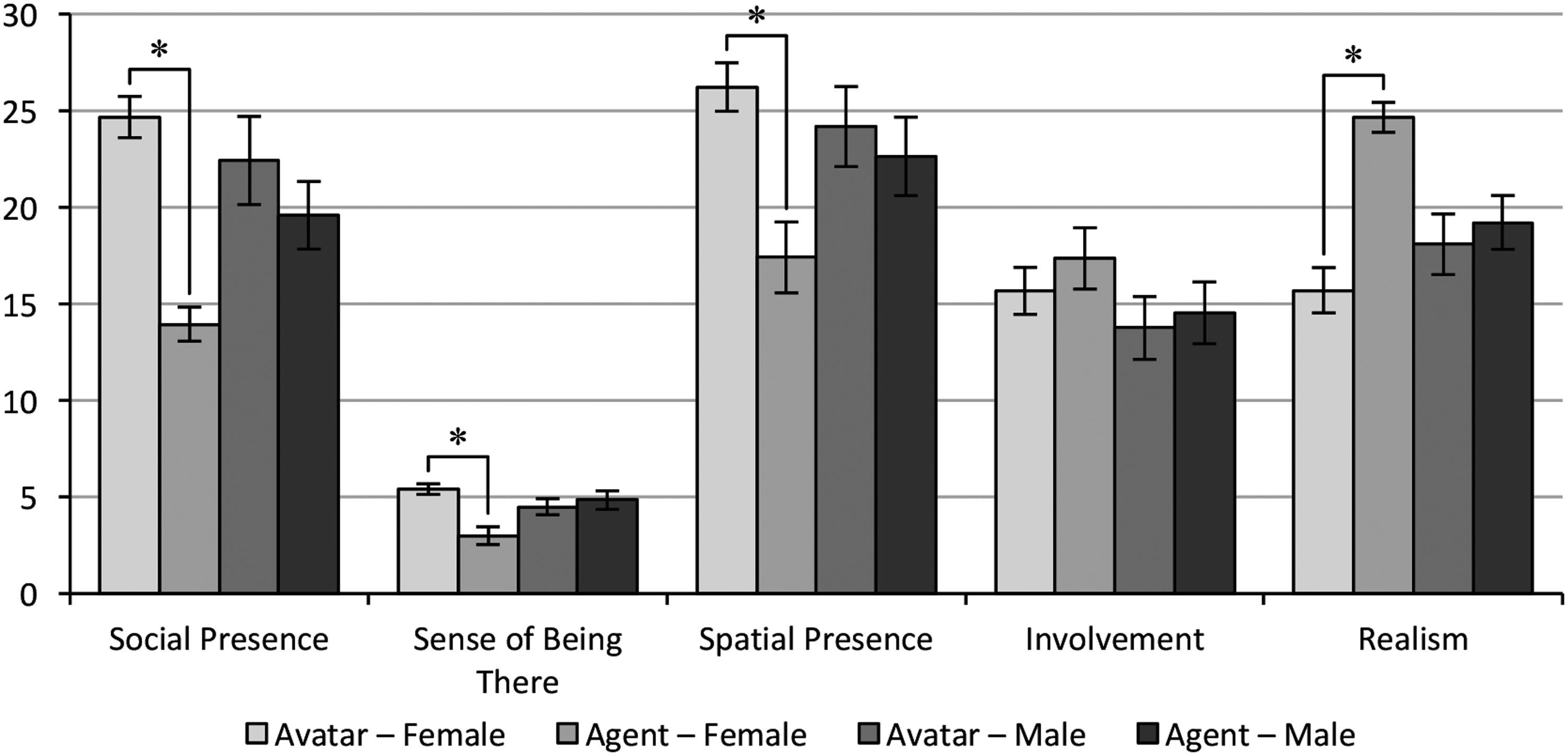
Mean (±SEM) of all Social and Physical Presence components sorted by agency and gender. SEM, standard error of the mean. *p < 0.001.
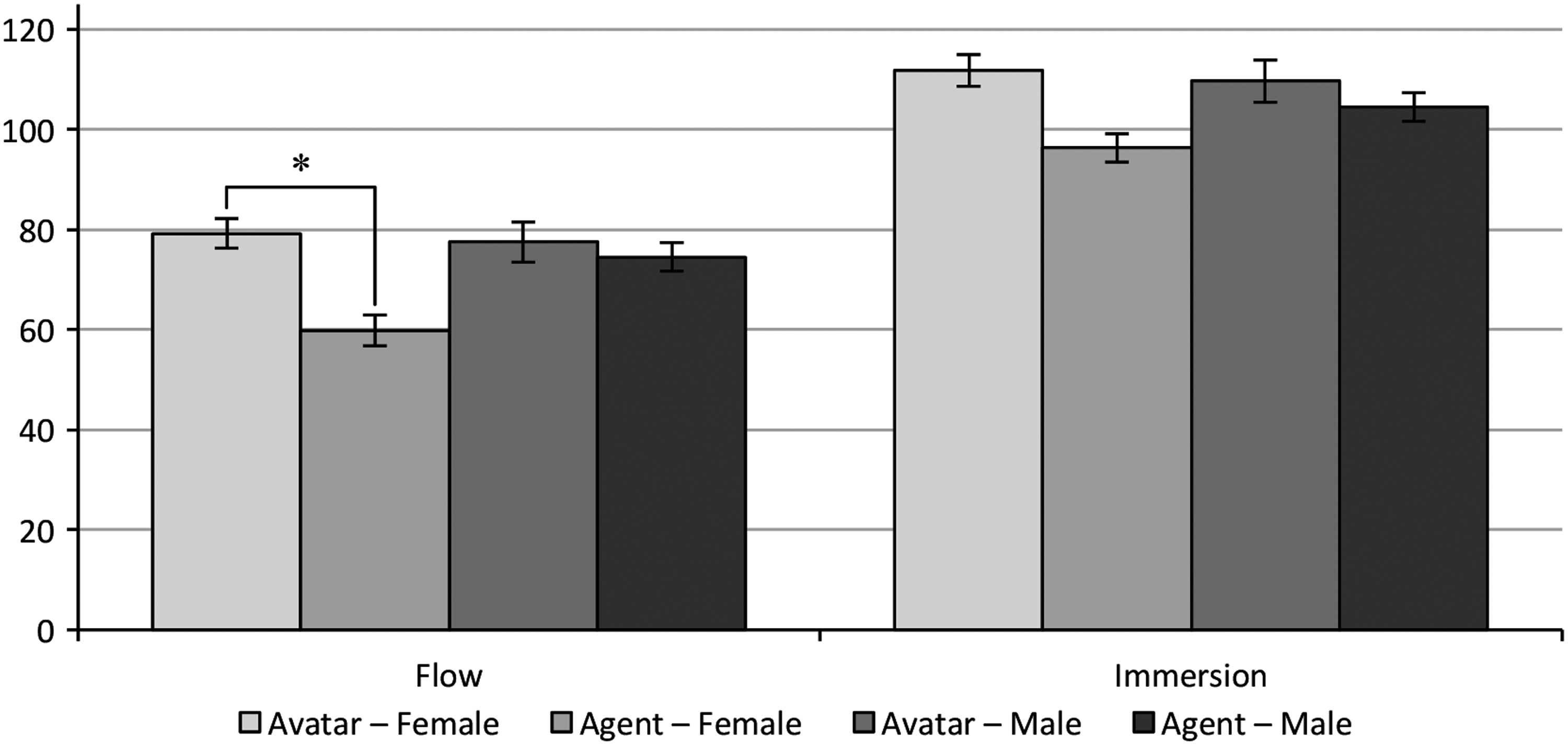
Mean (±SEM) of Flow and Immersion sorted by agency and gender. *p < 0.001.
Agency × gender interaction
A significant agency × gender interaction was found for Social Presence [F(1, 73) = 7.24, p = 0.009, ηp 2 = 0.090], Spatial Presence [F(1, 74) = 4.04, p = 0.048, ηp 2 = 0.052], Realism [F(1, 74) = 9.297, p = 0.003, ηp 2 = 0.112], Sense of Being There [F(1, 74) = 10.72, p = 0.002, ηp 2 = 0.127], and Flow [F(1, 70) = 6.25, p = 0.015, ηp 2 = 0.082], but not for Involvement (p = 0.772) or Immersion (p = 0.131). Simple effect analyses revealed that females in the avatar condition showed higher ratings of Social Presence (p < 0.001, d = 2.27), Spatial Presence (p < 0.001, d = 1.19), Sense of Being There (p < 0.001, d = 1.37), and Flow (p < 0.001, d = 1.38). Only Realism was perceived higher by females in the agent condition (p < 0.001, d = 1.80) than in the avatar condition. Conversely, no interaction effects were found for male participants (all ps: 0.216–0.952).
Affect
The changes in positive and negative affect ratings differed from zero across all participants [positive: t(77) = 32.56, p < 0.001, d = 3.69; negative: t(77) = 6.49, p < 0.001, d = 0.72; Fig. 4], and revealed both more positive and more negative affect after the virtual experience. A mixed ANOVA with gender and agency condition as group factor and change in affect as within factors did not yield significant results for agency [F(1, 74) = 0.24, p = 0.629, ηp 2 = 0.003] or gender [F(1, 74) = 0.67, p = 0.418, ηp 2 = 0.009]. Similarly, no interaction was significant, neither of group nor of within factors (all ps: 0.095–0.629).
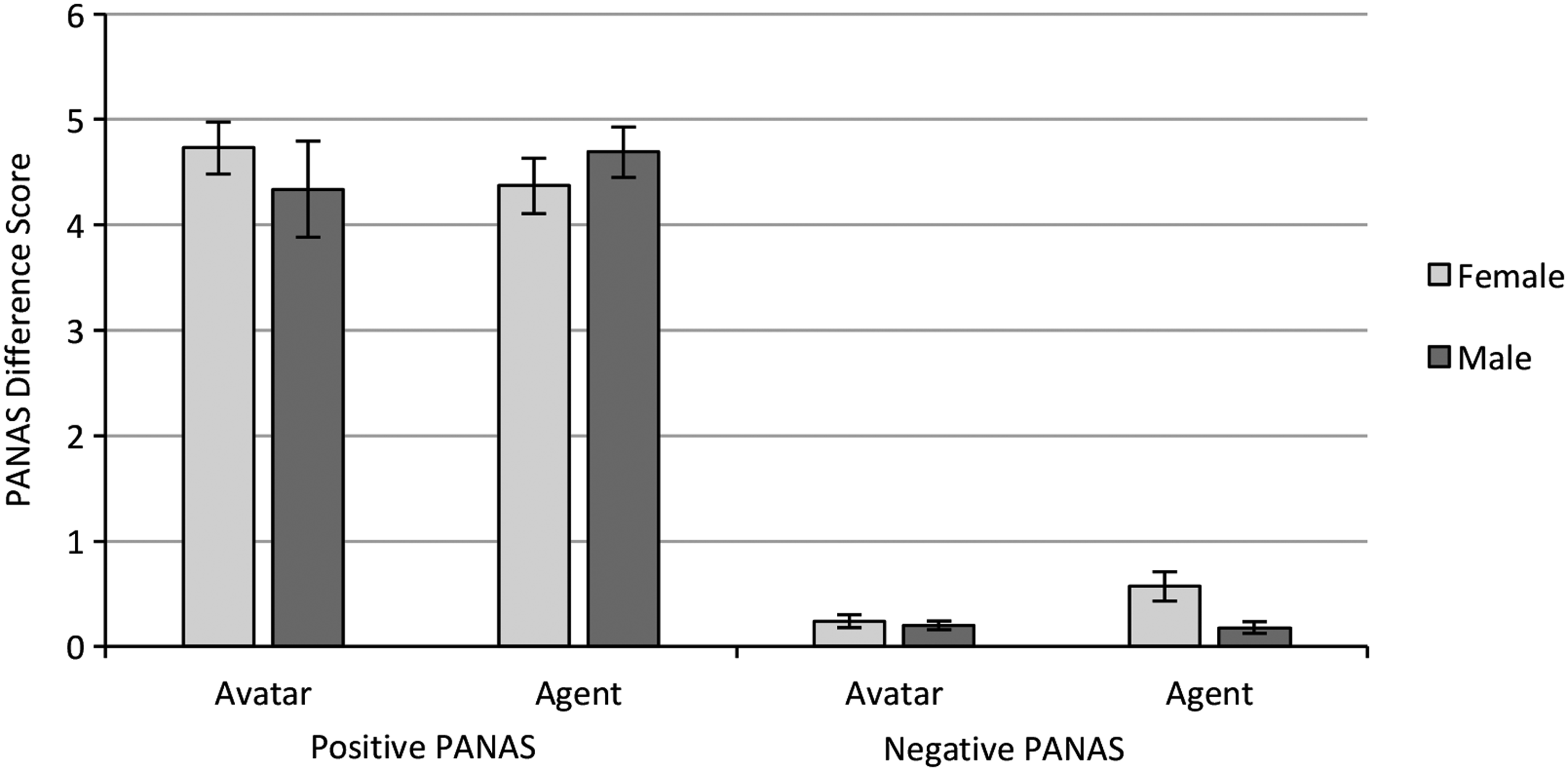
PANAS difference scores (±SEM) reflecting the change in positive and negative affect ratings before and after the experiment. PANAS, positive and negative affect scale.
Discussion
To learn more about older adults' experiences in VEs, 78 older adults (54–90 years) were exposed to a brief social interaction with either a human-steered avatar or a computer agent. In addition to controlling for gender and agency, key factors of virtual experiences, such as immersion, flow, physical and social presence, as well affective responses were assessed. In general, the current results support the idea that older adults' virtual experiences seem to differ from younger adults' perceptions of VEs.
Overall, the virtual experience had a pronounced impact on older adults' affective responses (PANAS). All participants—regardless of gender and condition—showed a considerable change in positive and negative affect after exposure to the VE. Hence, it is safe to assume that the virtual encounter per se constituted a meaningful event and that the potentially high emotional impact of VEs 31 seems to hold true not only for younger adults but also for the elderly.
Furthermore, we found no main effect of gender on social presence, physical presence, or immersion. Only flow revealed a trend toward significance, with women reporting slightly more intense flow experiences than men. This tendency needs to be reexamined in a larger sample and debunked with respect to mediating factors, such as cognitive abilities, motor skills, and perceived meaningfulness of the task 32 to check whether it holds up under different circumstances. Generally, however, the overall lack of gender differences stands in contrast to prior findings.15,23–25 Naturally, the drawback of past studies is the participants' younger age. Only one study has, to our knowledge, tackled this issue in a sample of older adults 24 and has found no differences in social presence, but higher levels of spatial presence, involvement, and realism in males. Yet, a notable limitation to this research is the fact that participants knowingly conversed with a computer algorithm and that, consequently, no conclusions can be drawn about interactions between gender and agency.
In this study, agency had a significant impact on older adults' experiences: Participants in the avatar group reported higher levels of immersion, flow, social presence, spatial presence, realism, and sense of being there. These results are in line with prior research15–18 and seem to support the Threshold Model of Social Influence. 22 In other words, the interaction with another human resulted not only in a more pleasurable and more intense experience, but also in a stronger sense of being there and perception of the VE as a real place. However, this did not hold true for involvement, as both groups reported to pay the same attention to the VE and to be equally captivated by it. It is conceivable that on the one hand, older adults' experience patterns may differ from those of younger users because of age-related changes in cognitive and attentional abilities 5 ; on the other hand, this may particularly become evident in those measures that tap into according to cognitive processes. These assumptions are further supported by the fact that involvement—reflecting attentional processes—also did not reveal any gender × agency interactions.
Most notably, our results indicate that men's and women's virtual experiences differ particularly with regard to whether they knowingly interact with an avatar or an agent. Apart from involvement and immersion, females reported significantly different experiences from their male peers: Females showed higher levels of social presence, spatial presence, sense of being there, and flow when interacting with a human and more realism when conversing with the computer. Again, these results are the first of their kind as past findings on agency and gender 15 are based exclusively on younger samples. It seems, however, that elderly women are especially prone to experience an online interaction as more rewarding and realistic when it includes another person, whereas elderly men treat both computer-generated and human-controlled virtual entities the same. Generally, women have repeatedly been assumed to be more focused on social interaction, 33 and to be more empathic than men. 34 It is, thus, possible that these gender-specific characteristics interfere with the virtual experience and produce different experience patterns for males and females especially when taking agency into account. Interestingly, our female participants also rated the VE as most realistic in the agent condition. This is generally in line with a study by Bracken, 35 but due to differences in sample age and modality (television vs. VE), comparability is limited. We may only hypothesize that females in the agent group may have been surprised to find the VE to be quite realistic notwithstanding the fact that it was computer controlled. An alternative explanation is that women in the avatar group attended more to the virtual character and to the sensation of sharing a mutual space because they knew that it was controlled by another person, whereas females in the agent group had the liberty of steering their attention away from the computer character and devoting it more to environmental details. Either way, future studies are challenged to debunk these complex associations.
Limitations and Conclusions
One of this study's limitations is that elderly participants' experiences were examined by means of a very specific scenario, including a formal and cordial interaction with a virtual other. It is, thus, possible that stressful and unpleasant virtual encounters (e.g., ostracism/social evaluation) may result in altered reaction patterns, as males and females tend to engage in different coping mechanisms when confronted with social stress.36,37 Also, virtual social interactions were simple and lasted only for a short period of time. The current results may, thus, not hold true for more complex social interactions in VEs, which include more subtle cues (mimics, gestures) and more elaborate dialogs. Furthermore, our sample consisted of educated elderly persons with considerable computer and gaming experiences, all of which may have influenced the observed reactions to the VE. Hence, generalizations to uneducated and unexperienced elderly users should be undertaken with caution. A further limitation is the low internal consistency of the Social Presence Survey (SPS), which to date has only been evaluated in younger samples. Due to this fact, a multidimensional assessment of social presence should be used in further studies, especially when considering age as a factor. Also, a validation of the scale in different age groups may additionally contribute to a better understanding of individual differences in social presence.
Overall, this study reveals that older adults' experiences in VEs seem to follow unique patterns. It may be crucial to ensure human–human social interaction particularly for women to achieve the best possible outcome, whereas male users may equally profit from both agents and avatars. Despite this, it is safe to conclude that older adults do not seem to fall short of successfully participating in social VEs.
Footnotes
Acknowledgments
This study was part of the ICARUS (Information and Communication Applications: Research on User-oriented Solutions) Project which was funded by the Austrian Research Promotion Agency (Forschungsförderungsgesellschaft, FFG), Project number: 831199. The authors thank Nathalie Hauk, Elisabeth Kastenhofer, Ellen Baumm, Jasmine Gomm, and Antonia Scholz for their assistance in the acquisition of parts of the data.
Author Disclosure Statement
No competing financial interests exist.