




Abstract
Abstract
Online social media is now omnipresent in many people's daily lives. Much research has been conducted on how and why we use social media, but little is known about the impact of social media abstinence. Therefore, we designed an ecological momentary intervention study using smartphones. Participants were instructed not to use social media for 7 days (4 days baseline, 7 days intervention, and 4 days postintervention; N = 152). We assessed affect (positive and negative), boredom, and craving thrice a day (time-contingent sampling), as well as social media usage frequency, usage duration, and social pressure to be on social media at the end of each day (7,000+ single assessments). We found withdrawal symptoms, such as significantly heightened craving (β = 0.10) and boredom (β = 0.12), as well as reduced positive and negative affect (only descriptively). Social pressure to be on social media was significantly heightened during social media abstinence (β = 0.19) and a substantial number of participants (59 percent) relapsed at least once during the intervention phase. We could not find any substantial rebound effect after the end of the intervention. Taken together, communicating through online social media is evidently such an integral part of everyday life that being without it leads to withdrawal symptoms (craving, boredom), relapses, and social pressure to get back on social media.
Introduction
O
Much research has been conducted on why and how people use social media. 3 Although social media has many advantages, a growing body of research focuses on the downsides. Some people develop signs of addiction, which has been termed “social network site addiction,” 4 or show symptoms of burnout when overusing (“social media burnout” 5 ). There are even people who leave social media for reasons such as a lack of control over interruptions, privacy issues, overuse, or external pressures (e.g., Instant Messaging 6 ; Facebook7,8; and Twitter 9 ).
Interestingly, little research has been conducted on what happens when people are unable to use social media anymore, although the area of technology nonuse in general is not that new. 10 Regarding social media, two general cases have been analyzed: involuntary nonuse (e.g., through loss of smartphone 11 ) or nonuse by choice 12 (for a typology, see Wyatt 13 ). Effects of social media nonuse seem to be comparable to analyzing withdrawal, relapse, and rebound effects in patients with substance abuse (e.g., alcohol and drugs). In classical addictions, it is not only the symptoms of using that are of interest but also what happens when patients do not or cannot use the substance in question.
Such effects have indeed been found in relation to social media nonuse. In a study about Facebook, almost half of the respondents who left Facebook, by deactivating their account voluntarily, subsequently returned to Facebook, thus representing a relapse effect. 7 In another Facebook study, 23 percent logged in to Facebook in a 48-hour nonuse experimental condition, although instructed not to do so. 14 Similar results were reported for Twitter users, where 36 percent returned to Twitter within a 40-day period of voluntary nonuse (Christian period of Lent). 9 Furthermore, feelings that are associated with addiction (e.g., withdrawal and limited self-control) predicted an increased likelihood of recidivism (99-day voluntary Facebook nonuse). 12 In an experiment, well-being (operationalized as life satisfaction and intensity of emotions) was significantly raised when participants did not use Facebook for 1 week, with the effect being moderated by the intensity of Facebook usage (the heavier the usage, the stronger the negative effect). 15 Involuntary nonuse has also been studied, with research showing that participants who lost their mobile phones reported negative feelings, such as boredom, anxiety, and loneliness. 11 To sum up, research on the impact of social media nonuse suggests that participants experience withdrawal symptoms characterized by relapse and negative feelings.
In this study, we wanted to expand on these studies by advancing the design as follows:
We used participants' smartphones for data collection (thrice per day plus end-of-day questionnaire) in a longitudinal design (i.e., experience sampling16–18
). Using smartphones instead of more common assessment devices (e.g., personal digital assistants) has the advantages that most people—at least in Western countries—own a smartphone, most social media users use these networks on their smartphones, and the administration of the study was easier. Participants had to install a smartphone app specifically developed by the authors, which was designed to carry out the whole data collection procedure (i.e., questionnaires and in-app reminders). This had the advantage of realizing a field experiment where participants filled in the questionnaires in their familiar environments.
19
Furthermore, participants were instructed to report their current feelings. This design promotes ecological validity, that is, generalizability of results to everyday situations.
20
We used an Ecological Momentary Intervention methodology
21
by defining a baseline (4 days), an intervention phase (7 days), and a postintervention phase (4 days). This made it possible not only to analyze the effects of social media nonuse but also to analyze possible rebound effects when participants could once again use social media.
14
We were not focusing on a specific social media site or application. Not allowing the usage of, for example, Facebook might in turn spur an increased usage of other social media sites, which could potentially diminish or blur the effects under investigation. In our study, participants were allowed to only use smartphones, PCs, or laptops for phone calls, SMS, or e-mail. All other online social communications, irrespective of the specific device (e.g., smartphone and PC), were not allowed. We measured concepts that are related to withdrawal symptoms, such as positive and negative affect, on a daily basis. Past research has found that reduction of Facebook usage was associated with reduced positive, but also negative affect,
22
which seems counterintuitive. If abstinence was perceived as undesirable by participants, we would expect reduced positive affect, but heightened negative affect.
Furthermore, we measured boredom 11 and craving, 23 both of which should be elevated during the intervention phase. Boredom has even been stated as a withdrawal symptom when it comes to Internet addiction. 24 In addition, we measured perceived social pressure to be on social media. Past research has found that this plays a critical role in social media use. Social media users have the feeling that the social group they belong to (which also uses social media sites and applications) expects them to use social media for group communication. 25 If this is the case, then the perceived social pressure should again rise during the intervention phase and subsequently return to a baseline level in the postintervention phase.
Method
Participants
The app (for more details, see the following subsection) was installed by 214 participants, of whom 28 dropped out before or during the intervention phase and 34 did not fill in the final online questionnaire. Hence, data were available from 152 participants who participated in the longitudinal phase and completed the final online questionnaire (70 percent women). Reported participant age ranged from 18 to 80 years (M = 27.4, SD = 11.9; for further demographics, see Supplementary Data; Supplementary Data are available online at
Design, procedure, and smartphone app
The sample was recruited from a community in Germany using a snowball sampling technique (e.g., postings on Facebook and newspapers). Interested individuals had the opportunity of visiting an online project page, where detailed information was given about the project (e.g., procedure, prerequisites, informed consent, and app installation) and where they had the opportunity to indicate their interest in participation by filling in an online form with their e-mail address. In total, 290 people stated their interest in the study. Two days before the project launch, participants were instructed by e-mail how to install the smartphone app and were reminded about the exact procedure of the study.
We adapted an open-source software called Paco (The Personal Analytic Companion) to realize mobile experience sampling designs (e.g., event-based, time-based, and end-of-the day questionnaires) 26 using Android smartphones (for more information, see Supplementary Data). We used an ecological momentary intervention approach (i.e., experimental intervention in the field in real time). The experimental design comprised a 4-day baseline phase (i.e., using social media as always), a 7-day intervention phase (i.e., not using social media for communication at all; only exception: telephone calls, SMS, and e-mail), and a 4-day postintervention phase (i.e., again using social media as usual). The start and end of the intervention phases were communicated by e-mail and by using push notifications (i.e., notifications generated with the backend were automatically transferred to the frontend smartphone app and displayed on the screen).
In general, three randomly produced reminders were administered each day (default setting: between 9 a.m. and 9 p.m.). After each reminder was sent out through the app, participants had 30 minutes to respond to this reminder by filling in the questions. If a participant did not respond, the reminder was automatically deleted and the participant had to wait for the next one. Besides this time-based sampling, we also used an end-of-the day questionnaire. The reminder for this questionnaire was sent out once a day at 9 p.m. (unless adjusted) and participants were given 60 minutes to respond to this reminder (for more details, see Supplementary Data).
After the longitudinal part of the study, an Internet-based posttest questionnaire was administered. Participation was remunerated by optional course credit and/or graphical feedback at the end of the study about affect changes during the longitudinal part. The entire study was run in German.
Measures
Daily questionnaire
In the longitudinal part of the study, we measured boredom (“How bored are you right now?”; Visual Analogue Scale [VAS]: 0 = not at all, 100 = very bored) and craving (“How much would you like to be on a Social Networking Site [e.g., WhatsApp] right now?”; 0 = not at all, 100 = very much) using single item measures.
Furthermore, we assessed positive and negative affect in the situation (i.e., state aspect) by shortening the 10-item International Positive and Negative Affect Schedule-Short Form (I-PANAS-SF) 27 down to six items to lower participant burden. We chose the three items with the highest factor loadings on the respective scales and negative loadings on the other scales for the sake of discriminant validity (Cronbach α: positive affect = 0.85 and negative affect = 0.87; for day-based reliabilities, see Supplementary Table S1 in the Supplementary Data), again using a VAS (e.g., 0 = not active, 100 = very active)
End-of-the-day questionnaire
We asked three questions: “How often were you on a social networking site (e.g., WhatsApp) today?,” “How long did you use social networking sites all together today in minutes)?” (text field using a ± input option), and “How strong was the feeling of social pressure (e.g., through friends) today to be on social networking sites?” (0 = not at all, 100 = very strong pressure).
Internet-based posttest questionnaire
In the final questionnaire, we assessed sociodemographics, as well as further concepts that are not part of this study (e.g., general social media intensity usage, Big Five, narcissism, self-esteem, and social media addiction).
Statistical analyses
Multilevel models with random intercepts were calculated using R (Package “nlme”) by nesting daily diary observations (level 1) within participants (level 2). Because of the within-subject design, we centered all variables under investigation around the respective baseline mean during the 4-day baseline phase for easier interpretation of effects before calculating multilevel models. Because level 1 variables represent data from multiple retests, we controlled for autocorrelations.
Results
First, we checked whether participants complied with the instruction not to use social media in the intervention phase. We additionally included participant sex and age as predictors. As can be seen from Figure 1, social media usage frequency as well as the social media usage duration were almost null. Almost half of participants never relapsed (41 percent), 17 percent relapsed once, 13 percent relapsed twice, and 29 percent relapsed more than twice, although the maximum number of relapses was small (range 0–10, M = 1.8, median = 1; mean duration of relapse = 3 minutes, median = 0). Compared to the baseline, social media usage was substantially smaller (β ∼0.90; Table 1). As expected, in the postintervention phase, social media usage did not differ from the baseline (Table 1). Furthermore, as expected, participants in the intervention phase felt significantly more social pressure from their social network to be on social media compared to the baseline (small to medium effect size, Table 1). Social pressure fell to a normal baseline level in the postintervention phase when participants started to use social media as they had previously (Table 1).
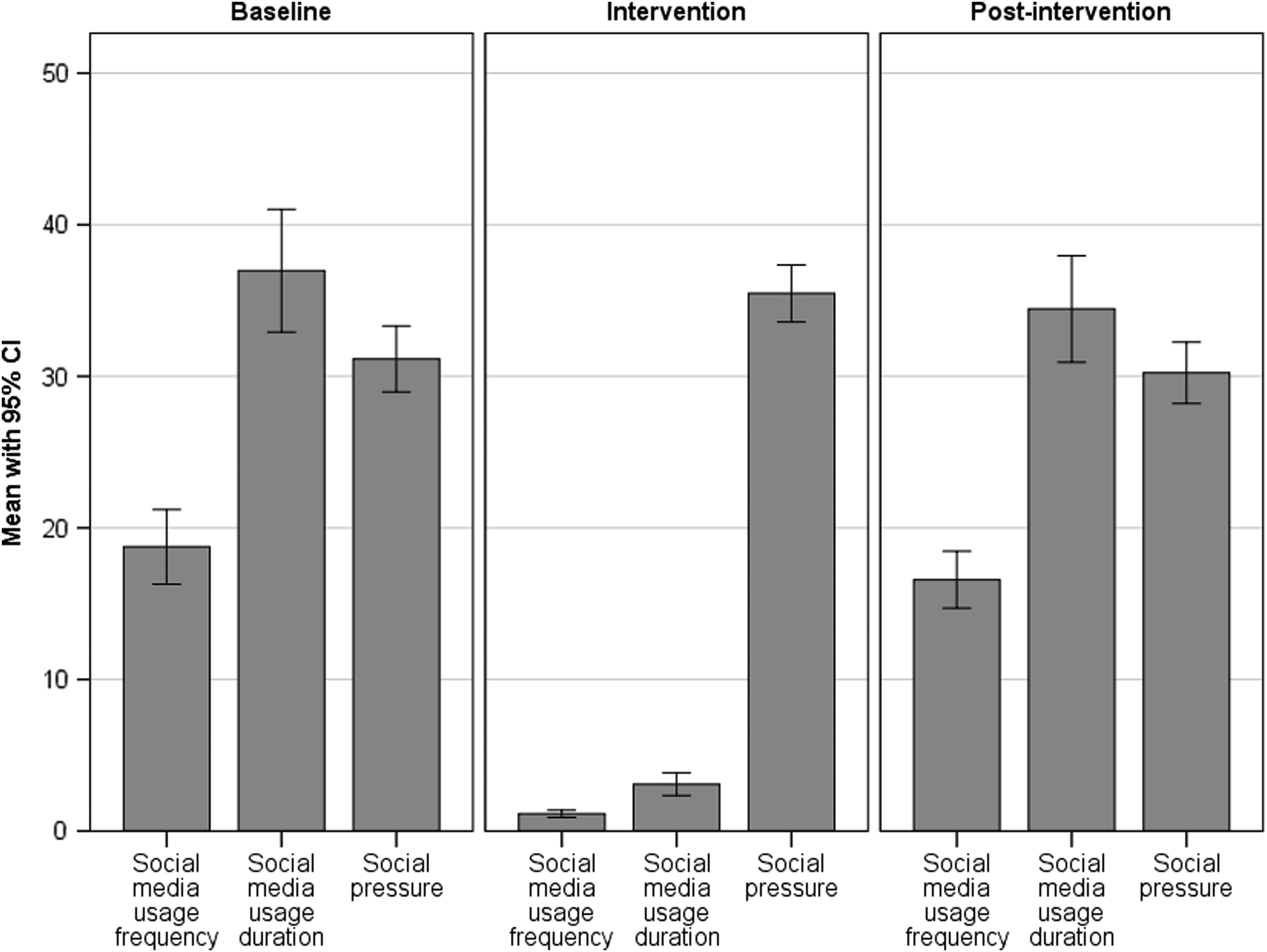
Mean scores with 95 percent CI for the variables in the end-of-the-day questionnaire, separated by the phases of the experiment. For display reasons, we present the noncentered values. CI, confidence interval.
Note: N = 152 (in parenthesis are all participants who provided data in the longitudinal part, but not in the posttest questionnaire; therefore sex and age were excluded: N = 186).
Sex: 1 = women, 2 = men.
Reference category is the baseline phase.
p < 0.05, **p < 0.01, ***p < 0.001, †p < 0.10.
As can be seen from Figure 2, being social media abstinent led to lower levels of positive affect in the intervention phase and higher levels in the postintervention phase, constituting a rebound effect, but this effect was not significant (Table 2). In addition, no substantial effect could be found for negative affect, although, descriptively, negative affect was lower in the intervention as well as the postintervention phase compared to the baseline.
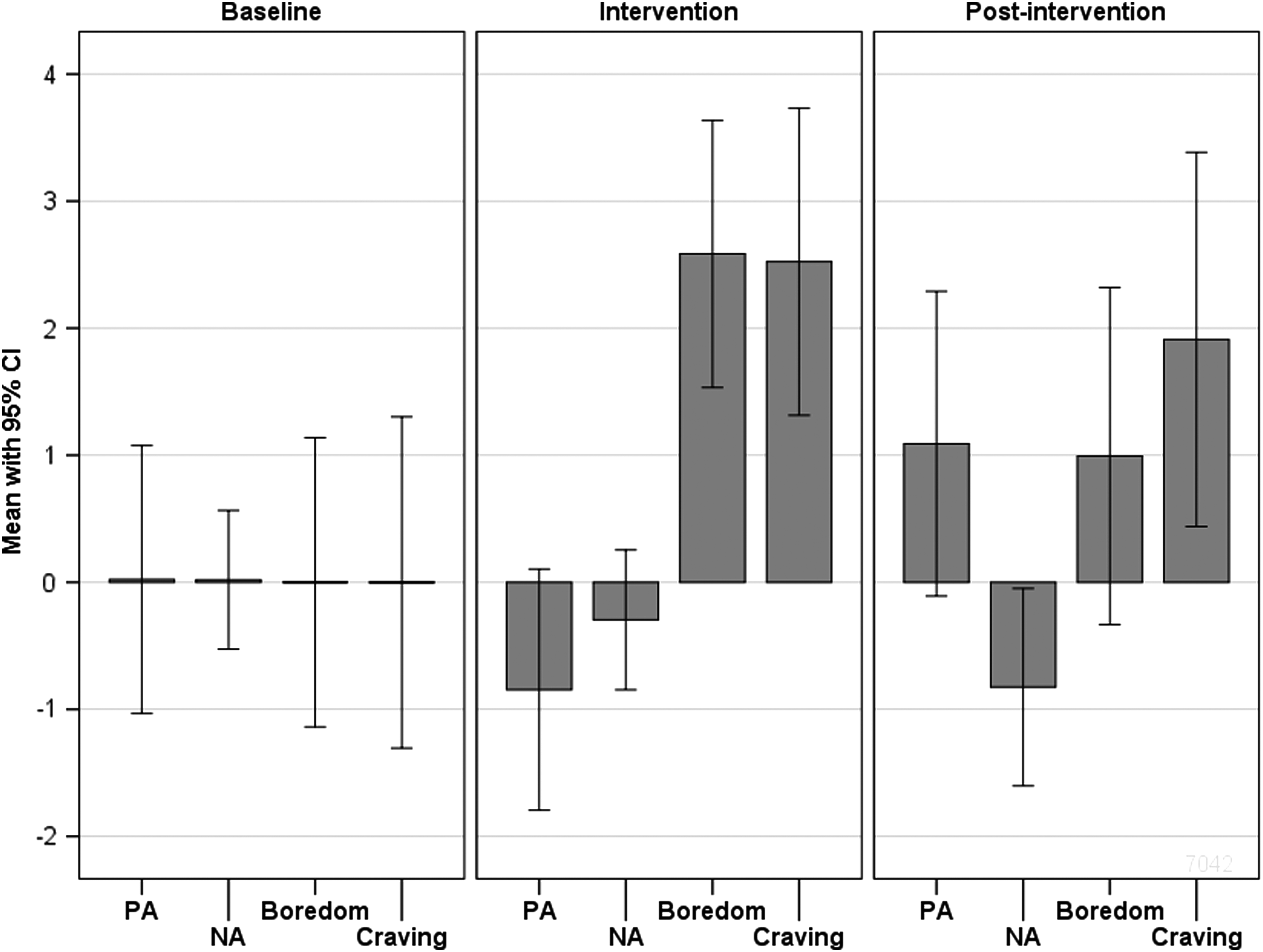
Mean scores with 95 percent CI for the variables in the daily questionnaire, separated by the phases of the experiment. Scale scores were centered on the baseline mean. PA, positive affect; NA, negative affect.
Note: N = 152 (in parenthesis are all participants who provided data in the longitudinal part, but not in the posttest questionnaire; therefore sex and age were excluded: N = 186).
Sex: 1 = women, 2 = men.
Reference category is the baseline phase.
p < 0.05, **p < 0.01, †p < 0.10.
Being abstinent led to significantly elevated boredom during everyday life in the intervention phase, but again, the effect diminished in the postintervention phase as expected (Table 2). Feelings of craving were significantly higher in the intervention phase (compared to the baseline) and, interestingly, a small effect remained in the postintervention phase (although of borderline significance; Table 2). This means that although participants could use social media without limitations, participants still described slightly higher feelings of craving compared to the baseline.
Discussion
Our main aim in this study was to analyze social media abstinence effects in an experimental longitudinal design in the field using smartphones. If social media has addictive qualities similar to classical substance addictions (e.g., alcohol and drugs), then we should find common addiction symptoms such as withdrawal, relapse, and rebound effects in social media users too. Broadly speaking, such effects were found in this study.
Withdrawal symptoms should affect one's mood, leading to reduced positive affect and heightened negative affect. Although we found these effects for positive affect (at least descriptively), the pattern for negative affect was counterintuitive because in the intervention phase, negative affect was reduced compared to the baseline (again only descriptively). Interestingly, this is in line with past research, 22 despite the underlying mechanism being currently poorly understood. It could be that there are two (perhaps cognitive) processes involved in how we feel when not using social media. During nonuse, one process brings to our mind that the usual negative outcomes of social media use are now gone (e.g., constant daily interruptions and shallow conversations), leading to reduced negative affect. The other process prompts the missing positive outcomes of use (e.g., possibilities to communicate and being connected with friends and possibilities to present oneself online), leading to reduced positive affect (for another dual-process view example, see Sheldon et al. 14 ). Because effects of positive and negative affect were not significant, firm conclusions cannot be drawn and results should be replicated on a larger sample.
Another observed withdrawal symptom was craving. As expected, during the intervention phase, participants stated significantly stronger craving effects compared to the baseline. Interestingly, this effect persisted into the postintervention phase, where participants could use social media as they used to before the intervention phase, but the effect only approached statistical significance. This might be interpreted as reflecting the dynamics behind dose increase (tolerance/resistance building, i.e., increase in use over time), which is very common in addictions. To analyze this in more detail, a replication study would be necessary, with a longer postintervention phase to see how long this heightened craving persists and if this postintervention craving, in the long run, leads to an increase of social media use later on.
Another oft-stated withdrawal symptom (at least for heavy Internet users) is boredom when Internet use is not possible.24,28 This could also apply to heavy use of social media. Indeed, this is what we found. Participants had significantly higher boredom scores during the intervention phase compared to the baseline or postintervention.
Furthermore, we found relapse effects. Although the number of relapses during the intervention phase was small and the mean duration of the relapse was short, in sum, 59 percent of participants relapsed at least once during the 7-day period of intervention. In line with other studies (range 23 percent to ∼50 percent),7,9,14 this underlines the argument that social media is by now so tightly intertwined with our everyday life that many participants cannot go without it. Although participants still had the possibility of fulfilling their needs of social communication and to keep in touch with friends using other allowed ways, such as SMS, e-mail, phone calls, or even meeting them in person, many participants could not resist the use of social media. One reason for this might be the social pressure to use social media for communication, which was also found in this study. The rise in social pressure to use social media during the abstinence phase was of low-to-medium effect size (0.19), but this is remarkable, keeping in mind that the abstinence phase lasted only for 7 days. This is in line with research about the fear of missing out (FOMO). 29 This theory assumes that social media users have a desire to stay continually connected with friends. If this desire is not fulfilled by, for example, not being able to connect, a FOMO emerges.
Another studied topic was rebound effects. If rebound effects were prevalent, then we should find different values in the postintervention phase compared to the baseline. All in all, we found no significant rebound effects, except a nominally statistical effect for craving as already discussed above. Rebound effects for affect were found descriptively, but should be reanalyzed in a larger sample. Nevertheless, the lower level of negative affect and higher level of positive affect in the postintervention phase are in line with predictions derived from the Technology Integration Model, 30 which represents a new theory of technology use integrating several other models. This model proposes that technology use is shaped by two predictors: the cost-benefit decision (e.g., technology extension and intrinsic and extrinsic motivation) and the situational context. Furthermore, the model proposes a longitudinal dynamic, that is, at the beginning of technology use, the cost-benefit decision is prevalent. When use becomes more habitual due to frequent usage, the situational context moves to the forefront. In general, the usage of technology can lead to an extension of the self. If this technology cannot be used anymore, this should lead to reactance because self-extension is threatened, that is, affect changes (higher negative affect and lower positive affect). If the technology can be used again, this pattern should reverse, that is, higher positive affect and lower negative affect. Although nonsignificant, exactly this pattern has been found (Fig. 2).
Limitations
One of the main findings of this study was that it was hard to find people who were willing not to use social media for a week voluntarily. The project page was assessed >1,000 times, 290 expressed their interest in the study, and finally 152 participated in the study until the end (i.e., also filled in the final Internet-based questionnaire). This represents a self-selection process, which has probably resulted in a sample of participants who found it easier to stay away from social media for a week than other people. Therefore, effects under investigation were probably weakened because of a biased sample with less heavy social media users.
The duration of the intervention phase of 7 days might have been too short to see strong effects. Although it seems difficult to motivate participants to abstain from social media for even longer periods, future research might try to use longer intervention phases.
Furthermore, we measured the social media usage behavior using self-assessments. This self-assessment can be biased when it comes to addictions (i.e., participants systematically underestimate their usage due to social desirability). Although objectively measuring usage patterns is technically possible when using smartphones for assessments, problems can occur due to privacy and ethical issues, as well as technical incompatibilities.
Future directions
One aspect of social media abstinence that, to our knowledge, has hitherto never been investigated is compensatory behavior. Similar to classical substance users, what kind of behavior do social media users engage in when being deprived of social media? In this study, we also asked participants in the final questionnaire, in an open question, what kind of communication channels they used instead. Coded independently by two raters, we found that participants more often used phone calls (52 percent), SMS (74 percent), and e-mail (30 percent) to compensate for the loss of social media (for more details, see Supplementary Tables S2–S5). Future research should take into account that participants do not always reduce their online communication behavior, but rather switch to different channels.
Furthermore, although we found no rebound effects, these effects might still be there, but could be rather short-lived, that is, effects might appear in the first couple of minutes after using social media again. This might be a fruitful approach by designing a similar study with a shorter time lag between assessments on the first day of the postintervention phase.
Footnotes
Acknowledgments
We thank Lisa-Marie Walther and Antonia Floß for their support in conducting this study and Friedrich Götz and Viren Swami for their useful comments on this article.
Author Disclosure Statement
No competing financial interest exists.
References
Supplementary Material
Please find the following supplemental material available below.
For Open Access articles published under a Creative Commons License, all supplemental material carries the same license as the article it is associated with.
For non-Open Access articles published, all supplemental material carries a non-exclusive license, and permission requests for re-use of supplemental material or any part of supplemental material shall be sent directly to the copyright owner as specified in the copyright notice associated with the article.
