




Abstract
Abstract
Countless messages and campaigns have been designed to convince individuals to engage in healthy behaviors in their daily lives. Because the vast majority of these messages are typically generated by others, the current study explores the effects of self-generated messages in the context of mobile media. A 3 × 2 (persuasion: self- vs. other-generated narrative vs. other-generated non-narrative × topic: regular exercise vs. healthy diet) field experiment (n = 133) was conducted during a 10-day timeframe. Results indicate that self-generated messages were more successful than other-generated messages at increasing vegetable consumption and fruit intake by way of boosting pro-attitudinal arguments and health self-efficacy. However, both self- and other-generated messages failed to increase regular exercise during the study period. We discuss theoretical and practical implications for health interventions.
Introduction
D
The majority of health campaigns use other-generated persuasive techniques involving an external source delivering messages either via narratives or direct, top-down educational approaches. In contrast, this study explores the role of self-persuasion, that is, persuading oneself as a result of generating one's own arguments in favor of a health issue.2,3 Emerging social and mobile media platforms may foster this type of self-effect since they focus on personal, self-related information. 4 Particularly, the push technologies of smartphones and the increasing prevalence of these phones allow health communicators to prompt users to generate arguments for adopting certain behaviors and, thus, instigate self-persuasion processes.
In this study, self-persuasion and other-generated persuasion are compared for their effects on behavioral change related to exercise and diet. Furthermore, the study examines whether self-persuasion leads to greater changes via a higher volume of pro-attitudinal arguments and enhanced self-efficacy.
Literature Review
Self- versus other-generated persuasion
The effectiveness of traditional health campaigns, built commonly around messages generated by an external source, has been called into question repeatedly. Indeed, when faced with direct communication that is unengaging or contradicts one's attitudes or beliefs, most people resort to tuning out, avoiding the message altogether, or generating counter-arguments.5,6 Recognizing these limitations, scholars have turned their attention toward less direct appeals, such as those based on narratives. In general, narrative persuasion has been considered effective in inducing attitudinal and behavioral changes because it can preempt counter-arguing.7,8
Evidence suggests, however, that both narrative and non-narrative persuasion have their strengths and limitations. 9 Neither of the two may be universally better than the other, and both have yielded mixed results.8,9 It may be why, on the whole, “[r]esearch findings suggest that campaigns are capable of generating moderate to strong influences on cognitive outcomes, less influence on attitudinal outcomes, and still less influence on behavioral outcomes.” 10
While debates regarding persuasive effectiveness have focused on other-generated persuasion, self-generated approaches have received significantly less attention. Self-persuasion, or “placing people in situations where they are motivated to persuade themselves to change their own attitudes or behavior,”2 has long been considered superior to other-generated persuasion. This is primarily because in other-generated persuasion, attitudes change in response to an external influence, whereas in self-generated persuasion, attitude change is the result of internal processes generated by the self, the source each person finds most credible. 11
In one study, 12 students were assigned to improvise arguments in favor of a certain issue and present it to their team members. Participants who improvised the arguments experienced greater attitude change than those who received the information from external sources. Likewise, another study 13 demonstrated that smokers who actively played the role of a non-smoker trying to convince a smoker friend to quit were more turned off to cigarettes than those who received the same information from someone else. A more recent study 14 examined the effects of video game role-playing on changes in students' attitudes toward Palestinians and Israelis. Participants, predominantly more favorable toward Israelis at baseline, displayed more positive attitudes toward Palestinians and negative changes toward Israelis when they played the role of a Palestinian president, rather than that of an Israeli prime minister. Together, these studies highlight the advantage of self-persuasion over other-generated persuasion.
Despite their promising utility in eliciting self-persuasion, social and mobile media have yet to be examined in relation to self-effects. 4 People's tendency to carry their phones with them everywhere and their attachment to their devices have already prompted scholars and practitioners to explore ways in which mobile phones can be used as platforms for health interventions, 15 such as smoking cessation 16 and encouraging sunscreen application. 17 Relevant to this study, the push technologies common in smartphones (e.g., short message service, alerts) offer straightforward ways to prompt users to think about and generate their own motives for engaging in certain health behaviors and, essentially, to trigger self-persuasion processes.
Hypotheses
Rooted in self-perception theory, 3 self-persuasion involves situations in which people end up persuading themselves as a result of generating their own arguments in favor of a particular issue. Typically, the goal of other-generated persuasion is to minimize counter-arguing likely to result from awareness of the persuasive intent. 7 In contrast, self-persuasion depends on the generation of arguments in favor of the desired attitude.
We expect that self-persuasion will boost health self-efficacy (i.e., one's perceived ability to perform certain health behaviors18–20 ) more than other-generated persuasion. There are several sources of self-efficacy, but the most relevant to the current study is verbal persuasion. Specifically, various forms of verbal encouragement coming from a credible source serve to boost a person's belief that he or she can perform a certain task. 18 In self-persuasion, the source of communication is the self—often deemed as the most credible source. 2 Moreover, the arguments generated in self-persuasion can essentially function as encouragement directed at oneself (e.g., Exercising regularly can make me look attractive).
In general, when people actively engage in the construction or delivery of a persuasive message, it can lead to attitude change in the source of that message. 21 Self-generated persuasion has been said to be particularly effective at changing attitudes and beliefs, both of which are stronger and persist longer than in other-generated persuasion.2,3 This is likely because self-persuasion is based on more extensive processing of attitude-relevant information and makes arguments more accessible than other-generated persuasion. Furthermore, people who generate their own arguments tend to come up with the reasons that they find the most compelling.2,22,23–25 Given that stronger attitudes are better predictors of behaviors, 26 we expect greater behavioral change through self-persuasion.
We also test a model (Fig. 1) illustrating the positive causal relationships among the focal variables—from paths a to e. This model also implies several indirect effects. Specifically, self-persuasion is expected to lead to behavioral change via pro-attitudinal arguments and, ultimately, health self-efficacy. Self-persuasion has been shown repeatedly to result in more pro-attitudinal arguments than has other-generated persuasion,12,21 and pro-attitudinal arguments can serve as verbal encouragement, a known source of self-efficacy. 18 Lastly, self-efficacy has long been established as an important predictor of behavioral change.20,27
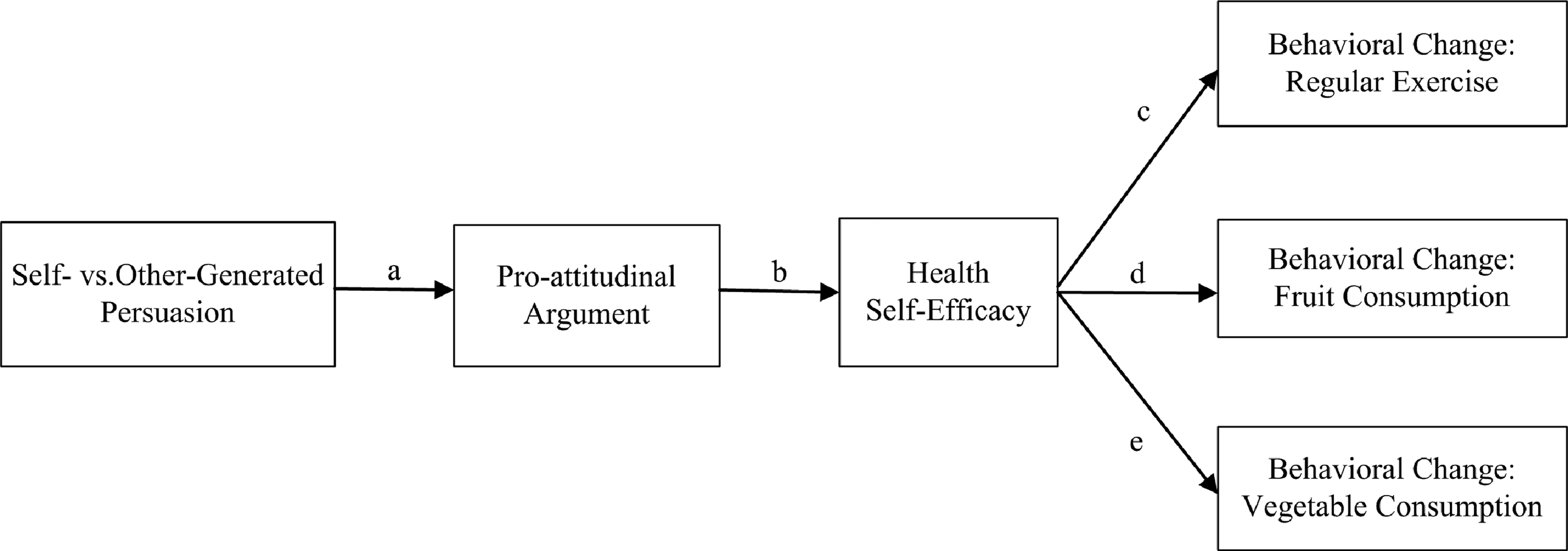
Hypothesized relationships among variables.
Methods
One hundred and thirty-three undergraduate students were included in the final analyses (65 % females). Their average age was 21.73 years (standard deviation [SD] = 1.87 years) and average weight was 136.38 pounds (SD = 27.69 pounds). An Android mobile app was developed by a professional developer. The app reflected a 3 × 2 between-participants design (persuasion: self-persuasion vs. other-generated narrative vs. other-generated non-narrative × topic: exercise vs. diet). “Topic” represents two instantiations of healthy behavior.
Procedure and stimulus materials
After Institutional Review Board approval, a recruitment message for Android smartphone users was posted on a popular bulletin board on a South Korean university's website. Participants first answered background questions and provided their email addresses in a pre-questionnaire. Next, they were instructed to install and register the study app by using the email addresses that they provided earlier. Upon registration, participants were randomly assigned to one of the six experimental conditions.
Participants were next informed that during the study, they would receive three push notifications prompting them to either write or read messages about health and well-being. The first notification was received on the first day of the study at 12:30 p.m.; the second and third notifications were received at 72 hours intervals thereafter.a With each push notification, participants were asked to click on the “writing” or “reading” button (on the basis of the condition), and then click on “exit” when done writing or reading (Table 1). The writing or reading duration was measured unobtrusively in seconds and averaged across notifications (Mself-persuasion = 94.47, SD = 219.93; Mnarrative = 5.96, SD = 4.44; Mnon-narrative = 6.30, SD = 8.09).
For the second and third push notifications in the two other-generated persuasion conditions, participants were exposed to different arguments with different gender-neutral names. Also, the number of words per stimulus message in the two other-generated conditions ranged from 25 to 33.
Three days after completing the last study task, participants were emailed a link to the final questionnaire, which consisted of two versions based on the two topics employed. Participants were compensated with a 20-dollar gift card.
Pre-questionnaire
Issue involvement
Participants' involvement with general well-being (e.g., It is important to me to live a healthy life; M = 5.33, SD = 1.02, α = 0.77) and each of the two topics employed—regular exercise (It is important to me to exercise most days of the week; M = 4.24, SD = 1.82) and healthy diet (e.g., It is important to me to eat a healthy diet most days of the week; M = 4.93, SD = 1.28, α = 0.70) were measured via an adapted scale (1 [Strongly Disagree] to 7 [Strongly Agree]). 28
Baseline measures
Participants indicated how often they exercised at least 30 minutes per day, ate one or two fruit servings per day, 29 and ate two vegetables per meal 29 during a typical 10-day period (1 [Almost None] to 6 [9–10 Days]). Median scores indicated that per typical 10-day period, participants exercised 1–2 days and ate sufficient fruits and vegetables 3–4 days.
Post-questionnaire
Number of pro-attitudinal arguments generated
Participants were asked to list as many arguments as possible in favor of engaging in 30 minutes of exercising (exercise condition) or eating around one or two fruit servings and two vegetables per meal (healthy diet condition) most days of the week. A content analysis was conducted to count the number of distinct arguments provided (M = 3.34, SD = 1.93). To establish interrater reliability, two research assistants were instructed to count the following as distinct arguments: general arguments (e.g., to be healthy), specific arguments (e.g., to have healthy skin), negatively worded arguments (e.g., to not disturb the body balance), and closely related arguments (e.g., to reduce tension and stress). Unclear arguments (e.g., “to prepare for unexpected activities” as a reason for regular exercise) were excluded them from the final analyses. The intraclass correlation coefficient was 0.91 (p < 0.001).
Health-related self-efficacy
A 7-item health self-efficacy scale (1 [Strongly Disagree] to 7 [Strongly Agree]) was adapted 30 to reflect the health context used here as well as to reflect official nutrition recommendations specific to Korea 29 (e.g., I am able to eat sufficient fruit (1–2 per day) and vegetables (2 per meal) most days of the week; M = 4.31, SD = 1.35, α = 0.90).
Self-reported behavioral change
Similar to the baseline measures in the pre-questionnaire, participants were asked how many days they exercised around 30 minutes per day, ate one or two fruit servings per day, and ate two vegetables per meal during the previous 10-day period (1 [Almost None] to 6 [9–10 Days]). These self-reported behaviors were subtracted from the baseline measures and three behavior change variables were created: regular exercise (M = 0.28, SD = 0.88), fruit consumption (M = 0.36, SD = 1.14), and vegetable consumption (M = 0.13, SD = 1.33).b
Results
For the final analyses, the two other-generated persuasion conditions were collapsed across the two topics because they showed no significant differences in the outcomes, and the involvement variables were not included because they did not significantly impact the outcome variables as covariates.
Hypotheses testing
SPSS 18 was used to test the hypotheses. H1 was tested using a 2 × 2 (persuasion × topic) analysis of variance (ANOVA) on the number of pro-attitudinal arguments. The results showed significant main effects, but a non-significant interaction. Self-persuasion (M = 4.08, SE = 0.34) elicited more pro-attitudinal arguments than did other-generated persuasion ([M = 3.12, SE = 0.18], F[1, 129] = 6.05, p < 0.05, ηp 2 = 0.05), and regular exercise (M = 4.01, SE = 0.24) elicited more of these arguments than did healthy diet ([M = 3.19, SE = 0.30], F[1, 129] = 4.55, p < 0.05, ηp 2 = 0.03). Thus, H1 was supported.
H2 was tested by using the same ANOVA on health self-efficacy. Health self-efficacy did not vary as a function persuasion type (F[1, 129] = 1.15, p = 0.29, ηp 2 = 0.01). Thus, H2 was not supported.
H3 was tested by using a 2 × 2 (persuasion × topic) multivariate analysis of variance on the three behavioral changes. Results showed a significant main effect for type of persuasion only (Wilks' Λ = 0.93, F[3, 127] = 3.30, p < 0.05, ηp 2 = 0.07). Univariate analysis of vegetable consumption revealed that; self-persuasion participants (M = 0.77, SE = 0.23) reported significantly higher vegetable consumption than those who participated in other-generated persuasion ([M = −0.06, SE = 0.13], F[1, 129] = 9.71, p < 0.01, ηp 2 = 0.07). Univariate analyses of regular exercise and fruit consumption showed that these behaviors did not vary as a function of type of persuasion. Thus, H3 was partially supported.
Model testing
AMOS 24 was used to test the hypothesized model. Figure 2 shows the paths associated with the model. Direct effects from each persuasion condition to each of three health behavioral changes were added to improve model fit, but this was not shown in the interest of clarity. The model fit was acceptable (χ2 [df = 4] = 6.60, p = 0.16, normative fit index [NFI] = 0.91, comparative fit index [CFI] = 0.95, root-mean-squared error of approximation [RMSEA] = 0.07).
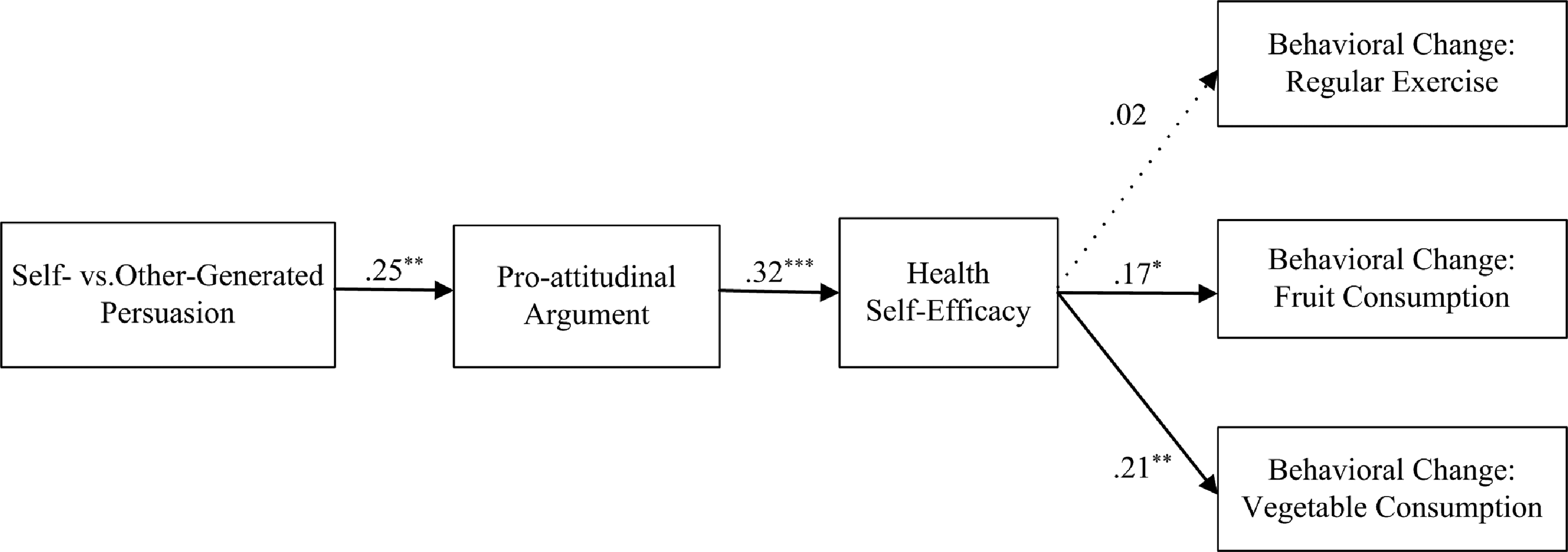
The effect of self- vs. other-generated persuasion on health behavioral changes. The persuasion condition was dummy coded (1 = self-persuasion). Entries are standardized β. *p < 0.05, **p < 0.01, ***p < 0.001. R 2 for pro-attitudinal argument = 0.06, R 2 for health self-efficacy = 0.10, R 2 for regular exercise = 0.00, R 2 for eating fruit = 0.04, R 2 for eating vegetable = 0.15. Covariance among error term of three behavioral changes: regular exercise and eating fruit = 0.26 (SE = 0.09), p < 0.01; regular exercise and vegetable consumption = 0.08 (SE = 0.10), p > 0.05; fruit consumption and vegetable consumption = 0.37 (SE = 0.12), p < 0.01.
Additionally, an examination of several indirect effects implied in the model revealed different routes to behavioral change (Table 2).
Condition = self- versus other-generated persuasion.
p < 0.05, **p < 0.01.
BC, behavioral change; H, health.
Discussion
The goal of the current study was to compare self-persuasion and other-generated persuasion for their effects on health behavioral change, and to identify the underlying mechanisms of these effects. The results showed that self-persuasion generated more pro-attitudinal arguments and had a stronger impact on health behaviors than did other-generated persuasion, though only for vegetable consumption. Health self-efficacy did not vary as a function of persuasion type. Additionally, a series of indirect effect tests showed that self-persuasion led to more frequent vegetable consumption because the opportunity to write reasons for maintaining a healthy diet first triggered participants to generate a higher amount of pro-attitudinal arguments, which further increased the participants' levels of health self-efficacy. A similar pattern was seen with fruit consumption. Although self-persuasion did not influence fruit consumption directly, it did so indirectly by triggering a high number of pro-attitudinal arguments and high levels of health self-efficacy. Behavioral change pertaining to regular exercise was not influenced by self-persuasion, directly or indirectly.
It is worth noting that the relationship between self-persuasion and health self-efficacy was not significant, but self-persuasion enhanced self-efficacy indirectly via pro-attitudinal arguments. Thus, it appears that simply asking people to generate reasons in favor of a particular health behavior, as in the self-persuasion condition, may not be sufficient on its own. It is only when those initial reasons resulted in a high number of pro-attitudinal arguments that self-persuasion really worked. Of course, it is also likely that the nature of those arguments (i.e., complexity) is important as well. Thus, future research would benefit from assessing not only the number, but also the quality of the generated arguments (i.e., degree of elaboration).
The discrepancy in behavioral change outcomes (exercise vs. diet) may be due to the effort required to change these behaviors. In South Korea people routinely eat rice and three to five side dishes consisting mostly of vegetables. Thus, participants may have increased their vegetable consumption with minimal effort. Increasing one's physical activity requires significantly more effort, however. It is possible that the effect of self-persuasion on more demanding behavioral changes may need to be examined over a longer timeframe (e.g., 1 month) or that the experimental treatment produced delayed effects for physical exercise.
There are several theoretical and practical implications of our findings. First, this study showcased the capability of smartphones to instigate self-persuasion processes. Despite the promise of attitude and behavioral change occasioned via self-persuasion, the challenge with this strategy is to get individuals to produce arguments in favor of the desired attitude or behavior and, perhaps, against their pre-existing beliefs. Although in self-persuasion there is no external communicator, there is still a need for an external force to help instigate the generation of pro-attitudinal arguments. 6 This study highlighted the use of mobile apps in this regard, thereby bringing an important contribution to a growing body of scholarship examining the role of self-effects generally, and self-persuasion particularly.7,14 It is further worth noting that our self-persuasion findings seem more impactful when considering that self-persuasion has been credited with producing some of the most enduring attitudinal and behavioral changes.3,4
This study is not without limitations. While the realistic experimental setting enhances the study's ecological validity, it is possible that differences in the experimental conditions (i.e., writing vs. reading) could have introduced potential confounds. First, although arguments presented in the other-generated persuasion condition and arguments produced in the self-persuasion condition overlapped considerably, the latter were more diverse and specific. While manipulating all possible claims into the other-generated persuasion condition was not feasible, the findings should be interpreted with the caveat that there may be some incomparability between the persuasion conditions. Second, the time spent on each app task was different across conditions; this raises concerns about alternative explanations. However, the inclusion of duration as a covariate when testing our hypotheses and model showed no significant effect of the covariate. Thus, duration was not included in final analyses, and alternative explanations can be ruled out. In future studies, however, it would be beneficial for researchers to ensure that the time investment by participants is equal across persuasion conditions.
Additionally, the self-persuasion condition had a small number of participants because of the mortality threats common in longitudinal designs. Of the 41 participants assigned to self-persuasion, some did not complete all of the app tasks,d some did not complete the post-questionnaire, and others had mismatched their e-mail addresses across the three data collection points. Lastly, we note that the pro-attitudinal arguments generated by participants were validated by the researchers. Although we found no clearly incorrect information, researchers of future studies should consider having clinicians validate these arguments.
In conclusion, this study suggests that within a short period, mildly demanding health behavioral changes can be effectively triggered via self-persuasion, and smartphones provide an apt tool for this process. Research is needed to establish whether self-persuasion is effective for more demanding health behavioral changes.
Notes
If participants did not respond to the first push notification sent at 12:30 p.m. on the first study day, additional notifications were sent on the same day at 1:30 p.m. and (if needed) at 2:30 p.m. If participants still did not respond to the subsequent notifications, “no participation” was indicated. This reminder procedure was repeated for the second and third push notifications. A total of eight participants failed to complete all three app tasks required, and they were excluded from the final analyses.
Of note, a 2 × 3 (topic × persuasion) MANCOVA was performed including the three baseline measures pertaining to regular exercise and healthy diet as dependent variables and gender, age, and weight as covariates. Neither the topic (Wilks's Λ = 0.99, F[3, 122] = 0.60, p = 0.62) nor the persuasion condition (Wilks's Λ = 0.97, F[6, 244] = 0.54, p = 0.780) nor their interaction (Wilks's Λ = 0.95, F[6, 244] = 1.11, p = 0.36) was significant, a result demonstrating that the random assignment was successful. Additionally, none of the three covariates was significant.
We initially included the topic variable as a covariate in the model. Results showed that the inclusion of topic did not cause a substantial change from the reported results. Thus, we did not include the topic in the final model.
For the app activities, the attrition rate is higher for self-persuasion (9.76 percent) than for the other-generated persuasion (3.75 percent). Therefore, there could be some individual differences (e.g., trait motivation) in the remaining participants.
Footnotes
Acknowledgments
This work was supported by the Ministry of Education of the Republic of Korea and the National Research Foundation of Korea (NRF-2015S1A5A8017580). The authors would like to thank Hyeseung Yang for his help in data collection.
Author Disclosure Statement
No competing financial interests exist.