




Abstract
Abstract
Studies on the quality of life (QoL) of older adults have tended to focus on sociodemographic, economic, and health characteristics and, more recently, have analyzed the importance of confidant networks. The Internet has redesigned individuals' daily lives and has become one of the main means of communication. In addition to the aforementioned variables, research must also gauge the importance of this technology and how it can influence the relationship between confidant networks and QoL of older adults. This article aims to analyze the contribution of the Internet on the QoL of older adults as well as the manner that it affects the aforementioned relationship. The present study focuses on a sample of 1,906 individuals aged 50+ who are resident in Portugal and were surveyed in the context of the SHARE project (Survey of Health, Ageing and Retirement in Europe), wave 4. The results of the regression analyses reveal the importance of the Internet on the QoL of older adults. The data also underline the moderating role played by the Internet on the relationship between the confidant network and the QoL of individuals aged 50+, in particular the fact that this technology optimizes the positive impact of confidant networks on QoL. The results obtained thus reinforce the importance of policies aimed at the e-inclusion of older adults as a way to promote their QoL.
Introduction
A
Many studies have pointed mainly to the impact of sociodemographic, economic, and health characteristics on the QoL of individuals aged 50+.2–6 In addition to these variables, the role of social networks has also been highlighted.
According to the most influential theoretical framework to highlight the impact of social networks in elderly well-being, “the convoy model,” 7 individuals are surrounded by supportive others who move with them throughout the life course. 8 Thus, social relations become a key aspect of aging, the life course, and well-being. 8
Of particular relevance within social relations are confidant networks. Confidant networks are composed of persons who are defined by individuals as especially meaningful to them and with whom they can share about both intimate worries and positive events.9,10 Confidant network structure is characterized by network size, emotional closeness, and frequency of contact. Ideally, convoy relationships have a beneficial effect, although they could also have deleterious effects. 11 There is a wide array of studies on how confidant networks are related to QoL. While the majority suggest a positive relationship,5,12–14 others point to an incipient or even negative relationship. 15
The formation and maintenance of these convoy relationships are affected by family, personal, and cultural circumstances.8,16,17 As individuals reach advanced ages, the frequent loss of professional identity, of several relatives and friends,18,19 allied to other factors, such as the emergence of health problems20,21 and increased geographical distances between the place of residence of older adults and the residences of their relatives and friends,19,22 tends to affect the ability of these individuals to maintain their confidant networks.
In this context, one of the main challenges facing the impact of social relations in well-being is the study of technological developments, such as the Internet. 23 Adults increasing use of the Internet point out to new areas for investigating how social relations influence well-being.23,24
With this regard, it is observed an open debate on two issues, whether mediated communication contributes to or detracts from people's QoL 25 and also whether the Internet is beneficial or harmful to social relationships. 26 We have found a gap with no studies to analyze the moderating role played by the Internet on the relationship between social relations, particularly the confidant network, and QoL that will constitute the main goal of this research.
Regarding the first debate, while some works point that Internet use has been associated with a better QoL, 27 others point to negative feelings 28 or no relation to QoL. 29 In the same vein, conclusions on the impact of the Internet on older adults' social networks are not consensual. While some works suggest that this technology brings people together and strengthens bonds, fostering the development of successful relationships between older adults, 30 other studies show that Internet use is not associated with strong ties and that there are no differences between users and nonusers, in terms of intimate or confidant networks. 31
The existence of these debates about the influence of the Internet on both elderly's social networks 32 and their QoL 29 as well as the lack of studies about the impact of the Internet on the relationship between confidant networks and QoL highlight the need to investigate these issues.
Based on the current state of scientific literature, the main objective of this work is to analyze the importance of the Internet and its moderating role on the relationship between the characteristics of confidant network structure (network size, emotional closeness, and frequency of contact 33 ) and the QoL of older adults in Portugal—a country where low rates of Internet use persist among individuals aged 50+. 34
We would expect to find a positive impact of the Internet on QoL. With regard to network size in general, it seems to be associated with greater well-being among elderly population,10,35 being consider important the presence of meaningful social ties for well-being. 33 Since according to some studies seniors tend to use the Internet to a higher extend to preserve than to expand their social relations, 36 we would not expect a significant effect of the Internet on the relationship between the network size and QoL. The emotional closeness between elderly and their confidant network is frequently associated with higher levels of well-being.2,4,5 Since the Internet enables communication between individuals 37 and some studies suggest that the Internet strengthens social ties,30,38–40 we do expect it to positively influence the relationship between the emotional closeness and QoL. Regarding frequency of contacts, results are not consistent with some studies showing a positive impact,10,35,41,42 whereas others find that this is not always the case and that it can even be associated with lower levels of QoL.4,5 Bearing in mind that people tend to select, optimize, and compensate their relationships across the life span, 43 it would be reasonable to expect that the Internet opens up the possibility for more selective and voluntary contacts, thus positively affecting the relationship between the frequency of contact and QoL.
Materials and Methods
Sample and procedure
This study focused on 1,906 individuals aged 50+, interviewed in Portugal, within the framework of the European SHARE project (Survey of Health, Aging and Retirement in Europe), wave 4 (2010–2011). Details on the SHARE study in Europe have been described elsewhere. 44 Briefly, a survey was conducted with a representative sample of the noninstitutionalized population aged 50+. To achieve representation of this population, SHARE employs a sample design that involves a baseline sample of the household population of persons aged 50+ living in Portugal.
Interviews were conducted face-to-face and took place in the households. Trained interviewers conducted interviews on a computer-assisted personal interviewing program.
The SHARE project, coordinated internationally by the Max Planck Institute for Social Law and Social Policy (Germany), has been approved by the Ethics Council of the Max Planck Society for the Advancement of Science and by the University of Minho Ethics Commission (Portugal).
Statistical analyses were conducted using SPSS software, version 23. First and foremost, univariate and bivariate descriptive analyses were conducted. The univariate analyses used calibrated individual weights since the SHARE survey did not have a uniform sample design. The bivariate analyses focused on the relationship between each of the independent variables and the dependent variable (QoL) of the linear regression model. Next, the moderating role played by the Internet on the relationship between the confidant network and QoL (Fig. 1) was tested.

Analysis model.
To test the above moderating model, and using Process software, linear regression analyses were conducted for each of the characteristics of the confidant network (size, emotional closeness, and frequency of contact). The variables were centered—to avoid issues of multicollinearity.
Measures
Dependent variable
QoL was assessed using the CASP-12,45,46 which consists of 12 items that assess how often individuals experience different feelings and situations on a four-point Likert scale ranging from “often” to “never,” with items such as: My age prevents me from doing the things I would like to do. The CASP-12 ranges from 12 to 48 points; items are recoded in such a way that higher values mean higher levels of QoL.
Moderating variable
It was coded as a dichotomous variable related to regular Internet use like in previous studies about Internet and the elderly.31,47–49 This variable has the status of a binary moderating variable, wherein an affirmative answer to the question on Internet use is the reference category.
Independent variables
The independent variables concern the confidant network. Wave 4 of SHARE included a module on confidant networks, using the name generator technique.14,50 Respondents were asked to identify up to six people with whom they discussed important personal matters and could identify an additional person who was important to them for any other reason.14,50
The characteristics of the network were operationalized as follows: confidant network size (0–7 individuals); frequency of contact assessed by asking respondents, During the past twelve months, how often did you have contact with (confidant's name) either in person, by phone or mail, email or any other electronic means? Response options ranged from (1) “Daily” to (7) “Never” and were reverse coded such that higher scores indicated higher frequency; emotional closeness was assessed by asking respondents, How close do you feel to (confidant's name)? with answers ranging from (1) “Not very close” to (4) “Extremely close.”33,51,52
Covariables
We included the variables that are traditionally considered in QoL studies, that is, sociodemographic and economic variables: age; gender: female (1) and male (0); years of schooling; and self-perception of financial stress: “great difficulty” or “some difficulty” in coping with monthly expenses (0), “easy” or “very easy” to support monthly expenses (1). We also considered health variables: (a) depressive symptoms evaluated by the EURO-D scale. 53 The EURO-D scale ranges from 0 to 12 points that refer to the presence or absence of 12 symptoms of depression such as suicidal thoughts, distinguishing between individuals with 3 or more symptoms and individuals with lower scores. 33 (b) Activities of daily living (ADLs) (limitations in ADLs)33,54 that refer to the presence or absence of difficulties in doing alone any of six ADLs, such as bathing, dressing, and toileting, distinguishing between individuals who reported having one or more limitations (1) and individuals who declared no limitations (0). (c) Instrumental activities of daily living (IADLs 54 ) that refer to the presence or absence of difficulties in doing alone any of seven IADLs, such as preparing a hot meal or shopping for groceries, distinguishing between individuals who reported having one or more difficulties (1) and individuals who declared no limitations (0). (d) Finally, the number of chronic illnesses reported by each individual.
Results
Table 1 shows the sociodemographic, economic, and health characteristics of the panel of respondents. The participants had a mean age of 66.03 years (SD = 10.32), with a majority of females (55.3 percent) and, on average, 5.78 years of schooling (SD = 4.049). More than half of the respondents (55.2 percent) reported having difficulties in meeting their monthly expenses.
Descriptive Statistics for Study Variables of Internet Users and Nonusers in the Sample
N = 1,906 (N nonweighted).
Source: SHARE wave 4, version 1.1.1 weighted data.
ADL, activities of daily living; IADL, instrumental activities of daily living.
In terms of health, 36.4 percent had symptoms of significant depression, 15.7 percent reported limitations in performing ADLs, and 19.1 percent had limitations in performing IADLs. The average number of chronic illnesses per individual was 1.78 (SD = 1.58).
In Table 1, it can also be observed that only 15.2 percent of participants use the Internet and that the confidant network is constituted, on average, by 2.17 confidants (SD = 1.429). Networks are also characterized by strong emotional closeness and frequency of contact (mean 6.63).
Table 2 evidence significant correlations between the dependent variable, QoL (CASP-12), and the remaining variables under study.
Correlations with the Dependent Variable, Quality of Life (CASP-12)
N = 1,906 (N nonweighted).
p < 0.05; **p < 0.01; ***p < 0.001.
Source: SHARE wave 4, version 1.1.1.
Table 3 presents the results of the regression analysis. First, it shows the contribution of the individuals' sociodemographic, economic, and health characteristics as well as that of the Internet and the confidant network on the QoL of adults aged 50+. Second, introduction of interaction terms evidences the moderating role played by the Internet on the relationship between the characteristics of the confidant network and QoL.
Moderating Role of the Internet on the Relationship Between the Confidant Network and the Quality of Life
N = 1,828 (nonweighted).
Source: SHARE wave 4, version 1.1.1 nonweighted.
On the basis of more in-depth analysis of the results of the regression analyses presented in Table 3, it can be stated (Model 1) that age is inversely associated with QoL, and pertaining to the female gender is also inversely related to QoL. However, higher levels of schooling and positive perception of the household's financial situation are positively related to QoL. Physical or mental health problems are associated with lower levels of QoL. More specifically, the existence of symptoms of significant depression, limitations in performing ADLs or performing IADLs, as well as a higher number of chronic illnesses are predictors of lower QoL.
Internet use is associated with higher levels of QoL. The confidant network size and emotional closeness are also positively associated with QoL. However, the frequency of contact does not reveal a statistically significant relationship with this indicator.
Introduction of interaction terms serves to underscore the dynamics of the interrelationship between Internet, confidant network, and QoL. Model 2 confirms that in relation to the contribution of the network size to QoL, there is no statistical difference between Internet users and nonusers (Fig. 2).
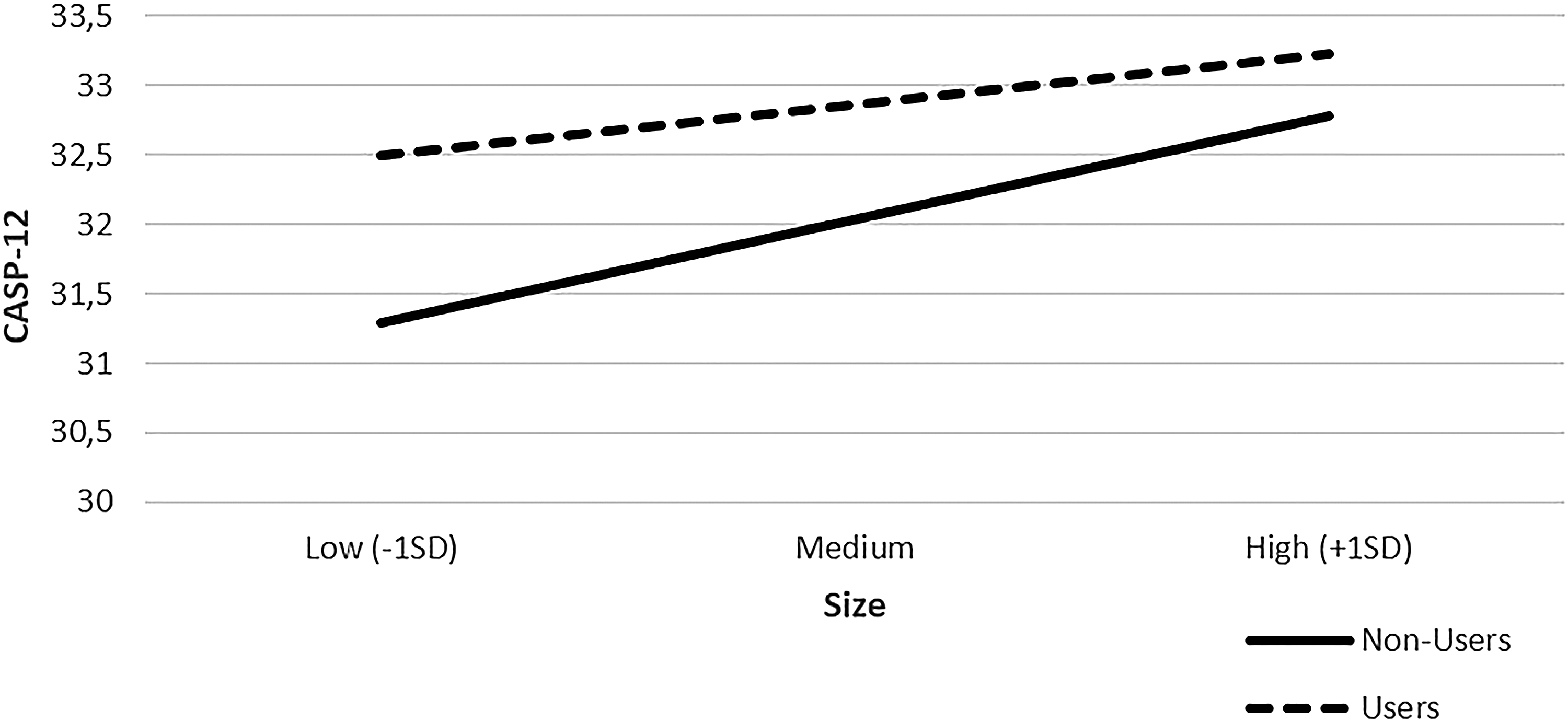
Association between the network size and the QoL. QoL, quality of life.
In Model 3, for each unit of increase of the emotional closeness with members of the confidant network of Internet users, there is an increase of 1.034 (95 percent confidence interval [CI] = 0.244–1.824; p = 0.010) in the QoL of these individuals when compared with those who do not use the Internet (Fig. 3).
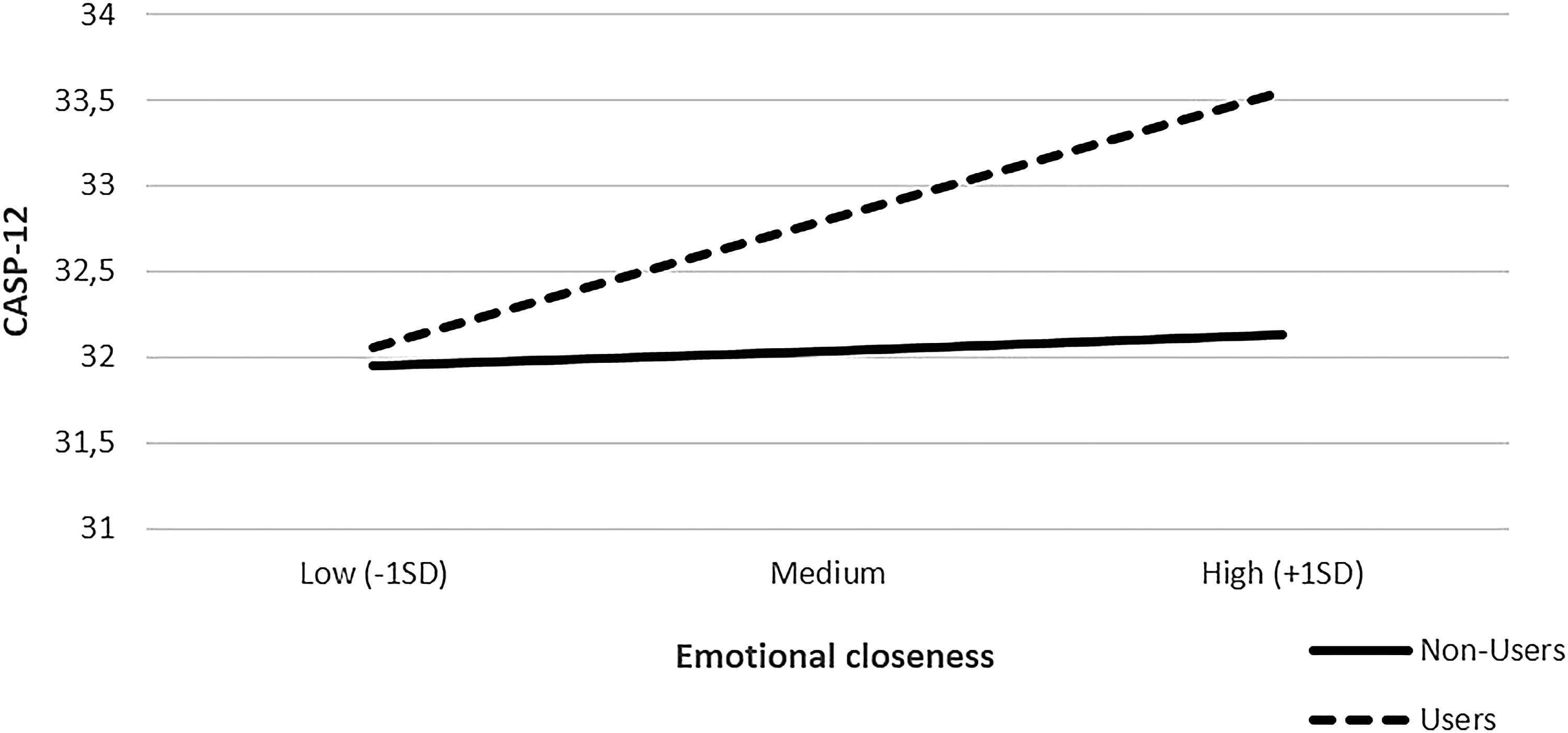
Association between the network emotional closeness and the QoL.
Finally, the fourth model (Model 4) makes it possible to verify that increased frequency of contact with the members of the confidant network of Internet users leads to an increase of 0.853 (95 percent CI = 0.108–1.598; p = 0.025) in the QoL of these individuals when compared with their counterparts who are non-Internet users (Fig. 4).
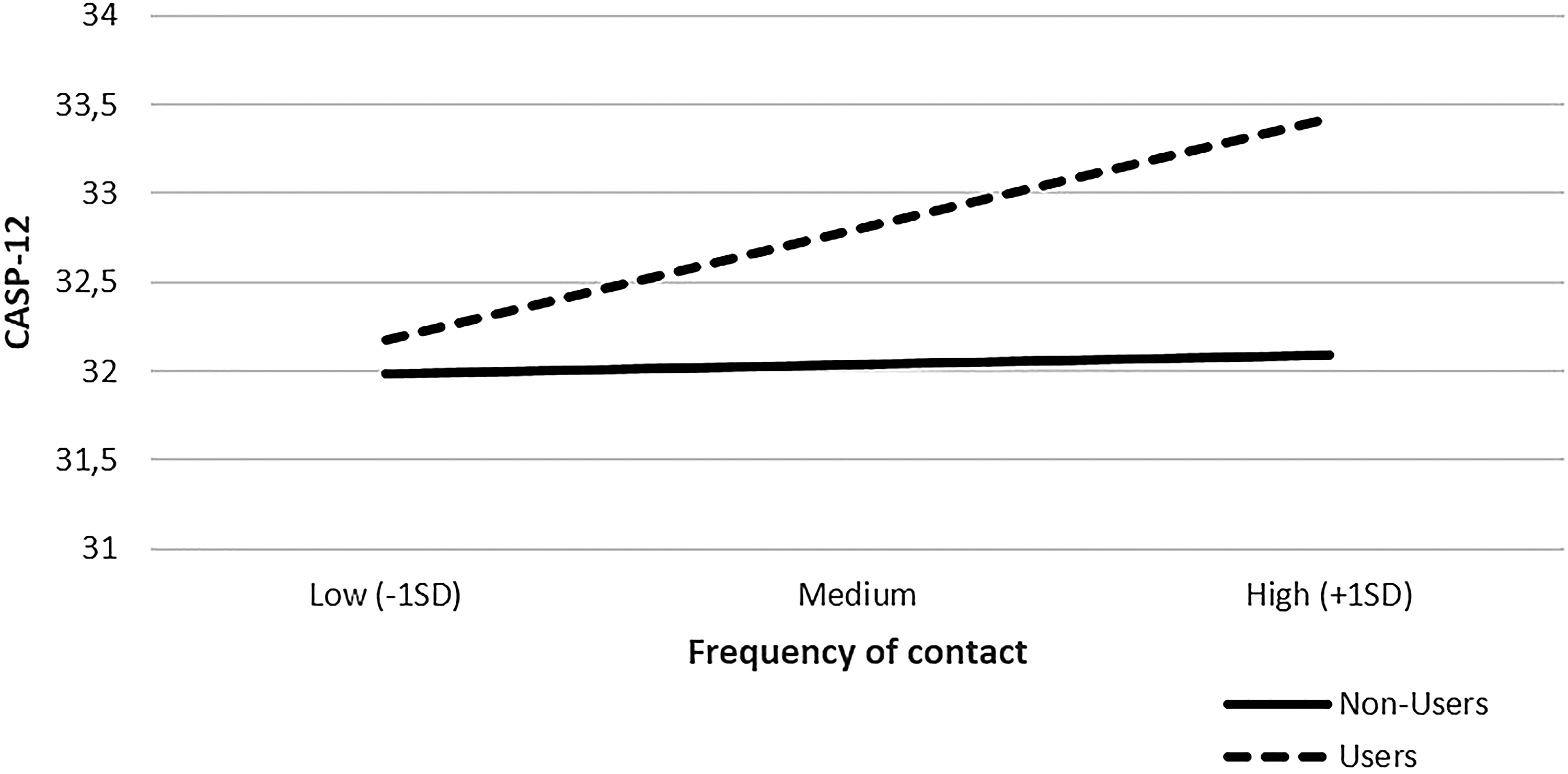
Association between the network frequency of contact and the QoL.
Discussion
The main goal of this study was to analyze the importance of the Internet for QoL and its moderating role on the relationship between the confidant network and QoL, contributing to extant research.
Previous research has focused mainly on the impact of sociodemographic, economic, and health characteristics on the QoL. Likewise, this study corroborates the results of those that highlight the importance of schooling, a positive financial situation,4,46,55 and the absence of health problems or limitations4–6,46 for the QoL of elderly persons, and it also highlights, as other studies, the lower levels of QoL for women and older adults.46,56
An important conclusion of this work is that, in addition to the aforementioned variables, the Internet also makes a positive contribution to QoL. This study thereby contributes to the ongoing discussion in the literature on the impact of the Internet on the QoL of older adults29,30,57,58 in favor of those studies, which point to the positive role of the Internet for QoL.27,30,38,57,59
Previous research has also emphasized the relevance of social relations for the QoL of older adults,5,12–14,60 pointing out that one of the main challenges for convoy relations on well-being is the study of the impact of the Internet. 23 No studies was found analyzing the moderating role played by the Internet on the relationship between the confidant network and QoL.
The main scientific contribution of this article precisely concerns the (moderating) role played by the Internet on the relationship between the confidant network and QoL, underscoring the dynamics of that relationship. That is, this study adds to the previous literature by demonstrating that Internet use optimizes the positive impact of emotional closeness and frequency of contact with confidant networks on the QoL of adults aged 50+. Previous studies have shown the positive impact of emotional closeness on the well-being of older adults.2,4,5,12,35 In this line, this work adds by showing that the Internet optimizes the impact of emotional closeness on QoL. Previous research showed inconsistent results about the impact of frequency of contact with the confidant network on QoL, with some evidencing a positive impact,10,35,41,42 while others found the opposite.4,5 The results of this study may shed light to clarify these inconsistent outcomes. We found that the Internet optimizes the impact of frequency of contact on QoL, suggesting that the Internet opens up the possibility of more voluntary and selective contacts that would lead to a beneficial impact on QoL. As expected, we did not find any evidence on the impact of the Internet on the relationship between the network size and QoL. This is probably due to that among social relations, confidant networks tend to circumscribe to a small group9,14 and that seniors tend to use the Internet to a higher extent to preserve than to expand their social relations.36,61
This study has some limitations that could be addressed by future research. The main limitation is that a single item was used to measure overall Internet use. Although Internet use by seniors have often been measured as a yes/no response to whether someone regularly uses the Internet,31,47–49 and consistently, this item was the only measure of Internet use available in the SHARE project, it is acknowledged that this measurement does not allow specific details to be learned about Internet use, such as different types of usage (recreational purposes, communication, information retrieval) or length of Internet use. Future research could include these aspects. It would also be of interest to distinguish between different devices and forms of contact when analyzing the frequency of contact. In addition, as the present study focused specifically on Portugal, the ability to generalize our findings to different contexts may be taken with cautious. Future research could also benefit from considering the influence of cultural effects.
Despite these limitations, the current study contributes to expand previous literature that showed the influence of social relations, and particularly, confidant networks on the QoL of older adults, by evidencing the positive impact of the Internet on this relationship.
Considering that the aging demographic trend around the world highlights the need to address factors that promote the well-being of older adults, 57 that this study evidences that the Internet optimizes the positive impact of confidant networks on QoL, and that welfare systems and public policies may have an impact on the likelihood of Internet use, 34 these results also invites to reinforce the need to develop policies to ensure the digital inclusion of older adults as a way to promote their QoL.
Footnotes
Acknowledgments
This article uses data from SHARE wave 4 (DOI: 10.6103/SHARE.w4.500), see Malter and Börsch-Supan (2013) for methodological details. The SHARE data collection has been primarily funded by the European Commission through FP5 (QLK6-CT-2001-00360), FP6 (SHARE-I3: RII-CT-2006-062193, COMPARE: CIT5-CT-2005-028857, SHARELIFE: CIT4-CT-2006-028812), and FP7 (SHARE-PREP: N211909, SHARELEAP: N227822, SHARE M4: N261982). Additional funding from the German Ministry of Education and Research, the U.S. National Institute on Aging (U01_AG09740-13S2, P01_AG005842, P01_AG08291, P30_AG12815, R21_AG025169, Y1-AG-4553-01, IAG_BSR06-11, OGHA_04-064), and from various national funding sources is gratefully acknowledged (
Author Disclosure Statement
No competing financial interests exist.