




Abstract
Abstract
Concern has been raised regarding the possible effects of mobile phone use on health, especially by children and adolescents. Thus, it is important to evaluate factors affecting their patterns of use. This study aimed to identify determinants of heavy mobile phone use among Israeli adolescents. Data were collected using a self-report questionnaire regarding mobile phone usage, leisure activity, sociodemographics, and opinion regarding mobile phone use. “Heavy use” was defined as >1 hour of daily duration of voice calls, or >50 daily text messages. The survey included 1,688 seventh and ninth graders in eight middle schools. The vast majority (96.1 percent) used the mobile phone for voice calls daily. Girls were heavier users than boys, and ninth graders were heavier users than seventh graders. Among students attending religious schools, the rate of heavy users was lower than among those attending secular schools. About half of the students did not use hands-free devices at least half of the time. Leisure activities were significantly associated with mobile phone use. This study demonstrates that several variables, including sociodemographics and leisure activities, may predict heavy mobile phone use among teenagers. This information can be useful for exposure assessment and for designing intervention programs for reducing radio frequency (RF) radiation exposure.
Introduction
Mobile phones, introduced in the 1970s, were used only for voice calls, and initially were only accessible to those living in wealthy households. However, over the last decades, mobile phones have become the favored information and communication device worldwide, and are used for multiple purposes by all population groups, including children and teenagers.1–5
Several surveys have indicated differences in penetration of mobile phones, in the amount of usage and type of phone activities by age, even among children and adolescents. Differences in mobile phone use were also demonstrated by personal characteristics, such as sociodemographic variables and lifestyle habits.5–10
The extensive use of mobile phones has raised concerns regarding the possible health impact of their use, especially for young users. These concerns have led to epidemiological studies mainly on the possible association between mobile phone use and risk of cancer.11–17 The results and interpretations of these studies are debated. 18 Less research has been performed on cancer and other health outcomes in children and adolescents.19–23
The World Health Organization (WHO) has classified the radiation emitted by mobile phones as a “possible carcinogen” (category 2B). 24 Subsequently, organizations worldwide have recommended adoption of the “precautionary principle,” especially with respect to children, who are generally more susceptible to developing cancer related to various risk factors, and because they will have had more years of exposure. 25
Exploring the different types and amount of mobile phone use, as a basis for exposure assessment, is crucial for risk determination. Evaluation of the factors affecting the adolescence usage habits is important in designing epidemiological studies as well as for intervention programs conducted in different geographically or culturally defined groups of children.
The aims of this study were to describe mobile phone use among adolescents in Israel, to evaluate the intensity of use, and to assess the sociodemographic and behavioral factors associated with heavy use. In addition, this report describes the teenagers' perceptions that may be associated with mobile phone use habits.
Materials and Methods
During the years 2012–2013, an educational intervention program entitled “The Mobile Generation” was conducted in middle schools in central Israel. The aim of this initiative was to reduce exposure to radio frequency (RF) radiation from mobile phones by adopting educated use, based on professional recommendations in line with the “precautionary principle.”
Eight schools, including 80 seventh and ninth grade classes, participated in the program, including a total of 2,675. Six of the schools were secular schools and two were religious schools. Evaluation of the program was conducted through the use of a 45-minute self-report questionnaire, including multiple choice questions. The baseline survey was conducted 1 month before the educational program began in each class during a single lesson.
A letter containing information regarding the survey and a request to sign an informed consent was sent to the parents of all students who participated in the program. Students without signed informed consent forms and students refusing to complete the questionnaire, or who were not in class during the survey session, were not included in the analysis (Fig. 1).
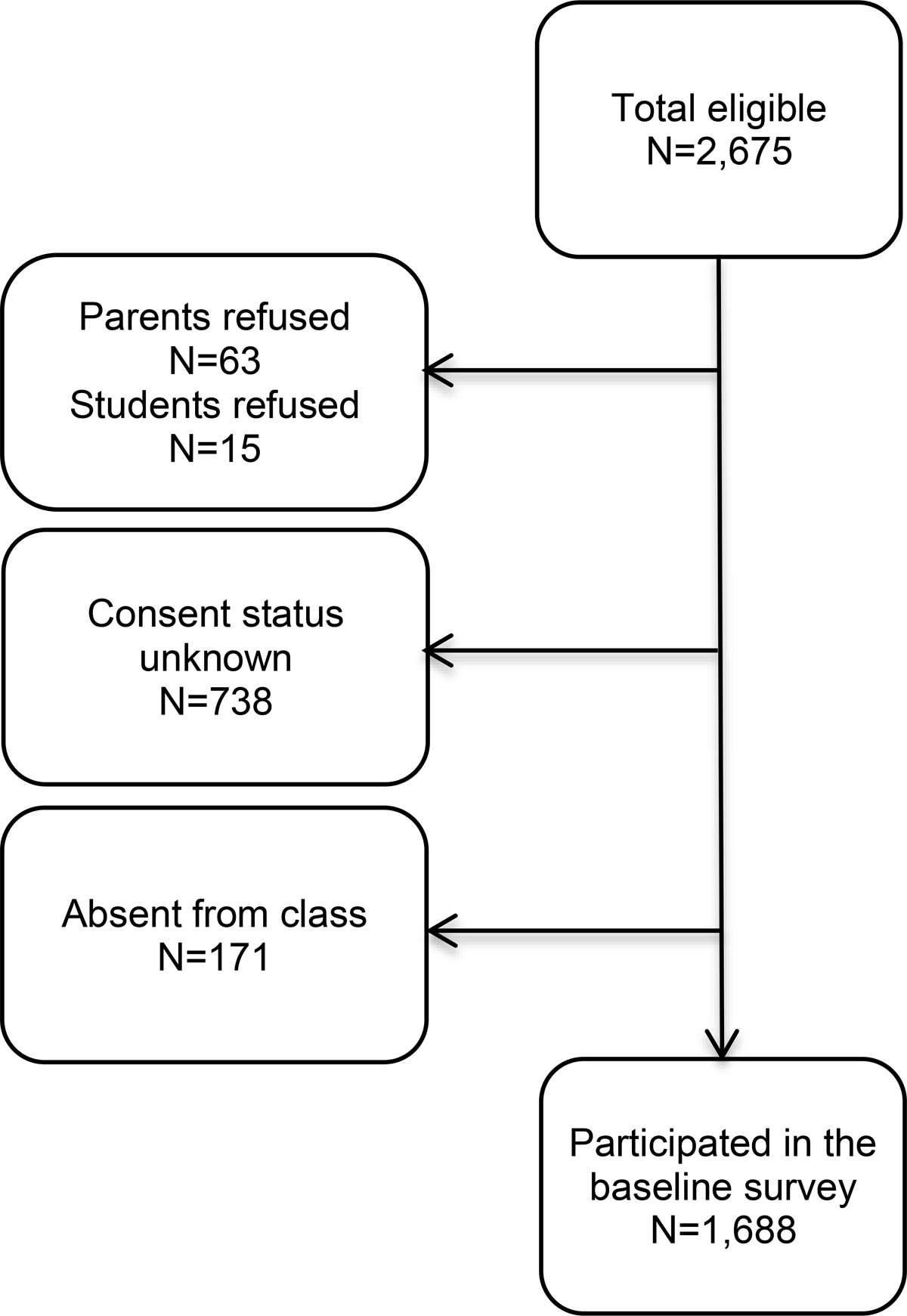
Study population.
Of the 40 questions in the survey, 20 were designed to assess the patterns of mobile phone use, such as duration of calls per day, number of text messages per day, and use of headsets and speakers. The students were asked about their response to an incoming call when in an elevator and their age at start of mobile phone use. Another section included questions describing perceptions related to mobile phone use. Information on leisure activities was also collected (e.g., using computers, meeting with friends). The questionnaire included data on sociodemographic characteristics, such as gender, age, grade, and number of rooms per person (RPP) in the home (as a proxy for socioeconomic status).
Mobile phone use (duration of voice calls, number of text messages, and duration of surfing) was collected as a categorical variable. Therefore, “heavy users” were defined as the combined closest categories to the highest quartile. Of the total participants, 27.9 percent spent >1 hour per day speaking on the mobile phone and 27.6 percent sent more than 50 text messages per day (Table 1).
Description of Study Population
Percent not including missing data.
RPP- rooms per person.
Text messages: SMS and/or WhatsApp.
Among users only: defined by duration of voice call (>1 min per day) or if unknown (three cases), defined as users by other variables (e.g., number of calls per day).
Odds ratios (ORs) and 95 percent confidence intervals (CIs) were calculated to identify factors associated with heavy use. Unconditional logistic regression was conducted to assess predictive variables for being a heavy user, adjusting for potential confounders (gender, grade, and school). Kendall's Tau-b tests were used to evaluate the correlation between duration of use and number of text messages. The Pearson correlation was used to compare the mean age at start of use in different groups. Statistical analyses were conducted using SAS (version 9.2, SAS Institute, Inc., Cary, NC).
The study was approved by the Ethics Committees of the Sheba Medical Center and of the Ministry of Education (Israel).
Results
Among the 2,675 eligible students who participated in the program, 1,688 were included in the baseline survey (63.1 percent compliance). Sixty-three students did not take part in the survey due to their parents' refusal and 15 students refused to participate despite the parents' agreement (total refusal rate of 2.9 percent). In addition, for 738 parents, the status of their consent was unknown, probably because they had not received the consent form sent by mail or given to the student. During the survey session, 171 students were not present in the class and therefore did not participate (Fig. 1).
Among the 1,688 participants, 44.7 percent were males and 55.3 percent were females; 45.4 percent and 54.6 percent were in the seventh and ninth grades (13 and 15 years old), respectively. The study population was drawn from six secular schools and two religious schools, which contributed 78.4 percent and 21.6 percent of the participants, respectively. Regarding socioeconomic status, 71.4 percent of the students lived in a home with ≤1 RPP, and 28.6 percent lived in a home with >1 RPP (“a” in Table 1).
Most of the students (96.1 percent) spent at least 1 minute per day using the mobile phone for voice calls (making and receiving calls) and were defined as mobile phone users. The pattern of mobile phone use among the total study population is presented in “b” in Table 1. While 27.9 percent of the students spent 0–10 minutes on voice calls per day, another 27.9 percent spent more than 1 hour on voice calls daily, and 11.0 percent of the students spent more than 2 hours on a typical day. Text messages (SMS and WhatsApp), were used by 85 percent of the participants: 27.6 percent reported more than 50 messages per day and 7.4 percent reported more than 300 messages per day. A significant positive correlation (p = 0.02) was found between the categories of the two types of use: duration of voice calls and number of text messages. About one-quarter of the students reported that they do not use the mobile phone to surf or play on the Internet, while 26.6 percent reported surfing for at least 2 hours a day, and 6.0 percent over 6 hours a day. Most of the mobile phone users (95.6 percent) began using a mobile phone before age 12 (8.4 percent before age six) and 94.9 percent were using their own mobile phone at the time of survey.
Girls began using mobile phones at an earlier age than did boys (mean start age ± SD: 9.8 ± 2.0 vs. 9.5 ± 2.0), secular students began earlier than did religious students (9.5 ± 2.0 vs.10.1 ± 2.0), and students in the seventh grade began earlier than did ninth grade students (9.1±1.8 vs. 10.1 ± 2.1) (p < 0.001). RPP was not associated with age at start of mobile phone use. More girls than boys had their own phones (94.9 percent vs. 91.2 percent, p = 0.01), and more ninth than seventh grade students had their own phones (95.0 percent vs. 90.9 percent, p = 0.002). Religiosity and RPP were not associated with ownership of the phone (data not shown). As shown in “b” in Table 1, answering calls and talking in the elevator were reported by 46.8 percent of the students. On the contrary, about half reported not answering or postponing the calls to a later time. Never (or almost never) using a headset was reported by 91.3 percent of the mobile phone users and 72.3 percent did not use the speaker phone for most of their calls (data not shown). Overall, 49.4 percent of the mobile phone users did not use hands-free devices (earphone or speaker) at least half of the time (“b” in Table 1). The main reasons given for not using a headset or speaker were “uncomfortable to use” and “lack of privacy.” Regarding leisure-time activity (“c” in Table 1), 45.0 percent reported that they meet friends and 43.4 percent reported using the computer for more than 2 hours a day, but only 26.0 percent read books for more than half an hour daily.
Heavy users for calling time were defined as those spending over 1 hour a day making and receiving calls (“heavy speakers”), and for texting, those sending and receiving over 50 text messages per day (“heavy texters”). The rate of heavy users was significantly greater among girls than among boys; 38.2 percent and 15.0 percent, respectively, spent more than 1 hour daily conversing on mobile phones (p < 0.05). Girls also sent/received more text messages than did boys (p < 0.01). More heavy users were seen among ninth grade students than among seventh graders (29.9 percent vs. 25.3 percent and 33.3 percent vs. 20.6 percent for voice calls and texting, respectively; p < 0.001). Students who attended religious schools demonstrated significantly less heavy use than did those who studied in secular schools (p < 0.05). While >1 RPP positively related with heavy texting (p < 0.001), this variable was not associated with duration of calls (Table 2).
Odds of Being a “Heavy User” (Compared with “Other Users”) by Selected Sociodemographic Characteristics
Percent not including missing data.
OR, odds ratio; CI, confidence interval, each variable adjusted separately for gender, grade, and school.
RPP, rooms per person.
Leisure-time activity was found to be associated with heavy use. While a higher probability for being a heavy user was found among those who met with friends for more than 2 hours a day (significant OR of 2.20–2.02 for voice calls and text messages, respectively), a lower probability was found among those who read books for more than 0.5 hours a day (OR: 0.69; 95 percent CI: 0.52–0.91 and OR: 0.58, 95 percent CI: 0.43–0.78, for voice calls or text messages, respectively). Using the computer for more than 2 hours a day was significantly associated with duration of calls, but not with the number of text messages (Table 3).
Odds of Being a “Heavy User” (Compared with “Other Users”) by Selected Leisure-Time Activities
Percent not including missing data.
OR, odds ratio; CI, confidence interval, each variable adjusted separately for gender, grade, and school.
Table 4 demonstrates selected mobile phone use habits among the 1,623 students who were defined as users. A negative association was found between age at start of mobile phone use and the probability of being a heavy user (p < 0.01). The rate of heavy users was high among students reporting owning their mobile phones, compared with those who did not have mobile phones and those who share the phone with others. Answering the phone while in an elevator was positively associated with duration of voice calls, but not with number of text messages. In addition, a positive association was found between the frequency of hands-free-device use and the rate of heavy users for duration of calls and number of text messages per day.
Odds of Being a “Heavy User” (Compared with “Other Users”) by Usage Habits
Among users only: defined by duration of voice call (>1 min per day) or if unknown (three cases), defined as users by other variables (e.g., number of calls per day).
Percent not including missing data.
OR, odds ratio; CI, confidence interval, each variable adjusted separately for gender, grade, and school.
Earphone or speakers.
The students were asked their opinion regarding mobile phone policy. To the question “If there is a suspicion that a product has a negative health effect, especially for children, what is your opinion regarding limiting its use?” the majority of participants (61.3 percent) supported restricted use. This group of students was less likely to be heavy users, compared with those who did not support the restriction of use (OR: 0.54, 95 percent CI: 0.41–0.71 and OR: 0.68, 95 percent CI: 0.52–0.90 for voice calls or text messages, respectively). In addition, the students who thought that mobile phones should be used by texting or by using hands-free devices were significantly less likely to be heavy users regarding duration of voice calls only but not of text messages (Table 5).
Description of Students' Opinion Regarding Mobile Phone Use Recommendations and the Odds of Being a “Heavy User” (Compared with “Other Users”)
Percent not including missing data.
OR, odds ratio; CI, confidence interval, each variable adjusted separately for gender, grade, and school.
Students were asked their opinion regarding the recommended age at which they thought that mobile phone use should begin. A trend toward inverse association was found between the recommended “age of start” and the probability of being heavy users (p for trend <0.01). Although 42.5 percent of the students recommended restriction of mobile phone use for children before age 12, most of the students (95.6 percent) reported actually starting to use a mobile phone before that age (Tables 1 and 5). Students who thought that their friends use the mobile phone less than they do were more likely to be heavy users in terms of duration of calling time and number of text messages (OR: 6.94, 95 percent CI: 4.49–10.76 and OR: 5.61, 95 percent CI: 3.57–8.80, respectively) (Table 5).
Sixty-three percent of the participants supported the restriction of mobile phone use in the class room, but most of them were against rules that would forbid bringing mobile phones to school or using them during recess (Table 6). Regarding actual use of the mobile phone for voice calls and text messages during a lesson, 41 percent reported making or receiving at least one call per lesson and 7 percent reported that they made/received more than six calls during the lesson. Sixty percent of the students receive or send text messages during the lessons, and among them, about 13 percent reported receiving and sending more than 30 messages during one lesson (data not shown).
Students' Opinion on Policy Regarding Use of Mobile Phone During School Time
Percent not including missing values.
Discussion
This cross-sectional survey conducted among 1,668 teenagers in middle schools in central Israel, assessed the association between mobile phone use and demographic factors, lifestyle habits, and concepts regarding policy for mobile phone use. The results showed that the vast majority of teenagers use their mobile phones for voice calls and text messages and three-quarters of them use the phone as a tool for surfing the Internet.
Several sociodemographic variables as well as leisure-time activity were found to be associated with heavy use. These include female gender, older age, and attending secular schools. Other studies have also demonstrated an association between mobile phone use and personal and/or cultural characteristics, including age, gender, and sociodemographic status. Several studies conducted in the United States and other countries (as well as in Israel) also found a positive association between female gender and age and mobile phone use among children and adolescents.5–8,10,26–31 Some of these differences may be attributed to the content of the use. Girls tend to be more sociable and talkative, and attached great importance to communication in relationships. Another possible explanation could be parents' concerns regarding the girls' safety, that is, they want to be in touch when the girl is away from home.30–33 This may explain why girls tend to own a mobile phone at a younger age than boys. Studies have demonstrated conflicting results regarding the association between socioeconomic status and the use of mobile phones by children and adolescents. These differences may be due to various classifications of high and low socioeconomic status, and also may reflect time trends that occurred by socioeconomic status. Initially, only well-to-do parents could provide such an expensive device with the ongoing service charges, and therefore, socioeconomic variables were found to be positively associated with amount of use, but over the years, costs reduced significantly and mobile phones penetrated all population groups and all geographic locations, including the developing countries.2,3,5,10,29
Teenagers who were sociable (i.e., met often with friends face-to-face) were more likely to be heavy users (for duration of voice calls and number of text messages). In contrast, those who read books frequently were less likely to be heavy users. It is possible that the nature of the child or other social characteristics influence these two factors (mobile phone use and leisure-time activity) independently. The positive association found between duration of computer use and mobile phone use can reflect a tendency to engage with technology. Therefore, the actual exposure to RF might be much higher than his/her estimated dose as evaluated by mobile phone use only. Teenagers' perceptions regarding mobile phone usage affects their use. For example, those who support limiting the use of mobile phones for young children were less likely to be heavy users.
Some health organizations in the world have adopted the Precautionary Principle in the context of mobile phone use. 25 According to this principle, reasonable precautionary measures should be taken to minimize the risk, even in the absence of sufficient scientific evidence of harmful health effects from a specific agent. The most important principle for limiting exposure to nonionizing radiation is distancing the radiation source from the body, based on the fact that the radiation decreases significantly with increasing distance from the radiation source. Regarding mobile phones, the best way to implement this principle is to distance the device from the body organs while using it. Therefore, using the phone for text messages rather than conversations, or use of hands-free devices during conversation, is in line with the precautionary principle policy. In the current study, the use of texting was high, but on the contrary, most of the students (almost 80 percent) did not use hands-free devices frequently. However, the association found between the students' concepts and the amount of mobile phones use is an encouraging indication that programs for sensible use could be effective in this age group.
This study design is cross-sectional, and therefore, the main limitation is the inability to determine the time relationship between the variables, thus preventing determination of causality. In addition, the data on mobile phone use were self-reported and might be subjected to misclassification of intensity of use. 34
The study demonstrates that the amount and patterns of mobile phone use among adolescents can be predicted by sociodemographic and other personal characteristics, including their views regarding this issue.
These data can be used in sensitivity analyses conducted to assess the possible impact of exposure measurement errors and for designing intervention programs for reducing RF radiation exposure.
The present study focuses on mobile phone usage patterns among Israeli adolescents. In Israel, specific cultural characteristics, including strong family bonds and cohesive social networks, as well as unique security circumstances, influence the pattern of mobile phone use (frequency, content, and affordance).35–37 Furthermore, Israel is characterized by a diversity of subpopulations (e.g., various levels of religiosity), each having its own specific usage pattern (e.g., ultra-Orthodox groups only permit use of “kosher smartphone,” which do not have access to the Internet and are not used on the Sabbath). As in other industrialized societies, Israeli adolescents have adopted the mobile phone as a modern communication device; however, this population has specific cultural needs and therefore demonstrates a unique pattern of mobile phone use.
In conclusion, the findings of this study show that mobile phone is widely used by a vast majority of Israeli adolescents. Furthermore, several sociodemographic variables (female gender, older age, and secularity) as well as leisure-time activities were found to be associated with intensive use of mobile phone. In addition, it was found that the students' perceptions regarding mobile phone affect their usage patterns. Therefore, intervention programs and guidelines for informed use of mobile phones and other new technologies should consider the habits and needs of the specific target population.
Footnotes
Author Disclosure Statement
No competing financial interests exist.