




Abstract
Abstract
Previous studies have found that playing massively multiplayer online games (MMOGs) such as World of Warcraft (WoW) can lead to socializing and enhanced connectedness as well as negative well-being outcomes. Motivations for achievement and socializing play central roles in playing MMOGs. Using data from a survey of 181 WoW players, this study examined the relationship among game identities, motivations for playing WoW, and psychological outcomes. Results from analyses of path models suggested that motivations for achievement and socializing were influenced by game identities. Although these motivations substantially explained the variance in players' sense of WoW community, these factors only explained a small portion of negative psychological well-being. This study attests to the possibility of utilizing identity-based motivations in online game studies to understand psychological outcomes for players.
Introduction
P
Several studies have investigated motivations for playing MMOGs, suggesting that motivation is a predictor of both actual playing behaviors and addiction.2,8 Using factor analysis, pioneering work categorized motivations for playing online games into achievement, social, and immersion components. 9 Later studies specifically examining the WoW context found that in-game activities, such as teamwork and competitions, accurately predicted actual playing behavior (e.g., quest achievements and player vs. player achievements), highlighting the importance of motivations for achievement and socialization in the WoW environment.5,8 Although immersion motivations have been examined in previous research, 9 this study focused on socialization motivations in the game. Thus, broader factors were outside the scope of this study.
Although there appears to be an association between motivations and problematic Internet game playing, previous studies overlooked the factors underlying motivations. According to the theory of identity-based motivation, any behavior is identity infused rather than merely following personal choices. 10 A previous study revealed that the identity of a WoW player, especially one's guild member identity, generated a strong in-group trust online and offline. 6 A qualitative study among WoW players indicated that in-game socializations are influenced by player's WoW identity (one's perceived uniqueness of playing WoW as opposed to other online games) and the guild member identity (one's perceived pride and honor of belonging to a particular WoW guild). 4 Thus, gamers' motivations for playing WoW are likely driven, at least partly, by their identities in the WoW context.
This study aimed to examine the relationships among motivations for achievement and socializing and their psychological outcomes by regarding the WoW context as a social environment (Fig. 1). As the theory of identity-based motivation has never been applied in WoW studies, this study aimed to test its application to the WoW context. We hypothesized that two game identities (WoW identity and guild identity) affect the major socialization-related motivations (achievement and socializing) for playing. Given the dominant function of WoW's in-game mechanisms, which encourage players to work collectively,5,6 we hypothesized that players' motivations for socialization partially explain their motivations for achievement (e.g., grading and other collective in-game activities). Consistent with previous findings, we hypothesized that negative psychological symptoms and game overinvolvement (addiction) relate to motivations for achievement,1,2 whereas sense of WoW community (one perceives oneself as a part of the WoW community) is influenced by motivations for socializing.4,6

Hypothesized model among WoW identities, motivations, and psychological outcomes. DASS, the Depression Anxiety Stress Scales; WoW, World of Warcraft.
Method
Participants
A total of 181 participants (128 males, 53 females) completed an online survey. Their ages ranged between 18 and 64 years (M = 25.07, SD = 7.62).
Measures
Demographics, playing history, and playing habits
Demographic information included gender, age, and country of residence. Participants also reported the number of months they had played WoW, as well as the number of hours they approximately spent playing WoW each week.
Details of the following measures are listed in the Appendix Table A1.
WoW identity and guild identity
Adapted from Brown et al.'s social identification measure, 11 we used a 7-point Likert scale with three questions (Cronbach's α = 0.84) to assess WoW identity (e.g., How much do you see yourself being a WoW player?), with an 8-point Likert scale of three items (Cronbach's α = 0.90) to measure guild identity (e.g., How much do you see yourself as a member of your guild?).
Motivation for achievement and socializing
Drawn from previous research findings, 9 we used a 5-point Likert scale with three and four questions to measure motivation for achievement (e.g., How important is leveling, acquiring great items and gear, and becoming powerful? Cronbach's α = 0.66) and socializing (e.g., How important is chatting with other players? Cronbach's α = 0.84), respectively.
Negative psychological symptoms
The Depression Anxiety Stress Scales (DASS)-21, 12 with a 4-point Likert scale, was used to test symptoms of depression, stress, and anxiety during the last week.
WoW addiction
Young's diagnostic questionnaire for Internet addiction was used with a 4-point Likert scale. Eight questions (Cronbach's α = 0.87) were asked with wording adapted to the WoW context (e.g., Do you play WoW longer than originally intended?).
Sense of WoW community
With a 5-point Likert scale, eight questions (Cronbach's α = 0.89) were used to assess the sense of community (e.g., I can get what I need through the WoW community). The sense of community scale is based on the Brief Sense of Community Scale, 13 adapted to fit the context of WoW, to measure participants' WoW-based psychological sense of community.
Procedure
Participants were recruited through text-based online announcements on Web sites catering to players of WoW (e.g., Rock Paper Shotgun) after permission was granted by Web site operators. Participants provide informed consent by being taken to an electronic informed consent form after clicking the link on the advertisement and indicating their consent by ticking a box and proceeding with the survey. No incentives were offered directly to participants; however, participants were informed that, for each participant who completes the online survey, $1 AUD would be donated to the charity Child's Play,
Results
Demographics and WoW playing status
Most participants resided in Australia (77.9 percent) and other English-speaking Western countries such as the United States (8.8 percent) and Canada (2.8 percent). Participants had been WoW players for an average of 37.35 months (i.e., just >3 years) in total (SD = 23.56). They spent an average of 16.83 hours (SD = 12.87) per week playing WoW.
Correlational analysis
As given in Table 1, Pearson's correlation tests showed that all variables were significantly associated with motivations for achievement (all p's < 0.05). Both game identities were correlated with the two motivations investigated (motivations for achievement and socializing). However, WoW addiction and DASS were related only to motivations for achievement but not socializing. Although sense of community was associated with motivations, it had no relation to addiction or DASS.
p < 0.05, **p < 0.01, ***p < 0.001.
WoW, World of Warcraft; DASS, the Depression Anxiety Stress Scales.
Model test and modification
Based on the hypothesized model (Fig. 1), a path model was first identified and tested. However, the fit statistics were poor: χ2(20) = 141.898, p < 0.001; RMSEA = 0.14, CFI/TLI = 0.74/0.54, SRMR = 0.09. Modification indices were examined and used to refine the model to enhance model fit and theoretical parsimony. As shown in Figure 2, the final model was constructed and generated good fit: χ2(21) = 166.50, p < 0.001; RMSEA = 0.07, CFI/TLI = 0.95/0.91, SRMR = 0.07.
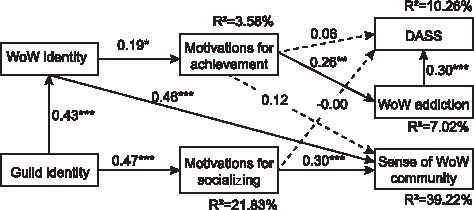
Modified model among WoW identities, motivations, and psychological outcomes. Numbers above paths are standardized coefficients. Significant paths are shown by solid lines, whereas nonsignificant paths are shown by dashed lines. Error items are not shown to avoid congestion. *p < 0.05, **p < 0.01, ***p < 0.001. Model fit statistics: χ2(21) = 166.50, p < 0.001; RMSEA = 0.07, CFI/TLI = 0.95/0.91, SRMR = 0.07.
In the modified model, except for the paths from motivations to DASS and the path from motivations for achievement to sense of WoW community, all other paths had significant coefficients. In line with hypothesized relationships, motivations for socializing had a medium and significant correlation with sense of WoW community. Interestingly, a small but near significant (p = 0.085) association between motivation for achievement and sense of WoW community emerged. As for the relationship among motivations for achievement and the negative psychological outcomes, although the direct relationship from motivations for achievement to DASS is nonsignificant, the motivation for achievement affected addiction, and addiction showed a significant relationship with DASS. Clearly, a sizable amount of variation (39.22 percent) of WOW Sense of Community was explained; the amounts for DASS and addiction were comparatively smaller.
For the game identity-based motivation section, the final model showed that motivations were influenced by game identities. However, inconsistent with our hypotheses, WoW identity only affected motivations for achievement and guild identity only for motivations for socialization; guild identity did not affect motivations for achievement but only motivations for socializing. A significant path from WoW identity to sense of WoW community was also identified. Although the motivations for socializing were largely explained (R 2 = 21.83 percent), only 3.58 percent of achievement motivations were explained.
Discussion
Examining a model incorporating game identities, motivations, and psychological outcomes, our study comprises a new perspective for WoW research. Importantly, our model suggests that the identity-based motivation theory is potentially a direction to reduce online game addictive tendencies by developing identity-tailored interventions. Sense of WoW community was well explained by the identity-based motivations in our study. Given the little existing research on sense of community in Internet games, 4 our study adds empirical knowledge to this field.
The model could not substantially explain the variance in negative psychological outcomes (DASS, WoW addiction), indicating that identity-based motivations may not be directly related to negative psychological outcomes. However, consistent with previous research, WoW addiction was found to be associated with DASS. 2 Since the motivations for achievement had a significant correlation with addiction, Internet game interventions may effectively improve players' psychological well-being by reducing their motivations for achievement alone.
The identity–motivation system indicated that motivations for playing online games are heterogeneous 9 and affected by different types of identities. Given the game's mechanics, motivations for achievement played a salient role in the model but only a small portion (3.58 percent) of variance was explained by identity factors. Because our research only targeted identities in WoW contexts, it is likely that off-game identities are also contributing to the motivations for achievement. Taking into account social and cultural factors, research has found that normative understanding of success is influencing the achievement motivations in WoW. 14 Moreover, ludic languages used in the WOW are found to be gender stereotyped 15 and avatars are believed to be the ideal selves of players 16 ; these findings suggest that identities such as gender and self-image might also impact players' interactions in games. Thus, it is important to include identities beyond game contexts for future studies to understand better the underlying determinants of motivations for playing WoW.
The moderate sample size and cross-sectional design are the main limitations of this study. The study can only conclude correlational, not causational, relationships between motivations and psychological outcomes. Future research with longitudinal and experimental designs can probe the directions of the multivariate relationships identified in this study so as to establish casual relationships. Nevertheless, this study comprises important initial findings applying identity-based motivation theory to the online game field, providing a new lens for future studies and online game interventions.
Footnotes
Author Disclosure Statement
No competing financial interests exist.
Appendix
| Construct | n | Measure | Scale | M | SD | α |
|---|---|---|---|---|---|---|
| WoW ID | 3 | How much do you see yourself being a “World of Warcraft” player? How important is being a “World of Warcraft” player to you? Do you feel that you have strong ties with other “World of Warcraft” players? |
[1] not at all to [7] very much | 12.15 | 4.69 | 0.84 |
| Guild ID | 3 | How much do you see yourself as a member of your guild? How important is being a member of your guild to you? Do you feel that you have strong ties with other members of your guild? |
[1] not at all to [7] very much | 14.09 | 4.97 | 0.90 |
| Motivation for achievement | 3 | How important—leveling, acquiring great items and gear, and becoming powerful. How important figuring out the game mechanics, planning my characters development, and optimizing my character. How important—competing with other players in terms of combat, crafting ability, or the economy |
[1] not important at all to [5] extremely important | 10.79 | 2.77 | 0.66 |
| Motivation for socializing | 4 | How important—getting to know other players. How important—helping other players. How important—chatting with other players. How important—being part of a friendly casual guild. |
[1] not important at all to [5] extremely important | 13.61 | 3.62 | 0.84 |
| YDQ | 8 | Do you feel preoccupied with “World of Warcraft” (think about the last time you played or anticipate the next time you will play)? Do you feel the need to play “World of Warcraft” for increasing amounts of time in order to achieve satisfaction? Have you repeatedly made unsuccessful efforts to control, cut back, or stop playing “World of Warcraft”? Do you feel restless, moody, depressed, or irritable when attempting to cut down or stop playing “World of Warcraft”? Do you play “World of Warcraft” longer than originally intended? Have you jeopardized or risked the loss of a significant relationship, job, educational, or career opportunity because of playing “World of Warcraft”? Have you lied to others to conceal how much you play “World of Warcraft”? Do you play “World of Warcraft” as a way of escaping from problems or of relieving feelings of feelings of helplessness, guilt, anxiety, or depression? |
[1] strongly disagree to [4] strongly agree | 4.98 | 13.87 | 0.87 |
| DASS | 21 | Participants were asked to indicate to what extent they have experienced each of the 21 symptoms in the past week: I found it hard to wind down I was aware of dryness of my mouth I could not seem to experience any positive feeling at all I experienced breathing difficulty (e.g., excessively rapid breathing, breathlessness in the absence of physical exertion) I found it difficult to work up the initiative to do things I tended to over-react to situations I experienced trembling (e.g., in the hands) I felt that I was using a lot of nervous energy I was worried about situations in which I might panic and make a fool of myself I felt that I had nothing to look forward to I found myself getting agitated I found it difficult to relax I felt downhearted and blue I was intolerant of anything that kept me from getting on with what I was doing I felt I was close to panic I was unable to become enthusiastic about anything I felt I was not worth much as a person I felt that I was rather touchy |
[0] did not apply to me at all through to [3] applied to me very much, or most of the time | 35.14 | 14.07 | 0.95 |
| I was aware of the action of my heart in the absence of physical exertion (e.g., sense of heart rate increase, heart missing a beat). |
||||||
| WoW sense of community | 8 | I can get what I need through the “World of Warcraft” community. |
[1] strongly disagree to [5] strongly agree | 24.27 | 6.28 | 0.89 |
All construct scores were calculated by summing up all items.
α, Cronbach's α; DASS, Depression Anxiety Stress Scales; n, item number of the construct WoW, World of Warcraft; YDQ, Young's diagnostic questionnaire.