




Abstract
Abstract
Despite the enormous growth of e-commerce, consumers still come against risk-related barriers while carrying out online purchases. Specialists of e-commerce have therefore explored the facets of online risk perception with the aim of identifying which has the greatest impact. There is, nonetheless, no consensus as to the facets of risk perception or their relative importance. This is the first study resorting to neurological tools that examines the differences between the three most widespread facets of risk (financial, privacy, and performance) in a low-involvement purchase environment. Contrary to behavioral findings, brain data from neurological analyses identify differences between the three facets of risk. Financial risk conveys the lowest subconscious aversion and negative values. Subconscious privacy risk, in turn, confers ambivalence and uncertainty while performance risk elicits the highest levels of disappointment and distrust. Implications from the current findings, if taken into account by retailers, can greatly improve web contents and purchase processes, and bolster sales.
Introduction
T
Given the importance of perceived risk as an antecedent to greater attitudes toward intention to adopt online purchases, specialists of e-commerce have deliberated extensively as to its definition, 5 main causes, 6 and dimensions or facets. 7 The notion of perceived risk is originally defined by Bauer 5 as uncertainty in the sense of lack of knowledge about what could happen after the purchase and the likely negative consequences. Subsequent studies concur in considering perceived risk as a multidimensional construct that can be subdivided into several facets, which together, explain the overall sense of risk associated with online purchasing. 8
Yet e-commerce studies do not concord in their focus of the different facets of risk. 9 Pires et al. 10 conclude that perceived risk comprises six facets: financial (likelihood of suffering a financial lost due to hidden costs), performance (possibility of the item failing to meet expectations), physical (probability of a harmed purchase), psychological (chance that the specific purchase be inconsistent with the consumer's self-image), social (likelihood that the purchase will lead to disdain by others), and convenience (probability that the purchase will result in loss of time in terms of late delivery). The findings of the study on this question carried out by Forsythe et al. 11 isolated three risk-related facets: financial, product, and time. Chiu et al., 8 in turn, identify financial, performance, privacy (likelihood that Web site shopping will lead to a loss of private and payment data), and product delivery as the main risks.
Recent research, however, consider financial, privacy, and performance risks as the widest (i.e., they may include other dimensions), most studied, influential, and common facets in online environments, and recommend going deeper into their processing as a first step in the understanding of the origin of general concerns induced by online purchases.12,13 Ignorance of the most important facet of risk may explain why businesses have not been coherent when directing their efforts to reduce online risk perception. Three determinants can explain the lack of unanimity in previous research: (i) the lack of control of the purchase involvement14,15 (ii) the heterogeneity of the sampling as to the level of online expertise or propensity of risk, 16 and (iii) the unconscious and automatic nature of risk related more closely to low-order processes than to conscious, self-reported mechanisms. 17
This study constitutes the first step to face those research gaps in a more objective way by using a neuroscientific tool, functional Magnetic Resonance Imaging (fMRI). Specifically, it advances a novel approach aiming to elucidate the neural underlying mechanisms of the widest, most studied, influential, and common risk facets, namely financial, privacy, and performance,12,13 in a low-involvement purchase environment. Delving deeper into the neurological processes triggered by these three types of risk not only serves to examine whether they are indeed different dimensions, but is essential to advance in the understanding of the subconscious origin of the concerns that risk facets induce in online environments.
When comparing the brain regions elicited by risk facets, the authors expected activation of several risk-related specific brain areas, notably the middle frontal gyrus, inferior and superior parietal lobes, and precentral gyrus. 18 Furthermore, some risk studies point to activations of brain areas (dorsomedial prefrontal cortex [DMPFC], anterior insula, thalamus, and striatum) linked to the penalty domain. 19 Unrest resulting from postpurchase events, in turn, may activate the angular gyrus and left cingulate, 18 brain areas linked to ambiguity. Areas such as the anterior insula related to distrust, a construct firmly linked to risk, are also highly activated when analyzing these facets. 20 A specific risk dimension can even elicit activations related to postpurchase regret and disappointment in the precuneus, right cingulate gyrus, or anterior insula. 21 Moreover, positive data resulting from the measurement of a facet of risk, when contrasted to others, can lead to activation of the dopaminergic reward system of the ventromedial prefrontal cortex (VMPFC). 19
In sum, the facet of risk that elicits the greatest activation of ambiguity, penalty, distrust, and disappointment may be indicative of a high level of negativity during the evaluation of products.
Materials and Methods
Participants
Thirty right-handed participants (15women, 15 men) averaging 25.04 (SD: 4.32) years of age were selected to participate in the experiment via the institutional Web site of the University of XXX. All participants were required to fill out informed consent forms according to the declaration of Helsinki and the project was approved by the Ethics Committee of the University. A total of 29 participants took part in the fMRI analyses as one individual did not adhere to the standards. Selection was limited to participants deemed to have a high to medium computer expertise, report spending more than 10 hours per week on the Internet, and a propensity to medium levels of risk. 22
Experimental design
The main objective of the experimental design was to simulate the online purchase process of low-involvement products, specifically books (previously corroborated through the Zaichkoswky involvement' scale
23
). The analysis was restricted to low-involvement products following previous research
24
and aiming to offer reproducible resultsa. Participants viewed eight different types of books, each penned by fictitious authors, sharing the same number of pages, color (black and white), and cover illustrations. Different images of books were chosen to avoid monotony. A fictitious book Web site
Participants, after viewing each book, were subject to viewing randomly selected items of measurement linked to one of the three risk facets (financial, privacy, and performance) and asked to estimate the level of risk produced by the purchase. In line with the work of Chiu et al., 8 the financial risk dimension was deduced from the item: “It is likely that shopping on this website will lead to financial loss due to hidden costs, maintenance costs or lack of warranty.” The privacy risk dimension, in turn, was inferred from the item: “It is likely that shopping on this website will cause me to lose control over the privacy of my personal and payment information.” The third performance dimension was inferred from the item: “It is likely that the online product I purchased fails to meet the performance requirements originally intended.”
Control was carried out by displaying a random slide on the
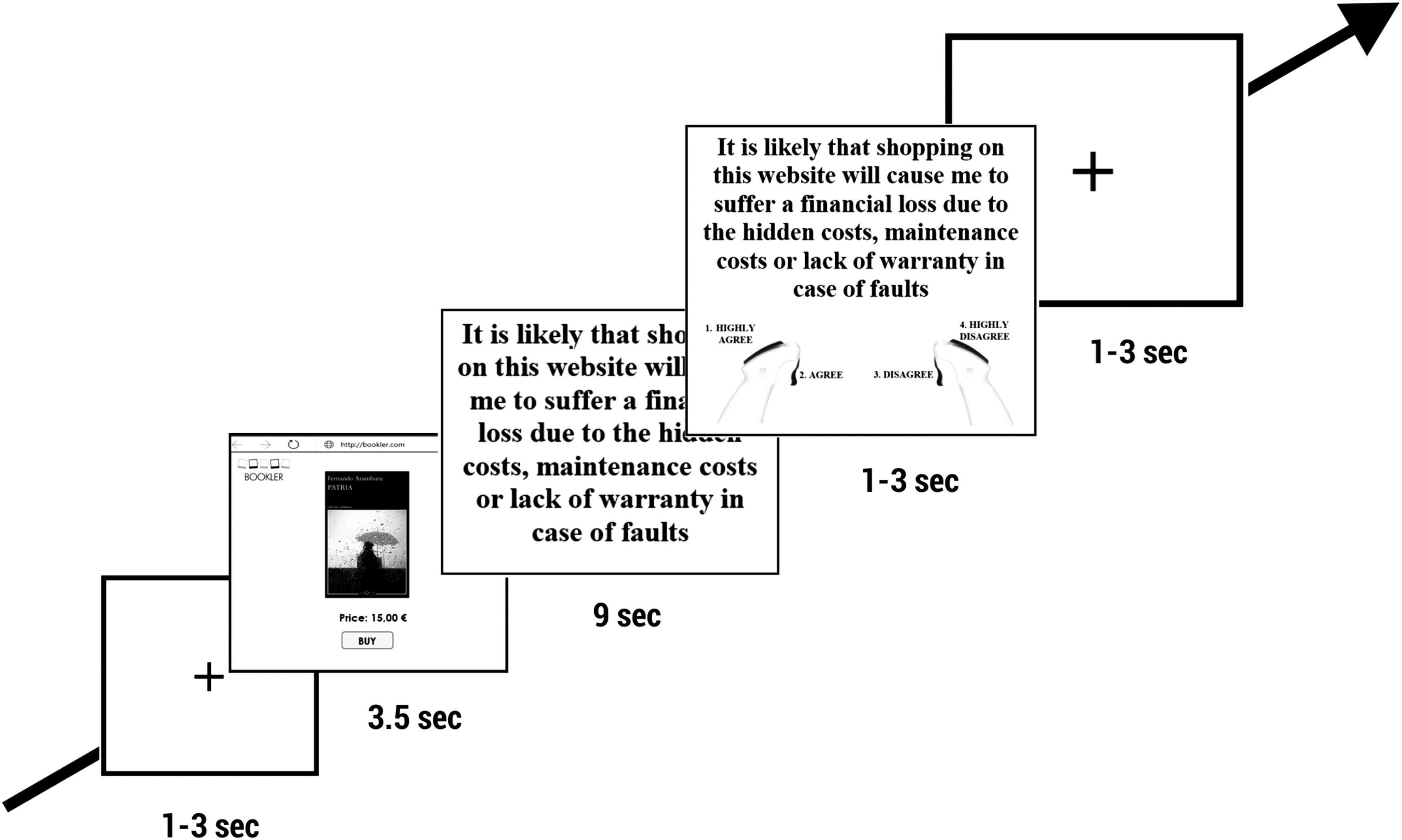
The fMRI task structure. The order corresponds to the first three trials: (i) the book within the
Image acquisition and analysis
MRI scanning was carried out in a 3 Tesla Trio Siemens Scanner equipped with a 32-channel head coil. Functional scans were acquired by a T2*-weighted echo-planar imaging sequence (TR = 2000 ms, TE = 25 ms, FA = 90°, slices = 35, thickness = 3.5 mm, slice order = descending). The distance factor was 20 percent and the slice matrix was of 64 × 64 mm.
The functional images were preprocessed and analyzed by a Statistical Parametric Mapping program (SPM12,
Specifically, the authors applied 10 mm spheres around the coordinates as reported by (i) Krain et al. for risk processing 18 : middle frontal gyrus (−32, 18, 61), inferior (−50, −41, 53) and superior (−30, −59, 50) parietal lobes, and precentral gyrus (40, 5, 36); (ii) Bartra et al. for penalty domain 19 : DMPFC (4, 22, 44), anterior insula (−36, 20, −6), thalamus (−6, −8, 6), and striatum (−12, 4, 2); (iii) Krain et al. for ambiguity 18 : angular gyrus (52, −54, 53) and left cingulate (−4, 22, 37); (iv) Riedl et al. for distrust 20 : anterior insula (−40, −16, −4); (v) Chua et al. for disappointment and regret 21 : precuneus (6, −66, 42), right cingulate gyrus (3, 18, 48), or anterior insula (39, 12, 21); and (vi) Bartra et al. for reward system activation 19 : VMPFC.
Results
At the conscious level, the participants did not reveal significant differences of values of risk facets when taking part in the online purchase of books (mean financial = 2.00, SD financial = 0.59; mean privacy = 2.00, SD privacy = 0.53; mean performance = 1.98, SD performance = 0.38). Brain data gleaned from the fMRI analyses, by contrast, do reveal differences.
Comparison of the financial facet versus the other risk dimensions reveals activation of the VMPFC (Bartra et al. 19 ). This comparison also elicited the occipital and temporal areas that are irrelevant to the current study (Fig. 2 and Table 1). The opposite comparison, in turn, yielded activations of the ROIs related to the negative domain according to Bartra et al., 19 and other areas linked to risk as noted by Krain. 18 Furthermore, neither the financial versus privacy, nor the financial versus performance, contrasts revealed supra-threshold activations.

Illustration of the brain regions activated during financial risk > the remaining risk facets. ROI VMPFC: ventromedial prefrontal cortex (x = 0, y = 40, z = −12). Whole-brain activations: MTG, middle temporal gyrus; STG, superior temporal gyrus. ROI, region of interest. Color images available online at
Peaks are significant at p < 0.05 FWE-corrected on ROI level.
Peaks of clusters are significant at p < 0.001 uncorrected, k > 20 voxels are reported.
DMPFC, dorsomedial prefrontal cortex; ROI, region of interest; VMPFC, ventromedial prefrontal cortex.
ROIs related to the domains of risk, ambiguity, and negative were strongly activated when contrasting the privacy dimension versus the other risks. The analysis comparing privacy versus financial and performance revealed that the areas elicited at the general level coincide with those conveyed only by the privacy versus financial dimensions. Privacy versus performance, in turn, did not reveal supra-threshold activations (Table 2).
Peaks are significant at p < 0.05 FWE-corrected on ROI level.
Finally, the comparison of the risk dimension with the two other facets (and vice versa) did not reveal activations in any ROI. However, significant activations were noted in the comparison of performance versus financial risk. These activations, reported by Bartra, 19 Krain, 18 Chua, 21 and Riedl, 20 relate, respectively, to the negative domains of risk, disappointment, and distrust. No other supra-threshold activations were identified in the performance versus privacy contrast (Fig. 3 and Table 3).

Illustration of the brain regions activated during (blue) privacy risk > financial risk: DMPFC, thalamus, striatum, IPL (inferior parietal lobe), left cingulate and angular gyri; (red) product performance risk > financial risk: DMPFC, IPL, anterior insula, right cingulate gyrus, and precuneus. DMPFC, dorsomedial prefrontal cortex. Color images available online at
Peaks are significant at p < 0.05 FWE-corrected on ROI level.
Discussion
Despite the enormous growth of e-commerce in the 21st century, consumers still encounter barriers during the online purchase process mainly related to perceived risk. E-commerce literature has therefore explored the construct of perceived risk with the aim of revealing the type of risk that exerts the most impact on consumer perception. However, there is no consensus as to the type of dimensions of risk or their relative importance. This is the first study that resorts to neurological tools to objectively examine this gap and ascertain the subconscious origin of the most widespread risk facets, namely financial, privacy, and performance. Although behavioral findings do not reveal differences between the three types of risks in a low-involvement purchase environment, brain data confirm that they represent three different dimensions. Interestingly, neurological analyses highlight the dimension of performance as that conveying the highest level of risk, disappointment, and distrust.
As regards the self-report responses, this study infers an equivalence at the conscious level of the financial, privacy, and performance risk facets involved in low-involvement product purchasing. Specifically, participants report medium levels of risk toward books, a finding that lines up with evidence of preceding studies indicating that consumers do not experience sensations of high risk when carrying out low-involvement purchases due to the fact that these purchases amount to a low amount of effort, importance, and money. 25
The measurements of neurological activations can reveal hidden processes during online purchases as the more conventional measurements of risk cannot capture low-order emotions and are difficult to collect in real time. This study, along this line, reveals for first time that brain data can indicate that financial, privacy, and performance risks are distinct dimensions that can be associated with different neurological processes.
Specifically, the VMPFC region was strongly activated while evaluating financial as opposed to other facets of risk. This type of activation during decision-making processes encodes values of positive outcome expectancy, 26 higher willingness to pay, 27 and trust. 17 Furthermore, the privacy and performance risks versus financial risk combination reveals an increase in activation in the anterior insula, DMPFC, and striatum, areas identified in preceding studies with aversive stimuli, 28 danger, 29 and potential threat. 19 The combination of the privacy and performance facets are also greatly elicited in the corresponding ROIs of middle frontal gyrus, inferior and superior parietal areas, and the precentral gyrus, a neural network identified in previous research with risk during decision making. 18
Taken together, these results suggest that the dimension of financial risk, when compared with the others, may convey less negative values during the purchase of online low-involvement products. This may indicate that online losses due to hidden costs may subconsciously confer less revulsion than the potential loss of personal information or failure of performance during low-involvement online purchases, notions that could be explained by the low economic effort dictated by low-involvement products such as books.
No ROI showed an increase in activation when contrasting the privacy and performance dimensions. Nonetheless, the comparison of each of these dimensions with the financial construct reveals mechanisms that can offer insight into the type of risk with the greatest impact. The privacy risk dimension, in particular, elicited great responses in the ROIs related to the domain of negativity 19 (DMPFC, thalamus, and striatum), risk processing 18 (inferior parietal lobe) and ambiguity 18 (angular gyrus and left cingular gyrus). Performance risk, in turn, elicited the ROIs involved with revulsion (DMPFC), regret and disappointment (precuneus, right cingulate gyrus, and anterior insula), and areas linked to distrust (posterior side of the anterior insula). In other words, despite the fact that both the privacy and performance facets lead to a common negative neural system, only the privacy dimension actually elicits a broader network of areas linked to aversion and ambiguity. Performance risk, however, shows more activation of the areas related to regret, risk, and distrust.
Taken together, these findings constitute a step forward as they suggest that when it comes to online low-involvement products, consumers may experience the greatest sense of risk and distrust if there is the possibility that the product fails to meet the original requirements of performance. The loss of control over privacy of their personal and payment information, in turn, confers only subconscious ambivalence and uncertainty during the purchase process.
The current findings therefore theoretically contribute to the literature exploring ways to reduce consumer risk perception in online purchase environments. Previous e-commerce studies along these lines have explored the notions of impact of conventional versus online shopping on risk perception, 30 the antecedents and consequences of perceived risk on services, 6 and specified and validated constructs of security and risk. 9 This study, nonetheless, has gone a step further by exploring the differences between the main facets of risk by controlling risk propensity of consumers and purchase involvement. Unlike previous fMRI research focusing on the neural correlates of trust, distrust, usefulness, and ease of use,17,31 this neurological study corroborates the differences between three online risk dimensions.
Empirically, the findings also throw light for the first time on the origin of general concerns induced by online purchases in consumers and advance that psychological processes such as perceived risk, trust, ambiguity, or disappointment are not equally present in all online risks, but it depends on the risk facet. Previous studies at this line showed that reducing security and performance risks plays an essential role in increasing intentions to use internet banking, 32 and that performance and convenience risks are mainly felt in high-involvement online purchases. 10 Unlike, through a neuroscientific tool, this study advances that online sale professionals of low-involvement products (e.g., books, cups, or pen drives) should go to great lengths to first meet the performance dimension requirements (e.g., physical conditions and delivery policies) and secondly, accurately define all the policies of consumer information management (e.g., through seals of approval, policy statements or consumer rating systems33,34). By following these recommendations, Web site retailers will increase subconscious certainty, trust, and security and possibly even enhance consumption.
It must be noted that this study was restricted to measuring self-reported risk and not authentic cases of risk. Moreover, the study also focused on a low-involvement online environment and selected participants with medium level propensity toward risk. Corroboration of these findings therefore requires further research in the framework of a broader range of products (e.g., high-involvement) and consumer categories.
Note
a. Consumer neuroscience studies tend to have a relatively small sample size (due to cost, health, or availability issues), which could offer reproducible results only when few experimental conditions are compared (e.g., no more than three). Investigations on the consumer neuroscience field require appropriate control variables to “cancel out” spurious brain activation due to visual stimuli, movement, and other sources of noise, and thus isolate brain activation only associated with the experimental stimuli. 17 Along this line, the authors of this article focus on comparing only three main risk facets (the most common) in a specific low-involvement purchase online environment.
Footnotes
Acknowledgments
This study was supported by an Excellence Project awarded by the Junta de Andalusia [REF: P12-SEJ-1980] and a FPU contract awarded by the Ministry of Education, Culture and Sports of Spain. [REF: FPU14/04736].
Author Disclosure Statement
No competing financial interests exist.