




Abstract
Abstract
Although social anxiety disorders (SADs) are increasingly treated by means of virtual cue exposure, the mechanisms leading to sufficient anxiety levels and thus to a success of virtual reality exposure therapy are still poorly understood. Also, most studies with SAD participants fail to evaluate social presence, although it may be a more appropriate indicator for virtual social stress scenarios than physical presence. Hence, for the first time, this study sets out to examine the link between social presence, physical presence, and emotional responses to phobogenic virtual social stimuli. A group of n = 12 participants with SAD and n = 12 healthy controls were exposed to three social tasks in an interactive virtual environment (VE). Self-report measures of physical and social presence as well as state anxiety were used alongside heart rate measures to evaluate the virtual experience. Results show significantly higher anxiety levels—both self-report and physiological—in SAD participants than in controls. Also, socially anxious subjects reported to experience more copresence and mutual attention as well as a higher sense of being in the VE than their healthy peers. In sum, social presence experiences may be more predicative of the anxiety response in SAD individuals than physical presence. Especially attentional processes seem to crucially shape the interplay between presence and affective responses.
Introduction
Social anxiety disorder (SAD) is characterized by a considerable fear of negative evaluations in one or more social situations (c.f., DSM-5 1 ). Traditionally, cognitive behavior therapy is used for treatment, yet especially the prolonged, repeated, and controlled real-life exposure to feared stimuli 2 is often difficult to implement in clinical practice. 3 Over the past decades, virtual reality exposure therapy has created a loophole for this intricate problem, and first meta-analytic studies 4 show promising effects for SAD patients.
Currently, the mechanisms that are thought to be responsible for stress reactions in virtual environments (VEs) are still subject of ongoing research. Among these, the construct of presence has been discussed as a factor possibly shaping the fear response and thus, the method's success. 2 Presence is broadly defined as the “perceptual illusion of non-mediation” 5 and as such it includes a certain level of involvement with the environment as well as the impression of being physically located in it. A hallmark of presence is a behavior that is congruent to a behavior in a comparable real-life situation. 6 Accordingly, presence has been construed by many researchers as a precondition for activating a phobic fear structure in a VE.7,8
Nevertheless, the relationship between affective responses and presence is not straight forward, and a lot of debate evolves around how presence may affect or be affected by emotional states. A causal model proposed by Robillard et al. 8 assumes that the level of presence may be determined by the congruence between the subject's emotional states and the VE's content. Hence, SAD patients are expected to report more presence when exposed especially to a situation involving phobogenic social stimuli. Prior studies8–11 indeed found anxious subjects to experience more presence in anxiety-inducing VEs than nonanxious controls. Yet, most research on subjects with SAD (e.g., Price et al. 2 and Felnhofer et al. 7 ) typically involves situations with minimal or no social interaction (e.g., public speaking), thus limiting conclusions about scenarios with a higher relevance to SAD symptomatology (e.g., confronting another person). Also, prior studies have primarily focused on the type of presence described previously. 12 A downfall of this concept—also coined physical presence—is that it does not bear relevance to social cues. Social presence may, thus, be a more appropriate indicator of the virtual social experience. Social presence is related to but conceptually distinct from physical presence. 13 It describes the impression of being in the presence of another sentient being and entails a certain level of cognitive and emotional engagement with the other. 14
To shed more light on the relationship between presence and affective responses in SAD individuals, this study—for the first time—set out to evaluate not only physical presence but also social presence in participants with SAD when confronted with three stressful social tasks in a VE. Physiological measures heart rate (HR) and subjective ratings were used as indicators for the anxiety response during cue exposure.
Methods
Participants
Participants were recruited among psychology students at a public university and received course credits for their participation. All subjects signed an informed consent form in accordance with the declaration of Helsinki. In total, 34 students followed the invitation to participate if they were socially anxious; among these, n = 12 (9 female) were screened and met diagnostic criteria for SAD according to DSM-IV (see Measures). Healthy controls who were tested negative for SAD (initial n = 18; n = 6 drop outs) were recruited among students from a regular psychology course (final n = 12; 8 female). There were no age differences (t(22) = −1.404, p = 0.174) between SAD participants (mean [M] = 22.83, standard deviation [SD] = 1.749) and healthy controls (M = 24.08, SD = 2.539). Also, both groups showed a comparable intelligence level (t(22) = −0.620, p = 0.541). Furthermore, participants in both groups had the same computer experience (t(22) = −0.0394, p = 0.698) and a similar distribution of gamers versus nongamers (Fisher's exact: p = 0.371), the majority (70.8%) reporting to play no computer games. All subjects had normal or corrected-to-normal eyesight and no prior experience with VEs.
Procedure
Upon arrival to the laboratory, participants were briefly interviewed and provided with the first set of questionnaires and tests (see Measures). The subsequent social cue exposure took place in an interactive VE. Participants donned a head mounted display (Sony HMZ-T1 3D Visor, Tokyo, Japan and head tracking: TrackIR 5; NaturalPoint, Corvallis, OR) and navigated through the VE with a smart phone device (HTC Desire SV, Taoyuan, Taiwan). After an initial orientation phase, participants were confronted with the following three social tasks in a virtual café (Fig. 1): (1) ordering a drink from the waiter, (2) responding to a stranger's request, and (3) reacting to being offered a false drink. Participants responded verbally, and the experimenter chose from a range of preprogrammed reactions to render the interaction more naturalistically. All three tasks included components known to be stressful to SAD patients: the first scenario required a choice between two drinks (coffee or tea), in the second task subjects had to approve or deny the request resulting in the stranger sitting down or leaving, and lastly, the third task required participants to either confront the waiter or accept the false drink.
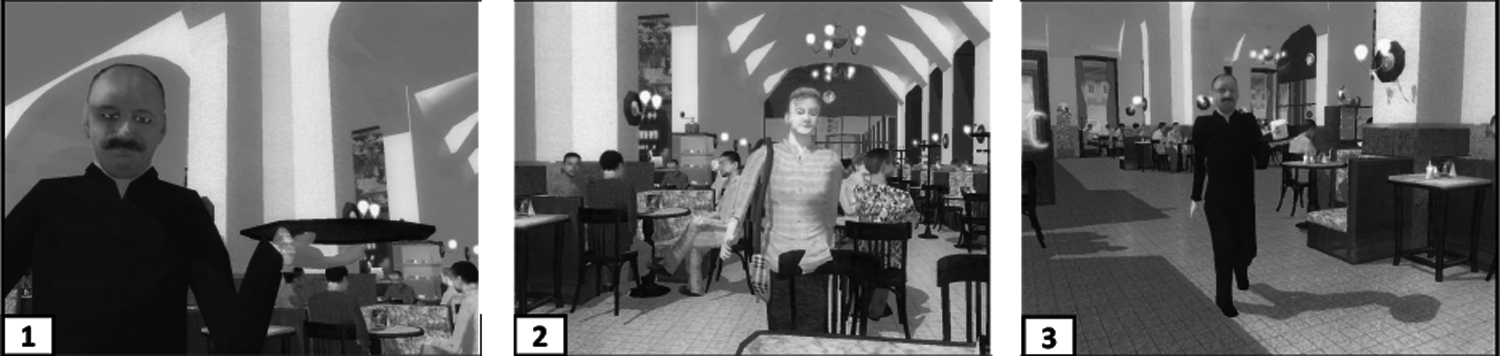
The three virtual social anxiety tasks.
In addition, HR was assessed (with M-EXG; Schuhfried BFB 2000 x-pert, Mödling, Austria) over a course of 15 minutes: baseline (1 minute), orientation within the VE (4 minutes), three social tasks (5 minutes), and recovery (5 minutes). At the end of the experiment, participants filled out the remaining questionnaires.
Measures
Social anxiety
To assess whether subjects fulfilled the criteria of SAD, the Structured Clinical Interview for DSM-IV Axis I Disorders (SCID-I 15 ) was administered by a trained clinical psychologist before the start of the experiment. In addition, the Social Interaction Anxiety Scale (SIAS 16 ) was used as an additional validation of SAD. The 20 items on a 5-point Likert-type scale (0 = not at all, 4 = extremely; scores ranging from 0 to 80) comprise affective, cognitive, and behavioral reactions to social interactions.
Intelligence
The Zahlen-Verbindungs-Test, 17 a trail-making test, was conducted before the experiment. Time to complete the task (seconds) was recorded and served as an indicator of general intelligence. 18
Presence
A German version of the Networked Minds Measure of Social Presence (NMMSP 19 ) was used after the VE experience to assess social presence. It contains 36 items on 7 subscales and 3 dimensions (7-point Likert scale; overall score ranging from 36 to 252): (1) Copresence: mutual awareness, (2) psychological involvement: mutual attention, mutual understanding, and empathy, and (3) behavioral engagement: behavioral interaction, mutual assistance, and dependent action. Physical presence was assessed with the 14-item iGroup Presence Questionnaire (IPQ 20 ). It consists of three subscales (7-point Likert scale; overall score ranging from 14 to 98): (1) spatial presence comprising the impression of being located in the VE, (2) involvement reflecting attentional engagement, and (3) realism evaluating whether the user perceives the VE as real. In addition, a single item represented the sense of being there in the VE.
Anxiety
Subjective state anxiety ratings were assessed immediately before and after exposure using an adapted 20-item state version of the State-Trait-Anxiety-Inventory (STAI-S 21 ). Items were answered on an 8-point Likert scale (1 = not at all, 8 = very much; scores ranging from 20 to 160). In addition, HR was recorded over the course of 15 minutes (see Procedure) through M-EXG (Schuhfried BFB 2000 x-pert) using three one-way electrodes (3M Medica RedDot electrodes, Perchtoldsdorf, Austria). Average HR levels per minute were used as reference points to assess time-dependent changes in physiological arousal.
Results
Data were analyzed using IBM SPSS version 23 (SPSS, Inc., Chicago, IL). Levene tests for homogeneity were acceptable for all dependent variables (all p's > 0.05).
Physical and social presence measures
Analyses with Student's t test revealed a significant difference (Table 1) between SAD participants and nonphobics regarding the sense of being there (t(22) = 2.266, p = 0.034) with SAD participants reporting a more nonmediated experience in the VE. However, there were no significant group differences in spatial presence (t(22) = 1.165, p = n.s.), realism (t(22) = −1.003, p = n.s.), or involvement (t(22) = −0.167, p = n.s.). Moreover, we found differences in copresence and mutual attention between SAD participants and controls.
Physical and Social Presence of Social Anxiety Disorder Participants and Control Group (N = 24)
Bold values indicate main factor scales of the questionnaire. * p < 0.050.
M, mean; SAD, social anxiety disorder; SD, standard deviation.
Anxiety measures
According to the SIAS, SAD participants show significantly higher values of trait social interaction anxiety than controls (t(22) = −11.049, p ≤ 0.001), additionally validating the group allocation based on the SCID screening. A repeated measures analysis of variance (ANOVA) regarding state anxiety levels (STAI-S; Fig. 2) showed a significant main effect before and after exposure (F(1, 22) = 0.742, p = 0.005, ηp 2 = 0.307) as well as a significant group effect indicating higher increase of anxiety in SAD participants immediately after exposure (F(1, 22) = 0.742, p = 0.048, ηp 2 = 0.166).

STAI-S scores (means ± SEM) before and after virtual exposure. SAD, social anxiety disorder; SEM, standard error of the mean; STAI-S, State-Trait-Anxiety-Inventory.
HR responses (Fig. 3) were analyzed with ANOVA for repeated measures with Greenhouse–Geisser correction due to violation of sphericity (ɛ < 0.75). There was an overall significant difference in HR over time (F(1, 4.138) = 2.992, p = 0.021, ηp 2 = 0.120) and a trend to significance regarding the effect of group (F(1, 22) = 4.125, p = 0.055, ηp 2 = 0.158), but no effect of group × time (F(1, 4.138) = 1.068, p = n.s., ηp 2 = 0.046). When evaluating the exact time points of cue exposure (minutes 6, 7, and 10), group-specific patterns emerge with higher HR in SAD participants in task 1: ordering a drink (t(22) = 2.241, p = 0.035), task 2: responding to a stranger (t(22) = 2.125, p = 0.045), and task 3: returning false drink (t(22) = 2.087, p = 0.049).

Heart rate responses (means BPM ± SEM) during baseline (1 minute), orientation phase (4 minutes), the VE exposure (5 minutes), and rest phase (5 minutes). Task 1—minute 6, task 2—minute 7, and task 3—minute 10 are highlighted. BPM, beats per minute; VE, virtual environment; VR, virtual reality.
Discussion
The current results provide strong support for the effectiveness of virtual cue exposure. For successful extinction learning, a phobic fear structure must be activated upon presentation of the feared stimulus. 22 In this study, confrontation with virtual social scenarios led to a significant rise in anxiety levels—both self-report and physiological (HR)—in both groups; a finding which is comparable with prior research and points toward the usefulness of VEs for cue exposure.4,7,8,12,23,24 However, SAD individuals tend to react stronger to social cues, as their HR was higher than that of healthy controls only at the critical time points of ordering a drink, responding to a stranger, and confronting the waiter.
Furthermore, our findings suggest that the experience of anxiety in VEs may be linked to different aspects of presence. In contrast to prior research,2,7 SAD participants reported to experience more copresence and mutual attention as well as a higher sense of being there than their healthy peers. However, a comprehensive comparison to past studies is difficult because of the noninteractive nature of past scenarios (e.g., public speaking tasks) and the lack of social presence measures. 12
In general, the association between presence and anxiety observed here seems to be largely based on the attentional components of social presence. Copresence and mutual attention are both rooted in cognitive processes closely linked to attention 19 and as such they clearly extend beyond the mere impression of sharing the same space with another being. 25 This observation is further supported by cognitive models of selective attention (c.f., Aue and Okon-Singer 26 and Bishop 27 ), which suggest threat-related attentional biases in highly anxious individuals. Hence, persons with SAD tend to have a low attentional threshold for task-irrelevant phobogenic social cues. Significant group differences may, therefore, be interpreted as evidence that presence may indeed be determined by the congruence between the subject's level of anxiety and the VE's content; especially the synergistic interplay between high trait and state social anxiety and virtual social cues may “make it difficult for [SAD patients] to resist feeling present.”8(p468) This also corresponds with past findings on a stronger link between presence and anxiety in clinical populations. 12
There are several limitations to our study, one of the most apparent is regarding the small sample size. Including larger samples may thus allow for more substantiated conclusions about the complex relationship between presence and anxiety. Yet, this study's strength is its use of different highly interactive virtual social scenarios as well as its comprehensive evaluation of social presence experiences. Subsequent research should, however, counterbalance the order of the tasks to account for possible position effects and include a broader range of social scenarios relevant to SAD (e.g., interaction with authority figures, giving a public speech). Furthermore, past findings indicate differential effects of avatars and agents on immediate and delayed user responses. 28 Future studies should, thus, take the virtual character's agency into account. Lastly, HR showed an unusual increase during recovery. This may be due to interactions with the experimenter in this phase. Hence, social interactions postexposure should be limited to obtain more reliable markers of stress habituation. In addition, subjective unit measures of anxiety (c.f., Heeren et al. 29 ) could be used during VE exposure as a more reliable marker of stress experiences.
In sum, social presence experiences seem to be a better indicator for anxiety responses in SAD individuals than physical presence. Especially, attentional processes are assumed to crucially shape the interplay between presence and affective responses.
Footnotes
Acknowledgments
This study was part of the ICARUS (Information and Communication Applications: Research on User-oriented Solutions) Project (Project No.: 831199) that was funded by the Austrian Research Promotion Agency (Forschungsförderungsgesellschaft, FFG). We would like to thank Elisabeth Kastenhofer, Nathalie Hauk, Jasmine Gomm, Ellen Baumm, and Antonia Scholz for their assistance in the acquisition of parts of the data.
Author Disclosure Statement
No competing financial interests exist.