




Abstract
Abstract
Body image disturbance (BID) affects quality of life even in the absence of clinically diagnosable eating pathology, and numerous studies have shown its crucial role in the emergence and maintenance of eating disorders. This study aimed at exploring attitudinal and perceptual components of BID using a novel virtual reality (VR)-based paradigm. A community sample of women (N = 27) recreated in VR their perceived body in both an allocentric (third-person view) and egocentric (first-person view) perspective. Specifically, women were able to choose between a wide range of three-dimensional bodies spanning body mass index 12.5–42.5 kg/m2. Attitudinal indexes of BID (body dissatisfaction, body uneasiness, and body image avoidance) were assessed through questionnaires. Attitudinal components predicted the perceptual BID only in the allocentric perspective. Specifically, overestimation was predicted by body image avoidance, while underestimation was predicted by body uneasiness. Furthermore, a common predictor of underestimation and overestimation was body dissatisfaction. In line with the allocentric lock hypothesis, the current results seem to confirm the presence of two different mechanisms underlying BID: one related to real-time perception-driven inputs (egocentric frame) and one related to abstract knowledge, beliefs, and attitudes related to a person's body (allocentric frame). These findings contribute to a better understanding of the nature and mechanisms underlying BID and provide additional evidence about the suitability of using VR for exploring and assessing body image-related components and disturbances.
Introduction
T
However, the mechanisms underlying BID remain unclear. A certain agreement in the scientific literature has been found in regard to two different components, which are theorized to be at the core of BID: a perceptual and an attitudinal-cognitive-affective component.8–10 The first one refers to a disturbance in estimating body size, whereas the second component refers to a subjective body and shape dissatisfaction, combined with the overemphasize influence of body weight and shape on self-evaluation.11,12
The scientific debate over the contributions of these two components in determining BID is still open. Recently, studies have shown that BID might be driven by distorted attitudes with regard to the perceived (i.e., the perception of one's own body) and ideal (i.e., the ideal body a person wants to achieve) body rather than by perceptual distortions.8,11 Indeed, recently, the results of two 4-year longitudinal studies—which involved both female and male college students—showed that attitudinal factors as body dissatisfaction, self-objectification (i.e., the tendency to experience the body from an external observer point of view), and appearance-ideal internalization predicted onset and maintenance of EDs at 4-years of follow-up.13,14
This vision is strengthened by a recent neuropsychological theory of BID in ED patients: the allocentric lock (AL) theory.15–18 The AL posits that our bodily experience involves the integration of different inputs originated from two different spatial reference frames: egocentric (first-person view) and allocentric (third-person view). The egocentric frame has its source in somatoperceptions that are representations of the present state of the body and tactile stimuli from sensory inputs. 19 The allocentric frame derives from somatorepresentations, which form the “memory of the body.”19,20 Somatorepresentations are abstract knowledge, beliefs, and attitudes related to a person's body. 19
The AL posits that individuals with (or at high risk of developing) EDs may be locked to an allocentric negative memory of their body. This lock is may be due to an impairment in the ability of updating the memory of the body (allocentric frame) with new egocentric contents from real-time perception-driven inputs.21,22 In this vision, ED patients may be (b) locked to a negative representation of their body (e.g., “my body is fat”), which is no longer updated by perceptual inputs even after restrictive diet and weight changes.
The assessment of BID is complex, given that it is conceptualized as depending on both a perceptual and an attitudinal component. Body size estimation (BSE) tasks in ambiguous situations can activate a person's memories related to the body.23,24 So far, BSE have been assessed with numerous techniques, the most widely used being figure rating scales and photograph distortion. 25
In the past two decades, researchers have embraced virtual reality (VR) to study, assess, and also treat BID. VR allows the development of three-dimensional (3D) human-like figures that represent the participant's body and whose size and shape can be modified according to the participant's body image representations.11,26 In VR, subjects can experience virtual avatars as if they were their own body. This phenomenon is called “embodiment” and it refers to the replacement of the physical body with a virtual one, thanks to synchronous stimulation.27–30 Thus, through VR, it is possible to recreate BID and to integrate new information about one's body, and to acquire different strategies to differentiate the cognitive and affective misperception of one's perceived or ideal body from the real one. 31
Recently, a growing number of studies have used different techniques to recreate BID in VR.32–34 Nonetheless, to the authors' knowledge, no study has assessed perceptual BID in both the egocentric and allocentric perspective through VR. In this study, we propose a novel VR-based paradigm to assess BID. Women were asked to recreate in VR their body representation (i.e., the perceived body) through two Virtual BSE Tasks. Women were able to choose between a wide range of 3D bodies, the one that best fits their perceived body in both an allocentric and egocentric perspective. Furthermore, the relationship between the performance in the two virtual tasks and attitudinal indexes of BID (i.e., body dissatisfaction, body uneasiness, and body image avoidance) was explored.
Methods
Participants
Twenty-seven female participants between 21 and 34 years of age (M = 25.41, standard deviation [SD] = 3.34) participated in the study. Seventeen of them (63 percent) were University students, eight (29.6 percent) were employed, and two (7.4 percent) of them were unemployed. Sample characteristics are summarized in Table 1. Women were recruited through word of mouth at the Catholic University of the Sacred Hearth in Milan, Italy. Potential participants were asked to provide their height and weight and to fill in the 26-item Eating Attitude Test (EAT-26 35 ). Only those who achieved an EAT-26 score of <20 (risk of eating-related psychopathology) were eligible to participate. 35
Sample Characteristics (N = 27)
Note: SD, standard deviation; SE, standard error of mean; Min, minimum; Max, maximum; 25th perc, 25th percentile; 50th perc, 50th percentile; 75th perc, 75th percentile; Actual BMI, actual body mass index; EAT26, eating attitude test-26; BIAQ, body image avoidance questionnaire; BUT, body uneasiness test; BSQ14, body satisfaction questionnaire-14; EA BMI, estimated allocentric body mass index; EE BMI, estimated egocentric body mass index; AD, index of distortion in the allocentric condition; ED, index of distortion in the egocentric condition.
Materials
Personal information sheet
Women provided information about age, presence of psychiatric and/or physical problems (i.e., mobility and sight problems), education level, and occupation. In addition, women were asked to provide their weight (in kg) and height (in cm).
Questionnaires
The EAT-2635,36 was used to assess and identify food- and weight-related pathological attitudes, and partial EDs. Answers are given on a six-point scale. A total score cutoff of >20 indicates risk of eating-related psychopathology. 35 Its internal consistency in this study was acceptable (α = .78).
The Body Image Avoidance Questionnaire (BIAQ37,38) is a 19-item self-report instrument on avoidance of situations that provoke concerns related to physical appearance. Items are measured on a six-point scale, with higher scores indicative of greater frequency of behaviors related to BID. The internal consistency of this scale was acceptable (α = 0.76).
Body uneasiness was assessed through the Body Uneasiness Test-A (BUT-A 39 ). The six-point 34 items are grouped in five subscales (weight phobia, body image concern, avoidance, compulsive self-monitoring, and depersonalization) and a Global Severity Index (GSI). In this study, the GSI was used as a measure of global body uneasiness, with a GSI score of above 1.2 as cutoff of relevant body uneasiness. The scale showed an excellent internal consistency (α = 0.96).
Participants also completed the Body Shape Questionnaire-1440,41, a 14-item questionnaire, which measures body dissatisfaction. Items are measured on a six-point Likert scale, and higher scores indicate greater body image concerns. The scale showed an excellent internal consistency (α = 0.96).
A 15-item embodiment questionnaire was used to assess the participants' sense of ownership, agency, and location of the virtual body (adapted from Piryankova et al., 42 ). Items are measured on a seven-point Likert scale, with a middle anchor of (4). 42 The scale showed an excellent internal consistency in both the egocentric (α = 0.94) and allocentric condition (α = 0.92).
Stimulus generation and technical setup
A set of 3D computer-generated women's bodies was created. Virtual bodies were presented without their heads, as facial features can draw attention away from the body,23,43 and dressed in blue shorts and black crop top. The bodies represent a continuum of body shapes from extreme underweight to morbid obesity (body mass indexes [BMIs] from 12.5 to 42.5 kg/m 2 ). The MakeHuman software (MakeHuman 1.1.1 r2128; The MakeHuman team) and the Autodesk 3ds Max (Autodesk 3ds Max 2017 19.0 SP3; Autodesk, San Rafael, CA) were used to create high definition and photorealistic human bodies. MakeHuman allows using several parameters to create different bodies. An experimental plug-in based on the Mosteller 44 formula was added to create the set of avatars with different BMIs. 45
The VR application was created using Unity3D (Unity 5.6.0f3; Unity Technologies, San Francisco, CA). The application includes two conditions: an egocentric (first-person perspective, see Fig. 1) and an allocentric (third-person mirror perspective, see Fig. 2) condition. The Kinect V2 was used to detect participants' movements, whereas a head-mounted display (Oculus Rift DK2) was used to visualize the virtual bodies in both the conditions (1080p resolution).

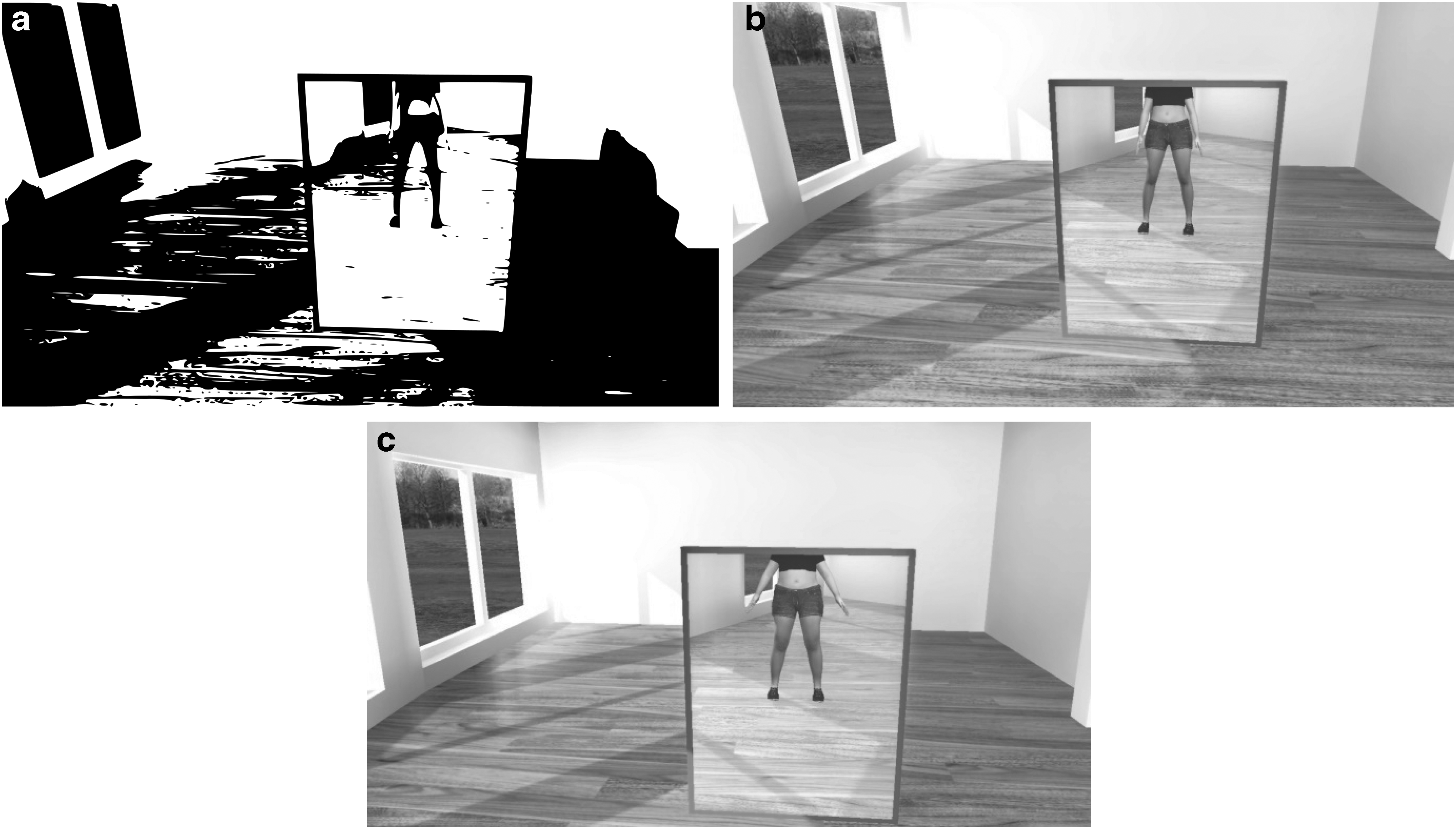
Virtual BSE task
Starting from a virtual body of a BMI of 20.5 kg/m 2 , they were asked to indicate thrice how to modify the body to recreate a body size that corresponded to their perceived body size. Women were asked to perform this task in both the egocentric and allocentric condition. The order of the conditions was randomized. To induce the feeling of embodiment, before starting the estimation tasks, participants were asked to perform an up-and-down movement with their hands for 90 seconds, always maintaining the focus of their attention on the virtual body.
Procedure
The procedure comprised the following: (a) a screening session and (b) an experimental session. In the screening session, biographical data as well as participants' weight and height were collected. Furthermore, the EAT-26 questionnaire was administered. In the experimental session, women completed the questionnaires, the BIAQ, BUT-A, and BSQ, and then performed the virtual BSE task as described above in both the egocentric and allocentric condition. Furthermore, after each virtual BSE task, participants completed the embodiment questionnaire.
Results
Analyses were done using IBM SPSS Statistics (Version 21, release 21.0.0.0 64-bit edition) and JASP software.
Manipulation check
A paired sample t test showed no significant difference between the egocentric and allocentric condition in all the three embodiment dimensions [Ownership: t(26) = 0.35, not significant (n.s.); Agency: t(26) = −1.54, n.s.; and Location: t(26) = −0.92, n.s.].
To explore the absence of significant difference between egocentric and allocentric condition in all the three embodiment dimensions, we used the paired sample T-Test Bayes Factor (BF01) to assess a ratio between the likelihood of the data given null-hypothesis and the one given the alternative one.46–49
Evidence showed a substantial effect for ownership and location (respectively, BF01 = 4.903; Error percent = 1.315e-4; BF01 = 3.354; Error percent = 2.502e-4), and an anecdotal effect for agency (BF01 = 1.729; Error percent = 2.358e-7), highlighting that the three measures are statistically similar in the two conditions (i.e., egocentric and allocentric), in contrast to the hypotheses that are different (Table 2). Thus, overall, participants reported that the avatar represented them in VR in both the conditions.
Descriptive Statistics and Bayesian Paired Samples t Test of the Three Subscales of the Embodiment Questionnaire Within the Two Conditions (i.e., Egocentric vs. Allocentric)
Note: aEvidence in favor of the model of interest (similarity of measures) is considered anecdotal (1 < BF <2.5) or substantial (2.5 < BF <10). To compare the relative predictive success of one model over another, the BF of the first model was divided by the BF of the other model, and the value of this ratio interpreted in terms of strength of evidence using the same values as above.
BF, Bayes factor.
BMI VR estimations
The average BMI of the avatars chosen in the three trials was used as “estimated BMI” to calculate the degree of distortion. The difference between actual BMI and estimated egocentric and allocentric BMIs was assessed through a pairwise t test. Likewise, pairwise t test was performed to evaluate the difference between the egocentric and allocentric degrees of distortion. No significant differences were found between actual BMI and estimated egocentric [t(26) = −0.36, n.s.] and allocentric BMIs [t(26) = 0.35, n.s.], or between the egocentric and allocentric degrees of distortions [t(26) = −0.75, n.s.).
To explore the absence of significant difference between actual BMI and estimated egocentric and allocentric BMIs, we used the paired sample T-Test Bayes Factor (BF01) (Table 3). Evidence showed a substantial effect for actual BMI and estimated allocentric and egocentric BMIs, highlighting that the three measures are statistically similar in contrast to the hypotheses that are different (Table 3).
Bayesian Paired Samples t Test Between Actual Body Mass Index and Estimated Egocentric and Allocentric Body Mass Indexes and Between the Egocentric and Allocentric Degrees of Distortions
Note: aEvidence in favor of the model of interest (similarity of measures) is considered anecdotal (1 < BF <2.5) or substantial (2.5 < BF <10). To compare the relative predictive success of one model over another, the BF of the first model was divided by the BF of the other model, and the value of this ratio interpreted in terms of strength of evidence using the same values as above.
Relationship between body image distortion and attitudinal indexes of BID
To quantify the degree of distortion of the estimated body size, the overestimation or underestimation relative to actual individual BMI was calculated. The distortion's formula, Distortion = [estimated BMI/actual BMI at experiment] × 100 − 100 (adapted from Mölbert et al. 11 ), was used, and negative values reflected an underestimation of body size, whereas positive ones reflected an overestimation of the woman's body size.
To explore the absence of significant difference between actual BMI and egocentric estimated BMI, we used the paired sample T-Test Bayes Factor (BF01). Evidence showed a substantial effect (BF01 = 4.871; Error percent = 1.339e-4), highlighting that the two measures are statistically similar in contrast to the hypotheses that are different. In other words, the model that considers the two measures similar is 4.871 time more probable than the model that considers them different.
Regarding the allocentric perspective, a multiple linear regression model showed that when underestimation of BMI was predicted, it was found that body uneasiness (i.e., BUT; B = 15.74, p = 0.03) and body dissatisfaction (i.e., BSQ14; B = −0.81, p = 0.03) were significant predictors. Body image avoidance (i.e., BIAQ) was not a significant predictor of underestimation of BMI in the allocentric condition (B = −0.01, n.s.). The overall model fit was R 2 = 0.42. With respect to the overestimation of BMI, a multilevel regression model showed that body image avoidance (B = −0.67, p = 0.02) and body dissatisfaction (B = 0.23, p = .05) were significant predictors, whereas body uneasiness (B = −0.18, n.s.) was not a significant predictor of BMI overestimation. The overall model fit was R 2 = 0.46 (Table 4).
Allocentric Condition: Summary of Multiple Linear Regression Analysis for Variables Predicting Overestimation and Underestimation (N = 26)
Note: *p < 0.05, **p < 0.001.
B, unstandardized coefficients beta; SE B, unstandardized coefficients − standard error; β = standardized coefficients beta; n.s., not significant.
The same multiple linear regression model was tested also with regard to the egocentric perspective. When BMI underestimation was predicted, it was found that neither body image avoidance (B = −0.09, n.s.) nor body uneasiness (B = −7.57, n.s.), nor body dissatisfaction (B = 0.42, n.s.) was a significant predictor (overall fit model: R 2 = 0.18). Likewise, when BMI overestimation was predicted, neither body image avoidance (B = 0.09, n.s.) nor body uneasiness (B = 0.50, n.s.), nor body dissatisfaction (B = −0.04, n.s.) was a significant predictor (overall fit model: R 2 = 0.02) (Table 5).
Egocentric Condition: Summary of Multiple Linear Regression Analysis for Variables Predicting Overestimation and Underestimation (N = 26)
Note: *p < 0.05, **p < 0.001.
Discussion
In this study, a novel VR-based paradigm was used to explore the attitudinal and perceptual components of BID in a women community sample. To the best of the authors' knowledge, this is the first study that used 3D photorealistic avatars in VR to investigate perceptual BID in both an egocentric and allocentric perspective.
First of all, this study provides evidence supporting the notion that a body ownership illusion can be generated in an immersive virtual environment, where participants can feel embodied in a virtual body. The results showed that our visual-motor synchronous virtual BSE task allows generating the sense of embodiment. Therefore, the VR-based paradigm used in this study allowed investigating perception of one's own body and realistically replicating in VR the representation of the perceived body.
According to the results of this study, the difference between actual and estimated egocentric and allocentric BMIs was not statistically relevant. Furthermore, no statistically significant difference was found between the estimations in the allocentric and egocentric perspective. In other words, women estimated their body size with a quiet accuracy. We did not expect a significant difference in these parameters as women who participated in this study had on average a BMI (M = 20.19; SD = 1.68) considered in the normal range (i.e., BMI between 18.50 and 24.99 kg/m 2 ).50–52 Nevertheless, the results of this study highlight interesting data about the attitudinal components of BID.
We found that different attitudinal components predicted the overestimation or underestimation of perceived body size. Results show that attitudinal components predicted the perceptual BID only in the allocentric perspective. Overestimation of one's body was predicted by body image avoidance, while underestimation was predicted by body uneasiness. A common predictor of underestimation and overestimation was body dissatisfaction. In line with the AL,15–18 these results suggest that attitudinal-cognitive-affective factors, for example, indices of body dissatisfaction, particularly affect the allocentric representation of one's perceived body. On the contrary, the egocentric representation seems to not be affected by these attitudinal-cognitive-affective factors.
Our results seem to confirm the presence of two different mechanisms underlying BID: one related to real-time perception-driven inputs (egocentric frame) and one related to abstract knowledge, beliefs, and attitudes related to a person's body (allocentric frame).
Because this research was conducted in a general population sample of women, there are no direct implications for diagnostic formulation. Nevertheless, some attitudinal factors as overvaluation and preoccupation with weight and shape have been found to be potent predictors of distress and ED behaviors in a population-based sample.51,52 As a future challenge, it would be helpful to apply this study among patients suffering from EDs. Recently, studies have shown that attitudinal components of body representation in anorexia nervosa (AN) patients are strongly distorted. Indeed, several studies found that patients with AN report higher weight and shape concern, and body dissatisfaction than control participant.53–55
A growing number of studies have been using VR to assess and explore these mechanisms in ED patients, but none of them has taken in consideration to explore and analyze the impact of negative attitudes toward the body in both an egocentric and allocentric perspective. It would be interesting to investigate if and how these distorted attitudes toward one's body would affect the perception of one's own body in both perspectives in ED patients.
This study presents different limitations. First, the sample size was small; however, similar studies have that a small sample can be adequate for regression models. 11 Furthermore, the conducted Bayesian analyses reinforce the results of this study. 56 Nevertheless, replication studies in larger community samples are required. Second, the set of computer-generated bodies presented some weakness. It was not possible to create virtual bodies that perfectly replicate the specific features of the body of each participant. It would be interesting in future studies to use a 3D body scanner that allows accurately replicating a VR participant's body shape. 11 Furthermore, the virtual bodies were principally designed for Caucasian women. It would be interesting to investigate if non-Caucasian women could feel embodied in the avatars or if a congruent color of the skin of the avatar is a factor indispensable to induce the feel of embodiment.
Regarding methodological limitations, the starting virtual body was the same for all participants, introducing the possibility of methods effects. Future studies should consider other alternatives, as for instance, controlling that the difference between real and starting virtual body would be the same for each participant. Furthermore, future work may expand upon the attitudinal variables included in this study by exploring associations between other important variables that have been shown to be related to BID (e.g., self-objectification and body shame). Finally, another limitation in this investigation is its cross-sectional design, which constraints the establishment of causal direction and may produce biased parameter estimates. Future studies should adopt a longitudinal design to confirm the directionality and predictability of these findings.
In conclusion, although preliminary, these findings contribute to a better understanding of the nature and mechanisms underlying BID and provide additional evidence about the suitability of using VR for exploring and assessing body image-related components and disturbances. Future studies are needed to replicate this novel paradigm in a community sample and to explore its potentiality in clinical population.
Footnotes
Acknowledgments
This study has been funded by CIBER Pathophysiology of Obesity and Nutrition (CB06/03), Carlos III Institute of Health, Madrid, SPAIN, and by MIUR PRIN research project, “Unlocking the memory of the body: Virtual Reality in Anorexia Nervosa” (201597WTTM).
Author Disclosure Statement
No competing financial interests exist.