




Abstract
Abstract
This study aims to provide explanations for how exposure to social media content on solitary drinking influences the frequency and quantity of solitary drinking, and posting about solitary drinking on social networking sites (SNS). An online survey was conducted with 506 Korean adults who had consumed alcohol at least once while alone in the previous year. The study showed the following results: First, exposure to social media content related to solitary drinking was positively associated with both descriptive norms and negative alcohol expectancies, both of which increased solitary drinking and posting on SNS. Second, although social media content influenced injunctive norm perceptions, injunctive norms did not influence solitary drinking or posting on SNS. Findings suggest that correcting descriptive norms on solitary drinking may be an appropriate intervention for solitary alcohol users in Korea.
Introduction
Drinking has traditionally been a social behavior. The widespread belief that alcohol is a social lubricant has encouraged alcohol use, especially in Asian countries. 1 Accordingly, drinking alone was considered not normative but rather a symptomatic behavior of individuals with depression or interpersonal difficulties. 2 Recently, however, the popularity of solitary drinking has increased in Korea. 3 According to the Korean Food and Drug Administration, two-thirds of Korean adults report having drunk alcohol alone in the previous 6 months.
From a social learning perspective, drinking is a learned behavior in society. 4 Direct or indirect observations of others' drinking can influence alcohol consumption. Much of this learning is acquired from primary groups, such as a peer group. 5 This study sought to answer two questions: First, does exposure to social media content on solitary drinking influence one's own perceptions and behaviors regarding solitary drinking? Second, how does this influence occur?
Social networking sites (SNS) are very popular in Asia. For example, Facebook is more popular in Asia than in any other region, with 396 million people using the platform every day. 6 Many users post drinking-related content on SNS. 7 In one study that sampled Facebook profiles of college students, all but one profile contained references to alcohol. 8 Users post drinking-related content to express themselves and to adhere to drinking norms. 7
Alcohol-related content on SNS can shape drinking-related social cognition and behavior. 9 A meta-analysis with 19 studies reported a moderate strength of correlation between alcohol-related SNS engagement and both drinking and its consequences. 10 For instance, in one longitudinal study of college students in the United States, exposure to alcohol-related SNS content during the first 6 weeks of college predicted alcohol use 6 months later. 11 It can increase alcohol consumption by reinforcing positive attitudes and attenuating perceptions of vulnerability. 12
As drinking-related SNS posts can be an indication of alcohol use, 13 it can contribute to the perception of drinking as a normative behavior, and therefore lead to further alcohol consumption. Studies consistently report that social norms are a strong predictor of drinking, especially among college students. 14
The social norms may be descriptive or injunctive. 15 Descriptive norms refer to our perceptions of others' actions. Injunctive norms refer to our perceptions of approval or disapproval of other people. Social norms elicit behavioral change through informational or normative mechanisms. People use descriptive norms as heuristics to make effective decisions. Descriptive norms, as information, have greater influence in uncertain situations where people do not know how to act appropriately. People conform to injunctive norms to fit in among the group and to be approved by others. 16 Therefore, injunctive norms exert a strong influence on behavior that can be observable by others. Studies have shown that both descriptive and injunctive norms have direct effects on alcohol use. 17
Norm perceptions can lead to alcohol use by reinforcing alcohol expectancies (AEs). AEs are expectations of what will happen after drinking. 18 The social influences of culture, family, and peers create expectancies and beliefs regarding alcohol and drinking.19,20 AEs are strongly associated with alcohol consumption. Positive AEs (e.g., “I expect to be the life of the party if I have a few drinks”) generally increase alcohol use. Negative AEs (e.g., “I expect to have a hangover if I have a few drinks”) generally motivate drinkers to restrain alcohol consumption.17,21
Although previous studies report the relationships between alcohol-related SNS engagement, norms, AEs, and alcohol consumption, however, these studies do not consider drinking contexts. Although exposure to alcohol-related SNS contents affects drinking behavior, which has been considered as a social behavior until recently, a similar result is not guaranteed in the context of solitary drinking. This study aims to test the impact of social media content on solitary drinking and its mechanism.
Based on theoretical and empirical findings described previously, this study proposes the social influence model of solitary drinking (Fig. 1). This model proposes that exposure to the content of solitary drinking on SNS (hereafter exposure to SNS contents) influences solitary drinking directly and indirectly through norm perceptions (descriptive and injunctive) and AEs (positive and negative). This model also includes posting on SNS on solitary drinking (hereafter posting on SNS) as a criterion variable. When people observe a particular behavior, they also tend to engage in the same behavior. 15 Observing others' post regarding solitary drinking on SNS can increase one's posting on SNS. In addition, considering that people strategically manage their impressions they make on SNS,22,23 posting on SNS will be influenced by their norm perceptions and expectancies.
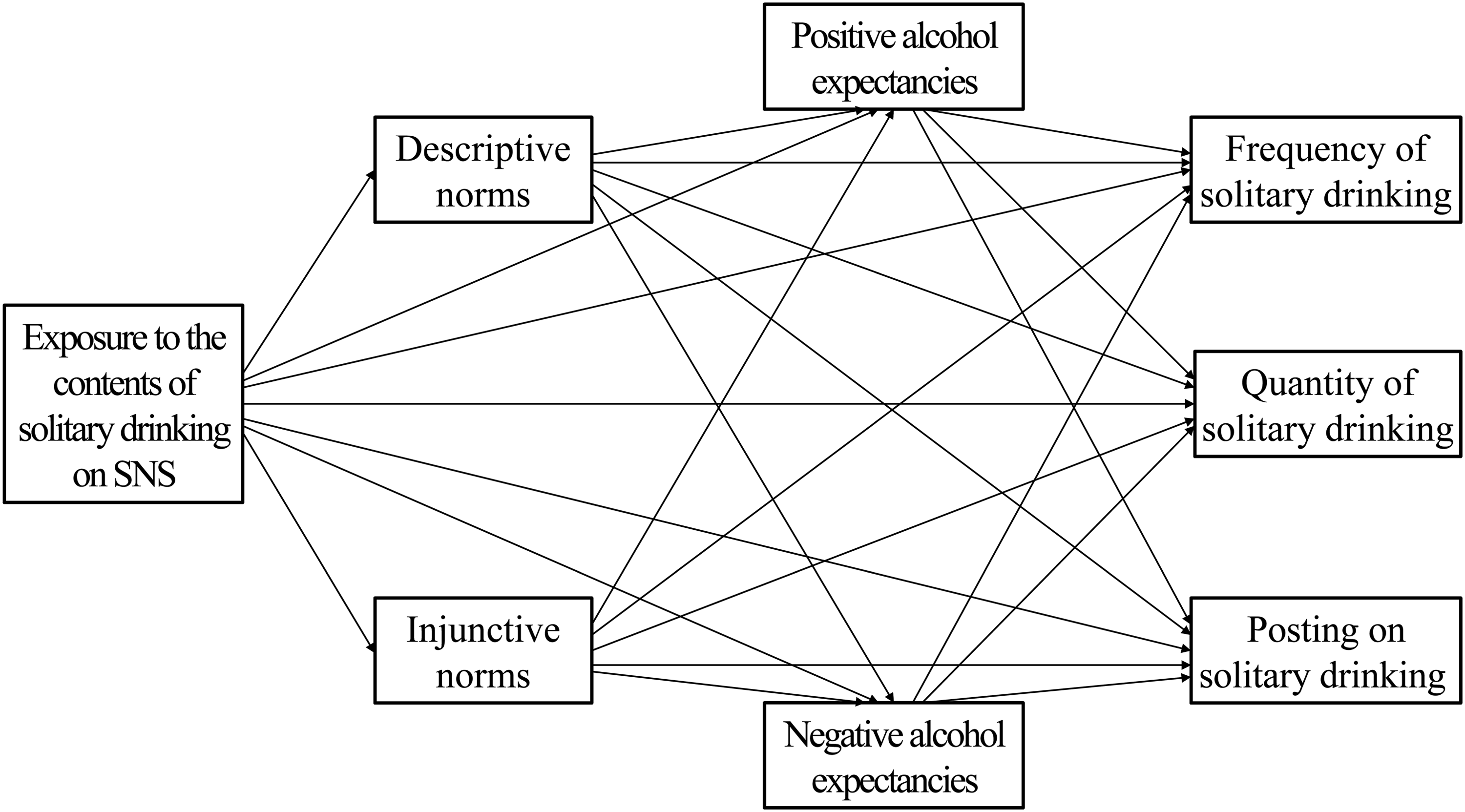
Proposed model.
Methods
Participants and procedure
An invitation to the online survey titled “The adult lifestyle study” was sent to 3,020 adults over the age of 20 who were randomly selected from a panel provided by a Korean research company. Among 1,443 respondents, a final sample of 506 adults (52 percent women) was eligible for inclusion and analysis. The inclusion criteria were as follows: having an active Facebook, Instagram, or other types of SNS account, and consumed alcohol at least once while alone in the previous year. The mean age of the final sample was 40.58 years (standard deviation = 11.44). Approximately 59 percent of the participants were married; 78.5 percent lived with children, and 11.5 percent reported that they live alone. Only a few participants (0.6 percent) lived with friends. On average, the participants reported solitary drinking at home twice a month, with an average drinking frequency of about four drinks per occasion. On average, they visited SNS about three times per week and spent 30–60 minutes during each visit.
Measures
Unless otherwise indicated, the following variables were measured on a five-point Likert scale (1 = not at all; 5 = extremely). Table 1 provides the descriptive statistics and simple correlations between the variables. Considering gender differences in several variables, data are presented for men in the lower triangle and for women in the upper triangle.
Descriptive Statistics and Intercorrelation Coefficients
Note: Men in the lower triangle, women in the upper triangle.
p < 0.05, **p < 0.01, ***p < 0.001.
1. Exposure to SNS = exposure to the contents of solitary drinking on SNS, 2. Descriptive = descriptive norms, 3. Injunctive = injunctive norms, 4. Negative AEs = negative alcohol expectancies, 5. Positive AEs = positive alcohol expectancies, 6. Frequency = frequency of solitary drinking, 7. Quantity = quantity of solitary drinking, 8. Posting on SNS = posting on SNS regarding solitary drinking, 9. Family member = the number of family members.
SNS, social networking sites; AE, alcohol expectancies; SD, standard deviation.
Exposure to SNS content related to solitary drinking
Participants responded to the statement, “I frequently see texts or pictures on solitary drinking posted by others on SNS.” 12
Descriptive norms
Participants assessed the extent to which they agreed with the following statement with three different referents 24 : “Most of ____ engage in solitary drinking”: (a) the adults living in our country; (b) the adults who are my age with same gender and similar socioeconomic status; and (c) my friends (α = 0.78).
Injunctive norms
Participants assessed their level of agreement with the following statement involving three different referents: “Most of ____ consider solitary drinking is not bad”: (a) the adults living in our country; (b) the adults who are my age with the same gender and similar socioeconomic status; and (c) my friends (α = 0.76). Thus, higher levels of injunctive norms correspond with “greater approval” of drinking.
Alcohol expectancies
We assessed the positive and negative AEs using a scale developed by Oei and Jardim and modified by Kim for Koreans.25,26 The five-item positive AEs included statements such as “drinking will make me more social” and the five-item negative AEs included statements such as “drinking alcohol will make me aggressive” (positive AEs, α = 0.82; negative AEs, α = 0.85).
Frequency of solitary drinking
Based on the alcohol consumption scale used in the Korea National Health and Nutrition Examination Survey (KNHANES), participants were asked to report the frequency of their solitary drinking at home: 1 = less than one per month; 2 = once a month; 3 = 2–4 times per month; 4 = 2–3 times per week; and 5 = more than four times per week.
Quantity of solitary drinking
Based on KNHANES, participants were asked, “When drinking alone at home, how many drinks did you usually have on a single occasion?” where 1 = 1–2 drinks; 2 = 3–4 drinks; 3 = 5–6 drinks; 4 = 7–9 drinks; and 5 = more than 10 drinks.
Posting on SNS
Participants responded to questions modified from Thompson and Romo 7 : “I post my status when drinking alone on SNS,” “I post pictures of myself drinking alone on SNS,” and “After I have been drinking alone, I post about its effects (e.g., being hung over).”
Analysis
A path analysis was performed using Amos 23.0 to model the associations among variables, that is, exposure to SNS contents, AEs, frequency and quantity of solitary drinking, and posting on SNS. Three exogenous variables—age, gender, and the number of people living together—were also included in the path model. 11 It was fit with χ 2 (20) = 52.204, p < 0.001, RMSEA (root-mean-squared error of approximation) = 0.06, CFI (comparative fit index) = 0.97, and NFI (normed fit index) = 0.95. Figure 2 gives the final model with standardized path coefficients.a We verified the indirect effects with follow-up bootstrap analysis using maximum likelihood estimation, 1,000 samples, and 95 percentile confidence interval estimates.
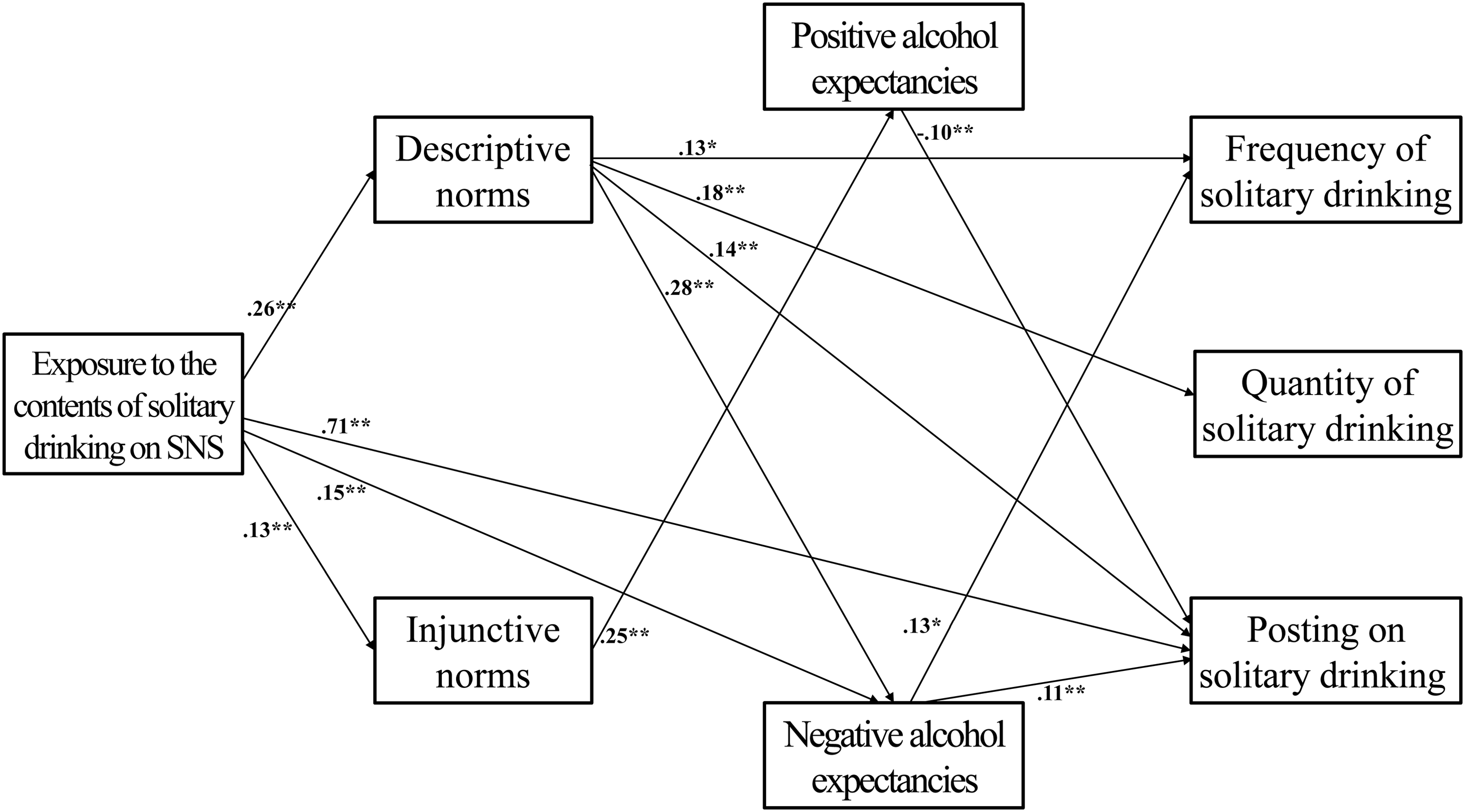
Standardized AMOS analysis of the proposed research model. χ 2 (20) = 52.204, p < 0.001, RMSEA = 0.06 (90 percent confidence interval = 0.04–0.08), CFI = 0.97, and NFI = 0.95. *p < 0.05, **p < 0.01. All the numbers in the paths represent standardized data; nonsignificant paths, control variables, and disturbance terms are not shown for simplicity. CFI, comparative fit index; NFI, normed fit index; RMSEA, root-mean-squared error of approximation.
Results
As hypothesized, exposure to SNS contents was positively related to descriptive norms (β = 0.26, p < 0.01) and injunctive norms (β = 0.13, p < 0.01). Exposure to SNS contents had also a positive and direct relationship with posting on solitary drinking on SNS (β = 0.71, p < 0.01). Exposure to SNS contents was also positively related to negative AEs (β = 0.15, p < 0.01).
Descriptive norms were directly related to the frequency (β = 0.13, p < 0.05) and quantity (β = 0.18, p < 0.01) of solitary drinking, and also to posting on SNS (β = 0.14, p < 0.01). Descriptive norms were also positively related to negative AEs (β = 0.28, p < 0.01), which were in turn directly related to the frequency (β = 0.13, p < 0.05) and quantity (β = 0.09, p = 0.054) of solitary drinking, and also to posting on SNS (β = 0.11, p < 0.01).
Injunctive norms only showed a significant relationship with positive AEs (β = 0.25, p < 0.01). Positive AEs were inversely related to posting on SNS (β = −0.10, p < 0.05), but had no significant relationship with the frequency (β = 0.08, p = 0.08) and quantity (β = 0.05, p = 0.28) of solitary drinking.
The results of the indirect effects showed several key points. Exposure to SNS contents had significant indirect effects on all the three criterion variables: (a) frequency of solitary drinking, (b) quantity of solitary drinking, and (c) posting on SNS. The path from exposure to SNS contents to the frequency of solitary drinking had a total effect of 0.13 (p < 0.01) with an indirect effect of 0.08 (p < 0.01). An analysis to estimate specific indirect effects showed that the path was mediated by descriptive norms (β = 0.03, p < 0.05), negative AEs (β = 0.02, p < 0.01), and descriptive norms and negative AEs (β = 0.01, p < 0.01). The path from exposure to SNS contents to the quantity of solitary drinking had a total effect of 0.14 (p < 0.01) with an indirect effect of 0.06 (p < 0.01). The path was mediated by descriptive norms (β = 0.05, p < 0.01), negative AEs (β = 0.01, p < 0.05), and descriptive norms and negative AEs (β = 0.01, p < 0.05).
In the path from exposure to SNS contents to posting on SNS, the total effect was 0.75 (p < 0.01) with an indirect effect of 0.04 (p < 0.01). There were five indirect paths: through (a) descriptive norms (β = 0.04, p < 0.01), (b) injunctive norms (β = −0.01, p < 0.05), (c) negative AEs (β = 0.02, p < 0.01), (d) descriptive norms and negative AEs (β = 0.01, p < 0.01), and (e) injunctive norms and negative AEs (β = −0.003, p < 0.01).
Descriptive norms had significant indirect effects on all the three variables: frequency of solitary drinking (β = 0.04, p < 0.05), quantity of solitary drinking (β = 0.03, p < 0.05), and posting on SNS (β = 0.03, p < 0.05). An analysis to estimate specific indirect effects showed that all paths from descriptive norms to the three variables were mediated by negative AEs. Injunctive norms had a significant indirect effect only on posting on SNS (β = −0.03, p < 0.01). The path was meditated by positive AEs. Tables 2 and 3 present indirect effects of variables.
Verification of Effects
Note: 1. Exposure to SNS = exposure to the contents of solitary drinking on SNS, 2. Descriptive = descriptive norms, 3. Injunctive = injunctive norms, 4. Negative AEs = negative alcohol expectancies, 5. Positive AEs = positive alcohol expectancies, 6. Frequency = frequency of solitary drinking, 7. Quantity = quantity of solitary drinking, 8. Posting on SNS = posting on SNS regarding solitary drinking.
Specific Indirect Effects for Multiple-Mediated Paths
Note: Among possible 51 mediating paths, only the significant paths were included in the table.
1. Exposure to SNS = exposure to the contents of solitary drinking on SNS, 2. Descriptive = descriptive norms, 3. Injunctive = injunctive norms, 4. Negative AEs = negative alcohol expectancies, 5. Positive AEs = positive alcohol expectancies, 6. Frequency = frequency of solitary drinking, 7. Quantity = quantity of solitary drinking, 8. Posting on SNS = posting on SNS regarding solitary drinking.
CI, confidence interval; SE, standard error.
Discussion
This study aimed to provide explanations for how exposure to SNS contents influenced the frequency and quantity of solitary drinking and posting on SNS. This study suggests two mediators in the relationships between the variables: descriptive norms and negative AEs. Exposure to SNS contents was positively associated with both descriptive norms and negative AEs, both of which increased solitary drinking and posting on SNS. Although exposure to SNS contents influenced injunctive norm perceptions, injunctive norms did not influence solitary drinking and posting on SNS. Positive AEs were related inversely to posting on SNS.
Descriptive norms were consistently shown to be a strong predictor of drinking. 27 They were also associated with solitary drinking in this study. When people see others' SNS posts about solitary drinking, they believed that solitary drinking was prevalent and engaged in the same behavior. It also increased participants' own posting about solitary drinking, thereby increasing the solitary drinking content on SNS. That cycle could exaggerate perceived descriptive norms of the behavior.
Although both descriptive and injunctive norms were positively correlated with the frequency of solitary drinking in the zero-order correlation, only descriptive norms, not injunctive norms, significantly affected solitary drinking when both norms were entered into the model. This suggests that the shared variance of descriptive norms and drinking may contribute to the zero-order association between injunctive norms and drinking. 28 In the context of solitary drinking, the power of injunctive norms may be weak because drinking alone at home is not observable to others. 29 Research showed that the relationship between injunctive norms and drinking is mediated by social drinking motives. 30
Negative AEs seem to have positive associations with descriptive norms, solitary drinking, and posting on SNS. This unusual result may be because our measures for AEs were not specific about solitary drinking, but about general alcohol use. It would seem likely that those who hold negative AEs would drink less alcohol with others to avoid negative consequences, but drink more when they are alone at home. Future work is needed to develop a scale to measure expectancies about solitary drinking and examine their impacts on solitary drinking. It may also be important to consider the proportion of solitary drinking episodes in the total drinking. Research on drinking motives can also help understand the impact of negative AEs on solitary drinking. In particular, drinkers with coping motives may engage more in solitary drinking, because they can be relaxed with alcohol or drunken without worrying about negative consequences of alcohol use.31,32
Future studies should test our model using various samples. For instance, previous research reported that negative AEs were associated with more drinking among women with alcohol use disorder. 33 It can be tested whether they engage in solitary drinking. In addition, a multigroup analysis for heavy drinkers and light drinkers might be valuable to test the impact of norms on AEs. Compared with experienced drinkers, inexperienced drinkers may learn AEs more indirectly from SNS posts or social norms.
The results of this study should be interpreted in light of the cultural and social characteristics of Korea. Descriptive norms are influential when people make their behavioral decision in unfamiliar situations. As solitary drinking is a relatively new and unfamiliar behavior in Korea, people might have used descriptive norms as information to guide their behavior. In addition, considering a collectivistic cultural orientation of Korea, norm perceptions induced by SNS contents might have had a strong impact on solitary drinking in this Korean sample. Future research will need to explore whether our model can be applied in various cultures.
We acknowledge some limitations in this study. First, as a cross-sectional design, this study precludes inferences about the temporal nature of the observed associations. The directions presented in the model can be reversed or bidirectional. For instance, people who drink heavily while alone might have had more friends who drink alone and higher chances of being exposed to their friends' SNS posts. Future longitudinal studies should investigate the causal relationships among this study's variables. Second, we paid attention only to solitary drinking at home. The generalization of these data to other types of solitary drinking may be limited. For instance, the strength and mechanism of normative influence may differ when solitary drinking occurs outside the home given that it is observable. 16 Third, self-selection bias could have been operating as only 47.8 percent of those who received our survey link participated in the study. Finally, the use of a single-item measure of frequency and quantity of solitary drinking constitutes a weakness in this study although such single-item measures of alcohol use are widely used. 33 The measurement error generated by single item measures might have attenuated associations among variables.
People who drink alone may be at higher risk than those who drink with others because they self-medicate to cope with the negative emotions. 1 Our findings have several implications for interventions targeting solitary drinkers. Previous research on social norms showed that alcohol use could be reduced by correcting misperceptions of descriptive norms. 29 Interventions for alcohol consumption should include attention to solitary users and their behavior on SNS; such interventions may benefit from the inclusion of social norm approaches. In addition, if people engage in solitary drinking to avoid the negative consequences of social drinking, as suggested by this study, interventions should also include messages about negative consequences of solitary drinking.
This is, within our knowledge, the first study that explores the influence of SNS contents on solitary drinking and its mechanism. Although unfavorable public sentiment has been evolving against heavy drinking and the frequency of social drinking has decreased in Korea, solitary drinking has become a new trend whose popularity will continue to spread. 3 This study calls health professionals' attention to this issue. Given that descriptive norms have significant impact on solitary drinking, it is important to shape desirable social norms before the behavior becomes widespread.
Notes
a. Because there were significant gender differences in several variables such as injunctive norms, posting on SNS regarding solitary drinking and solitary drinking quantity, we conducted a multigroup analysis in AMOS to test the equivalence of the paths across gender [χ 2 (14) = 29.099, p < 0.01, RMSEA = 0.05, CFI = 0.99, NFI = 0.98]. Only the path from positive alcohol expectancies to the quantity of solitary drinking was significantly different (Δχ 2 = 7.761, p < 0.01). The path was significant only among women (β = 0.18, p < 0.01), not among men (β = −0.01, p = 0.18).
Footnotes
Acknowledgment
This article was supported by the 2019 Research Fund of the Sahmyook University.
Author Disclosure Statement
No competing financial interests exist.