




Abstract
Abstract
To examine the associations of adolescent sexual orientation with cyber behaviors and health indicators 5 years later during young adulthood and test whether cyber behaviors contribute to sexual orientation health disparities. Data were drawn from Waves 2 and 7 from the NEXT Generational Health Study, a nationally representative cohort of U.S. adolescents (n = 2012). Multiple linear regressions were used to examine differences between sexual orientation subgroups (defined based on sexual attraction) in five cyber behaviors and five health indicators. Mediation analyses were conducted to examine whether cyber behaviors mediated the associations between bisexual attraction and health indicators. Relative to heterosexual peers, bisexual youth spent more time engaging in cyber behaviors and social media, and reported more psychosomatic symptoms and poorer general health. Gay and questioning males spent less time playing video games than heterosexual males. Bisexual females reported more depressive symptoms and less optimism and happiness than heterosexual females. Time spent on cyber behaviors and social media was a significant mediator of adolescent bisexual attraction and worse health outcomes in young adulthood. Frequency of cyber behaviors differed between sexual minority subgroups. Bisexual youth in particular had more psychosomatic symptoms and poorer general health. Engagement in cyber behaviors and social media use contributed to increased health disparities among bisexual youth.
Introduction
On average, adolescents in the United States spend more than 7 hours per day using electronic devices. 1 Engagement in cyber behaviors, encompassing a broad range of cyber activities using electronic devices, is common among young people. 2 How adolescents choose to spend their time online could lead to negative or positive consequences. 3 For example, playing video games may increase problematic behavior and reduce prosocial outcomes (e.g., helping, cooperation, and empathy),4,5 whereas using cell phones and social networking sites may increase peer support and access to health information.6,7 According to the Pew Research Center, 8 sexual minority adults are more likely than heterosexual adults to use social networking sites (80% vs. 58% in the general public). Of the sexual minority adults surveyed, 55% have met other sexual minority friends online, and 43% have revealed their sexual orientation/gender identity on social networking sites. However, it is unclear if sexual minority adolescents engage more frequently in cyber behaviors than heterosexual adolescents. This is a critical literature gap as increased cyber behaviors may expose youth to online safety risks such as cyberbullying, 9 a key contributor to depressive symptoms. 10 The present study examined the extent to which adolescents who report nonheterosexual attraction engage in more frequent cyber behaviors during young adulthood, whether sexual orientation subgroup differences extend to mental and physical health indicators, and if cyber behaviors mediate the association between bisexual attraction and health indicators.
Access to the cyberspace could benefit sexual minorities. Researchers have identified increased opportunities to accessing health information, connecting with like-minded peers, and participating in civic action as potential benefits of cyber behaviors among sexual minority adolescents. 11 The anonymity afforded by the Internet may provide sexual minority youth with improved access to helpful information about sexual identity development and health behaviors.12,13 The cyberspace may provide a unique platform for relationship formation among those who feel more comfortable disclosing personal information via the Internet. 14 Technological advances may also influence the way intimate relationships are developed and maintained.15,16 Several studies have found that sexual minority youth are more likely to use the Internet to find a romantic partner than heterosexual youth.17–19 A recent qualitative study found that Internet use could be helpful for young gay men to find and filter partners, facilitate communication, and support identity development. 20
Despite these potential benefits, cyberspace may also expose sexual minorities to various risks. One study estimated that sexual minority adolescents use social networking sites at similar rates as heterosexual peers, but they are almost twice as likely to experience cyberbullying victimization. 17 For sexual minority adults, finding partners online has been associated with riskier sexual behaviors, including exchanging sex for food, drugs, or accommodations, and engaging in unprotected sex. 21 Other cyber behaviors such as sexting and using phone applications to find romantic partners may also lead to worse mental and physical health.22,23 Given these findings, it is important to understand whether sexual minority adolescents engage in cyber behaviors more frequently than their heterosexual peers, as more frequent cyber behaviors could be indicative of heightened risks of cyberbullying victimization, risky sexual behaviors, and poorer health outcomes.
Engagement in cyber behaviors may differentially impact health outcomes of various sexual minority subgroups. Bisexual individuals experience greater mental health disparities, including depression, anxiety, and suicidality, than both heterosexual and gay/lesbian individuals.24–26 Negative stereotypes about bisexuality and “double discrimination” from both heterosexual and gay/lesbian individuals may contribute to these disparities.27,28 For instance, the stereotype that bisexuality is an unstable and illegitimate sexual orientation is a unique stressor that bisexual individuals face. More so than homosexual individuals, bisexual individuals may also be perceived as sexually irresponsible and unfaithful in relationships. These bisexual-specific stressors may lead to loneliness as a result of stigmatization and discrimination from both heterosexual and gay/lesbian individuals. 29 Overall, bisexual individuals are often perceived as being confused about their identity, tend to feel invisible, and experience social isolation and marginalization due to lack of supportive communities.30,31
Even with these previous studies, limited research has investigated positive mental and physical health during young adulthood among bisexual adolescents relative to heterosexual adolescents. Positive mental health variables, such as optimism and happiness, are important resilience factors that can bolster subjective well-being. 32 A better understanding of bisexual orientation disparities in positive mental and physical health indicators can provide insight into the development of strength-based health interventions.33–35 To our knowledge, no prior research has examined longitudinal associations between bisexual attraction during adolescence with cyber and health behaviors in young adulthood.
In this study, we compared the level of engagement in five cyber behaviors and ratings on five health indicators in young adulthood based on adolescents' sexual attraction subgroups. We hypothesized that bisexual adolescents would engage in cyber behaviors most frequently and experience the worst health outcomes, followed by adolescents with same-sex attraction or questioning, and finally by heterosexual adolescents. We further evaluated cyber behaviors as mediators of the associations between bisexual attraction and health indicators, and hypothesized that more frequent cyber behaviors among bisexual youth would be associated with worse health outcomes.
Methods
Sample
Longitudinal data were drawn from the NEXT Generation Health Study (NEXT), a national cohort study of 2,785 adolescents who were enrolled in 10th grade in 2009/2010 and followed annually for 7 years. A three-stage stratified design was used to recruit a diverse sample of U.S. high school students in 22 states. Sexual orientation was assessed at Wave 2 of the NEXT study; thus, we first restricted the sample to Wave 2 participants (n = 2,439; 87.6% of the full sample; mean age = 17.2, SD = 0.51). The final analytic sample consisted of 2012 adolescents (82.5% of Wave 2 NEXT sample; mean age = 22.6, SD = 0.53) who completed the Wave 7 questionnaire and provided valid responses to all study variables. Parents provided written consent and participants provided assent to participate in this study; on turning 18 years of age, participants provided consent. The study was approved by the Institutional Review Board of the Eunice Kennedy Shriver National Institute of Child Health and Human Development.
Measures
Sexual orientation (Wave 2)
Sexual attraction is considered the most important dimension of sexual orientation during adolescence as adolescents may still be developing their sexual identity, and sexual behaviors may be limited by context.36–38 Thus, participants were asked “Which of the following best describes your sexual orientation?” In this sample, 3.6% of males and 8.3% of females reported nonheterosexual sexual attraction. Frequencies and weighted percentages of sexual orientation subgroups are presented in Table 1.
Sample Characteristics for the Wave 2 NEXT Sample and the Analytic Sample
Unweighted frequencies and weighted percentages are presented.
Cyber behaviors (Wave 7)
Time spent on cyber behavior
Two separate items (weekday and weekend time) assessed the number of hours per day participants usually use a computer, the Internet, or a cell phone for chatting online, e-mailing, texting, tweeting, or similar social networking during their free time. Response options ranged from 0 = “none at all,” 1 = “about half an hour a day,” 2 = “about 1 hour a day,” to 8 = “about 7 or more hours a day.” To aid the interpretation of findings, “about half an hour a day” was recoded as 0.5 and “about 1 hour a day” was recoded as 1, with the final items ranging from 0 = “none at all” to 7 = “about 7 or more hours a day.”
Time spent on video games
Participants reported the number of hours per day they usually play games on a computer, or game console, in their free time on weekdays and weekends, with response options ranging from 0 = “none at all” to 8 = “about 7 or more hours a day.” After the aforementioned rescaling, the mean of these two items (α = 0.88) was used to represent the overall level of engagement in gaming (ranging from 0 to 7).
Frequency of phone use
Participants reported frequency of engagement in nine different activities using a cell phone or smart phone (sending text messages, take and/or share pictures, take and/or share videos, listen to music, play games, connect to the Internet, going to social networking site, watch TV shows/movies, and video chat) in the past 3 months. Response options included 0 = “never,” 1 = “less than monthly,” 2 = “monthly,” 3 = “weekly,” 4 = “daily,” and 5 = “multiple times a day.” A mean score (α = 0.77) was used to represent frequency of phone use.
Frequency of social media use
Participants reported frequency of engagement in seven different activities on a social networking site (tweet or update status, private, direct, or instant message, like a tweet/update/post, post comments to someone's post/update, share a picture, post comments to someone's picture, and use a cellphone to update or visit the site) in the past three months. Response options similarly ranged from 0 = “never” to 5 = “multiple times a day.” A mean score (α = 0.91) was used to represent level of engagement in social media.
Health indicators (Wave 7)
Psychosomatic symptoms
An eight-item scale taken from the Health Behaviour in School-Aged Children survey was used to assess frequency of psychosomatic symptoms (e.g., headache, stomachache, and feeling dizzy) in the last 6 months.39,40 Response options ranged from 0 = “rarely or never” to 4 = “about every day.” A mean score (α = 0.84) was used to represent psychosomatic symptoms.
Depressive symptoms
The pediatric PROMIS (Patient-Reported Outcomes Measurement Information System) scale was used to measure depressive symptoms. 41 Participants reported frequency of eight depressive symptoms (e.g., “I felt like I couldn't do anything right,” “I felt unhappy,” “I thought that my life was bad”) in the last 7 days. Response options ranged from 0 = “rarely or never” to 4 = “about every day.” A mean score (α = 0.96) was used to represent depressive symptoms.
Optimism
The Life Orientation Test-Revised 42 was used to measure optimism. Response options were on a five-point Likert scale from 0 = “strongly disagree” to 4 = “strongly agree.” Three items were reversed coded and six items were used to calculate the optimism scale. Sample items include “I rarely count on good things happening to me” (reverse coded) and “In uncertain times, I usually expect the best.” A mean score (α = 0.75) was used to represent the level of optimism.
Happiness
Participants were asked “In general, how happy are you with how your life is going?” Response options ranged from 0 = “I am very unhappy with my life” to 10 = “I am very happy with my life.”
General health
Participants were asked “Would you say your health is…?” Response options were 1 = “poor,” 2 = “good,” 3 = “fair,” and 4 = “excellent.”
Covariates
Race/ethnicity (White, African American, Hispanic, and other) and family affluence were included as study covariates. Family affluence was measured using the Family Affluence Scale, inquiring participants' family car and computer ownership, frequency of family holidays, and whether they had their own bedroom. 43
Statistical analyses
Multiple linear regressions examined sexual orientation differences in cyber behaviors and health indicators. These analyses were conducted in the overall analytic sample and separately by sex using STATA 14. Next, to test whether cyber behaviors mediated the associations between bisexual attraction and health indicators (Fig. 1), mediation analyses were conducted among bisexual and heterosexual youth (n = 1943), and with a focus on cyber behaviors that were found to be elevated among both male and female bisexual youth. The product of coefficient approach was used to test mediation. 44 Bias-corrected indirect effects and their 95% confidence intervals were obtained via bootstrapping (with 5,000 resamples) in Mplus 8. All analyses accounted for the complex survey design of the NEXT study.
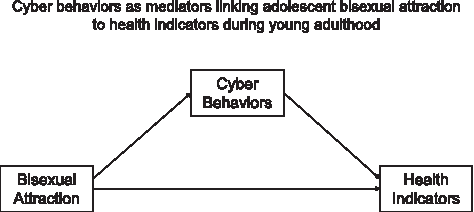
Conceptual mediation model. Due to moderate to high correlations between cyber behaviors, for each health indicator three mediation models were conducted separately for weekday time spent on cyber behavior, weekend time spent on cyber behavior, and frequency of social media use.
Results
Sample characteristics for the Wave 2 NEXT sample and the analytic sample are largely similar (Table 1). Multiple linear regression results are presented in Table 2. Relative to heterosexual youth, bisexual youth spent 0.97 (∼58 minutes) and 0.84 (∼50 minutes) more hours on cyber behavior the weekdays and weekend days, respectively. Bisexual youth also reported more frequent social media use than heterosexual youth. Analyses stratified by sex indicated that questioning males spent 1.73 more hours (about 1 hour, 44 minutes) on cyber behavior than heterosexual males during the weekend. Gay and questioning males spent less time on video games than heterosexual males.
Sexual Minority Subgroups at 11th Grade (Wave 2) as Predictors of Cyber Behaviors 4 Years Post-High School (Wave 7)
Weighted means and standard errors of cyber behaviors are presented by sexual orientation subgroups, with results from the multiple regression analyses presented alongside the descriptive statistics. For these analyses, heterosexual youth were set as the referent group. Weekday time spent and weekend time spent refer to time spent on cyber behavior. Significant findings are highlighted in bold. CI, confidence intervals; SE, standard error.
Multiple linear regression models focusing on health indicators revealed higher psychosomatic symptoms, higher depressive symptoms, lower optimism, lower happiness, and worse general health among bisexual youth than heterosexual youth in the overall sample (Table 3). Analyses stratified by sex showed that both bisexual males and females reported higher psychosomatic symptoms and worse general health than heterosexual peers. Generally, sexual orientation disparities in depressive symptoms, lower optimism, and lower happiness were more pronounced among females. Bisexual (mean symptoms [standard error] = 1.44 [0.13]) and questioning (1.47 [0.15]) females reported higher depressive symptoms than heterosexual females (1.11 [0.04]). Lesbian and bisexual females, as well as questioning males and females, all reported lower optimism relative to heterosexual peers. Bisexual females also reported lower happiness (mean [standard error] = 6.71 [0.22]) than heterosexual females (7.52 [0.13]).
Sexual Minority Subgroups at 11th Grade (Wave 2) as Predictors of Health Indicators 4 Years Post-High School (Wave 7)
Weighted means and standard errors of health indicators are presented by sexual orientation subgroups, with results from the multiple regression analyses presented alongside the descriptive statistics. For these analyses, heterosexual youth were set as the referent group. Significant findings are highlighted in bold. CI, confidence intervals; SE, standard error.
Results from mediation analyses are presented in Table 4. Bisexual attraction during adolescence was both directly and indirectly associated with higher psychosomatic symptoms and depressive symptoms during young adulthood through increased time spent on cyber behaviors and social media. Bisexual attraction was indirectly associated with lower optimism through higher frequency of these cyber behaviors. Weekday and weekend cyber behavior time, but not social media, contributed to lower happiness and poorer general health among bisexual youth. The proportion of the total effect mediated by cyber behaviors ranged from 7.1% to 25.0%.
Mediation Analyses Testing Cyber Behaviors as Pathways from Bisexual Attraction to Health Indicators
All mediation models were estimated for males and females together. Standardized regression coefficients and 95% confidence intervals are presented. Significant findings are highlighted in bold. All indirect effects were interpreted as significant except for the paths from bisexual orientation to happiness and general health through social media given nonsignificant associations between social media and the health outcome (path b). Path a refers to the association between bisexual attraction and the mediator. Path c' refers to the association between bisexual orientation and the health outcome after controlling for the mediator.
Discussion
The present study documents sexual minority subgroup differences in cyber behaviors and mental and physical health indicators among U.S. youth. Bisexual youth, but not lesbian/gay or questioning youth, spent more time on cyber behavior and had higher engagement in social media (but not phone use or video games) than heterosexual peers. Prior research suggested that bisexual individuals experience double discrimination from both heterosexual and lesbian/gay communities 28 as well as bisexual-specific minority stressors. 29 As a marginalized group, bisexual youth may find greater autonomy and affordances in their experience when they utilize the Internet to obtain health information and search for friends who accept their sexual identity.9,11,16 At the same time, engaging in problematic cyber behaviors (e.g., misuse of social networking sites) may also expose bisexual youth to greater risks of cyberbullying victimization 17 or other risk behaviors, 21 which may contribute to worse mental and physical health outcomes.
Bisexual males and females both had higher levels of psychosomatic symptoms and worse perceived general health than heterosexual peers. These disparities may reflect more challenges with health care access among sexual minority adolescents in general, 45 and bisexual adolescents specifically. 46 Importantly, bisexual-specific minority stressors such as internalized biphobia and concealment of bisexual identity may prevent bisexual adolescents from seeking help from health professionals due to heightened expectation of rejection. 47 Future research should examine the possibility that bisexuals experience more unmet medical needs and worse health outcomes because of increased perceived barriers to health care access. 48
Extending prior research showing sexual orientation disparities in depressive symptoms, 10 we found that bisexual females had higher depressive symptoms, lower optimism, and lower happiness than heterosexual females during young adulthood. The lack of corresponding differences among males may reflect sex differences in internalizing psychopathology. 49 Sexual minority subgroup differences in optimism and happiness underscore the importance of promoting minority mental health from a resilience perspective. Lower mean levels of optimism experienced by all sexual minority female subgroups highlights the need to design interventions, not only to reduce depressive symptoms, but also to build strength and optimism.
Contrary to our hypotheses, disparities in cyber behaviors and health indicators were generally not observed among gay and lesbian youth. Curiously, questioning youth, particularly females, experienced higher depressive symptoms but lower optimism similar to those experienced by bisexual peers. More research is needed to understand what is common to both female bisexual and questioning adolescents that might account for these findings. Drawing on existing literature, increased fluidity of sexual identity, 50 greater vulnerability to double discrimination, and reduced access to supportive communities 30 are possible explanations that warrant further investigation.
Findings regarding sexual orientation and video games showed another pattern of subgroup difference. Relative to heterosexual males, gay and questioning males spent less time on video games. Gay and questioning males may be less interested in gaming because greater conformity to masculine norms is common in video games. 51 Alternatively, this may be related to the underrepresentation of sexual minority-related content in video games. 52 Future studies that directly assess motivations to play (or not play) specific types of video games may extend our understanding of the observed subgroup differences.
This study has several limitations. First, sexual orientation was measured using a single item focusing on sexual attraction but not behavior/identity, and was only assessed at one time point. A multidimensional assessment of sexual orientation could have strengthened this study, and modeling fluidity in sexual orientation would be an important future direction. Second, while the current study uses a fairly large sample, the sample sizes for certain sexual minority subgroups such as questioning males were small. Despite this, a rather consistent pattern emerged to show bisexual disparities in cyber behaviors and health indicators, providing useful directions for future research with larger samples. Finally, several young adult outcomes relied on single-item measures to keep the survey at a reasonable length. The use of well-validated, multiple-item measures could be used in future studies to replicate and extend our findings.
This study contributes to our understanding of sexual orientation and cyber behaviors using recent data from a nationally representative longitudinal study. The current findings highlight the need to support bisexual adolescents as they may face bisexual-specific discrimination and challenges. In light of bisexual disparities in psychosomatic symptoms and general health, it would be important to provide reliable health information to and reduce barriers to health care among bisexual adolescents. The identification of increased time spent on cyber behaviors and social media as pathways to worse health indicators points to the importance of understanding why bisexual youth spent more time on cyber behaviors and what they do on social media sites. More nuanced assessment of the specific motivations behind beneficial and problematic use of electronic devices among bisexual youth is needed to guide prevention efforts.
Footnotes
Acknowledgments
This project (contract HHSN275201200001I) was supported, in part, by the Intramural Research Program of the Eunice Kennedy Shriver National Institute of Child Health and Human Development; the National Heart, Lung, and Blood Institute; the National Institute on Alcohol Abuse and Alcoholism; the National Institute on Drug Abuse; and the Maternal and Child Health Bureau of the Health Resources and Services Administration. Article preparation by Cecilia Cheng was supported by the Hong Kong Research Grants Council's General Research Fund (17400714). The opinions and assertions expressed herein are those of the author(s) and do not necessarily reflect the official policy or position of the Uniformed Services University or the Department of Defense.
Author Disclosure Statement
No competing financial interests exist.