




Abstract
Abstract
Celebrity suicides that are reported heavily in the media may increase risk for others' suicidal behavior. This study examined whether Internet search volumes for suicide-related terms changed after three celebrity suicide deaths (Robin Williams, Chester Bennington, and Alexander McQueen) and three celebrities who died by means other than suicide (David Bowie, Azzedine Alaia, and Paul Walker). Suicide search terms included suicide, how to suicide, commit suicide, depression, hanging, and suicide prevention. Observed suicide search volumes in the United States were collected from Google Trends for the 10 weeks before and the 2 weeks following each celebrity's death. Predicted search volumes for the 14 days postdeath were forecasted from the predeath search volumes and predicted search volumes were then compared to the true, observed search volumes. Search volumes for suicide terms significantly increased following Robin Williams' suicide death. Some of the terms increased in search volume following Chester Bennington's and Alexander McQueen's suicide deaths, but not significantly. Most search volumes for nonsuicide celebrity deaths did not change following their deaths. Celebrity suicide deaths can lead to significant, national increases in Internet search volumes for suicide-related terms for celebrities of high prominence. Results highlight the critical importance of reporting suicide deaths in the media responsibly.
Introduction
Media reports on suicide deaths are related to increases in suicidal behavior in the general population.1–4 For instance, Kim conducted a content analysis of 3,412 suicide lifeline calls in South Korea and found that media reports of others' suicide deaths, including celebrity suicides, impacted the details of the individuals' own suicide plans. Specifically, publicized suicide deaths provided ideas for what method(s) to use and places where to make an attempt. 5 Another research team in South Korea found that in the month after a celebrity died by suicide via hanging, rates of deaths by hanging increased among almost all age groups and genders. 4 Researchers in Austria determined that the suicide of a celebrity hotel owner was correlated with an increase in suicide deaths proportional to the amount of media coverage regarding this death in various regions of Austria. 6 Taken together, this and other research indicates that media reports about celebrity suicides can inform suicide plans and are linked to elevated suicide deaths.7–9
Unfortunately, investigating the effects of celebrity suicides on later suicide death rates in the United States and in other countries has been difficult, due partly to a multiyear time lag for official national suicide statistics being released to the public. For instance, the World Health Organization did not release 2016 estimates for suicide rates by country until 2018. 10 However, other forms of data, such as Internet data indexing the search terms people enter when browsing the Internet, are readily and quickly available at a national level. These data can then be used to inform the study of how celebrity deaths impact later self-injurious behaviors. An example of a platform that indexes search terms is Google Trends, which indexes the number of daily Google searches within the United States. This tool has been used to study human behavior in many fields and is a viable option to study changes in and predictors of self-injurious thoughts and behaviors, without substantial time lags.11–13 For example, Ayers et al. examined how Internet search volumes for suicide-related terms (e.g., teen suicide, how to commit suicide) changed after the release of 13 Reasons Why, a Netflix series that detailed why a character died by suicide and included a graphic scene of the character's suicide. 14 Results revealed a significant increase in suicide-related Internet search volumes for 12 out of the 19 days following the show's release (see Ayers et al. 14 , 2017, p. E2 Fig. B). This finding supports that data indexing Internet search terms may be used to further study how the media may affect suicide outcomes.
Purpose of study
The current study examined the impact of celebrity suicide deaths on suicide-related Internet search volumes in the United States using Google Trends (for a deeper explanation for how Google Trends indexes search volumes, please visit “How Trends data is adjusted” on the support web page). To understand whether changes in suicide search volumes were related to celebrity suicide deaths specifically or celebrity deaths in general, we also examined changes in suicide-related search volumes in the 2 weeks following the deaths of three celebrities who died from causes other than suicide. We predicted that suicide-related search volumes would increase after celebrity suicide deaths, but that suicide search volumes would not change after celebrity deaths from causes other than suicide.
Methods
This was a pseudo-experimental study. First, we identified six prominent celebrities who died by suicide in the past decade. We reasoned that the higher the celebrity's prominence, the more likely the suicide was covered in the media, which may prompt Internet search activity. Prominence was determined by the number of Google news reports published 5 years before the celebrity's suicide (>0.5 million reports). Next, we inspected whether other suicide-related events (e.g., news reports involving suicide bombers, other high-profile suicide deaths) occurred around the date of the celebrity's death because not accounting for other suicide-relevant events could obscure suicide search volume results. Two prominent celebrities (Kate Spade and Anthony Bourdain) were excluded from analyses because their deaths occurred within a week of one another. In addition, Chris Cornell was excluded as he died by suicide near the time of Aaron Hernandez's suicide and the release of the Netflix series 13 Reasons Why. Although statistical techniques can adjust for the effect of specific and isolated events, given the quantity of media reports (over half a million) released about 13 Reasons Why in the weeks before and after Chris Cornell's death, 14 we felt it would be better to exclude Chris Cornell from analyses. Therefore, we included in analyses three celebrities who died by suicide: Robin Williams (actor), Chester Bennington (musician),* and Alexander McQueen (designer).
Second, we identified a control group of celebrities who met three criteria: (a) died from causes that did not provoke suspicion of a suicide death (e.g., did not die from a drug overdose, single person car crash), (b) had similar (within 1.5 million reports) prominence as celebrity suicide decedents, and (c) had a similar profession (i.e., fashion designer, actor, musician). We created this control group to identify the normal fluctuation in suicide-related search volumes after any type of celebrity death. Our control group included David Bowie (musician), Azzedine Alaia (designer), and Paul Walker (actor).
Third, we identified suicide-related search terms to include in the study. Previous studies suggest that leading candidate terms for connecting online search activity to suicide rates are suicide, commit suicide, how to suicide, and depression.14–17 The term hanging was included as all the celebrities who died by suicide used this method. Finally, we included the term suicide prevention to examine whether media reports on suicide also affected changes in help-seeking thoughts or behaviors.
Google Trends allows users to exclude certain keywords when indexing search volumes. Because we were interested in the impact of celebrity deaths on search volumes, we excluded squad (Suicide Squad was a popular movie), attack, prevention (to avoid capturing results for suicide prevention), and bombing when indexing search volumes for the term suicide. Attack and bombing were also excluded for the terms how to suicide, commit suicide, and suicide prevention. Out was excluded for the term hanging.
Using Google Trends, we obtained the number of daily Google searches within the United States for these six suicide-related terms during the 10 weeks before and the 2 weeks following each celebrity's death. We included this timeframe because we were interested in how celebrity deaths affected daily search volumes, and daily search volumes are available for a maximum of 90 days.
Within the selected time period and for selected search terms, Google Trends data are automatically divided by the total number of daily searches and then scaled to range from 0 to 100. For example, if 10 days of data are selected for a single search term, a value of 50 on day 1 indicates that searches on day 1 were ∼50% of the maximum search volumes in the 10-day period.
Data analysis
An autoregressive moving average (ARMA) model is a statistical tool that can predict future values from given preexisting values (for additional information on ARMA models, please see Hyndman and Khandakar 18 ). We constructed a low-order ARMA model using 8 weeks of data where the order of the ARMA model was selected via Akaike Information Criterion using the forecast package in R (for more information on using R to forecast time series, please see Gjika and Puka 19 ). That model then forecasted (i.e., predicted) 2 weeks of daily suicide-related search volumes, which were then compared to the true, observed search volumes. To assess model accuracy, we first counted the number of days the observed search volumes fell within the forecasted values' 95% prediction intervals; observed volumes falling outside 95% prediction intervals indicated that observed search volumes were significantly different than predicted. Second, we calculated the square root of the mean squared prediction error (RMSPE). Higher RMSPE values indicated greater differences between observed and predicted values.
To assess a specific celebrity's influence on suicide-related searches, forecasting analyses were performed for the 2 weeks before the celebrity death (preperiod) and the 2 weeks after the celebrity death (postperiod). For postperiod analyses, the preperiod ARMA model was used to forecast predicted search volumes. However, the entire 10 weeks' versus 8 weeks' daily search volumes were used for model estimation, to maximize model accuracy. Fisher's exact test (a conservative test that tends to underdetect differences) was used to compare whether more searches were different than predicted (i.e., fell outside of the forecasted volumes' 95% prediction interval) during the postperiod relative to the preperiod, to indicate whether observed search volumes after deaths were significantly different than predicted. In addition, we compared RMSPE values between the pre- and postperiods to quantify the magnitude of the difference in prediction accuracy.
As described above, we examined whether other suicide-related events could have contaminated search volumes. To account for Chris Cornell's death (which occurred during Chester Bennington's 12-week data collection period), we included a dummy variable as a covariate for the week following Chris Cornell's death.
Results
Search volumes following deaths by suicide
The number of observed searches captured within forecasted volumes' 95% prediction intervals during the pre- and postperiods for all celebrities who died by suicide are shown in Table 1 and Supplementary Figures S1, S2, S3, S4. Significantly more days' search volumes for suicide, depression, commit suicide, and suicide prevention were different than predicted in the 2 weeks after Robin Williams' death, compared to the 2 weeks before his death, ps < 0.01 (Figs. 1A and 2A). However, search volumes were descriptively greater than predicted for all terms, including how to suicide and hanging. Comparisons of RMSPE values (i.e., the average difference between observed and predicted values for the given period) indicated that, relative to the preperiod, observed search volumes in the postperiod were between 2.49 times (hanging) and 43.76 times (suicide) greater.
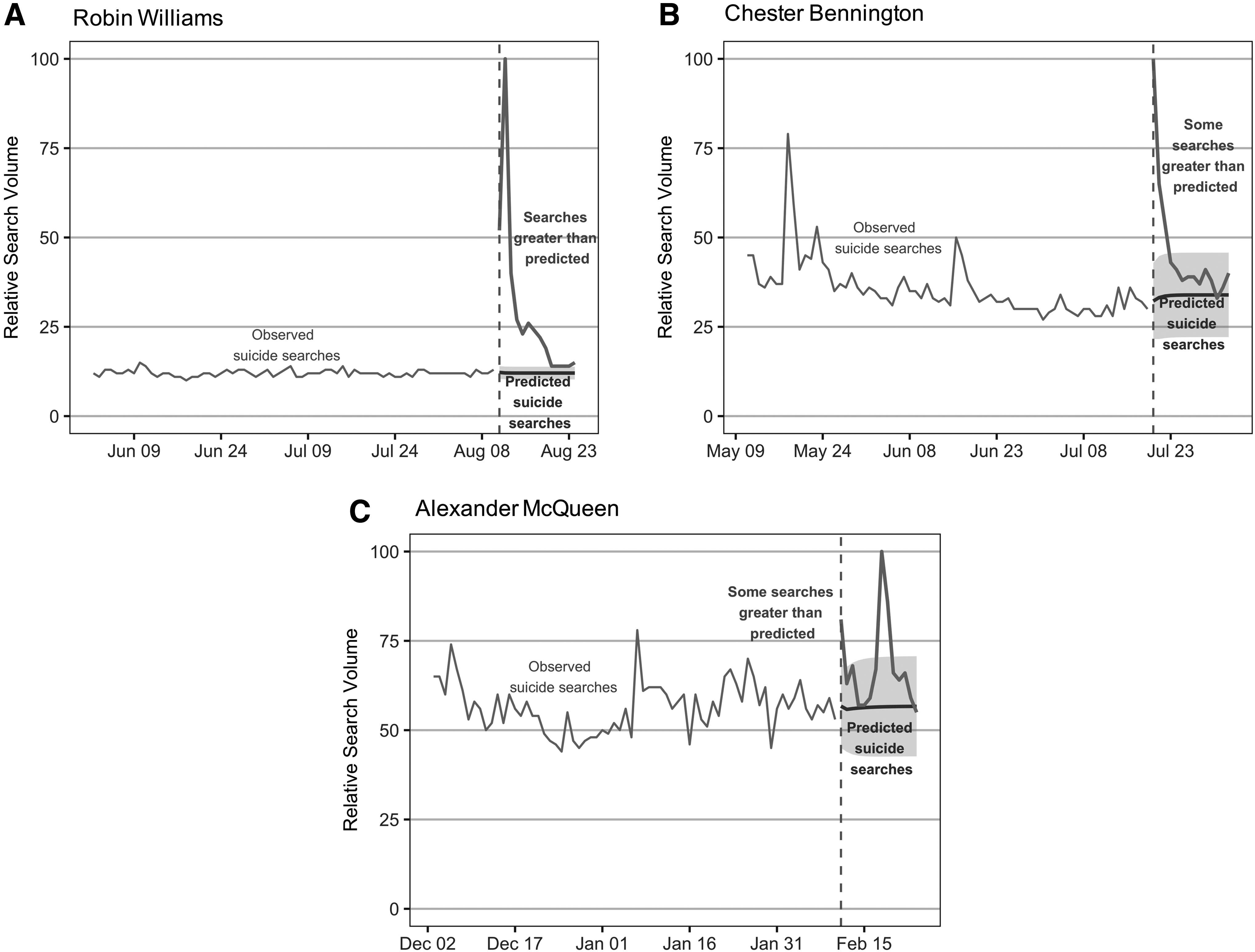
Relative search volumes for search term suicide after the deaths of Robin Williams

Relative search volumes for search term suicide prevention after the deaths of Robin Williams
Cross-Validation Model Assessing the Impact of Celebrity Suicide Deaths on Suicide-Related Internet Search Volumes
Model order indicates the order of the ARMA models. The first value indicates the autoregressive value and the second indicates the order of the moving average. For a review of ARMA models, please see Hyndman & Athanasopoulos (2018). 31 The reported p-values were calculated using Fisher's exact test.
ARMA, autoregressive moving average; RMPSE ratio, postperiod RMSPE/preperiod RMSPE; RMSPE, root-mean-square prediction error.
A similar trend was observed after Chester Bennington's death. Descriptively, more days' search volumes for suicide, how to suicide, commit suicide, hanging, and suicide prevention were different than predicted in the 2 weeks after his death, compared to the 2 weeks before his death (Figs. 1B and 2B). All differences in predicted values were descriptively greater than predicted, although the differences were not statistically significant. All days' search volumes for depression were predicted similarly in the pre- and postperiods. Comparisons of RMSPE values indicated that, relative to the preperiod, observed search volumes in the postperiod were between 0.99 times (depression) and 5.31 times (suicide) greater.
Descriptively, more days' search volumes for suicide, depression, how to suicide, and commit suicide were different than predicted in the 2 weeks after Alexander McQueen's death, compared to the 2 weeks before his death (Fig. 1C). All differences in predicted values were greater than expected except for how to suicide. However, the differences were not statistically significant. All days' search volumes for suicide prevention and hanging were predicted similarly in the pre- and postperiods (Fig. 2C). Comparisons of RMSPE values indicated that, relative to the preperiod, observed search volumes in the postperiod were between 0.80 times (hanging) and 2.77 times (suicide) greater.
Search volumes following deaths by means other than suicide
The number of observed search volumes captured within forecasted volumes' 95% prediction intervals during the pre- and postperiods for all celebrities who died by means other than suicide are shown in Table 2. Overall, most days' search volumes for suicide, depression, how to suicide, commit suicide, hanging, and suicide prevention were predicted similarly before and after the deaths of David Bowie, Azzedine Alaia, and Paul Walker. However, some descriptive differences in prediction accuracy between the pre- and postperiods were observed. For instance, after Azzedine Alaia's death, more days' search volumes for suicide were significantly different than predicted in the postperiod relative to the preperiod. Comparisons of RMSPE values indicated that, relative to the preperiod, observed search volumes in the postperiod were between 0.55 times (commit suicide for Paul Walker) and 2.38 times (suicide for Azzedine Alaia) greater.
Cross-Validation Model Assessing the Impact of Celebrity Deaths by Means Other Than Suicide on Suicide-Related Internet Search Volumes
Model order indicates the order of the ARMA models. The first value indicates the autoregressive value and the second indicates the order of the moving average. For a review of ARMA models, please see Hyndman & Athanasopoulos (2018). 31 The reported p-values were calculated using Fisher's exact test.
Discussion
We tested whether celebrity suicide deaths were associated with increases in Internet search volumes for suicide-related terms. Search volumes for suicide-related terms significantly increased only after Robin Williams' death. After Chester Bennington's and Alexander McQueen's deaths, most search volumes for terms related to suicide were descriptively, but not significantly, greater than expected. These results were not observed for celebrities who died by means other than suicide. In fact, for most control celebrities, search-volume prediction accuracy in the postdeath period was typically better compared with prediction accuracy in the predeath period. These findings indicate that increases in suicide-related search volumes appear unique to suicide deaths. However, because we did not see a statistically significant increase in search volumes across all celebrities who died by suicide, moderating variables may influence how search volumes change after a celebrity's suicide death.
Specifically, one reason why search volumes after Robin Williams' death increased most dramatically relative to the other celebrities may be because Robin Williams was a highly prominent and beloved celebrity who was well known to multiple generations. Comparatively, Alexander McQueen and Chester Bennington may have been well known only to specific subgroups of the population, such as those interested in fashion and alternative rock music, respectively. It stands to reason that if a celebrity dies by suicide, higher celebrity prominence will be associated with more media reports of the death. Previous research has found a dose–response relationship between the amount of exposure to media reports of suicide and later suicide deaths. 6 Thus, relative to the suicide deaths of other celebrities included in this analysis, Robin Williams' suicide may have received greater media coverage, which in turn may have affected search volumes for suicide-related terms.
A key problem with high media coverage of celebrity suicide deaths is that many news reports about the deaths—even those published by respected news outlets—directly contradict established guidelines on responsible media reporting of suicide.20,21 For example, the Huffington Post and Newsweek reported highly graphic details about Robin Williams' and Alexander McQueen's suicide methods and suicide preparations,22,23 which guidelines strongly recommend against. Responsible reporting is important given that researchers in Austria found that when media reports of suicides adhere to suicide-reporting guidelines, observed suicide rates substantially decreased. 24 Thus, just as a dose–response relationship exists between media reporting on suicides and later suicide deaths, 6 a similar relationship may exist between responsible media reporting on suicides and fewer suicide-related Internet searches and suicide deaths. 24
Since this study only examined whether Internet searches for suicide-related terms increased after celebrity deaths, the important question remains of whether suicide-related Internet content is associated with later suicidal behavior. Previous research has found that, indeed, online suicide-related activity may be associated with later suicidal behavior.25–27 For example, Fink et al. 28 examined whether suicide deaths in the United States increased in the 4 months after Robin Williams' death while controlling for typical seasonal patterns of suicides. They found that suicide deaths were nearly 10% greater than expected—meaning that in addition to the thousands of people in the United States who die by suicide every month, more than 2,000 additional suicide deaths were observed after Robin Williams' death. Coupling Fink et al. results with the current findings, it is possible that Internet searches for suicide-related terms are related to increases in suicidal behavior.25–28 Indeed, search volumes for suicide and depression are not only associated with the incidence of suicidal behavior in England, they also significantly improve the ability to predict the rate of suicide. 16
Implications
Given our findings, we echo many others in suggesting that media professionals balance newsworthiness of celebrity suicide deaths against the risk of overreporting and potentially increasing Internet searches for suicide-related terms and increasing suicidal behavior. 23 Because the media can play a pivotal role in increasing awareness about public health problems, suicide deaths should be reported, provided that reports follow established guidelines, such as those developed by the World Health Organization, the International Association for Suicide Prevention, and those available at reportingonsuicide.org/recommendations.29,30
Strengths, limitations, and future directions
The study has multiple strengths and limitations, which inform future research on Internet behavior following celebrity suicide deaths. A key strength is the analytic approach. We included multiple controls, including (a) using the ARMA model that accurately forecasted search volumes in the predeath period to forecast search volumes in the postdeath period and (b) analyzing whether suicide-related search volumes increased following celebrity deaths in general. We also assessed search volumes at a national level and were not limited to only portions of the country.
The most critical limitation is that we cannot infer a causal relationship between (a) celebrity suicide deaths and later increases in suicide-related search volumes or (b) increased suicide-related search volumes and later increases in suicide deaths. However, as described above, Robin Williams' death has been associated with substantial increases in suicide deaths. Future research would benefit from methodologically rigorous assessments of how Internet search activity is related to later suicide attempts, especially in individuals with a history of depression, suicidal ideation, nonsuicidal self-injury, and suicide attempts. Finally, this work should be replicated using these celebrities and others from different parts of the world to see if patterns differ by country.
Conclusion
The current study assessed the impact of celebrity suicide deaths on suicide-related Internet search volumes. Publicizing suicide deaths in the media has long been associated with later spikes in suicide deaths. Our findings suggest that celebrity suicide deaths are also somewhat associated with increased search volumes for suicide-related terms, and it is possible that elevated Internet queries for suicide are also associated with later suicidal behavior. Irresponsible media reporting of suicides may explain why celebrity suicide deaths are associated with spikes in Internet searches for suicide-related terms and in suicide deaths. If guidelines on responsible reporting on suicide are followed, the media can be an ally in preventing suicide.

References
Supplementary Material
Please find the following supplemental material available below.
For Open Access articles published under a Creative Commons License, all supplemental material carries the same license as the article it is associated with.
For non-Open Access articles published, all supplemental material carries a non-exclusive license, and permission requests for re-use of supplemental material or any part of supplemental material shall be sent directly to the copyright owner as specified in the copyright notice associated with the article.
