




Abstract
Abstract
Online hatred based on attributes, such as origin, race, gender, religion, or sexual orientation, has become a rising public concern across the world. Past research on aggressive behavior suggests strong associations between victimization and perpetration and that toxic online disinhibition and sex might influence this relationship. However, no study investigated both the relationship between online hate victimization and perpetration and the potential moderation effects of toxic online disinhibition on this relationship. To this end, the present study was conducted. The sample consists of 1,480 7th to 10th graders from Germany. Results revealed positive associations between online hate victimization and perpetration. Furthermore, the results support the idea that toxic online disinhibition and sex, by way of moderator effects, affect the relationship between online hate victimization and perpetration. Victims of online hate reported more online hate perpetration when they reported higher levels of online disinhibition and less frequent online hate perpetration when they reported lower levels of toxic online disinhibition. Additionally, the relationship between online hate victimization and perpetration was significantly greater among boys than among girls. Taken together, our results extend previous findings to online hate involvement among adolescents and substantiate the importance to conduct more research on online hate. In addition, our findings highlight the need for prevention and intervention programs that help adolescents deal with the emerging issue of online hate.
Introduction
Given adolescents’ rapid uptake of digital technology, researchers have investigated various online risks, including excessive online behavior, cyberbullying, cybergrooming, and sexting.1–4 More recently, online hate has become a rising concern in societies across the world that requires addressing. 5 Online hate is defined as the perpetration of aggressive behaviors and advocation of aggression against a person or group based on certain characteristics (i.e., origin, race, gender, religion, or sexual orientation) through information and communication technologies (ICT).5–7
There are some reasons to suggest that adolescents are at particular risk for online hate involvement. Adolescence is the life phase in which communication, collaborative skills, and critical thinking develop and the debate on sociopolitical issues begins. 8 At the same time, this phase of life is marked by uncertainty, curiosity, the violation of social norms, and risky and deviant behavior. 9 In addition, online hate material is increasingly targeting adolescents through stylistic devices appealing to youths. 10 Therefore, it is not surprising that there is emerging evidence that adolescents are frequently involved in online hate.6,7,11
Recent findings suggest that many adolescents are worried about online hate and report negative feelings (e.g., anger) after being exposed to it, further underscoring the need for more research on this understudied topic. 12 However, until now, it is not known whether varying participating roles in online hate are interrelated and how the relationships might be explained. To this end, the present study investigates whether online hate victimization and perpetration are correlated and whether toxic online disinhibition and sex moderate this relationship. The findings might provide information for prevention programs that aim to reduce online hate among adolescents by promoting democratic coexistence in a pluralistic society.
Associations between online hate victimization and perpetration
Initial research has shown that adolescents can be victims who feel targeted by online hate material and perpetrators who post, forward, or share online hate material. 6 Regarding frequency rates, in a study with Finnish adolescents between 15 and 18 years, 23.4 percent reported online hate victimization and 6.7 percent reported perpetrating online hate. 6 Different theories attempt to explain the overlap between victimization and perpetration. For example, in accordance with the Social Learning Theory, online hate victims might become more aggressive and perpetrate online hate as they have learned these behaviors as a result of their victimization. 13 Indeed, a lot of criminological, psychological, and educational research has shown for decades regardless of culture, country, analytical, and statistical methods that both perpetration and victimization are highly associated.14–17 More specifically, research on offline discrimination revealed that experiencing discrimination can promote social disintegration tendencies and reactive aggressions.18,19 Therefore, the present study investigates the overlap between online hate victimization and perpetration.
Toxic online disinhibition and sex as moderators of the relationship between online hate victimization and perpetration
The online environment is characterized by anonymity, invisibility, and lack of face-to-face contact, which can decrease the ability for empathy, self-control, and the ability to recognize social cues.20,21 In general, these environmental conditions can promote rude language, harsh criticisms, anger, and hatred, which is often referred to as toxic online disinhibition. 20 A growing body of research has demonstrated that higher levels of toxic online disinhibition are positively associated with aggressive and discriminating online behavior.4,21–25 More recently, research has revealed that toxic online disinhibition is positively related to online hate perpetration and that it moderates the association between being bystanders and perpetrators of online hate. 26 However, it is unclear whether feeling less inhibited online moderates the relationship between online hate victimization and perpetration. Therefore, the current study investigates whether higher levels of toxic online disinhibition strengthen the relationship between online hate victimization and perpetration.
During adolescence, boys tend to show more externalizing problems, such as conduct disorders and aggression. 27 Although findings on sex differences in perpetration of online aggressions are mixed, meta-analyses have found boys slightly more likely to be perpetrators compared with girls.28,29 There is also some evidence that online bully-victims are more likely male.17,30 Moreover, some research has revealed that girls when compared with boys are more likely to seek social support after experiencing online victimization. 31 The seeking of social support might reduce stress levels and make externalizing behaviors less likely. Some research has shown that low social support increases adolescents’ aggressive behavior. 32 The most commonly reported emotion in response to online hate by adolescents is anger. 12 There is also some evidence that anger predicts more frequent aggression among boys than girls. 33 Thus, it can be assumed that the association between online hate victimization and perpetration is stronger for boys than for girls.
The current study
In summary, online hate among adolescents seems to be a prevalent issue that brings out feelings of apprehension.6,7,11,12 Previous research has shown that victimization and perpetration often overlap14–17
and that toxic online disinhibition is associated with perpetrating online aggression and discrimination.4,21–25 There is also some evidence to suggest that toxic online disinhibition moderates the association between online hate victimization and perpetration.
26
Furthermore, there is some support to suggest that boys are more likely to be online perpetrators, boys use less constructive coping strategies with online victimization, and tend to react more often with unpleasant emotions.31,33 However, no study has investigated whether online hate victimization and perpetration are correlated. Moreover, the variables that moderate the association between online hate victimization and perpetration have yet to be examined. Thus, it was hypothesized that:
Methods
Participants
The sample included 1,480 adolescents; the mean age of participants was 14.21 years (SD = 1.22, ranging from 12 to 17 years; 7th to 10th graders). The sample included 744 female (50.3 percent) and 736 male (49.7 percent) participants. Around 10 percent (n = 144) reported that German is not the main language spoken at home. Around one-third of all participants (33.6 percent; n = 483) stated that they live in families of low affluence, 33 percent (n = 474) in families of middle affluence, and 33.4 percent (n = 479) in families of high affluence.
Measures
Online hate involvement
To measure online hate involvement, two items adapted from Hawdon et al.'s 7 research were used to measure online hate victimization and perpetration. For measuring online hate victimization, participants were asked: “How often did it happen in the past 12 months that you have personally been the target of hateful or degrading writings or speech online because of your sex, religious affiliation, race, or sexual orientation?” For online hate perpetration, they were asked: “… that you have posted hateful or degrading writings or speech online, which inappropriately attacks certain groups of people or individuals based on their sex, religious affiliation, race, or sexual orientation?” Participants responded on a five-point Likert scale, ranging from 0 (never) to 4 (very frequently).
Toxic online disinhibition
The extent to which adolescents believed that the online environment disinhibited their online behavior was measured by one scale consisting of four items (e.g., It is easy to write insulting things online because there are no repercussions.) with response options ranging from 0 (definitely do not believe) to 4 (definitely do believe). 23 A mean score was computed by averaging all items. Cronbach's alpha was 0.79.
Control variables
For demographic characteristics, participants reported their age and sex (Girl = 0; Boy = 1). They also provided information about their migration background by indicating whether German was mainly spoken at home (Yes = 0; No = 1). To assess socioeconomic status (SES), adolescents answered questions on the Family Affluence Scale (FAS III).34,35 The FAS III includes six items such as “Does your family own a car or another motorized vehicle?” (No = 0; Yes, one = 1; Yes, two = 2). FAS has been shown to be a valid instrument to measure adolescents’ SES. 36 As recommended, the FAS III was trichotomized into low, medium, and high SES. Cronbach's alpha was 0.63.
Procedure
Data protection officer and education authority of the federal state of Bremen, Germany, as well as University Institutional Review Board, approved this study. Using a list of 167 schools, 20 schools were randomly selected for recruitment. There were nine school principals who did not reply to the recruitment e-mail, four expressed interest in the study but had other commitments preventing them from participating, and seven agreed to allow their school to participate. As the adolescents were underage, parents had to sign a written consent form allowing them to participate. A letter and parental permission slip were distributed to adolescents. Of the 1,788 parental permission slips sent home, 1,480 parental permission slips were returned.
During data collection, an online survey was administered in the school's computer laboratory during one regular school hour. Instructions were given to participants concerning their participation. Participants were told that their participation was anonymous, their participation was optional, they could choose not to answer questions, and that participation could be stopped at any time without giving a reason and with no consequence. To prevent distress and further harm by participating in this study, participants were given written information about whom they could talk to if they believed that they needed counseling; this information was also conveyed orally as well.
Data analyses
Before testing our hypotheses, descriptive statistics and bivariate correlations were computed to investigate the study's variables. To test the study's hypotheses, a regression-based moderated model was conducted using the Process Macro version 2.16 Model 2 including 5,000 bias-corrected bootstrap samples. 37 The independent variable was online hate victimization (X), with toxic online disinhibition (M) as the primary moderator, sex (W) as the secondary moderator, and online hate perpetration as the dependent variable (Y). All analyses were controlled (C) for participants’ age, migration background, and SES. Continuous variables were standardized to obtain standardized regression coefficients. We utilized Cohen's f2 as an indicator of effect size, with f2 ≥ 0.10, f2 ≥ 0.25, and f2 ≥ 0.40 representing small, medium, and large effect sizes, respectively. 38 Multicollinearity was examined and determined to be in the acceptable range (Table 1). Less than three percent of the data were missing or incomplete, and these missing data were handled through imputation. 39
Means, Standard Deviations, and Correlations Between Online Hate Perpetration, Online Hate Victimization, and Toxic Online Disinhibition and Control Variables
The correlations among continuous variables, namely online hate perpetration, victimization, and toxic online disinhibition, were computed by Pearson's bivariate correlations; correlations between binary variables, such as sex and migration background, and continuous variables were computed by point-biserial correlations.
p < 0.01; **p < 0.001.
SES, socioeconomic status; TOD, toxic online disinhibition.
Results
Descriptive statistics
For the online hate perpetration item, 88.7 percent (n = 1256) of participants responded with never, 7.6 percent (n = 104) very rarely, 1.8 percent (n = 26) occasionally, 0.9 percent (n = 13) frequently, and 1.2 percent (n = 17) very frequently. For the online hate victimization, 83.1 percent (n = 1178) reported that they never have experienced online hate victimization, 9.6 percent (n = 136) very rarely, 4.3 percent (n = 61) occasionally, 1.6 percent (n = 23) frequently, and 1.4 percent (n = 20) very frequently.
Means, standard deviations, and bivariate correlations between online hate victimization, online hate perpetration, toxic online disinhibition, age, sex, migration background, and SES are shown in Table 1. Higher levels of online hate victimization and toxic online disinhibition were positively related to higher levels of online hate perpetration. Boys in comparison with girls and adolescents with increasing age reported higher levels of online hate perpetration and toxic online disinhibition. Participants with migration background reported higher levels of online hate perpetration and victimization compared with participants with no migration background. With increasing family affluences, online hate victimization decreased.
Moderation analyses
There were statistically significant influences on whether participants perpetrated online hate (Table 2). The overall model was significant, F(8, 1327) = 46.51, p < 0.001, R2 = 0.22, indicating a large effect (Cohen's f2 = 0.60). Online hate victimization was positively associated with online hate perpetration (β = 0.24, p < 0.001). Higher levels of toxic online disinhibition were positively associated with online hate perpetration (β = 0.15, p < 0.001). Increasing age was positively associated with online hate perpetration (β = 0.05, p = 0.009), and being male was positively related to online hate perpetration (β = 0.19, p < 0.001). However, migration background and socioeconomic background were not significant predictors of online hate perpetration.
Standardized Coefficients of the Model Predicting Online Hate Perpetration
95% BCa bootstrap confidence intervals based on 5,000 samples.
OHV, online hate victimization; SE, standard error.
A significant moderation effect was found between online hate victimization and toxic online disinhibition when predicting online hate perpetration (β = 0.17, p < 0.001). Probing the interaction further revealed that victims of online hate reported more online hate perpetration when they reported higher levels of online disinhibition (β = 0.39, p < 0.001 at +1 SD) and less frequent online hate perpetration when they reported lower levels of toxic online disinhibition (β = 0.12, p < 0.001 at −1 SD; Fig. 1).
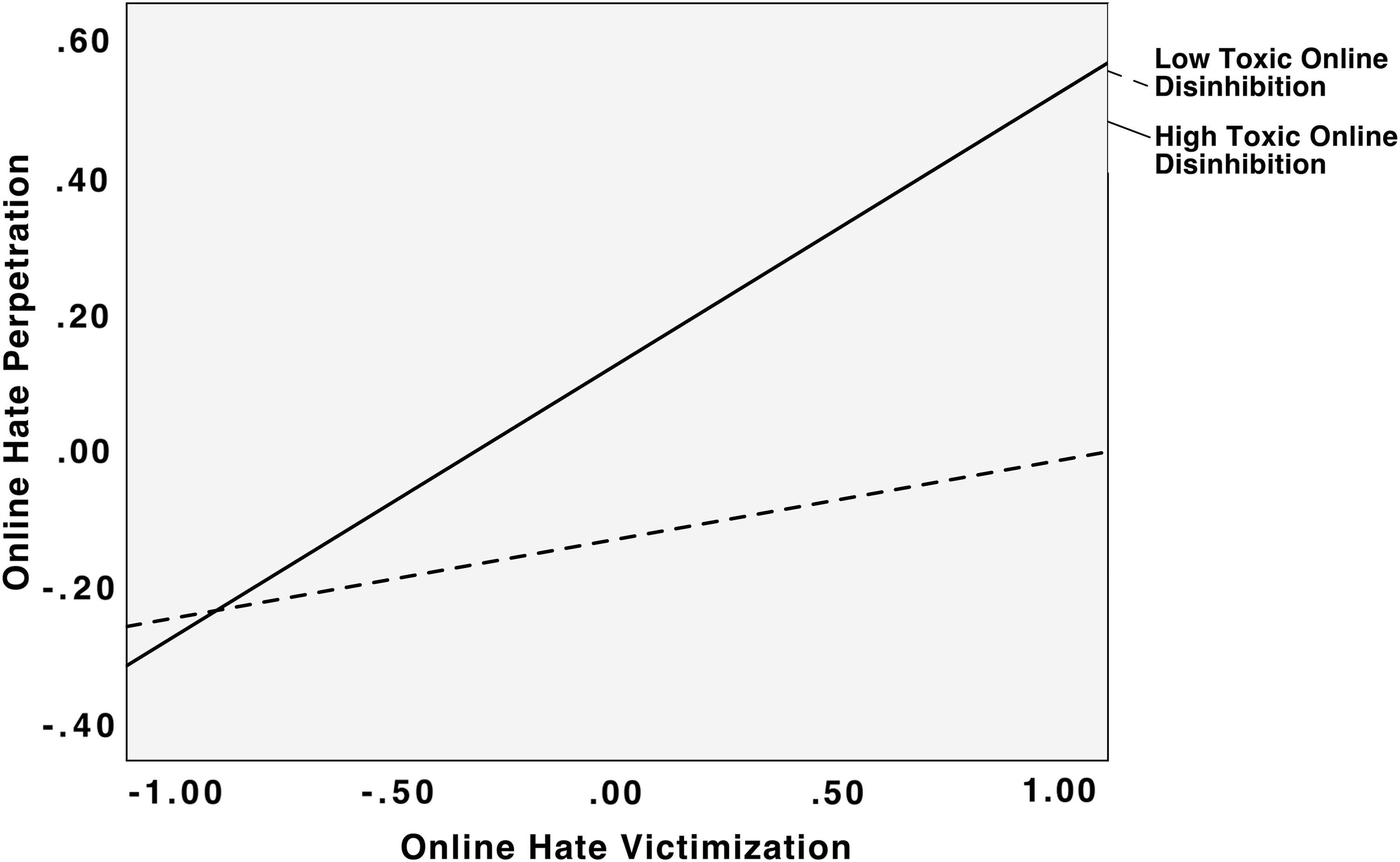
Graphical representation of the moderation of toxic online disinhibition on the association between online hate victimization and perpetration.
Sex also moderated the relationship between online hate victimization and online hate perpetration (β = 0.31, p < 0.001). The moderating effect of sex is further elaborated in Figure 2. The figure shows that online hate victimization increases online hate perpetration among both boys and girls, yet the slope for the boys (β = 0.47, p < 0.001) is much steeper than for the girls (β = 0.11, p < 0.001), suggesting that boys are more prone to perpetrate online hate when they experience victimization.

Graphical representation of the moderation of sex on the association between online hate victimization and perpetration.
Finally, we repeated the analyses using Model 3 in PROCESS to investigate a three-way interaction (moderated moderation) between online hate victimization (X), toxic online disinhibition (M), and sex (W). The three-way interaction was not significant, which suggested that the magnitude of the moderation of online hate victimization on online hate perpetration by toxic online disinhibition was not different depending on sex. More details are available from the first author.
Discussion
The present study sought to investigate (a) the association between online hate victimization and perpetration and (b) the moderation effects of toxic online disinhibition and sex on the relationship between online hate victimization and perpetration.
Approximately, every ninth participant (11.3 percent) reported having perpetrated at least one incident of online hate, and every sixth participant (16.9 percent) reported being targeted directly with online hate at least once. Compared with previous research among Finnish adolescents, 6 in the present study, the prevalence rates were higher for online hate perpetration and lower for online hate victimization. We also found some demographic differences, with boys compared with girls and older students compared with younger students more likely to perpetrate online hate.
As hypothesized, victimization and perpetration of online hate were correlated positively (H1). This finding is in accordance with previous research on online and offline aggressive behavior.13–17,40,41 It is also aligned with research on offline discrimination that has shown that experiencing discrimination can promote aggressive behavior. 19 Possible explanations for the victim–perpetrator pathway are a victim's desire for revenge, poor coping strategies, observational learning, and dynamic group processes.14,40,41 On one hand, this finding suggests that there is a need to educate adolescents that retaliation is not an adequate reaction to online hate and equip them with more appropriate coping strategies to deal with online hate victimization. On the other hand, it is important for adolescents to understand that basic human rights and democratic values apply to the online world as well. Teachers, educators, and parents can help instill these values and support adolescents.
More research is needed to understand whether the group of online hate victim–perpetrator differs from pure victims and pure perpetrators regarding internalizing and externalizing behavior problems. We suggest that the link between online hate victimization and perpetration represents a vicious cycle of victimization, leading to retaliation; however, this proposal is an assumption that requires further investigation. Longitudinal studies could help provide a better understanding of the joint and bidirectional associations between online hate victimization and perpetration over time. These studies could also include offline hate to consider potential overlaps between offline and online hate victimization and perpetration.
We also found some support for our prediction that the associations between online hate victimization and perpetration are moderated by toxic online disinhibition (H2). It has been shown that victims of online hate reported more online hate perpetration when they reported higher levels of online disinhibition and less frequent online hate perpetration when they reported lower levels of toxic online disinhibition. A possible explanation for this result might be that victims of online hate are more likely to perpetrate online hate because they feel less inhibited and are less concerned with the consequences of their actions in the online world.
Prevention measures should aim to decrease toxic online disinhibition among adolescents as a means of preventing online hate victims from becoming online hate perpetrators. Thus, adolescents need to be educated by parents and educators about how the online environment might influence their own behavior. It is also important that adolescents learn to increase their self-control, develop strategies for self-monitoring, and recognize social cues and self-reflection to reduce the effects of online disinhibition, which might thereby decrease the likelihood of online hate victimization and perpetration.
The results appear to confirm our hypothesis that sex acts as a moderator variable between online hate victimization and perpetration (H3). This finding might be explained by the less frequent use of constructive coping strategies by boys (e.g., less often support seeking) and their tendency to react more aggressively to victimization.31,33 Moreover, the findings are consistent with the research that revealed that boys are more likely to be online victims and perpetrators simultaneously.17,30 In addition, we did not find that the moderation effect between online hate victimization and toxic online disinhibition when predicting online hate perpetration was stronger for boys than for girls. Overall, our findings indicate that online hate perpetration can be best understood as a result of personal and environmental factors. Therefore, prevention programs need to address both to decrease online hate perpetration among adolescents.
Limitations and future directions
Although the present study contributes valuable insight into the associations between online hate victimization and perpetration and the moderation effects of toxic online disinhibition and sex, there are some limitations that should be addressed in future research. The study involved a cross-sectional design limiting our ability to make conclusions regarding the temporal ordering of the study's variables. Not all types of online hate are easy to detect. Some are subtler or masked as jokes, making the measurement of online hate difficult. Furthermore, not much is known about how adolescents detect online hate and which factors influence their ability to detect online hate. These circumstances might have influenced the prevalence rates obtained in this study.
The items used to measure online hate were more global items rather than specific items that address specific groups or behaviors. Therefore, we cannot clearly distinguish which form of online hate adolescents experienced or perpetrated. We also relied on single-item measurement for the assessment of online hate. Thus, typical problems with single-items measurements (i.e., degree of validity, accuracy, and reliability) cannot be precluded. Future research should overcome this limitation by developing valid scales.
Furthermore, online hate shows similarities with cyberbullying. Both forms of online aggressions are carried out to intentionally harm and devaluate a person or group by utilizing ICT. Although cyberbullying is often directed at an individual person, it can also be as online hate based on prejudicial views of minority groups. Thus, future studies on online hate should control for cyberbullying involvement and other potentially relevant control variables, such as offline discrimination, and ICT use. Finally, the present study included only German students. Thus, caution is recommended when generalizing the findings to other cultural contexts. Followup cross-cultural research is needed to understand whether the present findings are also valid for adolescents in other cultures.
Conclusion
This study examined the associations between online hate victimization and perpetration and the moderating effects of toxic online disinhibition and sex in this relationship. The results showed that online hate victimization, toxic online disinhibition, and being a boy were positively related to online hate perpetration. Moreover, the findings confirmed a moderating role of toxic online disinhibition and sex for the effect of online hate victimization on online hate perpetration. To prevent and reduce online hate among adolescents, research on developing valid scales and specific risk groups must be intensified. Given the current lack of research attention on the correlations of online hate, it is difficult to develop effective prevention programs. Considering the role of observational learning in a variety of behaviors, it is imperative that people model appropriate and positive behavior online in an effort to help reduce adolescents’ exposure and perpetration of online hate.
It is important that people across the world interact online with a peaceful and democratic coexistence that promotes collaboration and positivity versus competition and hate. Everyone should become involved in a global movement to reduce online hate by recognizing that online hate undermines our values, warranting a community-wide response.
Footnotes
Author Disclosure Statement
No competing financial interests exist.