




Abstract
Abstract
A web-based experiment (n = 960) examined how debunking of publicly shared news on social media affects viewers' attitudes toward the source who shared the fake news, their agreement with the news position, and perceived credibility of social media as a news platform. Exposure to debunking information did not lower participants' agreement with the news position, but led them to derogate (1) the source who shared the misinformation and (2) social media as a news platform. However, participants who initially favored the source were less likely to attribute the sharing of fake news to the source's dispositions, rather than situational factors, thereby maintaining their positive attitudes toward the source.
Introduction
Given the seemingly irreversible trend toward the proliferation of misinformation and fake news, researchers have pursued potential remedies by which to alleviate its negative influence. Fact-checking services, such as
Although the awareness of falsehood does not shield people from the negative influence of misinformation (i.e., continued influence effect of misinformation 4 ), the known falsehood of information may nonetheless alter individuals' evaluations of the source who publicly shared the misinformation as well as the platform through which the fake news was disseminated. Thus far, much research on (mis)information online has centered on what cognitive heuristics people rely on when judging the credibility of mediated information 5 and how various technological affordances affect such judgments. 6 Reversing the causal direction, this study investigated what would happen when people are explicitly informed that the news they have read is “fake,” and what cognitive processes might explain such effects. Considering that it is the unprecedented virality of misinformation that renders misinformation a significant threat to our society, we focused on the effects of fake news sharing, a relatively understudied area.
Study Overview
Considering that the known deception in a narrative ad induced unfavorable attitudes toward the deceivers but did not nullify the ad's effect on the attitudes toward the product, 7 one may predict that a debunking message will only negatively affect the audiences' attitudes toward the immediate source who delivered misinformation (H1a), but not those toward the debunked message itself (i.e., continued influence; H2a). Alternatively, as the target person merely shared, rather than produced the fake news, the post hoc knowledge that the news was fake may not significantly alter individuals' attitudes toward the source (H1b). Also, even if corrective information fails to nullify the influence of debunked message, it may alleviate its impact2,8 (H2b). Yet another possibility is that the effects of debunking information may not be uniformly found across individuals. In particular, receivers' prior attitudes toward the source may trigger different attribution processes, such that those who were favorably disposed toward the source may interpret fake news sharing as an inadvertent incident that commonly occurs on social media (H3), rather than a reflection of the source's dispositions as people normally would (i.e., fundamental attribution error)—that way, they can maintain their positive attitudes toward the source without experiencing dissonance. 9 Regardless, the mere awareness of the falsehood of information may lead people to blame social media for facilitating the mass diffusion of misinformation, and evaluate them to be less credible as a news channel (H4). Just as the perceived credibility of a medium affects individuals' evaluations of the message it conveys, the known falsehood of a message may, in turn, shape their perception of the medium that spreads it far and wide.
Method
A total of 960 Facebook users (541 men, age M = 38.68, SD = 11.17 years), recruited through a survey company in South Korea, were randomly assigned to a 2 (debunking: present vs. absent) × 2 (news position: pro vs. con) between-subjects design experiment. After indicating their attitudes toward several celebrities, including the target source (actor Ah-In Yoo), they viewed a mock-up Facebook page of the target. The screenshot showed Yoo sharing a news article about the “pet tax,” either favoring (“Pet tax must be levied”) or opposing (“Pet tax can't be justified”) it. The headline and the first paragraph of the news article that contained brief arguments supporting each position were shown. Yoo commented, “I'm sharing this, for people seem to be interested. This news article came out today.” Then those in the debunking condition saw another mock-up fact-checking webpage, which displayed a dashboard indicating that the article they had read was fake, along with the statement, “The story about the pet tax has been verified to be fake.” Those in the no-debunking condition did not see the fact-checking webpage. All participants completed a post-test questionnaire.
Participants' prior attitude toward the source was measured by “unfavorable (1)–favorable (6),” and “negative–positive.” The scores were averaged (r = 0.97, M = 3.55, SD = 1.26). For post-test source attitude, 10 semantic differential items were presented, including “unfavorable (1)–favorable (6),” “negative–positive,” and “immoral–moral.” Scores were then averaged (α = 0.96, M = 3.69, SD = 1.02).
To measure dispositional attribution of (fake) news sharing, participants indicated their agreement with four statements, 10 including “Sharing (fake) news on Facebook reflects who he is,” and “Posting a (fake) news article on social media was consistent with his personality” (1 = strongly disagree, 6 = strongly agree; α = 0.91, M = 4.06, SD = 1.06 [no-debunking condition]; α = 0.85, M = 3.13, SD = 1.07 [debunking condition]). Situational attribution of (fake) news sharing was measured with three items, 10 including “His act of posting (fake) news was mostly shaped by the Facebook environment” and “He shared (fake) news because he was on Facebook.” (α = 0.75, M = 3.74, SD = 1.05 [no-debunking condition]; α = 0.79, M = 3.25, SD = 1.10 [debunking condition]). An exploratory factor analysis yielded two factors, each representing dispositional and situational attribution (Table 1). To capture the extent to which participants attributed (fake) news sharing to the source's dispositions, rather than situational factors, the situational attribution score was subtracted from the dispositional attribution score (M = 0.31, SD = 1.04 [no-debunking condition]; M = −0.12, SD = 1.19 [debunking condition]).
Factor Analysis of Attribution Items
Varimax rotation.
For agreement with the news position, participants indicated their attitudes toward the pet tax policy, 11 “oppose (1)–favor (6),” “foolish–wise,” “bad–good,” and “harmful–beneficial,” plus “disagree (1)–agree (6).” The scores were reversed for those who read the news article opposing the pet tax, so higher scores indicated the degree to which participants accepted the news position (α = 0.98, M = 3.58, SD = 1.66). For perceived credibility of social media, participants rated how “credible,” “accurate,” “informative,” and “trustworthy” social media were as a news channel (1 = strongly disagree; 6 = strongly agree; α = 0.93, M = 2.61, SD = 1.03).
Results
To test whether exposure to debunking information affects individuals' attitudes toward the immediate source (H1a) or not (H1b), and if it does, how participants' predisposition toward the source moderates the attribution of news sharing, thereby altering their post-test source attitudes (H3), PROCESS macro was used 12 (Model 7). First, dispositional (vs. situational) attribution (mediator) was regressed on the exposure to debunking information (IV), participants' prior attitude toward the source (moderator), and their interaction term. Next, post-test source attitude (dependent variable) was regressed on both the mediator and the IV to assess both direct and indirect effects (Fig. 1).
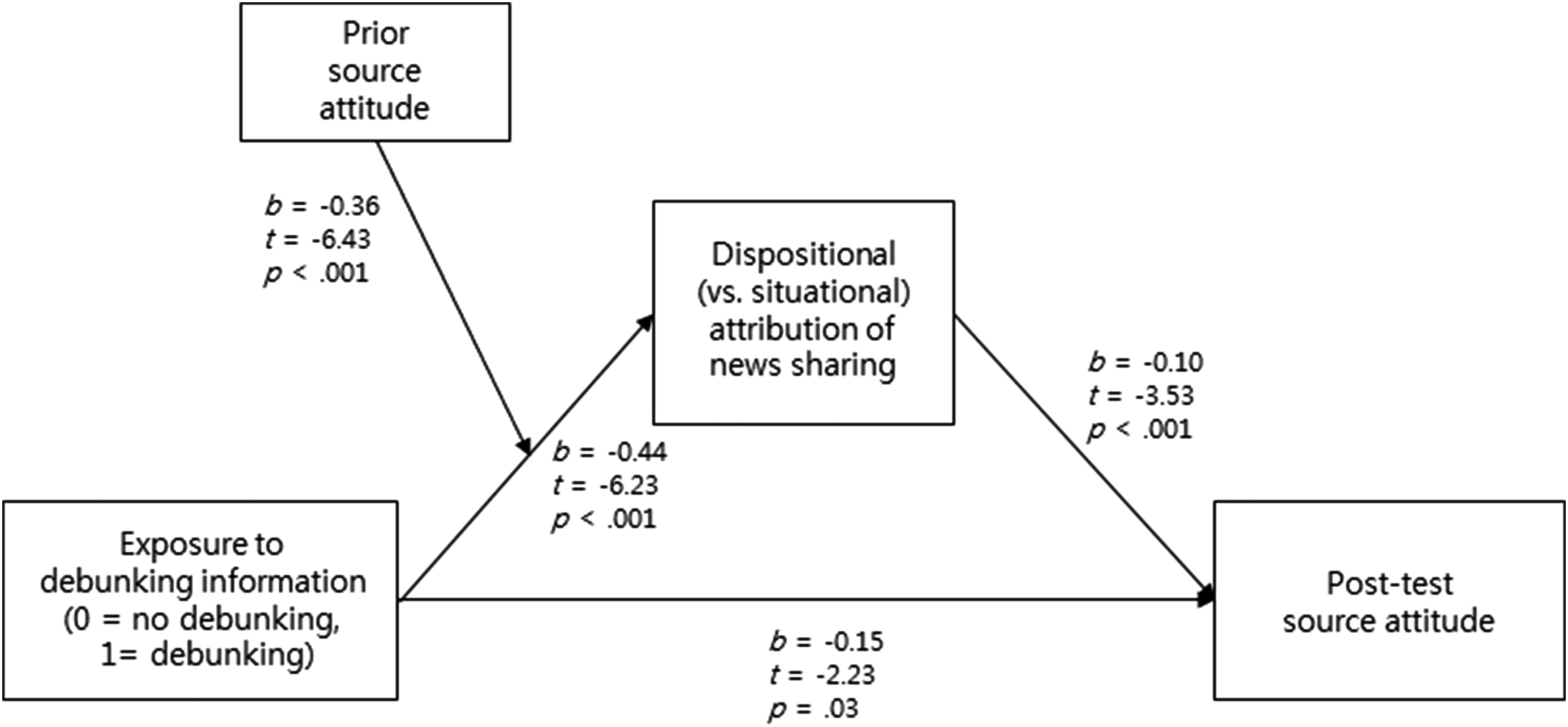
Direct and indirect effects of exposure to debunking information on post-test source attitude through dispositional attribution of news sharing: prior source attitude as a moderator.
Exposure to debunking information had a negative direct effect on post-test source attitude, as participants expressed more negative attitudes toward the source after learning that the news he shared was fake, supporting H1a. However, a significant conditional indirect effect through dispositional attribution also emerged. Exposure to debunking information negatively predicted dispositional, rather than situational, attribution but only among those who held moderately (M) or highly favorable (M + 1SD) prior attitudes toward the source (Fig. 2). The less participants attributed the sharing of misinformation to the source's dispositions, the more favorable their post-test source attitudes were, indirect effect = 0.05, SE = 0.02, 95 percent bias-corrected 5,000 bootstrap confidence interval (CI) [0.02 to 0.08] and indirect effect = 0.09, SE = 0.03, 95 percent CI [0.03 to 0.16], respectively. For those with negative prior source attitudes (M–1SD), however, exposure to debunking information did not affect their attribution, and thus, the indirect effect on post-test source attitude was not significant, indirect effect = −0.001, SE = 0.01, 95 percent CI [−0.03 to 0.02]. Therefore, H3 was supported.
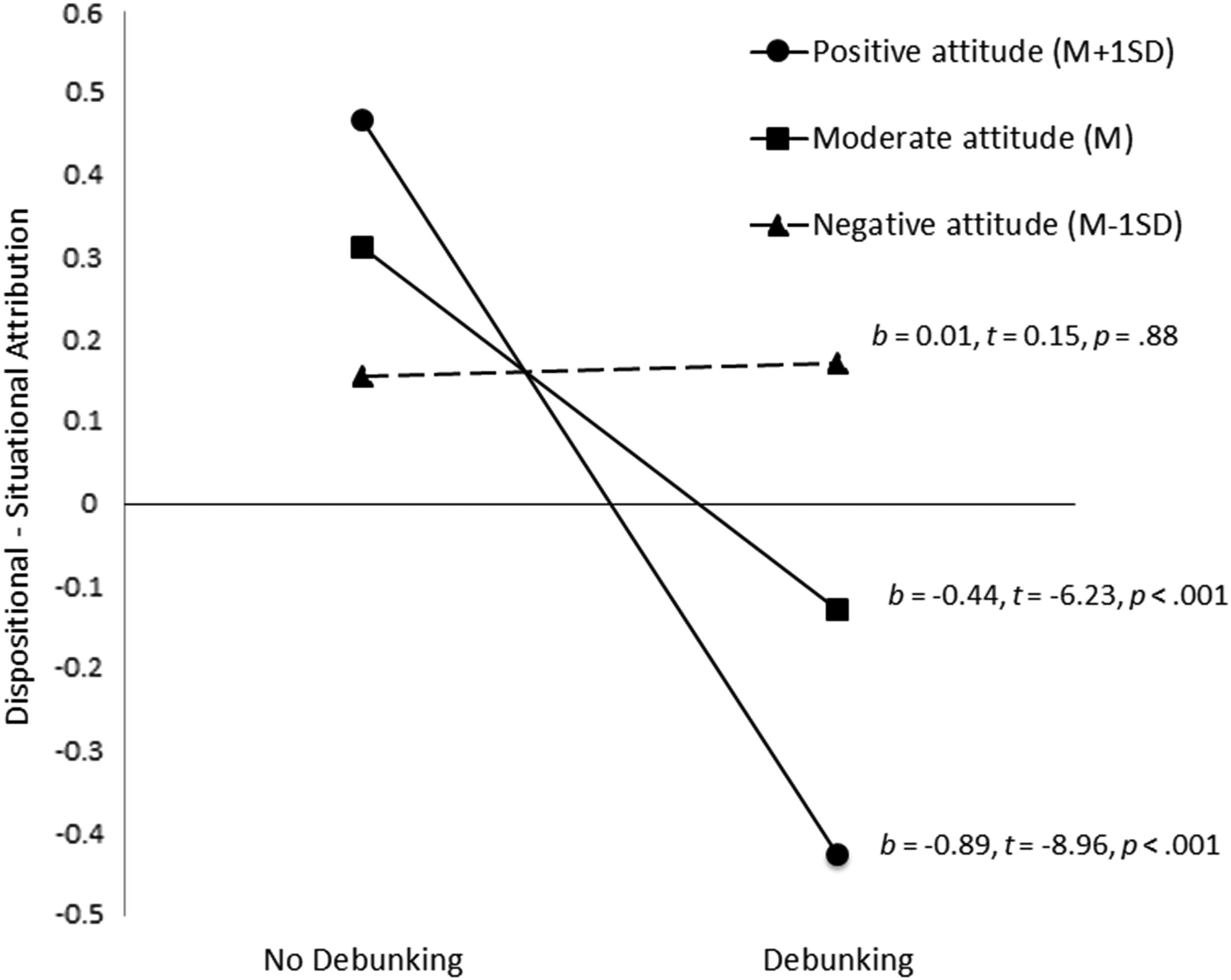
Interaction between prior source attitude and exposure to debunking information on the attribution of (fake) news sharing.
To examine if the exposure to debunking information lowers participants' agreement with the news position (H2b) or not (H2a), an independent samples t-test was performed. The degree to which participants agreed with the news position did not vary whether they saw the debunking information (M = 3.51, SD = 1.64) or not (M = 3.65, SD = 1.68), t(958) = 1.25, p = 0.21, supporting H2a. By contrast, the exposure to debunking information lowered perceived credibility of social media as a news channel (M = 2.38, SD = 0.92) as compared with the no-debunking condition (M = 2.85, SD = 1.09), t(958) = 7.20, p < 0.001. Therefore, H4 was supported.
Discussion
Overall, the results showed that when the falsehood of information was exposed, participants became less favorable toward the immediate source who shared the misinformation (H1a), but their initial source attitude also moderated their reactions by inducing different attribution processes (H3). Specifically, those who liked the source attributed the problematic behavior to the source's dispositions, presumably to avoid internal conflicts and potential dissonance, thereby espousing even more positive attitudes toward the source than when no debunking information was shown.
Consistent with the continued influence of misinformation account, 4 participants' agreement with the news position was not attenuated by the explicit post hoc correction (H2a). Considering that information is judged as truth when it meets intuitive evaluation criteria (e.g., familiarity, compatibility with existing knowledge), 13 once false information is received and integrated into one's knowledge system, debunking its falsehood may not be sufficient to undo it. Interestingly, even though people did not discount the news after learning that it was judged to be false, they rated social media to be a less credible news channel (H4).
Our findings suggest that news readers' predisposition toward the source may contribute to the difficulty of correcting misinformation. Fake news often spreads over social media through interpersonal contacts, rather than formal news agencies. As such, familiarity and liking of an interpersonal news source can make shared information seem more credible 14 and discourage people from independently validating received information. Moreover, even when the information was verified to be false, instead of revisiting their positive evaluation of the source, participants blamed the media platform instead, while strengthening their initial attitudes toward the source.
While offering some preliminary insights into what debunking of misinformation can and cannot do, this research has some limitations. First, because only one source and one news topic were considered, it remains unknown how some idiosyncratic attributes of the source and/or the news topic might have altered the findings, independently and in combination. Second, research found some post hoc corrections are more efficacious than others, such as repeating retractions or providing readily accessible factual alternatives to minimize the impact of misinformation.8,13,15 The current null effect of debunking information on the agreement with the news position may be attributable to the use of an ineffective correction strategy, demanding future research employing various debunking strategies.
Albeit exploratory, these findings suggest that individuals' perception of a medium is relatively malleable. If a single exposure to debunking information caused people to adjust their evaluation of social media as a news platform, repeated exposure to corrective information may help people develop healthy skepticism about the veracity of information they encounter on social media. To better understand the production, distribution, and consumption of misinformation, future research should adopt a more holistic approach that entails both objective and subjective attributes of the source, the medium, and the message.
Footnotes
Acknowledgments
This study was supported by the Ministry of Education of the Republic of Korea and the National Research Foundation of Korea (NRF-2016S1A5A8017749), and the Institute of Communication Research, Seoul National University.
Author Disclosure Statement
No competing financial interests exist.