




Abstract
Abstract
There is a pressing need to better understand how parents make feeding decisions for their children, but extant measures focus primarily on outcomes rather than examining the process of food choice as it unfolds. This exploratory study examined parents' translational movement as they moved throughout a virtual reality-based buffet restaurant to select a lunch for their child. Our aim was to explore whether translational movement would be related to cognitive and affective variables that underlie motivation, effort, and ultimate choices within food decision-making contexts (e.g., guilt, self-efficacy). Movement data were quantified in terms of path tortuosity: the degree of straightness of one's path while traveling through a space. Greater path tortuosity predicted a reduction in parents' guilt about their child feeding, above and beyond actual food chosen. Results suggest path tortuosity serves as an implicit measure of effort put forth by parents throughout the food decision-making process. Future work should continue to explore the utility of novel metrics that can be obtained from unique data sources, such as location tracking, for elucidating complicated behavioral processes such as food choice.
Introduction
There is a pressing need to effectively motivate parents to choose healthier foods for their young children.1–3 However, the best methods for successfully engaging and encouraging parents to make healthier feeding choices remain unclear, 4 due in part to poor understanding of how parents actually make these choices. Food choice is a complex behavioral process, composed of a large collection of microlevel decisions and behaviors.5–8 Despite evidence that examining more nuanced aspects of parental feeding can yield useful insight into how the final decision is made, 9 it remains difficult to measure and quantify these nuances. Thus, there have been calls to improve methodology for quantifying the implicit mechanisms underlying food choice, with some researchers encouraging greater use of indirect behavioral observation methods and less reliance on self-report. 6 This study explores novel behavioral measurement approaches for elucidating process-oriented aspects of parental food choice.
From a methodological standpoint, it has proven difficult to measure and quantify the many cognitive and affective aspects of parental feeding. Observational and qualitative studies provide reason to believe that a great variety of real-time factors interact throughout the feeding process, as parents internally negotiate factors such as taste, healthfulness, and child preferences,9–12 but due to methodological difficulty, the multifactorial complexities of parents' feeding decisions have been studied very rarely. Given the need for easily quantifiable and objective measures of nuanced aspects of this process, virtual reality (VR) has been introduced as a tool for studying parental food choice. VR enables the quantification of otherwise difficult-to-measure outcomes (e.g., number of calories chosen), as well as many aspects of behavior as choices are being made. The VR Buffet is a simulation wherein parents select a lunch for their child from a virtual buffet restaurant. Since its development for previous studies, it has been formally validated, affirming that parents' choices in this VR-based scenario are reflective of their choices in real-world scenarios, 13 and is now freely available for researcher use. The VR Buffet also provides abundant behavioral measures regarding the process by which parents make food choices. The data informing the current report were drawn from a study conducted with the VR Buffet. 14
One unique methodological advantage of VR is that it can track the physical movement of the user in a variety of ways, including head orientation, distance from virtual objects, and translational movement throughout the virtual space. These location-tracking data are unobtrusively and automatically collected by the equipment multiple times every second. Extant literature provides substantial evidence that quantifying physical movement may lend useful insight into implicit psychological processes occurring as decisions unfold, including in the domain of food choice.15–19 The current report explores the utility of examining translational movement (walking forward, backward; left, right) of VR users as they move throughout a virtual space to select food for their child.
Although copious data can be collected from behavior in VR environments, the raw data must be quantified meaningfully in order to be useful. One potentially insightful measure that can be derived from translational movement data is called path tortuosity. Path tortuosity is defined as the degree of straightness of one's path as s/he travels through a space. 20 The earliest and most extensive applications of path tortuosity to behavioral data have involved the analysis of animals' movement paths throughout their habitats.21–24 Kearns et al.25–28 have more recently applied a path tortuosity metric to human movement data to examine the wandering patterns of persons with dementia and traumatic brain injury; this collection of studies has shown that path tortuosity is strongly associated with cognitive functioning, namely in its relation with spatial orientation. The current study aimed to link path tortuosity with higher-level psychological variables by examining translational movement data in a decision-making context. Although translational movement has been examined in interpersonal and social scenarios,29–31 no studies have explored its role within decision-making paradigms. Given the identified links between physical movement and psychological underpinnings of dietary decision-making,16,18 we hypothesized that path tortuosity would be indicative of higher-level cognitive and affective processes in this new context.
There are a variety of metrics for quantifying path tortuosity,32,33 but the current study focuses on fractal dimension (FD). FD is well established as a reliable measure of path tortuosity, 34 and was our choice because it is the only metric to have been previously applied to human movement data25–28 ; it behaves well when applied to movement within a confined (i.e., indoor) space 32 ; and it displays low sensitivity to sample size. 32 FD is a unitless metric that typically ranges from 1 to 2. When a path is a perfectly straight line, it can be described with only one dimension (i.e., length), and thus will yield an FD of 1. In contrast, a path that is so convoluted that it fills up an entire two-dimensional plane will yield an FD of 2 (Fig. 1). 20 In rare cases, when a path is very convoluted and crosses over itself many times, FD may exceed 220; however, this is largely a theoretical case and is unlikely to be observed in healthy adult samples. Previously, FD ranging from 1.10 to 1.25 was observed in healthy adults. 27 See Craighead35(p. 4–5) for a detailed overview regarding the mathematical calculation of FD.

Examples of increasing fractal dimension (FD).
In this study we derived FD from parents' translational movement data as they moved throughout a VR-based buffet restaurant to select a lunch for their child. Our primary aim was to explore whether path tortuosity would be linked to parents' psychological states during this feeding task. Indeed, in food decision-making contexts, greater physical movement has been linked to greater cognitive effort and internal negotiation.15–19,36 In addition, it is well established that emotions—particularly guilt—play an important role in motivation, effort, and ultimate choices, especially in the domain of food choice.37–40 Similar links have emerged with cognitive variables such as self-efficacy and perceived threat.41–44 Thus, this study explored whether path tortuosity during a child feeding task would be linked to affective and cognitive variables underlying motivation and effort during decision-making.
Methods
Participants
Participants were 190 parents who were recruited through online and newspaper advertisements, flyers, databases of individuals interested in research, and by word of mouth. All participants had a biological child between 4 and 7 years of age and with no major allergies or dietary-related health conditions. All participants gave informed consent for the study and were compensated $60. All study activities were approved by the IRB of the National Human Genome Research Institute. See Table 1 for a description of the sample.
Sample Demographics
Original study procedure
Data for this report were drawn from a study whose original goal was to evaluate the effects of emotional state and framed health messages on parents' food choices for their children. 14 Participants were consented online, filled out a baseline questionnaire online, and were then scheduled to come to the laboratory for an in-person study visit. During the in-person visit, participants were reconsented and trained on how to use the VR buffet assessment. They were then presented with experimental manipulations. After these, participants filled out a short “prebuffet” questionnaire. They then completed a session in the VR buffet. Finally, participants completed a “postbuffet” questionnaire and were debriefed. See Persky et al. 14 for a more detailed description of study procedures.
VR equipment
The VR system used for the current study included an nVisor SX60 head-mounted display (HMD) and Worldviz Precision Point tracking system. Retroreflective markers attached to the HMD were used to track location as the participant traversed the room; a series of cameras detected infrared light that was emitted by the markers on the HMD. Accuracy in all dimensions ranged from 1 to 3 mm.
Measures
The VR buffet
In the VR buffet, parents were instructed to select foods and a drink that would constitute a lunch plate for their child, from among a variety of choices meant to be palatable to children and to represent a range of nutrient and calorie densities. In the current report, we utilized a variety of behavioral metrics obtained from the VR data output. First, we calculated the total servings of fruits and vegetables parents selected; this variable was relevant because parents had just undergone experimental manipulation that focused on fruit and vegetable feeding. Second, we calculated total calories on the plate; this variable, alongside fruit and vegetable servings, served as a proxy for the overall healthfulness of the plate. Third, we computed the number of unique foods placed on the plate; we included this variable due to speculation that path tortuosity would be related to variety of selections on the plate. Finally, we considered each parent's total time spent in the buffet, due to speculation that path tortuosity would be strongly related to amount of time spent in the virtual environment.
Fractal dimension
FD values were calculated from the location-tracking coordinates provided by the VR data output. The output included translational location data in the x-, y-, and z-directions. Since the y-direction represented height, it was excluded from FD analysis. Thus, translational data in the x- and z-direction were utilized to calculate FD; see Figure 2 for a visualization of these directions within the buffet simulation. Location coordinates were recorded in half-second intervals, and were expressed in meters, with [0,0] being the user's starting point in the center of the space. We used the fractaldim package in Sevcikova et al. 45 to calculate FD values.

Overhead view of the VR buffet with x- and z-axis labels.
Self-report measures
At baseline, we assessed demographic characteristics with respect to both the parent and child. We also assessed perceived child risk for obesity with a 1–7 scale (“Indicate how you think your child's chances of obesity in the future compare to the average child of his/her gender and age,” 1 = much lower than average, 7 = much higher than average), and worry about child risk for obesity with a 1–7 scale (“Indicate how worried you are about your child's chances for obesity in his/her lifetime,” 1 = not at all worried, 7 = extremely worried). In the prebuffet questionnaire, we assessed parents' levels of guilt using a 1–7 scale (“I feel guilty about my child's current eating habits,” 1 = strongly disagree, 7 = strongly agree). In the postbuffet questionnaire, we reassessed perceived risk, worry, and guilt with the same items, and assessed self-efficacy about child feeding with seven items, each on a 1–5 scale (e.g., “I am confident I can give my child healthy foods,” 1 = not at all confident, 5 = very confident).
Data cleaning and analysis
Participants were excluded from further analysis if they spent >800 seconds (i.e., 13.3 minutes) in the buffet (n = 16). Although FD was not conflated with time spent in the buffet among the full sample (r = −0.06), it was assumed that participants who spent >13 minutes in the buffet could be considered unusual cases with unrepresentative data; median time spent in the buffet was 3.6 minutes, and upon inspection of boxplots depicting time spent in the buffet, 13 minutes emerged as a sensible cut point. In addition, participants whose location data were corrupted due to equipment malfunction were excluded (n = 5). Thus, our final sample size was 169, 66 percent of whom were mothers (n = 112).
Preliminary analyses involved examining the distribution of FD among the sample, and testing for group differences in FD by demographics and experimental condition to determine the need for covariates in later analyses. We then conducted correlational analyses to investigate associations between FD and behavioral variables calculated from the VR data output, as well as self-reported cognitive and affective experience. Following the significant correlations found in this step, we conducted stepwise regression to determine the strength of association between FD and self-reported experience, above and beyond any potential confounding variables.
Results
Preliminary analyses
FD was normally distributed among the sample, M = 1.14, SD = 0.03. FD values ranged from 1.065 to 1.261 (Fig. 3). On average, participants spent about 3.8 minutes in the buffet (M = 227.59 seconds, mdn = 213.02 seconds, SD = 71.36 seconds). See Figure 4 for a histogram and QQ-plot displaying the distribution of FD, a histogram of time spent in the buffet, and a scatterplot that displays their relationship.
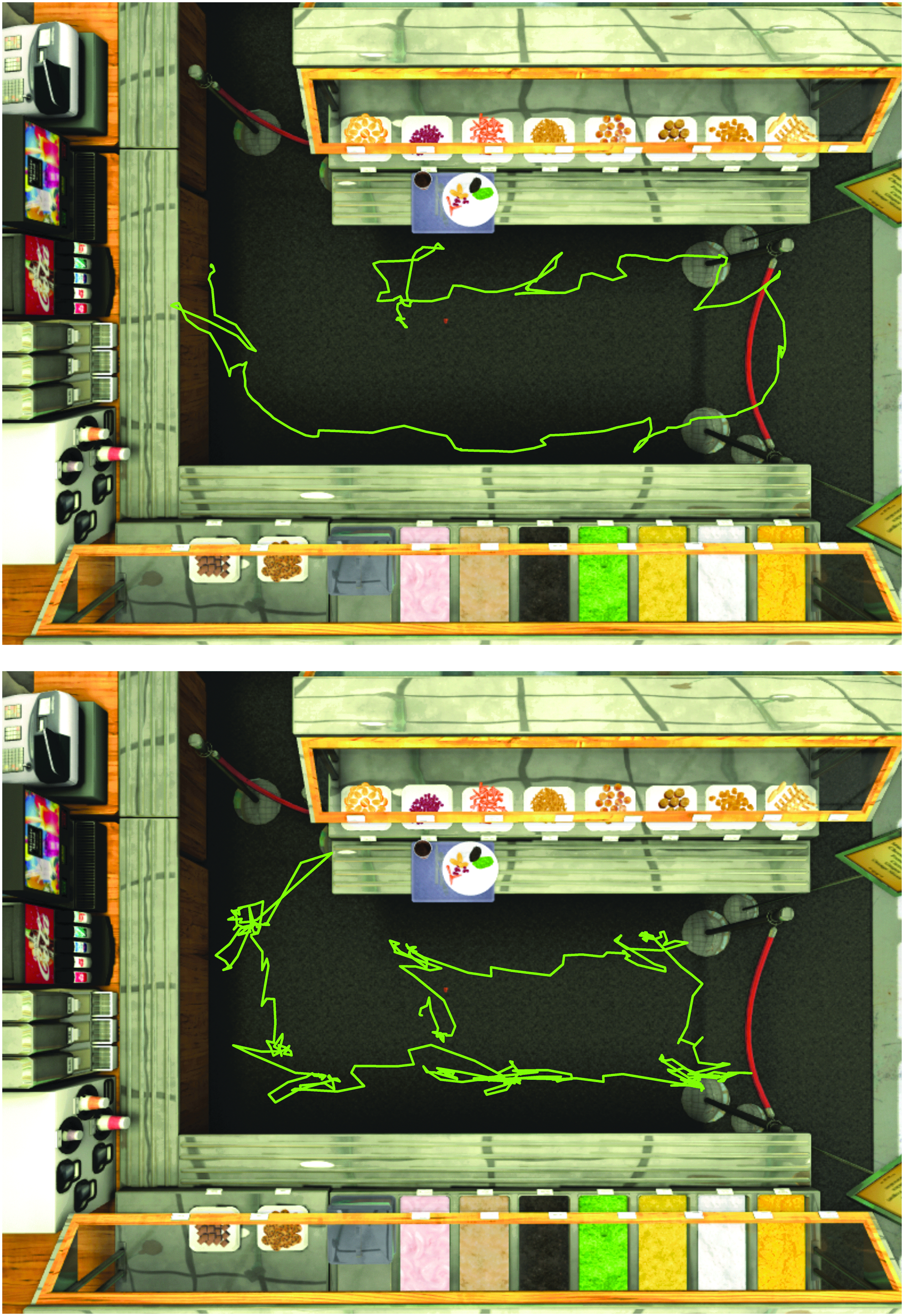
Minimum FD observed (FD = 1.065). Maximum FD observed (FD = 1.261).
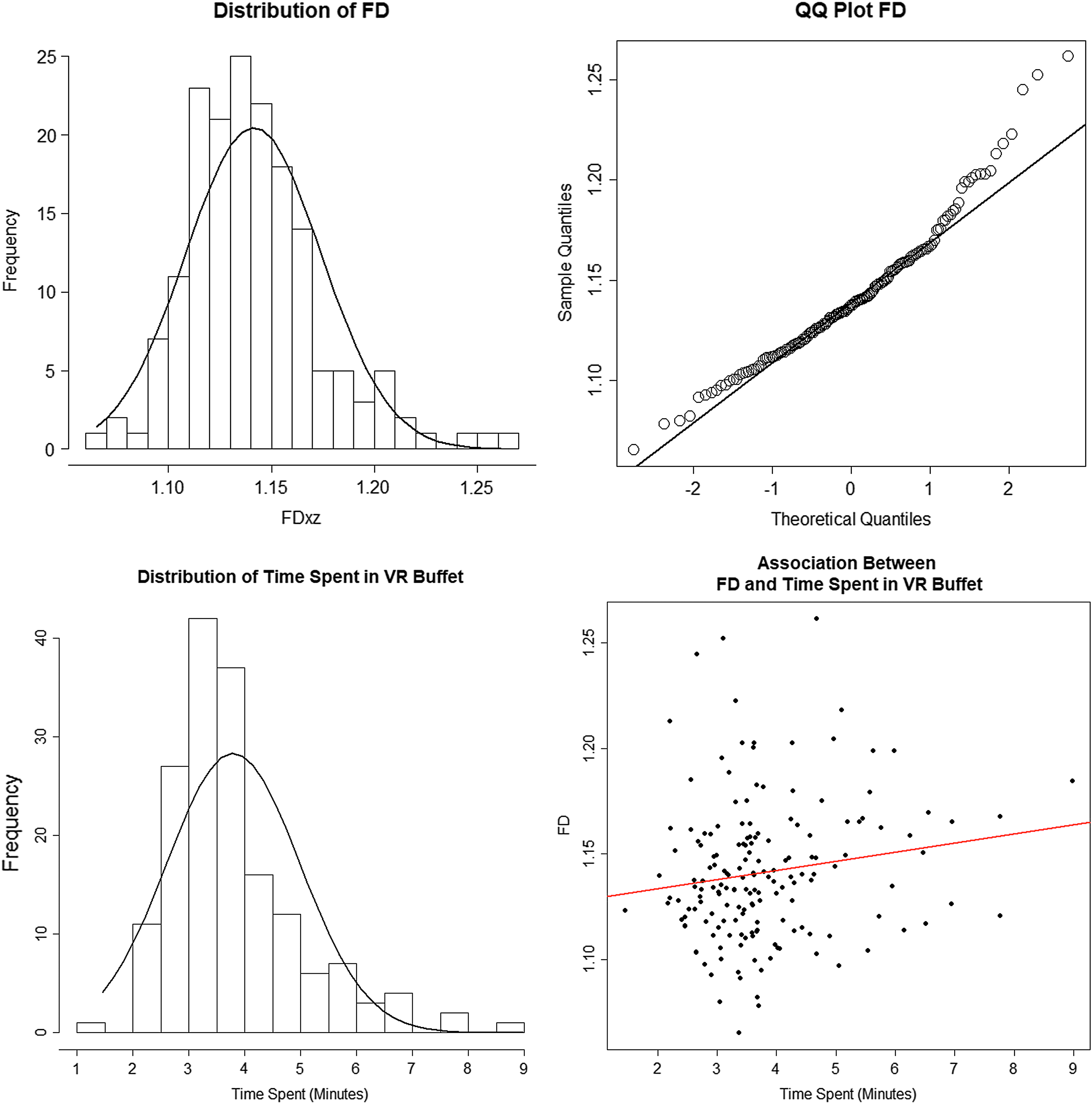
Descriptive characteristics of FD and time spent in the buffet.
We conducted correlational analyses to examine associations between FDx (i.e., FD generated by movement variability in the x-direction), FDz, and ultimate FD values that were based on both the x- and z-directions. FD was strongly positively correlated with FDx (r = 0.77, p < 0.01) and FDz (r = 0.89, p < 0.01). Notably, the strength of correlations was similar, indicating that movement variability along both axes contributed similarly to ultimate FD values.
Correlational analyses and ANOVAs revealed FD was not significantly associated with parent age, child age, parent BMI, child BMI, child gender, or parent race. An independent-samples t-test revealed significant differences in FD by parent gender, with fathers (M = 1.157, SD = 0.032) exhibiting higher tortuosity than mothers (M = 1.133, SD = 0.031), t = 4.57, p < 0.01. In addition, there were significant differences by educational attainment, with noncollege-educated participants (M = 1.160, SD = 0.045) exhibiting higher tortuosity than those who were college educated (M = 1.136, SD = 0.027), t = 2.91, p < 0.01. There were no differences in FD by experimental condition.
As a final preliminary check, we evaluated whether there were associations between FD and participants' subjective experience in the VR world. Subjective experience was measured through self-report in the postbuffet questionnaire and assessed participants' perceptions of the realism, immersivity, and feasibility of the buffet (e.g., “How much did the virtual world seem like the real world?,” 1 = not at all, 5 = extremely). There were no associations between FD and general subjective experience.
Correlational analyses
See Table 2 for results of all correlational analyses. FD was significantly positively correlated with unique foods on the plate and total calories on the plate. In addition, after the removal of outliers (discussed earlier), a moderate positive correlation emerged between FD and total time spent in the buffet. FD was significantly negatively correlated with guilt about child feeding at the postbuffet timepoint.
Correlations Among Behavioral, Cognitive, Affective Variables and Fractal Dimension
*p < 0.05, **p < 0.01.
F/V, fruit and vegetable; VR, virtual reality.
Regression analysis
Given the significant correlation observed between FD and guilt, we conducted a stepwise regression (Table 3). The dependent variable was guilt about child feeding at the postbuffet timepoint. In Step 1, FD was entered as the sole predictor. In Step 2, we added all other behavioral metrics: fruit and vegetable servings chosen, unique foods on the plate, total calories on the plate, and total time spent in the buffet. In Step 3, we added guilt about child feeding assessed at the prebuffet timepoint. In Step 4, we added parent gender and college education status, due to significant group differences in FD. In the final model, FD remained a significant predictor of lower guilt at postbuffet, β = −7.46, t = 2.34, p = 0.02.
Stepwise Regression of Path Tortuosity and Other Behavioral Variables on Parental Guilt About Child Feeding at Post-Test
p < 0.05, **p < 0.01.
FD, fractal dimension.
Discussion
This study explored the utility of applying a path tortuosity metric, FD, to parents' translational movement data as they selected food for their child. It appears that FD is a feasible metric to apply to this context; it behaved as expected across the sample and displayed a range nearly identical to the range previously observed in a healthy adult population. 27 Further confirming the suitability of the metric, logical relationships emerged between FD and other behavioral data; FD was positively correlated with total time spent in the buffet and number of unique foods chosen. Most notably, higher FD predicted less guilt about child feeding at postbuffet, above and beyond all other behavioral metrics obtained from the VR data output. This relationship was preserved even when controlling for prebuffet levels of guilt; thus, we can infer that greater path tortuosity predicted a reduction in guilt from pre- to postbuffet.
In the context of parental food choice, path tortuosity appears to be linked to affective experience throughout the decision-making process. We speculate that path tortuosity serves as a proxy for parents' level of effort put forth while choosing food. Indeed, if parents who displayed higher tortuosity felt that they had tried harder throughout their experience, it follows that they would report less guilt afterward. In addition, a link emerged between path tortuosity and variety of foods chosen; this observation is consistent with the idea that greater path tortuosity arises from greater instrumentality and “shopping behavior,” or in other words, more thought and internal negotiation throughout the food choice process.
It is also important to note that path tortuosity predicted lower guilt above and beyond total calories on the plate, as well as servings of fruits and vegetables on the plate. In other words, greater path tortuosity was related to guilt reduction even after accounting for the objective healthfulness of the food that the parent selected.
The current findings tentatively suggest that path tortuosity serves as an implicit measure of effort put forth throughout parents' food choice processes. This method presents a step toward less reliance on self-report to measure parental feeding, which some researchers have identified as a significant limitation to our understanding of parents' dietary choices for their children. 6 This method also contributes to the body of work that has established the value of motor movement for elucidating decision-making processes, and is in line with prior findings that have linked greater physical movement with greater effort and negotiation throughout decision-making tasks.15–19,36
In the current study we applied path tortuosity to the domain of food choice; the relations uncovered here will require replication and further exploration. However, behavioral researchers may also wish to explore path tortuosity in other process-oriented contexts. Future work may seek to explore the utility of path tortuosity in other VR paradigms such as education,46,47 interpersonal interaction, 48 and rehabilitation. 49 Given the capacity for VR and other emerging technologies to collect unique behavioral data such as translational movement, future work should continue to explore metrics that can be derived from such data, and that have the potential to elucidate the implicit aspects of complicated behavioral processes.
Limitations of the study also merit consideration. Most notably, the current report consists of secondary analyses of data that were collected for the purposes of a different study. Thus, our findings are somewhat inferential due to an inability to directly test whether path tortuosity is an implicit measure of effort put forth throughout child feeding. Rather than confirming that this is the mechanism underlying our results, at present we can only speculate.
In sum, this exploratory study applied FD, a metric of path tortuosity, to parents' translational movement data as they chose food for their child within a VR-simulated buffet restaurant. Results suggest that applying this metric to a food choice context may elucidate implicit mechanisms underlying the feeding process. Future work should continue to explore the utility of path tortuosity, as well as other unique metrics that can be derived from motion tracking data, in disentangling the nuances of complicated behaviors. Given the need to better understand how parents make food decisions for their children, harnessing the unique methodological capabilities of VR and other emergent technologies will undoubtedly prove useful in elucidating this complex behavioral process.
Footnotes
Acknowledgments
This research was supported by the intramural program of the National Human Genome Research Institute. The project reported here was supported by the Immersive Virtual Environment Testing Area. We thank the nTech study team, William Klein, Rebecca Ferrer, Sofia Bouhlal, Megan Goldring, and Rachel Cohen, for their roles in the development of the original study and data collection. We thank Cade McCall, Bill Kearns, Jeff Craighead, and James Fozard for editorial comments on an earlier version of this article. This study was funded by the National Institutes of Health Intramural program (Award No. Z01-HG200384-06).
Author Disclosure Statement
No competing financial interests exist.