




Abstract
Abstract
Studies examining the associations between Internet use and social skills are increasingly frequent. However, most of them only evaluate offline social skills and consider them as equivalents to online social skills. So far, no instrument allowed differentiating social skills depending on online versus offline contexts. This study aimed to develop and validate the Real and Electronic Communication Skills questionnaire (RECS), a new measure evaluating several dimensions of social skills in two different contexts (i.e., face-to-face and computer-mediated communication). Results of exploratory and confirmatory factor analyses among a sample of 657 adolescents and young adults (mean age = 17.68 years; 67% female) showed that the best fitting model for each context is a bifactor solution, with one general factor (Social Competence) and four specific factors (Sociability, Emotion Decoding, Disclosure, and Assertiveness). Each specific factor was differentially correlated with theoretically relevant subscales of the Social Skills Inventory, confirming the external validity of the RECS. The RECS is the first instrument allowing not only to assess social competence in online settings but also to quantify the relationships between offline social skills and their online counterpart. Given its ease of use and brevity, the RECS is a useful and promising instrument to capture social skills in both online and offline contexts.
Introduction
Is it possible to be more sociable when interacting with a friend on Facebook rather than face-to-face (FtF)? Since the rapid spread of the Internet, a growing number of studies suggested that social skills may be expressed differently when people interact in online versus offline contexts. Indeed, many theories suggest that a distinction should be made between offline and online social interactions. FtF and computer-mediated communication (CMC) contexts differ from each other, for instance, in terms of their number and type of cue systems (e.g., verbal, nonverbal, or paraverbal), their degree of instant feedback, or in terms of the personal focus they require from the user (e.g., amount of time to formulate a response; Ref. 1 ). Consequently, a person could be more (or less) socially skilled depending on whether he or she communicates FtF versus through CMC.
Given that social skills are considered context sensitive,2,3 their assessment among Internet users would be comprehensive by addressing not only the context of FtF interaction but also the context of CMC. Surprisingly, the majority of studies exploring the associations between Internet use and social skills used measures intended for either FtF (e.g., Refs.4–8 ) or CMC interactions (e.g., Refs.9–11 ). Only a few studies evaluated specific social skills, such as self-disclosure, in both contexts simultaneously (e.g., Refs.12,13). The purpose of this study was to fill this gap by developing a self-report questionnaire, the Real and Electronic Communication Skills questionnaire (RECS), which simultaneously assesses multiple dimensions of social skills in both FtF and CMC contexts.
Dimensions of social skills
One major difficulty in developing a measure of social skills resides in the relatively broad definition of this construct. Indeed, the conceptualization of social skills varies drastically depending on the research area (psychology, sociology, medicine, management, etc.), or on the school of thought. 14 Given the lack of a universal definition of this concept, our approach consisted of selecting the most important dimensions of social skills that occur within both FtF and CMC contexts. Hence, these dimensions mainly focus on interpersonal relationships, thereby excluding other concepts that are also considered social skills (e.g., self-management, academic, or compliance skills; Ref. 15 ). In line with a recent review of literature by Reich, 16 we found that the following six dimensions were frequently used in previous research examining social skills in FtF and CMC contexts: (1) Assertiveness, (2) Initiation of Interactions, (3) Self-disclosure, (4) Sociability, (5) Expression of Emotions, and (6) Emotion Decoding. From a theoretical point of view, these skills are considered essential ingredients for good interpersonal relationships in both online and offline contexts. Even if their expression is context dependent, 2 their function remains the same regardless of the environment within which social interactions take place. Specifically, these skills allow people to create new interactions, to maintain and manage these relationships, and, more generally, to communicate appropriately. 17
Assertiveness
The definition of assertiveness includes two response classes: positive assertion and negative or conflict assertion. 18 Positive assertion includes aspects such as the expression of positive emotions, the acceptance of compliments, or the ability to initiate, sustain, or terminate social interactions. Negative or conflict assertion consists of making reasonable requests, asking others to change their behavior, or expressing disagreement. In this study, we considered the components of initiating interactions (for positive assertion), as well as the aspects of giving personal opinions even if they are unpopular, expressing disagreement, and refusing unreasonable requests (for conflict assertion).
Initiation of interactions
The ability to initiate interactions consists of taking the initiative of starting a new interaction with someone (e.g., speaking to a stranger and suggesting to a friend to engage in a new activity). As this skill involves some components of initiative, it was frequently considered a response class of assertiveness in different theoretical conceptualizations19–21 and in various assertiveness inventories.22,23 However, factor analyses carried out by Buhrmester et al. 24 on several domains of interpersonal competence indicated that skills of initiation and conflict assertion are relatively independent constructs. Given this assumption, we considered them as separate skills.
Self-disclosure
In line with Tardy and Dindia, 25 we considered self-disclosure as the intentional divulgation of personal information by verbal means, that is, a behavior that implies taking a certain amount of risks. Specifically, we focused on the disclosure of highly risky information by examining the “core layer” of self-disclosure, namely the divulgation of intimate information about self (e.g., values, needs, fears, and personal beliefs). 26
Sociability
Sociability refers to the tendency to prefer affiliating and interacting with others instead of being alone. It involves the ability to enter a peer group and to integrate one's behavior with the ongoing activity, including meeting strangers and making new friends.17,27
Expression of emotions and emotion decoding
Our last two dimensions of interest—expression of emotions and emotion decoding—are considered subcomponents of the broader construct of emotional intelligence. 28 These concepts represent one of the most elementary forms of communication. 29 Contrary to the dimensions presented above, expressing and decoding emotions are predominantly based on nonverbal or paraverbal cues, such as facial expression, tone of voice, or bodily movements. For these reasons, these two dimensions are usually studied in the realm of nonverbal behavior. 30
Methods
Participants and procedure
Two samples of adolescents and young adults were used in this study (N = 657). Sample 1 (n1 = 358; 81.7% female) allowed us to identify the factor structure of our initial 100-item questionnaire and to select the best fitting items for the final form. This sample was composed of participants recruited among apprentices and university students in the French-speaking part of Switzerland. Their mean age was 21.66 years (SD = 3.84 years; 90% confidence interval range = 18–28 years). Sample 2 (n2 = 299; 49.8% female) was used to confirm the factor structure of the final form of the RECS. It was composed of adolescents recruited in French-speaking middle schools with a mean age of 12.93 years (SD = 0.86 years; 90% confidence interval range = 12–14 years). Finally, we used the total sample of this study (N = 657; 67% female) to assess internal consistency as well as external validity of our measure. Mean age for the total sample was 17.77 years (SD = 5.23; 90% confidence interval range = 12–26 years). Most respondents reported using the Internet every day for private purposes (72.2%) and to communicate online with people they had previously met offline (81.6%). In line with socioeconomic levels generally observed in Switzerland, 31 socioeconomic status measured with the Indice de Position SocioEconomique 32 indicated that 58% of the participants came from middle to upper class families. Our study was conducted in compliance with the Ethical Code of the Swiss Psychological Society.
Measures
Real and electronic communication skills questionnaire
The initial version of the RECS consisted of a 100-item questionnaire and comprised two subscales referring, respectively, to FtF and CMC contexts. First, the Real Communication Skills (RCS) subscale aimed to evaluate dimensions of social skills as used in FtF social interactions. Second, the Electronic Communication Skills (ECS) subscale focused on the evaluation of the same dimensions of social skills, but as used in text-based, CMC social interactions. Each subscale assessed the following six dimensions of social skills: (1) Expression of Emotions, (2) Emotion Decoding, (3) Sociability, (4) Initiation of Interactions, (5) Self-disclosure, and (6) Assertiveness. Items for each dimension were either created or derived from existing instruments, assessing social skills in FtF contexts. Specifically, items of the Assertiveness dimension were developed on the basis of the Rathus' Assertiveness Schedule23,33 and the Assertiveness subscale of the Questionnaire about Interpersonal Difficulties for Adolescents. 34 Items of the Initiation of Interactions dimension, of the Sociability dimension, and of the Expression of Emotions and Emotion Decoding dimension were, respectively, inspired by the Initiation subscale of the Interpersonal Competence Questionnaire, 24 by Cheek and Buss 27 Sociability scale, and by the Positive and Negative Expressivity subscales of the Berkeley Expressivity Questionnaire. 35 Responses were rated on a 5-point Likert scale (1 = strongly disagree, 5 = strongly agree).
Social Skills Inventory
The Social Skills Inventory (SSI)36,37 is one of the most widely used questionnaires for evaluating basic social skills. This 90-item questionnaire assesses three dimensions of basic social communication skills (expressivity, sensitivity, and control) on two levels (emotional and social), for a total of six subscales. The dimensions of expressivity, sensitivity, and control refer to sending, receiving, and monitoring messages, respectively. The emotional level concerns nonverbal messages dealing with affects, attitudes, and status, whereas the social level relates to verbal messages, social discourse, and social norms. Responses were rated on a 5-point Likert scale (1 = not at all like me, 5 = exactly like me). In this study, Guttman–Cronbach's alpha was 0.82 for the total scale and ranged from 0.67 to 0.85 for the different subscales. We used this measure to examine the nomological validity of RECS subscales and to investigate the associations of different social skills with RECS dimensions.
Analysis strategy
First, we performed two principal components analyses (PCAs) on Sample 1: the first one allowed us to explore the factor structure of each subscale and to identify their most informative items; the second one allowed us to examine and describe their new structure. Second, we conducted a confirmatory factor analysis (CFA) on Sample 2 to confirm the factor structure of our two subscales, and to identify the best structural model for the whole instrument. We assessed the internal consistency reliability for the dimensions of each subscale using Guttman–Cronbach's alpha38,39 and McDonald's 40 omega coefficients. Finally, we tested the nomological validity of the RECS by comparing its dimensions with dimensions of the SSI. Analyses were performed using R-Software 3.1.0. 41
Results and Discussion
Principal component analyses
To identify latent factors for each of the two subscales of the RECS, we performed PCAs with varimax rotation on Sample 1. The Kaiser–Meyer–Olkin (KMO) values were excellent for the RCS (KMO = 0.83) and the ECS (KMO = 0.88), indicating sampling adequacy and good factorability of both subscales.
As a first step, we roughly refined the initial item pool. For the first PCA, we examined the scree plots to decide on the number of factors to extract. Contrary to the hypothesized six-factor structure, the scree plots suggested a four-factor solution for both RCS and ECS subscales. These four-factor solutions accounted for 33% and 38% of the variance, respectively. In both subscales, our expected dimensions of Self-disclosure and Expression of Emotions were merged into a single factor named Self-disclosure. This is congruent with a somewhat broader definition of self-disclosure that includes the disclosure of feelings. 25 The dimensions of Sociability and Initiation of Interactions were also grouped into a single Sociability factor. Indeed, initiation of interactions can be considered a specific part of the broader concept of sociability, as it is often a necessary first step to achieve the exploratory activity inherent in the sociability concept. To summarize, the final four factors for each subscale were labeled as follows: (1) Sociability, (2) Self-disclosure, (3) Emotion Decoding, and (4) Assertiveness.
As a second step, we reduced the number of items of each subscale by selecting those with the highest loading on each factor, thereby excluding items loading on more than one factor (cross-loadings) or items loading on unexpected factors. Among the items meeting these criteria, we selected those that had corresponding items in both subscales (RCS and ECS). Each factor consisted of five items, except for the Assertiveness factor, which included only three items because of a large number of cross-loadings. In sum, the final version of the RECS is a 36-item questionnaire and composed of two subscales: one assessing social skills in FtF contexts (RCS) and the other in CMC contexts (ECS; see Supplementary Data). Each subscale consists of 18 items mirroring the items of the other subscale and measuring four dimensions of social skills (i.e., Sociability, Self-disclosure, Emotion Decoding, and Assertiveness).
Finally, we ran PCAs separately on each subscale to examine their new structure. Results are presented in Table 1. As these 18-item forms were intended to be the final ones, we used several statistical procedures to determine the optimal number of factors to extract the following: scree plots, Horn's parallel analysis, and the Very Simple Structure procedure. 42 All three methods converged on a four-factor solution for each subscale. The varimax-rotated solutions explained, respectively, 51% and 48% of the variance for the RCS and the ECS.
Varimax Rotation of the Four-Factor Solution of the Real and Electronic Communication Skills Questionnaire
Note: Factor loadings ≥0.32 are in boldface.
Item scale: 1 (strongly disagree) to 5 (strongly agree).
Reverse scored item.
ECS, Electronic Communication Skills; RCS, Real Communication Skills.
Confirmatory factor analyses
To confirm and clarify the internal structure of the RECS, we conducted a CFA on Sample 2. First, we compared alternative models for both subscales of the RECS. Model 1 represents the four independent factor model (Sociability, Self-disclosure, Emotion Decoding, and Assertiveness). Model 2 allows latent factors to covary. As the explained variance in our PCAs was not very high (∼50%) and given that the communalities of the items were sufficiently important, we assumed the existence of a general construct for each subscale. This led us to examine two alternative models (Models 3 and 4). Model 3 supposes a hierarchical structure with a second-order general factor, whereas Model 4 is a bifactor model in which a general latent factor underlies all of the items, alongside four domain-specific factors (Sociability, Self-disclosure, Perception of emotions, and Assertiveness), which underlie four subsets of items. The second-order model (Model 3) differs from the bifactor model (Model 4) in that the former assumes that the domain-specific factors are correlated, and that the higher order factor accounts for the relationship between the lower order factors. 43 Conversely, the bifactor model (Model 4) supposes that the general factor accounts for the communality of the items, and that each specific factor accounts for unique variance in its own set of items.
The fit indices for these four models are presented in Table 2. The bifactor model (Model 4) provides an excellent fit for both subscales. Our results also indicate that the bifactor models provide a statistically significant improvement in terms of degrees of freedom and model chi-square in comparison with the alternative models. These results confirm the four-factor solution based on the exploratory factor analysis of each subscale, and suggest the existence of a general factor accounting for the specific context of each subscale. The general factors of the RCS and ECS represent the general constructs of offline and online social competence, respectively.
Fit Indices of Alternative Structural Models of the Real and Electronic Communication Skills Questionnaire
p < 0.0001.
CFI, Comparative Fit Index; RMSEA, Root Mean Square Error of Approximation; SRMR, Standardized Root Mean Square Error of Approximation.
After identifying the best structure for each subscale, we compared alternative models of relationships between these subscales. Model 5 (Table 2) assumes complete independence between both subscales. Model 6 allows each group factor of a subscale to covary with the similar group factor of the other subscale (e.g., the Sociability factor of the RCS was allowed to covary with the Sociability factor of the ECS), whereas Model 7 allowed an additional covariance between the two general factors. Only Model 7 showed acceptable fit, with satisfactory RMSEA and SRMR values. Comparative Fit Index (CFI) value was lower, but incremental fit indices such as the CFI are known to penalize slightly distorted models, when their main loadings are lower than 0.70, which is the case with our data. 44 In addition, compared to the alternative models, Model 7 presented a statistically significant improvement in terms of degrees of freedom and model chi-square. To summarize, the total structure of the RECS matches our expectations in that each latent factor estimated in one context—be it a general or a specific factor—shares some common variance with the same latent factor estimated in the other context (Fig. 1). Moreover, each general and specific factor seems to have some core characteristics that are expressed differentially depending on the context. This is congruent with the idea that interactions are determined conjointly by personal characteristics (e.g., social skills, motives, or attitudes) and by contextual parameters (see, e.g., Ref. 45 ).
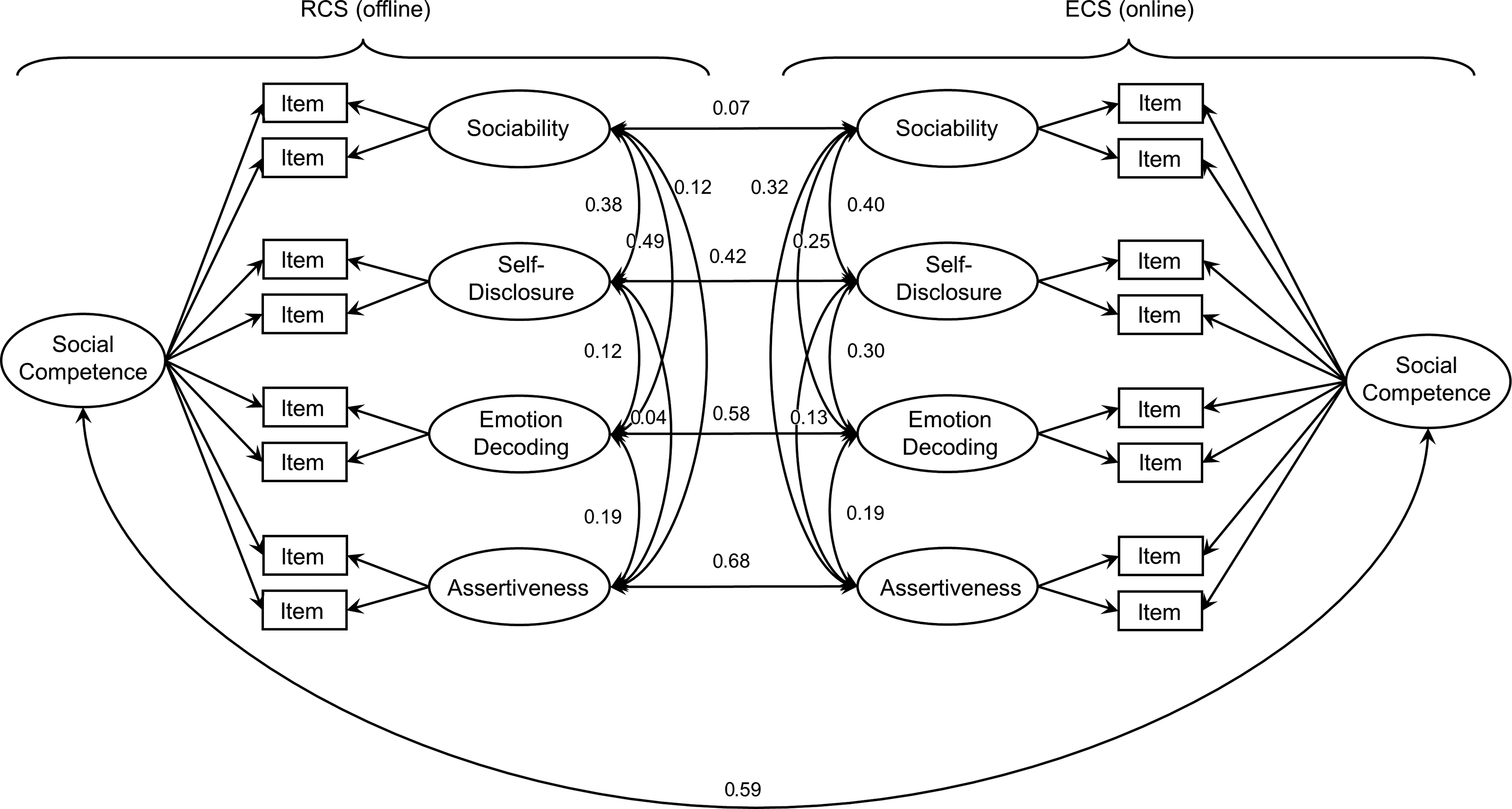
Standardized coefficients for the relationships between both bifactor subscales of the RECS. For clarity reasons, all 36 indicators (items) do not appear in the figure, but their position is shown schematically. ECS, Electronic Communication Skills; RCS, Real Communication Skills.
Internal consistency
Reliability indices were good for the whole RCS and for its dimensions (Table 3). For the whole ECS, reliability indices were equally good, with indices of some dimensions somewhat lower (e.g., Assertiveness). Knowing that the alpha is always lower in scales with few items, these relatively low levels are acceptable. 46
Internal Consistency Reliability and Correlations between the Real and Electronic Communication Skills Questionnaire and the SSI Subscales
Note: n = 200.
In bifactor models, this coefficient refers to McDonald's 43 omega total coefficient, which represents the variance of each subscale that is explained by the general and domain-specific factors.
p < 0.05 (Bonferroni adjusted).
EC, Emotional Control; EE, Emotional Expressivity; ES, Emotional Sensitivity; SC, Social Control; SE, Social Expressivity; SS, Social Sensitivity.
Nomological validity
The correlations between the two subscales of the RECS and the six subscales of the SSI are shown in Table 3. The total scores of the RCS and ECS have both positive and large statistically significant correlations with the total score of the SSI, which denotes a good relationship between RECS' subscales and basic social skills. Moreover, we found that each dimension of the RECS has a differential relationship with the subscales of the SSI. Each subscale of the RECS had the highest correlations with a theoretically relevant subscale of the SSI: Sociability was linked with Social Expressivity, Disclosure with Emotional Expressivity, Emotion Decoding with Emotional Sensitivity, and Assertiveness with Social Control. Finally, the various dimensions of the SSI were more strongly correlated with the RCS subscales than with the ECS ones. This result is not surprising as the SSI measures social skills in FtF interactions.
Conclusion
The purpose of this study was to develop and validate a multidimensional measure of social communication skills applicable to CMC and FtF contexts. The RECS has been subject to a thorough and stringent validation procedure, and the final form of the questionnaire showed good psychometric properties. Its complex factor structure allowed accounting for both individual and contextual factors. Internal consistency indices were satisfactory, given the conciseness of the questionnaire. The external validity of the RECS and its different subscales, as measured by the correlations with the SSI, was also good and confirmed the place of the RECS in the nomological network. Thus, the results of this study provide preliminary evidence of the factorial, reliability, and nomological validity of the RECS. Although promising, this study is limited. First, given that Sample 1 was mainly composed of females (81.7%), we cannot exclude that the initial item selection was biased. In fact, previous research has shown that females are more likely to view affectively oriented social skills as slightly more important compared to males. 47 Nevertheless, the structure of the RECS has been confirmed by the CFAs using the more balanced Sample 2. Second, given that this study was conducted in the French-speaking part of Switzerland, it is unclear to what extent the use of the RECS could be generalized to other cultural contexts.
Today, many adults assume that youth are necessarily experts in new Internet technologies, but there is important variation in adolescents' experience and use. 48 Despite these differences, interactions between adolescents are increasingly mediated through new Internet technologies. 49 This increase of online peer interactions has generally led to growing concerns about the effects of the Internet on young people's socialization. 50 The evaluation of these effects should not be limited to a single aspect of socialization, but should be considered more broadly. In a recent literature review, Reich 16 points out that, to date, no study investigated social competence in online spaces, nor identified links between online and offline social competence. The RECS is the first questionnaire allowing a one-to-one comparison of several dimensions of social skills in FtF versus CMC contexts. In addition, questions arise as to whether online social competence may be transferred to offline social competence, or whether different contexts (i.e., online and offline) may be associated with differences in patterns of social competence. 51 In this regard, the RECS is the first tool to create a bridge between the overarching constructs of offline and online social competence, as well as to quantify the relationship between offline and online social skills. As young people keep being more and more connected, 52 this bridge may allow future studies to investigate the importance of social competence in online contexts.
Footnotes

References
Supplementary Material
Please find the following supplemental material available below.
For Open Access articles published under a Creative Commons License, all supplemental material carries the same license as the article it is associated with.
For non-Open Access articles published, all supplemental material carries a non-exclusive license, and permission requests for re-use of supplemental material or any part of supplemental material shall be sent directly to the copyright owner as specified in the copyright notice associated with the article.
