




Abstract
Abstract
Help-seeking use of social media continues to demonstrate a therapeutic potential for improving health outcomes. This scoping review explores the outcomes associated with the use of social media by young adults experiencing suicidal ideation. It incorporates a therapeutic affordance framework. A meta-synthesis method was applied to elicit themes related to therapeutic affordances from each of the included articles. The five therapeutic affordances that emerge from the thematic analysis are as follows: (a) connection, the practicality of being able to connect with peers or professionals, (b) exploration, the ability to explore and gather information for oneself or others, (c) narration, the ability to tell one's story, (d) collaboration, the ability to interact and collaborate with others, and (e) introspection, a personal and internally reflective process, and perspective. A reduction in suicidal ideation for users was found across the majority of studies (n = 9). Few studies reported negative outcomes (n = 3), while others were exploratory and considered the experiences of suicide-related social media users (n = 3). Existing literature supports the first four therapeutic affordances, while introspection is potentially unique to the young adults experiencing suicidal ideation group. The included studies present considerable heterogeneity in participant ages, making it difficult to draw unique and significant conclusions about young adults experiencing suicidal ideation.
Introduction
Suicidal ideation is a significant public health issue globally and has been linked to an increased risk of suicide,1–5 and suicide attempt.6,7 Social media represent a help-seeking potential for young adults with various health or social issues.8–10 Social media such as social networking sites, blogs, and photo sharing sites are tools that promote user-generated content and interaction; and can result in the formation of online support, sharing of knowledge and experiences, and development of new online communities. 11 This presents an opportunity for mental health practitioners wishing to guide consumers toward evidence-based support. 12 A therapeutic affordance perspective offers an emerging conceptual framework that enables the development of such an evidence base, through analysis of the possible actions and opportunities latent within a social media environment, 13 for example, self-presentation, connection, and narration. Accordingly, the following scoping review seeks to explore the existing research in this domain. It proposes a list of therapeutic and nontherapeutic affordances that may underpin these experiences.
Background
Suicide and suicidal ideation
Suicide and suicidal ideation represent significant public health issues, with 800,000 deaths by suicide recorded globally each year. 14 The age-standardized rates of suicide (deaths per 100,000 population) for 2016 demonstrate a variability between countries, Greece, 3.8; United Kingdom, 7.6; Singapore, 7.9; China, 8.0; Australia, 11.7; South Africa, 12.8; United States of America, 13.7; Japan, 14.3; India, 16.5; and Russian Federation, 26.5, as reported by the World Health Organization. 15 Moreover, the population lifetime suicidal ideation rates are similarly heterogeneous, Australia, 13.3 percent 16 ; Ireland, 14.6 percent, Finland, 9.8 percent, Britain and Norway, both 7.4 percent; Spain, 2.3 percent 17 ; China, 3.1 percent; Japan, 10.9 percent; and New Zealand, 15.9 percent. 18
Help-seeking rates remain disturbingly low, with only 40 percent for those who had died by suicide, 19 and 40 percent of participants living with suicidal ideation 16 having accessed traditional, professional support, e.g., general practitioner.
Social media
Social media have turned the Internet into an interactive, participatory, collaborative, and interpersonal medium,11,20 and are increasingly fundamental to the communication needs of people and organizations, allowing them to share thoughts, opinions, experiences, and information, or to develop new online communities and supports.21–23 Examples of social media include social networking sites, video and photo sharing platforms, online support groups, blogs, wikis, and virtual environments, as well as earlier predecessors such as chat rooms, message boards, and discussion forums. Social media enable people to connect and communicate with others.13,21,24
Social media and help-seeking
There is extensive literature exploring the role of social media in various health and mental health help-seeking domains. Bourgeois et al. 24 found that actions such as checking Facebook daily was associated with a greater sense of fitting in and being connected to self or their peers. Webbers and Moors 10 explored communication in an online sexual assault-related forum and found that professional contributors consistently provided systematic responses related to advice, reflection, and specific information about resources available. Comparatively, the responses from the general online community lacked both detail and information.
Hether et al. 25 found participants trust in pregnancy-related social networking sites, to be positively associated with feeling happier about their pregnancy and adhering more closely to the recommendations found on the sites. Similarly, there were positive relationships between perceived social support in the sites, the desire to remain healthy throughout pregnancy, pursuing further information about posts they read, and adhering to the recommendations gained from the sites. They also reported that provision of support in the social networking sites was more positively associated with beneficial outcomes than it was for those who were help-seeking and support receiving. These examples of help-seeking use of social media increasing pose an alternative to the traditional form of one-way service delivery to a consumer. 25
Examining help-seeking social media use for stigmatized issues, including suicidal ideation, Belfort 26 discusses a case study of an adolescent's expression of suicidal intent on Facebook within the context of cyberbullying and compulsive social media use, and it being discovered by their mother. Following the discovery, the adolescent was taken to the local emergency department resulting in a voluntary admission to an adult inpatient psychiatric facility, where they received treatment for their suicidal ideation. In this context, Luxton et al. 21 discuss the potential means by which social media could lead to increased suicides, noting cyberbullying, suicide pact development, access to prosuicide information, media contagion, and peer pressure. They also discuss the many positive examples of suicide prevention efforts made possible by social media, including reporting cyberbullying buttons, the proliferation of suicide prevention groups and resources available online, and opportunity for people to anonymously describe their experiences in online settings linked to support agencies. These authors suggest the need for further research to examine the positive and negative influences of social media on suicidal behavior. 21
The role of social media in supporting people with suicidal ideation creates an opportunity for mental health practitioners seeking to guide consumers toward known evidence-based support. 27 There are concerns for the vulnerability of different populations, with some28–31 arguing that these sites or communities pose more risks than benefits, and too easily lead to the development of suicide pacts. Arguably, social media use presents both risks and benefits that need to be considered.9,32,33 However, what is lacking is an evidence base that allows for meaningful comparisons to be made of social media, to then guide suicidal consumers toward those with an established therapeutic benefit.
Therapeutic affordances of social media
To better understand how social media platforms can influence the experiences of their users, the theoretical concept of affordances has demonstrated potential.13,34,35 An affordance perspective began in ecological and behavioral psychology, referring to the possible actions and opportunities that exist in the relationship between an individual and their environment. 36 Affordances are varied and driven by the actor's perceptions, needs, and motivation, as well as their class or cultural groups. 37
Research surrounding human-computer interaction has evolved over many decades in the wake of advances in technology, with the focus shifting from the physical structures and tasks situated in human-computer interaction to include the cognitive and psychological aspects influencing technology users, or the perceived affordance.38–40 Perceived affordances are increasingly important as technology becomes more immersive and ubiquitous within our daily lives, for example, through portable devices, wearable technology, and social media.
Social media provide unique affordances for their users, anonymous interaction with others, locally or globally, immediately or asynchronously41,42; or they can elicit self-disclosure of stigmatized experiences. 42 It allows users to create and control the language used through verbal, visual, and interactive means; this connection can produce an increased sense of social support for their users.22,43,44 Affordances offer a framework for the mental health practitioner to understand and explore the impact of social media on the mental health of their clients; notably, social media's ability to guide consumers toward meaningful information, connect with others, and share their experiences.13,45–47
Merolli et al.13,45–47 sought to draw a link between specific affordances and patient-reported outcomes in patients living with chronic pain, positing that therapeutic affordances of social media were associated with reports of improved health outcomes and self-management. Merolli et al. 13 proposed the SCENA model, attributing five therapeutic affordances to improved patient-reported outcomes: self-presentation, connection, exploration, narration, and adaptation. SCENA received further support in the investigation of therapeutic affordances of social media use by women with endometriosis 34 and for those within an online self-harm support community. 35 To date, the potential therapeutic affordances of social media for young adults experiencing suicidal ideation have not been the focus of any research. Exploring human-computer interaction in health-related outcomes within a social media context supports the development of such an evidence base.42–45 This scoping review aims to explore the existing literature and to investigate the availability of therapeutic affordances for young adults experiencing suicidal ideation to engage within social media.
Method
A scoping review has utility when seeking to examine the range, nature, and extent of existing research; to summarize and share the findings; and to identify gaps in the existing research. 48 This scoping review process followed a five-stage framework of identifying the research question; identifying relevant studies; study selection; charting the data; and collating, summarizing, and reporting the results. 48 In this review, all five stages involved the active participation of all authors supporting the lead author as the PhD candidate (P.D.).
Stage 1: Identifying the research question.
Over several consultations, the research team explored the literature surrounding the topic, ultimately deciding on the questions for this review
Qu. 1: What therapeutic affordances are attributable to social media use by young adults with suicidal ideation?
Qu. 2: What are the outcomes that could be associated with these therapeutic affordances?
Stage 2: Identifying relevant studies
A systematic scoping review of seven databases, ASSIA, PsycINFO, MEDline, Academic Search Premier, CINAHL, Web of Science, and PubMed, was conducted during November 2015. These databases were chosen for their coverage of social work and mental health literature, after consultation with a research librarian.
Stage 3: Study selection
Articles were limited to those peer reviewed, English language, and published after the year 2000. Articles were analyzed for inclusion of the three main search terms, “suicidal ideation” AND “social media” AND “outcomes” or their derivatives (Table 1). Review articles, protocols, case studies, and discussion or editorial articles were all excluded. A final selection of 15 articles was included for further and complete analysis as part of the scoping review (Fig. 1).
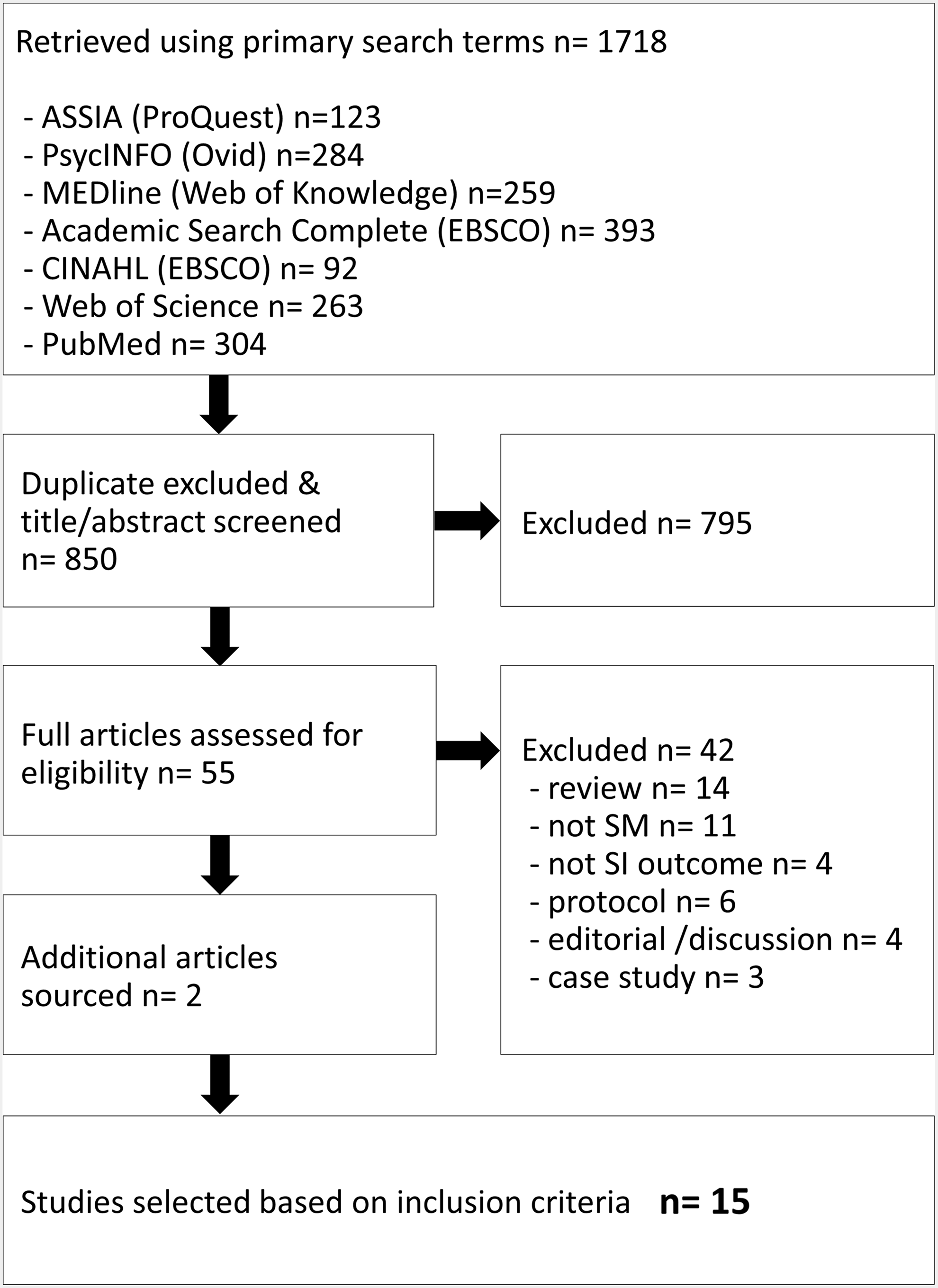
Flow chart of scoping review search strategy. SM, social media.
Scoping Review Search Terms and Derivatives
Stage 4: Charting the data
The analysis involved capturing and tabulating key details and data from the respective research articles. PD undertook this process, again under the supervision of the other three researchers.
Stage 5: Collating, summarizing, and reporting the results.
A meta-synthesis method was applied to draw out themes of references to any potential therapeutic affordance of social media. Few articles articulated the words “afford” or “affordances” within them explicitly. All four researchers were involved directly through extracting, collating, tabulating, and interpreting the data. To establish a proposed list of therapeutic affordances, we collated and deductively analyzed the themes, cross-checking within the group any ambiguous findings.
Results
The resulting proposed therapeutic affordances of social media for young adults experiencing suicidal ideation are connection, exploration, narration, collaboration, and introspection. Table 2 is a summary of the social media types from the review with their associated therapeutic affordances.
Social Media Type and Associated Therapeutic and Nontherapeutic Affordances
BBS, Bulletin Board Systems; iCBT, Internet cognitive behavioral therapy; SM, social media.
Connection
Refers to the practicality of being able to connect with peers or professionals. Across several studies,29,49–52 connection inferred the opportunity to establish practical communication links to others, whether like-minded peers29,49,50,53 or professionals. 51 The synchronous and asynchronous aspects of social media are also considered, alongside the immediate utility and mobility of social media.51,54 Sometimes, the ability to connect with others was enhanced by their confidence to remain anonymous within that connection.50,51,55 However, Tseng and Yang 52 also found that connection or web communication was associated with an increase in the broader term self-injurious thoughts and behavior for males, which included suicidal ideation. They suggest that the gender difference in their results indicate that females are more skilled at establishing positive online relationships and support networks. They believe that males are less skilled in this regard. This can then lead to reduced access to resources and support through periods of emotional need.
Exploration
Refers to the ability to explore and gather information for oneself or others. In a survey of individuals using the Internet for suicide-related purposes, 64 percent of respondents identified the primary reason for their use being for information. 50 Exploration also includes the seeking of prosuicide information.49,56 The latter research 56 did not involve a validated measure for suicidal ideation, although they did report an increase in suicidal ideation, indicating, like connection, that exploration can relate to a nontherapeutic outcome for some users. Otherwise, the notion of exploration and therapeutic outcomes is often cited.49,50,55,57
Narration
Refers to the ability to tell a story. Social media users can express their suicidal ideation, and how they have learned to survive. 49 For those living with suicidal ideation, social media may also provide an opportunity to discuss and share with others their reasons and desires for wanting to die.50,54,56 Sueki and Eichenberg 56 reported an increase in suicidal ideation linked to the presentation of the narrative, although they did not report using a validated suicidal ideation measure. Here, it appears that the narration affordance too can result in nontherapeutic outcomes.
Collaboration
Refers to the ability of social media users to interact and collaborate with others. While collaboration requires a connection, it also provides an opportunity for planning events, working on group projects, seeking recommendations, and the idea of a community working together. Notions of collaboration appear in various review articles with references to users responding to, or helping others in crisis49,56,58; establishing online social support through groups50,54,56,59; finding acceptance or belonging with others52,55; or making friends and new interpersonal relationships.29,50,56 Collaboration also incorporated references to being able to involve others when establishing a personal crisis plan, 49 in a method for accessing help from others in the future,56,60 when accessing support from a professional.29,61 These help-seeking benefits are in contrast to the concerns raised in some research for potential collaboration to involve the establishment of suicide pacts,49,55,56 realizing the nontherapeutic potential associated with the collaboration affordance.
Introspection
Refers to the potential of social media to promote an internally reflective perspective for users living with suicidal ideation. Introspection was found in the description of thoughts, feelings, behaviors, and experiences leading on to suicidal ideation. This relates to going beyond narration and the telling of the lived experiences into a deeper reflection and consideration of what had ultimately brought the person to their crisis. 49 The opportunity for introspection is potentially very relevant for young adults experiencing suicidal ideation. 55 For some, introspection involved the anticipation of a response from others on social media, as well as the reflection and observation of the depths and their subjective experience of their suicidal ideation in a somewhat objective way. 54 Introspection may also involve safely considering the impact of any suicidal act, including imagining a world without them, exploring the potential outcome of surviving a suicide attempt, or reflecting upon the tensions between the reasons for living and the reasons for dying. 29 Positive introspection may be encouraged and guided through the use of social media, as such introspective thoughts and analysis may be prompted when reading another persons' narrative of struggle and survival on social media.
Outcomes
In terms of validated measures utilized in the research to assess suicidal ideation (Table 3), the Beck Scale for Suicidal Ideation,53,57,59 Patient Health Questionnaire,51,61 and Suicide Behaviors Questionnaire–Revised29,50 were most commonly used. Other authors created their nonvalidated surveys49,56,60 or adopted qualitative content analysis54,58 to determine suicidal ideation experience.
Included Suicidal Ideation Outcome Measures from Scoping Review Articles
ASIQ, Adult Suicidal Ideation Questionnaire; BSSI, Beck Scale for Suicidal Ideation; Kiddie-SADS-E, Schedule for Affective Disorders and Schizophrenia for School-age Children-Epidemiologic version; PHQ-9, Patient Health Questionnaire-9; SBQ-R, Suicide Behaviors Questionnaire—Revised; SIQ-JR, Suicidal Ideation Questionnaire-Junior version; SITBI-S, Self-injurious Thoughts and Behaviors Interview-Short form.
With regard to suicidal ideation outcomes (Table 4), nine articles report on the beneficial aspect of social media in reducing suicidal ideation for its consumers. Harris et al. 50 reported that suicide-risk Internet users sought peer-to-peer communication, acting on desires or needs to communicate their suicidal feelings to others, choosing an anonymous medium for doing so. Suicide ideation scores were significantly higher for those participants who went online for suicide-related content compared to those who did not with a large Pearson's r effect size. Harris et al. 29 report that suicide risk participants were more likely to go online for suicide-related Internet content, although their goal is for peer-to-peer communication and developing interpersonal relationships, but displayed little interest in receiving professional support. The researchers found a significantly higher score for the Online Relationship Building Scale, for both suicide-risk and nonsuicidal groups for women with medium Cohen's d effect size, and men with a small Cohen's d effect size.
Scoping Review Summary of Included Articles
ISP, Interactive Screening Program; OR, odds ratio; OSG, online support group; PF, personalized feedback; RCT, randomized control trial; SA, suicide attempt; SI, suicidal ideation; SITB, Self-Injurious Thoughts and Behavior.
Using online cognitive behavior therapy interventions, both the Hedman et al.'s 51 and Robinson et al.'s 62 studies reported reduced suicidal ideation. The Hedman et al.'s 51 study found a significant reduction in suicidal ideation with a medium Cohen's d effect size, while the Robinson et al.'s 62 study reported Internet-based interventions may be effective in treating suicidal ideation (SI), as well as depression among this population that can be hard to engage in traditional forms of treatment, finding a reduction in suicidal ideation scores with a moderate effect size. Adopting a mobile phone intervention postsuicide attempt, Marasinghe et al. 59 documented that an immediate mobile phone-based intervention was beneficial, finding significant reductions in SI and depression and improvement in social support. It was noted that the intervention group had significantly reduced suicidal ideation scores across the study time frames of baseline, and 6 and 12 months, compared to the control group for both men and women. The separate studies of King et al. 61 and Moffitt et al. 60 initially measured suicidal ideation, but did not report on the followup scores.
The following researchers both presented independent and collaborative work; however, studies and results were inconsistent. Eichenberg 49 found that most discussion forum use was constructive, and for helping themselves or others by communicating with people they felt understood them. Although a small group reported an increase in suicidal ideation following forum use, there was a significant overall reduction in suicidal ideation, with a near to large Cohen's d effect size. Sueki and Eichenberg 56 found bulletin board systems to have a suicide prevention effect, with the outcomes influenced by the intention, motivation, and participant user types. The scores for suicidal thoughts decreased from before using the bulletin board system to the time of survey, irrespective of the participant's motivation for using social media.
Sueki's 53 research, however, showed that suicidal ideation, depression, anxiety, and loneliness increased in response to certain suicide-related online activity. They found that suicidal ideation increased significantly with increased levels of suicide-related online behavior, including consulting about mental health, searching suicide methods, and viewing suicide methods. They also found that suicide-related Internet usage increased alongside increased suicidal ideation. Notably, they report that no form of Internet use lessened these measures of suicide risk. Sueki et al. 57 reported there was a significant relationship linking an increase in suicidal ideation, to three specific online behaviors: disclosing suicidal ideation up until a month ago; disclosing suicidal ideation within the last month; and browsing the Internet for information about suicide methods within the last month. There was no association between anonymous mental health consultation with another within the last month and suicidal ideation rates.
Lin et al. 55 reported that Internet-addicted adolescents had a higher risk of suicidal ideation and suicide attempt; they found an association between some Internet activities and suicidal ideation, notably that adolescents who went online for online gaming, using MSN chat, studying, or information searching had higher rates of suicidal ideation than those adolescents who did not partake in these activities. Tseng and Yang 52 found that for adolescent males, a greater score for web communication was associated with increased suicidal ideation. Adolescent females were reported to be better at forming positive online relationships and supports than males.
Two articles involved exploratory methodologies considering the motives and experiences of suicide-related social media users. Barak and Dolev-Cohen 58 found that active involvement in the online support group related to a decrease in the participant's level of distress. Gilat and Shahar 54 provide an overview of an online support group, with personal chat and phone helpline options. Broad benefits and opportunities were presented, backed by qualitative insights from consumers, for example, “Now, when I feel depressed, I think of what they [the online support group] may tell me, and go to see my psychiatrist”. 51
Discussion
The role of social media in the lives of young adults experiencing suicidal ideation is complex. While there are areas and opportunities for a therapeutic benefit,10,12,25 concern remains for the vulnerability of some who use social media.28–31 Within social media, there are many opportunities for connection, and linking with others globally,13,34,35 as well as collaboration with many other young adults for mutual support and benefit around the world. Furthermore, the use of social media as a means of help-seeking has been demonstrated.10,13,25,34,35 The opportunity for individuals to engage with social media anonymously has shown benefit for people to confidently engage in this space and to share their experiences, whether about day to day life or their experiences with suicidal ideation. 63
The use of a variety of different measures to assess suicidal ideation and other outcomes makes it difficult to draw clear conclusions from the results. Results are mixed and indicate that social media can be largely beneficial for some young adults experiencing suicidal ideation, while also more problematic and hazardous for others. The included research includes young adults experiencing suicidal ideation, although not exclusively, and there is considerable heterogeneity among the studies as to the age ranges that were included. It remains therefore difficult to draw significant conclusions about young adults experiencing suicidal ideation specifically from this review. Nonetheless, considering the proposed therapeutic affordances, there are comparisons that can be drawn from previous therapeutic affordances and social media research.
Connection is discussed within much of the existing literature, regarding connecting with similar or like-minded others.13,24,42–44 Relating to exploration, Merolli et al.'s13,43 study involving patients with chronic pain found users valued the explorative and information-filtering potential of social media. The mediation, sharing, and information-seeking potential of social media are discussed in existing research, from the general health related46,47 to sexual assault related. 10 Narration appears through the existing literature.43,44,64 Hård Af Segerstad and Kasperowski 65 cite the importance of narration among other factors concerning coping with the loss of a child. Similarly, Nolan et al. 64 and Lin et al. 66 refer to emotional disclosure and self-disclosure, respectively. As with connection, anonymity remains an enabling and essential element in narration.64,67 Within the existing literature, Zhao et al. 40 refer to the possibility of collaboration through the development of web 2.0, while Fieseler et al. 68 explore the role of social media for the unemployed, finding ultimately lower social isolation for its users. Social media's ability to facilitate interaction and collaboration between multiple individuals may realize potential benefits for different groups of users. 46
While the notion of introspection as a therapeutic affordance of social media does not appear to have been reported in the literature, the concept of introspection, however, is not new and, like therapeutic affordance itself, originates from the field of psychology. Introspection refers to the human ability to think about one's thoughts and feelings. 69 Discussions about introspection over the last century have largely debated its adoption as a methodology. 70 Smithies 71 argues that introspection is the privileged access to one's thoughts and feelings that are not observable by others. Naikan therapy, a Japanese-based intervention, which combines religion and psychotherapy, involves introspection as a form of meditation.72,73 There appears to be limited research linking social media and introspection, and certainly, the authors of this review are not aware of any discourse regarding its potential therapeutic benefit.
Contrary to the earlier therapeutic affordances of social media research of Merolli et al. 45 and Coulson et al., 35 there have been some contentions raised here regarding the therapeutic versus nontherapeutic duality of certain proposed therapeutic affordances. This warrants further research to seek to better understand social media's impact on the lives of young adults experiencing suicidal ideation. In the context of the nontherapeutic features associated with the previously understood therapeutic affordances, it is necessary to seek to understand what may influence an individual's outcome. Future research should consider further and more detailed examination of the moderating roles of gender, the amount of time spent on social media, and the motivations or intentions of the user. There may be merit in examining the effect of prior suicidal ideation upon social media use compared to those without such prior lived experience.
A limitation of this scoping review is that it did not undertake any search of the literature within Google Scholar, or Scopus, which may limit this review. However, this scoping review has demonstrated that further empirical research is required to investigate the application of a therapeutic affordance framework for social media users experiencing suicidal ideation. The review has demonstrated that therapeutic affordances provide a framework that enables a theoretical and analytical bridge connecting varied research methods and social media use.
Future research is needed to seek the views and opinions of young adults experiencing suicidal ideation directly, so to validate the aforementioned proposed therapeutic affordances of social media for young adults experiencing suicidal ideation from this review. Further research should also seek to expand the view of social media to explore the variety of platforms, examining which are particularly helpful or harmful from the perspective of young adults who use social media. Ongoing research incorporating a therapeutic affordance framework will support the mental health practitioner to understand and explore both the positive and negative impact of social media on the mental health of their clients.
Conclusion
Social media have arguably become an everyday part of life and have a potential application as a help-seeking resource for people with various health or social concerns, including those experiencing suicidal ideation. The evidence in this field to offer guidance for both consumers and practitioners alike is still limited. A therapeutic affordance perspective offers an evolving conceptual framework, enabling the development and refinement of such an evidence base. This scoping review provides an overview and analysis of the existing research, with consideration to the outcomes associated with social media use by young adults experiencing suicidal ideation, while also exploring and proposing a list of therapeutic affordances. Social media can be effective in reducing levels of suicidal ideation among certain users, but further research is required to continue to inform practitioners and researchers in the area. This will need to be guided by the perspectives and perception of young adults experiencing suicidal ideation, who use social media.
Footnotes
Acknowledgment
This study is supported by the Australian Government Research Training Program Scholarship.
Author Disclosure Statement
No competing financial interests exist.
Funding Information
No funding was received for this article.