




Abstract
Abstract
In a two-wave, 4-month longitudinal study of 308 adults, two hypotheses were tested regarding the relation of Twitter-based measures of online social media use and in-person social support with depressive thoughts and symptoms. For four of five measures, Twitter use by in-person social support interactions predicted residualized change in depression-related outcomes over time; these results supported a corollary of the social compensation hypothesis that social media use is associated with greater benefits for people with lower in-person social support. In particular, having a larger Twitter social network (i.e., following and being followed by more people) and being more active in that network (i.e., sending and receiving more tweets) are especially helpful to people who have lower levels of in-person social support. For the fifth measure (the sentiment of Tweets), no interaction emerged; however, a beneficial main effect offset the adverse main effect of low in-person social support.
Social connectedness helps people cope with almost all forms of mental health problems, especially depression.1–5 More recent evidence suggests that these benefits can derive from online as well as in-person social relations, especially those characterized by positive interactions.6–8 Less clear, however, are the combined benefits of online and in-person social connectedness. Two theories make opposite predictions. The rich-get-richer hypothesis suggests that people who have more extensive in-person social support systems should derive greater benefits from social media, as they use it to maintain, improve, and enhance their already well-established social networks.9–11 For example, a popular person may use social media to keep up with recent events in the lives of their large number of friends.
Alternatively, the social compensation (or poor-get-richer) hypothesis suggests that people with weaker in-person social supports should derive greater benefits from social media use, as they use it to find online niches where they are more accepted. 10 For example, a shy or socially awkward person who is challenged by in-person relationships may be more comfortable in online spaces where they have more control over the pace of social interactions and can take more time to curate their responses.
The primary goal of this study was to test these two competing theories. Toward this end, we conducted a longitudinal investigation of the prospective relation of social media use (specifically, Twitter) with depressive symptoms for people with different levels of in-person social support. On the one hand, support for the rich-get-richer hypothesis would consist of an interaction between Twitter use (TU) and in-person social support, in which TU predicts greater decreases in depressive symptoms for people with higher levels of in-person social support. On the other hand, support for the social compensation hypothesis would consist of an interaction in which TU predicts greater decreases in depressive symptoms for people with lower levels of in-person social support.
Previous support for the rich-get-richer hypothesis has taken several forms. Reich's review reveals several lines of research. 12 One set of studies suggests that personality characteristics such as extraversion are correlated with time spent on social media and number of online friends. 13 The assumption here is that the correlation between in-person and online social networks is due to a “third” variable, extraversion, which promotes both. A second set of studies reveals that online and in-person social support network parameters are positively correlated, suggesting that they complement each other in ways often seen as consistent with the rich-get-richer hypothesis.11,14
Other research supports the social compensation hypothesis. For example, Reich's review suggests that people with social anxiety, introversion, and low self-esteem spend more time online, where they experience better social connection with others.12,15–19 Complementing this work, Rains and Tsetsi's cross-sectional analyses of Pew survey data suggest that social inequities in the in-person world are less evident online, suggesting that the online world has the potential to provide kinds of support that may not always be available in person. 20
Two aspects of these studies limit their relevance. First, these results are largely based on cross-sectional analyses, whereas the underlying theories anticipate prospective relations. Second, these results largely focus on the main effects of online and in-person social variables. The current hypotheses are more nuanced, focusing on potential moderators of these relations. In this context, a critical corollary to the rich-get-richer hypothesis is that social media use will be especially helpful to people who already have strong in-person social relations. Conversely, an important corollary to the social compensation hypothesis is that social media use is especially helpful for people who have weak in-person social relations because social media platforms provide access to social supports that they cannot obtain in person.
This study examined the longitudinal effects of TU, in-person social support, and their interaction on depressive thoughts and symptoms in a general population of TUs. The rich-get-richer and social compensation hypotheses should pertain to most social media platforms; however, we elected to focus on Twitter because by 2016 it was the most popular social media platform 21 that had public access to its content. (Facebook was the most popular; however, since Facebook upgraded its privacy settings in 2014, the proportion of its data that is publicly available for mining greatly diminished. 22 )
Methods
Participants
We used
Measures
Social support was measured at wave 1. In keeping with modern conceptualizations of depression as a dimensional continuum, we operationalized the construct as a composite of depressive thoughts and symptoms, measured at both waves 1 and 2. 29 All Twitter variables were obtained for the time interval between the two waves.
Perceived Social Support Scales
The Perceived Social Support Scale (PSSS) is a 40-item questionnaire measuring perceived in-person social support from both friends and family. Items are rated on binary (yes/no) scales. We used only the 20-item subscale about friends' support. 30 The instrument has excellent psychometric support.31,32 In this study, reliability was high (KR-20 = 0.92).
Cognitive Triad Inventory
The Cognitive Triad Inventory (CTI) is a 36-item scale assessing negative views of self, world, and future. 33 Items are rated on 7-point scales: 1 = totally agree to 7 = totally disagree. Higher scores represent higher levels of depressive thinking. 33 The CTI has strong psychometric support.34,35 In this study, coefficient alpha was 0.97 at both waves.
Beck Depression Inventory-Version II
The Beck Depression Inventory-Version II (BDI-II) is a 21-item self-report measure of cognitive, behavioral, and emotional depressive symptoms. Items offer a series of statements ranging from 0 (no presence of the symptom) to 3 (severe form of the symptom). 36 The BDI-II has excellent psychometric properties.36–38 In the current sample, coefficient alpha was 0.92 at both waves.
Twitter variables
Utilizing participants' handles, the Twitter data archives, and the official public representational state transfer application programming interfaces (REST APIs) provided by Twitter, 39 we obtained information about Twitter activity between waves 1 and 2 to derive five indices of TU: (1) Follows, the average number of people that a person followed between waves 1 and 2 (computed as the mean of a user's da; (2) Followers, the average number of people who follow the target personb; (3) Tweets, the number of messages posted on Twitter by the target person; (4) Retweets, the number of messages reposted on Twitter (5) Valence, the sentiment of content posted on Twitter (assessed under the premise that more positively toned communications would be associated with more supportive relationships). 40 We measured sentiment using Nielsen's AFINN-111 glossary of microblog words and phrases. 41 Each glossary entry is associated with a sentiment rating ranging from very negative (−5) to very positive (+5).42,43 We obtained each Tweet posted by every participant over the selected time frame. From each Tweet, all whitespace and special characters were removed, leaving only words. If a word or phrase appeared in the glossary, it was assigned a numeric sentiment rating. Words not in the glossary were assigned values of 0. Within participant, sentiment ratings were summed across all Tweets posted during the interwave interval. Thus, scores increase when a participant uses either a larger number of positively valenced words or uses words that have higher valence ratings (or both). The number of neutral words is irrelevant to the sum as their valence scores are 0. Correlations among Twitter variables appear in Table 1.
Correlations Among Study Variables
Note: Correlations ≥0.10 are significant at p < 0.05.
Procedure
Institutional Review Board approval was obtained for this study. Participants completed all surveys online. Through MTurk, we retained worker ID numbers. Approximately 4 months later, we used MTurk worker IDs to recontact all wave 1 participants who met our screening criteria, asking them to complete the online survey again. We then linked both waves of data to the Twitter data-mining results.
Results
Descriptive statistics
Means and standard deviations of all waves 1 and 2 variables appear in Table 2. Descriptive statistics are similar to other studies of community adults, although mean levels of depression were slightly elevated.44,45 At wave 1, ∼32% reported at least mild depressive symptoms, and 21% reported at least moderate depressive symptoms on the BDI. 46
Descriptive Statistics for Study Variables
BDI-II, Beck Depression Inventory-version II; CTI, Cognitive Triad Inventory; LIE, Lie Scale of the Revised Eysenck Personality Questionnaire-Short Form; MCSF-C, Marlowe-Crowne Social Desirability-Short Form C; NAQ, Negative Activities Questionnaire-Revised; PSSS, Perceived Social Support Scale.
Primary analyses
The correlation between BDI and CTI was 0.81 at wave 1 and 0.85 at wave 2. Given these very strong relations and given that our goal was to predict depressive thoughts and symptoms, we formed a composite depressive thoughts and symptoms variable (DEP) by standardizing and averaging these two measures at each wave. (All of the following analyses were conducted as described and then repeated with additional control variables: age, sex, and race. All significant results remained significant, and all nonsignificant results remained nonsignificant.)
In our primary analyses, we examined the main and interaction effects of TU (Follows, Followers, Tweets, Retweets, and Sentiment) and in-person social support (PSSS) to predict change in depressive thoughts and symptoms. Our dependent variable was wave 2 depressive symptoms (DEP2). Wave 1 depressive symptoms (DEP1) served as a control variable. These analyses were based on the following general regression model: DEP2 = b0 + b1DEP1 + b2TU + b3PSSS + b4TU × PSSS. In this way, TU, PSSS, and the TU × PSSS interaction are used to predict residualized change in depressive thoughts and symptoms from waves 1 to 2 (generally regarded as superior to the prediction of raw change or difference scores). 47 When the interaction was significant, we plotted the effects of the Twitter variable on the outcome at high and low levels of the in-person predictor. [In the figures, high = mean + 1 SD, and low = mean – 1 SD (or 0 when mean – 1 SD <0 and 0 was the lowest possible value on the scale.] When the interaction was not significant, we eliminated it and plotted the main effects. In each of these five analyses (one for each TU variable), wave 1 DEP served as a covariate. With N = 308, we had 0.80 power to detect even a small effect (f 2 = 0.02) and 0.99 power to detect a medium effect (f 2 = 0.15) of our key predictor in a four-predictor regression.
As shown in Table 3, four of five interactions were significant. In the fifth analysis, the Sentiment main effect was significant (Fig. 1). The four significant interactions revealed that for people with low in-person social support, following more people on Twitter, being followed by more people on Twitter, sending more Tweets, and having more of those Tweets Retweeted predicted improvement in depressive thoughts and symptoms. The same was not true for people with high levels of in-person support. For these four variables, this pattern is consistent with the social compensation corollary. The fifth analysis revealed a strong longitudinal main effect for Sentiment. Use of positive sentiment on Twitter was associated with a longitudinal reduction in depressive thoughts and symptoms for people with either high or low in-person social support. This result does not explicitly support either the rich-get-richer or the social compensation hypotheses. Rather, it suggests that use of positive sentiment in Twitter predicts reductions in depressive thoughts and symptoms for all people (i.e., everyone gets richer).
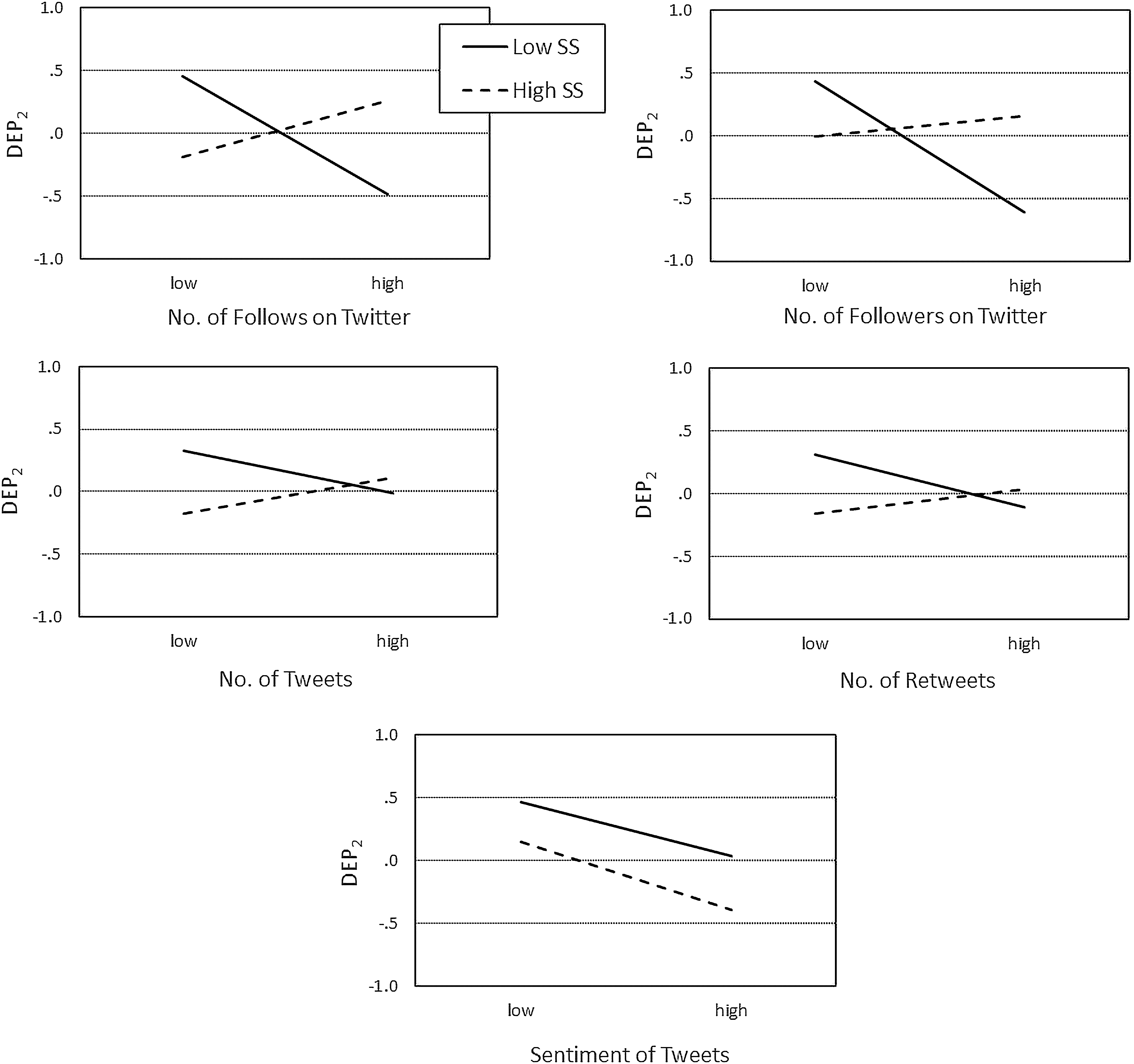
Main effects and interactions of Twitter use and in-person SS on residualized change in depressive thoughts and symptoms (depressive change) over time. DEP, mean of standardized Cognitive Triad Inventory and Beck Depression Inventory-II; SS, social support.
Regression of Wave 2 DEP onto Twitter Variables, Perceived Social Support Scale, and Their Interaction, Controlling for Wave 1 DEP
DEP, mean of standardized Cognitive Triad Inventory and Beck Depression Inventory-II.
Discussion
This study examined the longitudinal effects of TU as a means for offsetting the adverse effects of low social support on depressive thoughts and symptoms. Two key results emerged: first, support emerged for our corollary to the social compensation (or poor-get-richer) hypothesis but not for the rich-get-richer hypothesis. Four aspects of TU were related to reductions in depressive thoughts and symptoms, but only for people with low initial levels of in-person social support. Second, conveying positive sentiment through Twitter predicted a reduction in depressive thoughts and feelings, irrespective of people's level of in-person social support. Below, we elaborate on these findings and their implications.
Our first set of findings was consistent with our corollary to the social compensation hypothesis. People with low social support showed improvements in depressive thoughts and feelings over time if they reported four markers of TU: following more people on Twitter, having more people follow them on Twitter, posting more Tweets, and having more of their posts retweeted by others. These markers were unrelated to depressive thoughts and feelings of people who already had high levels of in-person social support. These results support Baker and Algorta's observation that the effect of social media on depression-related outcomes is complicated by social, psychological, and behavioral moderators. 8 The current research provides longitudinal evidence that in-person social support may be one such moderator. These results also suggest that social media might be a way to combat the adverse effects of low social support on mental health. This possibility is commensurate with the conventional wisdom that having one or two good friends in one social niche can offset social adversity in other social niches.48,49 Perhaps social media platforms represent a modern version of such niches. We urge caution along these lines as previous research has also shown that the relation of Twitter with depression-related outcomes varies as a function of how (and when) Twitter is used6,7,50–54 (also refer literature reviews by Guntuku et al. 55 and Hur and Gupta 56 ).
Three reasons for this finding are possible.9,57 One is that meeting people with similar interests or characteristics may be easier online than in person, especially when such people are not available within one's in-person social networks.57–61 For people who lack these affiliations, connecting with others online may have an especially strong impact. A second explanation is that the online channels of communication are simpler, such that people who find it challenging to develop supportive in-person social networks may be more effective in the more restricted online world of social media. One's ability to interpret nonverbal cues, one's physical characteristics, one's proper use of vocal tone, and one's timing of social responses may be less important online than in person. Nesi et al. referred to this as cue absence in their transformation theory.62–65 In a related vein, online interactions tend to be asynchronous. Delays between online communications might allow people the time to compose more effective responses. 62 Understanding the mechanisms that underlie these results represents an important avenue for future research. A third explanation for these results is that the value added by having online followers may not be as beneficial to people who already have strong in-person social support, at least insofar as reducing depressive thoughts and symptoms are concerned. Some evidence even suggests that having a very large number of online friends may actually be associated with negative outcomes.66,67 The current interaction plots in Figure 1 somewhat reflect this possibility, in that some of our TU variables appeared to have adverse effects for people who had strong in-person social supports. We caution against overinterpreting this result, however, as the slopes for participants with low social support were not statistically significant.
Our second set of findings was the significant main effect of Twitter sentiment, which offset the adverse effect of low in-person social support. Two aspects of this result deserve emphasis. First, this finding cannot be explained as consequences of depression, as it derives from longitudinal analyses in which prior levels of depression were statistically controlled. Second, these results were not moderated by level of social support. The effects of positive sentiment applied to people at all levels of social support. Indeed, positive Twitter sentiment offset much of the depressive effects of low in-person social support. People with problematic social networks but highly positive Twitter sentiment had similar levels of depressive symptoms as did people with strong social networks but more negative Twitter sentiment, reminiscent of Granovetter's early work on the strength of weak ties. 68
Shapiro and Margolin's extensive literature review describes at least four reasons why effective use of online social media platforms could offset the adverse effects of problematic face-to-face relationships, especially with respect to cognitive and emotional outcomes. 57 First, people can engage in selective self-presentation more easily online than in person. By crafting carefully their online communications and constructing their online persona, some people can accrue more positive feedback online than they can in person, which may in turn result in improvement on psychological outcomes.64,65 Second, connecting with similar people or with people who share similar interests may be easier for some people online than in person, especially when such affiliations are not available within in-person social networks.58–61 Third, through the Internet, communicating with others from more diverse intellectual, political, and social backgrounds can expand one's self-identity while enhancing feelings of belongingness and affiliation. 69 Trepte et al. hypothesized that large, diverse groups may feel more connected with each other online and are thus more likely to support each other. 70 Fourth, self-disclosure may be easier online than in person, potentially facilitating online social relationships or enabling people to practice for in-person relationships.71,72
Taken together, these results begin to suggest interesting supplemental strategies in the prevention of depression in people who are at risk because of low social support. The current findings, derived from one of very few longitudinal studies in this area, increase our understanding about prospective (not just correlational) relations and could have implications for the use of social media in prevention research. 12 A powerful next step will be true experimental research designs in which positive use of social media is actively manipulated, so that its causal effect on mental health outcomes can be assessed. If successful, online social skills training could become a valuable component of comprehensive depression prevention efforts.
Several shortcomings of this study suggest important avenues for future research. The first focuses on our sentiment analysis. Although examining the actual sentiment conveyed by Twitter communications is a powerful step, in-depth content analysis of people's Tweets could reveal more about more specific aspects of people's communications that might be responsible for the relation of sentiment with depression-related outcomes. Furthermore, in short textual passages (such as Tweets), it is extremely difficult to reliably measure issues such as sarcasm and irony. Also, some kinds of negatively toned messages (e.g., expressing distress) could serve as triggers for positive responses (e.g., emotional support). Second, depressive thoughts and symptoms are extremely important mental health outcomes, emblematic of one of the most common and debilitating classes of mental illnesses; however, many other important clinical outcomes should be explored, including Internet addiction, social anxiety, and obsessive-compulsive disorder.73–75 Third, our study focused only on Twitter. Other social media platforms exist generate very different kinds of risks and benefits, which should be explored. Fourth, we used an observational/correlation research design, which leaves various “third variables” uncontrolled. Random assignment to high versus low Twitter conditions could control for self-selection factors such as extraversion or level of depression. Fifth, although use of MTurk for participant recruitment has certain strengths, weaknesses have also been documented. These include crosstalk among participants, misrepresentation of personal characteristics to qualify for studies, and provision of unreliable results.76–78 Although these issues do seem to be characteristic of some MTurk participants, research shows that these problems actually occur at similar rates in samples obtained from more conventional methods. 79 Future studies should examine the generalizability of the current results across a wider variety of populations.
Footnotes
Notes
Author Disclosure Statement
No competing financial interests exist.
Funding Information
This research was supported in part by Patricia and Rodes Hart and a Peabody Small Grant awarded to the first author by Peabody College, Vanderbilt University. Contributions by Elizabeth Nick and Rachel Zelkowitz were supported by NIMH T32MH018921-26 and F31MH108241-01A1, respectively.