




Abstract
Abstract
While there is a growing body of research on how individuals evaluate interracial exclusion in offline settings, much less is known about evaluations of interracial exclusion in online settings. This study aimed to address this gap by examining evaluations by male adolescents and young adults (N = 151; Mage = 17.59, standard deviation = 0.50) of interracial exclusion in both online and offline settings to understand these evaluations in concert. Furthermore, participants completed measures of offline and online intergroup contact, providing new evidence that intergroup contact in online settings is an important context for learning about others. The findings indicate that participants' online and offline intergroup contacts were related. In terms of evaluations of exclusion, participants were much more likely to attribute exclusion to nonrace-based reasons in online and offline settings than to race-based reasons. Additionally, participants with higher rates of intergroup contact were more likely to perceive race-based exclusion as wrong than those with low rates of contact. The novel findings document that young men's online and offline intergroup contact shape their evaluations of interracial exclusion in online settings.
Introduction
Adolescents and young adults experience social exclusion frequently, and their experiences of social exclusion have lasting negative impacts on their social/emotional, mental, and academic wellbeing. 1 Social exclusion often occurs because of one's group membership, for instance because of one's race, or ethnicity. 2 Increasingly, online environments have become an outlet for antisocial, discriminatory and biased conversation and behavior. 3 While much is known about intergroup and interpersonal exclusion in offline settings, 4 less is known about how adolescents, particularly male adolescents, and young adults evaluate exclusion in online settings. The current study seeks to understand evaluations of race-based and nonrace-based social exclusion in both online and offline contexts. Comparing both online and offline evaluations is important, as these contexts may be evaluated rather differently by adolescents and young adults.
Online and offline social exclusion
The internet is rapidly changing the way different groups interact with and relate to each other, 5 and over 90 percent of adolescents and young adults use the internet on a daily basis. 6 Online settings provide unique opportunities and challenges for adolescents and young adults. 7 On the one hand, the internet provides a venue where individuals can explore issues such as race and stereotypes, 8 yet the internet can also be a place where prejudice and discrimination run rampant. 9 As an example, the vast majority of tweets about racial/ethnic groups are negative. 10 Negative sentiments expressed online have documented negative outcomes on viewers' health and wellbeing.10,11 Further reports indicate that cyberbullying (a form of social exclusion) is increasingly common. 12
Experiences of exclusion in online settings may be very different for individuals. For instance, adolescents report daily experiences of negative peer interactions, and that these negative experiences may occur exclusively in one setting (online or offline) but not the other. 13 Little is known about whether adolescents and young adults expect that interracial social exclusion in online (and offline) settings is likely to be due to intergroup (for instance because of one's social identity) or nonintergroup (such as because of personal characteristics) reasons. Research in offline settings has demonstrated that children and adolescents consider different possible causes for interracial exclusion, at times assuming that race is the cause of the exclusion, and at other times assuming that a lack of shared interests is the cause of the exclusion. 14 Context matters when making these complex evaluations of social exclusion. For instance, ethnic minority young people are more likely to expect that race-based exclusion occurs than are majority group members, 14 and those with more intergroup contact are less likely to expect race-based exclusion and more likely to judge race-based exclusion as wrong than are those with less intergroup contact. 15
Intergroup contact in online and offline settings
Contextual factors, such as intergroup contact, relate to evaluations of interracial exclusion.4,16 Intergroup contact that is high quality, establishes equal status between the groups, includes opportunities for collaboration and cooperation, and is sanctioned by authority figures is associated with reduced prejudice and discrimination.17,18 Some findings suggest that direct online contact decreased perceptions of threat and social distance toward LGBT outgroup members, but not toward undocumented immigrant outgroup members. 19 This preliminary work demonstrates the importance of additional research into online intergroup contact as little is known about rates and quality of online versus offline intergroup contact. Online intergroup contact has the potential to meet the intergroup contact conditions,17,20 but it may differ from offline intergroup contact. For instance, online settings may provide greater opportunity to learn about others, but the quality of that contact may be lower than in-person intergroup contact. On the other hand, online intergroup contact may promote positive intergroup attitudes as it may lead to reduced anxiety, because in online settings one has more control over one's self-presentation and more freedom in choosing when and how to engage in intergroup contact. 21
A focus on male adolescents and young adults
While prior research finds that girls often judge social exclusion to be more wrong than do boys, 22 ethnic minority males with high intergroup contact judged racial exclusion as more wrong than did males with low intergroup contact, 16 which indicates that male adolescents and young adults may have unique experiences with social exclusion. During the formative years between adolescence and young adulthood, males are more likely than are females to engage in problematic internet use, 23 specifically males exhibit more negative outcomes of their internet use than do females. 24 Finally, males may be overlooked in the study of social exclusion, as research with children, adolescents, and young adults finds that stereotypes often associate females with relational aggression. 25 Thus, a focus of male adolescents' and young adults' evaluations of interracial social exclusion in online and offline settings is an important new avenue for investigation.
Theoretical framework
This research is framed using both intergroup contact theory 17 and the social reasoning development perspective. 26 Intergroup contact theory posits that intergroup contact, which meets specific criteria, is likely to reduce prejudice. 17 The social reasoning development perspective posits that when individuals make complex social decisions they balance information about their moral principles with information about group loyalty and group norms. 27 The current study aims to understand how male adolescents and young adults evaluate interracial exclusion in online and offline settings with attention to moral judgments as well as their expectations about why the exclusion may have occurred (e.g., was it about race?). Furthermore, participants' intergroup contact was measured, to examine differences in online and offline intergroup contact and to identify whether male adolescents and young adults with differing levels of intergroup contact make different judgments and evaluations.
Hypotheses
Based on prior research documenting that individuals often seek out opportunities for intergroup contact across different settings,15,16 we expected that
Furthermore, based on research documenting that adolescents with more intergroup contact are more likely to recognize that race-based exclusion is wrong, we expected that
Moreover, given that children and adolescents judge race-based exclusion as more wrong than exclusion that is not based on race,4,28,29 we expected that
Furthermore, we also expected that
It was an open question whether differences between the online and offline settings would manifest. This issue was of central interest as no prior research has examined evaluations of both online and offline interracial exclusion.
Methods
Participants
Participants (N = 135; Mage = 17.59) were male and were recruited through online forums for popular games, such as World of Warcraft. Participant ethnicity was 77.8 percent White Non-Hispanic, 0.7 percent Black, 11.1 percent Asian, 5.2 percent Hispanic, and 5.2 percent Biracial.
Procedure
Participants were recruited through online forums and social media sites using an online advertisement. First, participants were asked to enter their age. Participants who indicated that they were between the ages of 13 and 17 were asked to give their e-mail address and their parents' e-mail address to obtain parental consent. Once parental consent was obtained a link to the online survey was e-mailed to adolescent and young adult participants. Participants who self-reported as 18 and older were able to follow a link directly to the consent form and survey site. Male adolescent and young adult participants who completed the survey were eligible for a random lottery drawing of four $100 Amazon gift cards. Participants were directed to a separate site after completion of the survey and submitted their e-mail addresses to enter into the drawing. Four participating adolescents and young adults were randomly selected from among all participants who opted in to the lottery to receive a $100 Amazon gift card. This was done to incentivize participation.
Measures
Demographic information
General demographic information was collected on age, race, and gender from all participants.
Social reasoning about exclusion
The social reasoning about exclusion measure used in this study was modified from Crystal et al.
15
The modified version consists of two scenarios both based on crossrace friendship in offline and online settings. The offline scenario described two White youth who play soccer (offline) or play online games (online), and who meet a new peer who is Black. One person decides that he does not want to invite the other peer to hang out because he does not think they will have much in common.. After the presentation of each scenario, participants were asked to respond to following assessments:
Attribution for social exclusion (Why do you think that X believes that they will not have much in common?). Responses were coded into three categories by trained coders: race, nonrace, or both race and nonrace based. Reliability based on 20 percent of responses was good (κ = 0.96). Wrongfulness of offline/online race-based exclusion and nonrace-based exclusion (What if Michael thinks they will not have much in common because: Doug is Black? or Doug does not like the same games? How good or bad is that?; Likert type: 1 = very, very bad to 8 = very, very good). Estimations of the frequency of offline/online race-based and nonrace-based exclusion (e.g., How often do you think others your age might not invite someone to hang out because they are a different race?; or they do not share the same interests?; Likert type: 1 = never to 5 = always).
Developmental intergroup contact measure
A modified version of the Developmental Intergroup Contact Survey 15 measured participants' level of offline and online intergroup contact. We measured both offline and online intergroup contexts [e.g., How many of your (online) friends are from a different racial or ethnic group than you?]. Participant was presented with 16 questions. Two items were on five-point scale, whereas 14 items were on four-point scale. Thus, we first adjusted five-point items to match the four-point scale for the rest of the intergroup items. Then, factor analyses were conducted for offline and online intergroup contact questions. This yielded one factor for each type of contact explaining 61 percent and 59 percent of the variance, respectively. Based on the factor analysis, one item from each scale was dropped. The offline intergroup scale (seven items; α = 0.83) and the online intergroup scale (seven items; α = 0.78) scores were computed by averaging scores for each of the seven items that loaded on the offline intergroup scale and by averaged scores for each of the seven items that loaded on the online intergroup scale. Consistent with previous work, 16 the scale was split along the mean into groups of “high” and “low” intergroup contact for offline and online settings. The mean for the offline intergroup was 2.26 (four-point Likert-type scale). The mean for the online intergroup was 2.42 (four-point Likert-type scale).
Results
First, descriptive statistics on offline and online intergroup context for the assessed variables were computed (Table 1).
Means, Standard Deviations of Study Variables Based on Intergroup Contact
SD, standard deviation.
Chi-square analysis showed that participants who reported high levels of offline intergroup contact had significantly higher levels of online intergroup contact than their peers with low levels of offline contact, χ 2 (1) = 37.44, p < 0.001.
Significant differences were not found for the participants' attribution (race, nonrace, and both race and nonrace) for online or offline exclusion between high and low offline intergroup context. Rather, participants were likely to attribute nonrace-based reasons, in general (Figs. 1 and 2).
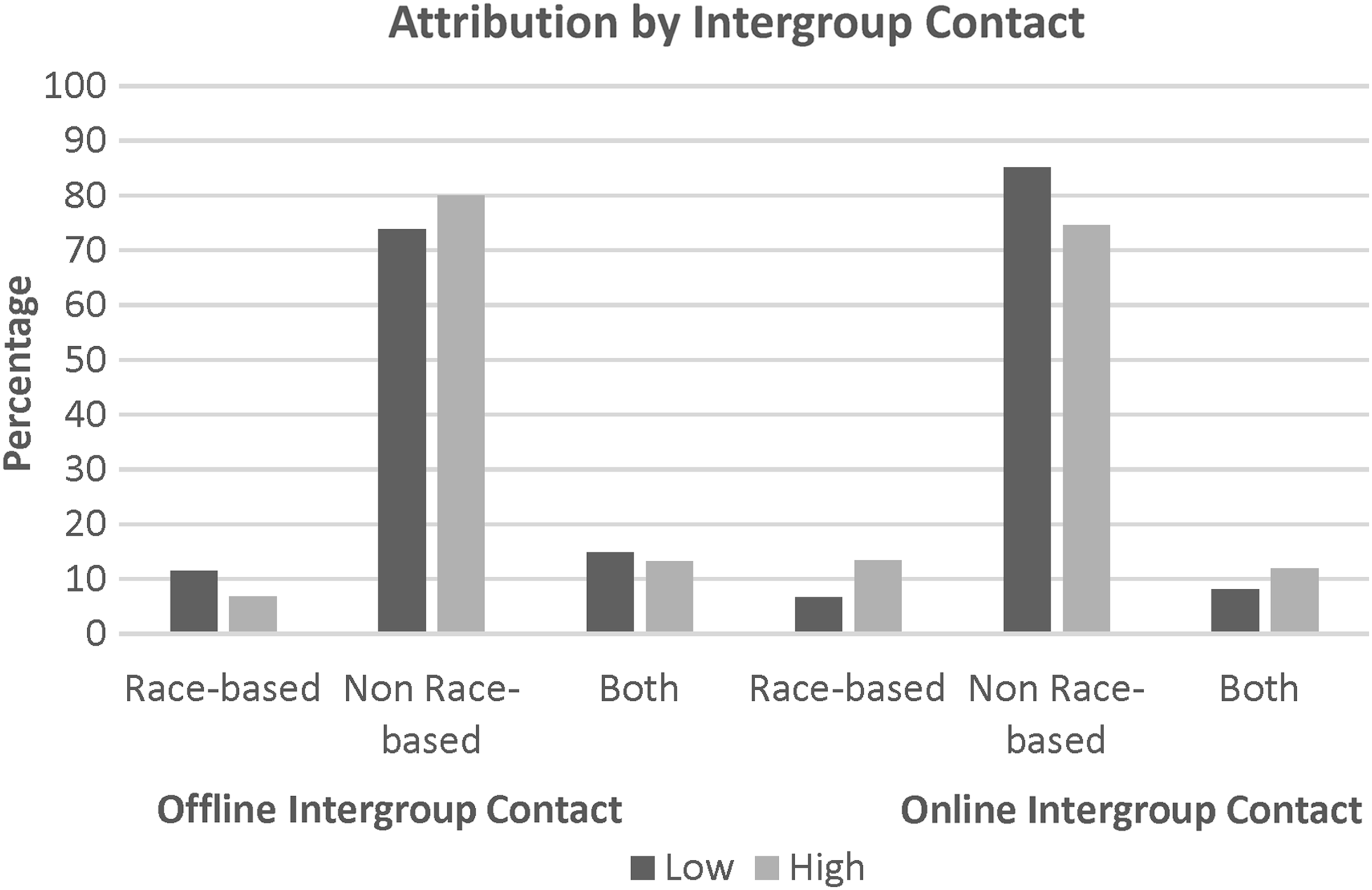
The percentages of attributions to offline and online exclusion by intergroup contact.

The percentages of attributions to offline and online exclusion by intergroup contact.
To examine evaluations of the two types of exclusion, a 2 × 2 × 2 × 2 (exclusion context: online, offline × type of exclusion: race-based, nonrace-based × offline contact: high, low × online contact: high, low) analysis of covariance (ANCOVA) controlling for ethnicity and age was conducted on wrongfulness ratings for exclusion.
There was a main effect of the type of exclusion, F(1, 129) = 56.163, p < 0.001, ηp 2 = 0.303 indicating that participants rated race-based exclusion as significantly more wrong than nonrace-based exclusion (Table 1). There were significant three-way interactions between context, type of exclusion, and offline intergroup contact, F(1, 129) = 4.93, p = 0.028, ηp 2 = 0.037, and between context, type of exclusion, and online intergroup contact, F(1, 129) = 7.21, p = 0.008, ηp 2 = 0.053. Participants with low offline contact rated offline nonrace-based exclusion (exclusion that was not about race) as more wrong than online nonrace-based exclusion, p < 0.001. Participants with low offline contact also rated online nonrace-based exclusion as more okay compared with participants with high offline contact, p = 0.021. Furthermore, participants rated race-based exclusion as more wrong across levels of offline contact (high and low) and exclusion contexts (offline and online) as compared with nonrace-based exclusion (all p-values <0.001). Participants with high online contact rated offline nonrace-based exclusion as more wrong than online nonrace-based exclusion, p < 0.001. Lastly, participants rated race-based exclusion as more wrong across levels of online contact and exclusion contexts compared with nonrace-based exclusion (all p-values <0.001).
To examine estimations of the frequency of exclusion in online and offline scenarios a 2 × 2 × 2 × 2 (exclusion context: online, offline × type of exclusion: race-based, nonrace-based × offline contact: high, low × online contact: high, low) ANCOVA controlling for ethnicity and age was conducted on the ratings of the frequency of exclusion. There was a main effect of type of exclusion, F(1, 129) = 67.21, p < 0.001, ηp 2 = 0.343, indicating that participants estimated nonrace-based exclusion as significantly more likely than race-based exclusion. There was also an interaction between context and type of exclusion, F(1, 129) = 4.81, p = 0.030, ηp 2 = 0.036. Participants reported significantly higher estimates of the frequency of race-based exclusion in the offline scenario than in the online scenario.
Discussion
Around 70 percent of adolescents and young adults report that they sometimes feel excluded when using social media and 64 percent of adolescent users of social media report that they encounter racist, sexist, or other prejudicial content in online settings. 30 Our novel findings indicate that both online and offline intergroup contact are important for understanding adolescent and young adult evaluations of interracial exclusion. While it was an open question whether male adolescents and young adults would evaluate online and offline exclusion differently, we found that there are important differences in how this group thinks about online and offline exclusion.
Confirming our third hypothesis, participants evaluated race-based reasons for interracial exclusion as much less acceptable than nonrace-based reasons in both online and offline settings. This provides a key new extension of prior research that had documented that children and adolescents judge race-based exclusion as less acceptable than nonrace-based exclusion in in-person contexts. 4 Additionally, participants were much more likely to attribute interracial exclusion to nonrace-based than to race-based reasons in both settings. For instance, participants frequently mentioned a lack of shared interest in the same games or that they may not have much in common. Thus, adolescents and young adults take a measured approach when considering interracial exclusion. Participants do not assume that race is necessarily the cause for the exclusion, but they recognize that if the reason is race based, then this type of interracial exclusion is much less acceptable than interracial exclusion that is non race based (for instance because of a lack of shared interests).
Supporting this pattern of findings and confirming hypothesis 4, participants rated race-based exclusion as unlikely to occur in either setting. While these low ratings of the frequency of race-based interracial exclusion suggest that participants were not likely to assume prejudicial or racist behavior on the part of their peers, these findings also raise questions about how aware adolescents and young adults are of the discriminatory experiences their peers encounter. Participants in the current study were predominantly European American males. Prior research indicates that individuals from ethnic majority backgrounds may estimate lower frequencies of race-based interracial exclusion in offline settings than do individuals from ethnic minority backgrounds. 14 Additionally, research suggests that individuals who are exposed to color-blind mindsets are less likely to perceive racial discrimination. 31 Findings suggest that cyberbullying is also increasing over time, with social media becoming a common outlet for bias-based cyberbullying. 32 Given these reports, research should examine whether adolescents and young adults are inaccurate in their low attributions of race as the explanation for interracial exclusion.
Importantly, these findings were novel in measuring both online and offline intergroup contact. First, confirming our first hypothesis, our results demonstrate that participants with high levels of offline intergroup contact also report high levels of online intergroup contact. However, confirming our second hypothesis, participants with high offline intergroup contact rated online nonrace-based exclusion as more wrong than those with low offline intergroup contact. These participants may have recognized that nonrace-based reasons for exclusion could be rooted in stereotypes about race or ethnicity. As an example, individuals may, at times, use information about race, including stereotypes, when making decisions about shared or common interests others may have. 33 Thus, in-person, offline intergroup contact is important for recognizing the wrongful nature of racial exclusion even in online settings. Given how frequently young people do engage in social interactions online, this finding is particularly salient—their offline contact experiences may help them navigate these new online worlds.
Furthermore, also confirming our second hypothesis, participants with high online contact rated offline nonrace-based exclusion as more wrong than online nonrace-based exclusion. They may be concerned that offline nonrace-based exclusion is likely to be more harmful to the target of exclusion because it is done in person compared with online nonrace-based exclusion. Research should aim to unpack this finding in more detail, perhaps through focus groups or in-depth interviews to understand if the salience of the online and offline interracial exclusion scenarios is evaluated similarly by participants.
While the current study provides new information about evaluations of interracial exclusion in online and offline settings, there are a number of limitations to this research. First, this study measured self-reported intergroup contact and involved evaluations of hypothetical scenarios. Future research might use additional methods for quantifying online intergroup contact and evaluations of exclusion. Second, this study focused on interracial exclusion, but future research should also examine exclusion based on other group membership categories, such as religion or sexual orientation. Moreover, future research should include female and ethnic minority participants to provide a broader representation of attitudes about social exclusion.
In summary, this study provided new information about interracial exclusion in online settings. First, young people recognized the harmful nature of race-based interracial exclusion in both offline and online settings. Participants did not expect high rates of race-based interracial exclusion online or offline and were unlikely to attribute interracial exclusion to race-based causes. Furthermore, individuals with high levels of offline intergroup contact were also likely to have high levels of online intergroup contact. Moreover, participants with high intergroup contact were more likely to recognize the harmful nature of some types of interracial exclusion.
Footnotes
Acknowledgments
This article is based on the doctoral dissertation of the first author under the supervision of M.D.R., the fifth author, and submitted to the Graduate Center, City University of New York, in partial fulfillment of the PhD degree and supported in part by a Graduate Center Research Fellowship also awarded to the first author.
Author Disclosure Statement
No competing financial interests exist.
Funding Information
No funding was received for this article.