




Abstract
Abstract
Drawing on the uncanny valley effects (UVE) hypothesis and related works on avatar-based interactions, this study investigates the role of UVE (i.e., a feeling of eeriness), induced by avatar realism and animacy, on the perceived trustworthiness (PT) of an avatar user, and subsequent decisions to befriend that avatar user in a virtual social networking service (SNS). Specifically, the current study examines whether (1) the realism (hyperrealistic vs. cartoonish) and animacy (animate vs. still) of avatars, rendered through a 3D scanning technology, will induce a feeling of eeriness as a result of UVE; (2) the degree to which perceivers experience a feeling of eeriness will negatively bias the PT of an avatar user; and (3) PT, determined by UVE, will serve a role as a gating mechanism for the decision whether to befriend the unknown avatar user in a virtual SNS. Results from a two (realism: cartoonish vs. hyperrealistic) × two (animacy: still vs. animate) between-subjects online experiment (N = 134) indicated that a feeling of eeriness, induced by the realism and animacy of avatars, negatively biased the PT of the avatar user, and this, in turn, led avatar perceivers to reject a friend request sent from the unknown avatar user. These results call into the question the effectiveness of rendering avatar realism in social virtual environments. Overall, the findings of our research provide theoretical as well as practical implications for the design of avatars in virtual SNSs.
Introduction
With advances in visual simulation technologies, virtual environments (VEs) can now offer benefits for the utilization of more human- (or self-) like avatars. Recently, virtual reality (VR) content creators (e.g., High Fidelity) have begun to develop a software that enables the quick and effortless creation of photorealistic and animate avatars for social VR and games utilizing a full-body 3D scanning technology. At the heart of this technological advance is the premise that the rendering of photorealistic and animate avatars will make social interactions in VEs more seamless and authentic, which connotes that avatar realism will engender positive effects on user perceptions. In support of this premise, previous works have established the positive relationship between avatar realism and social perceptions such as likability and trust.1–4 Along with such findings, social presence theory 5 and/or the Modality, Agency, Interactivity, and Navigability model 6 demonstrate that rendering realism in media technologies can engender positive user perceptions.
However, the uncanny valley effects (UVE) hypothesis 7 conversely suggests that enhancing realism in anthropomorphic entities may not always induce positive user perceptions, but avatar realism may paradoxically induce perceivers' negative affective state (i.e., a feeling of eeriness). Potentially, the positive relationship between avatar realism and trust might unfold differently upon the activation of UVE, as social judgments have been found to be biased in the direction of prevailing affective states. 8 In line with this notion, some studies found that avatar realism can negatively influence the trustworthiness ratings of an avatar.3,9 Furthermore, avatar impressions were found to be extended to the evaluation of a person represented by the avatars, 10 which suggests that UVE may potentially bias the evaluation of the trustworthiness of a person represented by an avatar. Given that perceived trustworthiness (PT) serves a role as a gating mechanism for future social interactions, 11 the PT of an avatar user, biased by UVE, may play a pivotal role in determining people's decisions to befriend that user in a virtual social networking service (SNS).
Taken together, this study explores whether (1) the realism and animacy of avatars, rendered through a recent 3D scanning technology, will influence a feeling of eeriness (i.e., UVE); (2) a feeling of eeriness will negatively bias the PT rating of an avatar user; and (3) the PT of an avatar user, biased by UVE, will influence avatar perceivers' decisions to befriend that user in a virtual SNS. This investigation may provide insight into the future design of avatars in virtual SNSs.
Uncanny valley effect
The UVE hypothesis predicts that enhancing avatar realism may paradoxically engender perceivers' negative responses (i.e., a feeling of eeriness) due to “inconsistency in the realism of an anthropomorphic entity's features.” 12 Previously, a feeling of eeriness has been conceptualized as a negative affective state that could be activated when human-like features nearly approximate real human entities, but fail to be perceived as real human properties. 13 Although simulation technologies nowadays enable the creation of photorealistic artificial entities, recent studies demonstrate that they are still not free from UVE. 12 While inconsistency in the human-likeness 14 of artificial entities was found to play a major role in activating UVE, animacy15–17 can also induce negative responses when there is a mismatch between a biological appearance and mechanical movement.13,15 Animacy was found to instigate a greater feeling of eeriness when it is applied to relatively more human-like entities.13,16,18,19
Past findings suggest that even hyperrealistic and animated avatars rendered through a recent 3D scanning technology will likely engender UVE. However, given the curvilinear nature of the UVE hypothesis, it remains an open question whether they will indeed induce a greater feeling of eeriness (compared with cartoonish and still avatars) by paradoxically falling into the uncanny chasm hypothesized in the original model. 7 Therefore, we first test the UVE hypothesis in the context of a recent 3D scanning technology through the following research questions:
RQ(a/b): Will (a) hyperrealistic and (b) animated avatars induce a greater feeling of eeriness compared with cartoonish and still avatars respectively?
RQ(c): Will applying animacy to hyperrealistic avatars amplify a feeling of eeriness (compared with applying animacy to cartoonish avatars)?
UVE and PT
Previous studies suggest that the feeling of eeriness elicited by UVE may negatively bias PT of an avatar user. Previous research demonstrates that enhancing human-likeness of an artificial entity can negatively influence the credibility rating of the entity when people perceive the features of an artificial entity as not sufficiently representing real human properties.
9
Worthy of note, such avatar impressions were found to extend to the evaluation of a person represented by an avatar,
10
while they can be biased in the direction of prevailing affective states.
8
These related works8–10
suggest that a negative affective state (i.e., a feeling of eeriness), signaled by UVE, may negatively bias the PT of an avatar user. Guided by the previous findings, we posit:
PT and friendship decision
As social interactions among unacquainted individuals are increasingly taking place on SNS,20,21 SNS users often face situations, in which they have to make decisions whether to befriend unknown others using only limited information (e.g., profile photo, the number of mutual friends). Previous studies demonstrate that befriending is a social behavior by which individuals make decisions whether to share their personal information with others.22,23 Although befriending strangers can be risky as it often accompanies risks of privacy invasion (e.g., cyber-stalking, identity theft),22,24 SNS users are found to willingly share their information when trust is established.
25
This is because people often make decisions whether to approach or avoid a person on the basis of PT of a target individual.11,26 Given that people make such decisions by heavily relying on the first impressions formed via visual information,11,26,27 we speculate that the likelihood of accepting the friend request sent from an unknown avatar user will decrease when the PT rating of the avatar user decreases as a result of UVE:
Mediation path
Finally, we aim to validate the process by which UVE influence people's friendship decisions through the mediation of PT. We specifically test if the PT of an avatar user will mediate the impact of UVE (i.e., a feeling of eeriness) on the likelihood of a friend request acceptance. Accordingly, we posit:
Methods
Experiment
We used a two (realism: cartoonish vs. hyperrealistic) × two (animacy: still vs. animate) between-subjects online experiment to validate the proposed hypotheses. Worthy of note, the original experiment was deliberately designed to collect data for two different studies at once, and subset of the variables (30 percent) in the full dataset was used for another published study. 13 The published study examined the role of UVE on avatar perceivers' information processing style and subsequent accuracy of personality judgments (i.e., extraversion, agreeableness, and neuroticism). While this research shares the same experimental protocol with the published study, the current research only reused the independent variable (i.e., a feeling of eeriness) and a few demographic variables (i.e., age, gender, education level) in the full dataset to investigate whether and how UVE will affect social connections among avatar users in a virtual SNS through the mediating role of PT. The variables measured for the current study, including PT, friendship decision, familiarity with 3D avatars (F3D), and disposition to trust, are not used in the published study.
Participants
Participants (N = 134) were recruited through Amazon Mechanical Turk, and they were randomly assigned to each condition. To control the potential effects of sex-differences, we approximately balanced the sex of the participants across the conditions. Approximately 54 percent of the participants were females (N = 72, 53.7 percent) and the average age of the participants was 33.7 (SD = 9.06), ranging from 19 to 67. On average, participants reported modest levels of F3D based on a single seven-point scale item (i.e., “Please indicate your previous experiences with computer-generated 3D graphic avatars.”; 1 = very unfamiliar; 7 = very familiar; M = 4.62, SD = 1.77). The detailed demographic information of the participants is presented in Table 1.
Demographic Information
Materials
For the development of stimuli, we used Crazy Talk 8 Pro. 28 This software enables the creation of 3D avatars and the application of motions through a 3D scanning technology. The stimuli created using this software are presented in Figure 1. In the animated conditions, both cartoonish and hyperrealistic avatars had exactly the same neutral facial movement (i.e., blinking).

The final stimuli used for the experiment (cartoonish and hyperrealistic avatars) and the actual photo used for the development of the stimuli (Reprinted with permission from Shin et al. 13 ).
Procedures
Participants were presented with a scenario before their exposure to stimuli (for more details, see Fig. 2). This scenario was designed to facilitate participants' understanding of the experimental manipulation, in which they receive a friend request from an unknown avatar user in a virtual SNS. After the exposure to the scenario, we had the participants watch either a hyperrealistic or a cartoonish avatar that was either still or animated for 20 seconds and complete an online questionnaire. In exchange for participation in the Institutional Review Board-approved study, participants received $1.20.

The scenario presented in the experiment.
Measures
Eeriness was measured by existing three bipolar adjective items (e.g., “reassuring/eerie”) with a 7-point semantic differential scale 29 (α = 0.76). PT was measured by existing five 7-point Likert scale items 30 (e.g., “I can freely share my ideas, feelings, and hopes with the person behind the avatar”) (α = 0.90). Friendship Decision was measured through the following single item: “Will you accept the friend request sent from the avatar user?” (“Accept” = [1] and “Reject” = [0]). To control for demographic characteristics, age, gender, ethnicity, education level, and F3D were also measured. In addition, given that people who have a high disposition to trust (DT) tend to indicate greater trust toward others, DT was measured and controlled using existing eight seven-point Likert scale items 31 (e.g., “I usually trust people until they give me a reason not to trust them”; α = 0.94).
Results
Among the demographic variables, gender, F3D, and DT were included as control variables in the analyses. Other variables, such as age, ethnicity, and education level, were dropped because they did not have any significant effects on other measured variables. The means, standard deviations, and correlations among the variables included in the analyses are presented in Table 2.
Mean, Standard Deviation, and Correlations of the Measured Variables
p < 0.05.
p < 0.01, two-tailed.
Gender: Male = 1, Female = 2; F3D, familiarity with 3D graphic avatars; DT, disposition to trust; PT, perceived trustworthiness.
A two-way analysis of covariance (ANCOVA), with gender and F3D as covariates, was conducted to test the RQs. Results showed that the participants who were exposed to the hyperrealistic avatar (M = 4.78, SE = 0.14) reported a greater feeling of eeriness than the participants who were exposed to the cartoonish avatar (M = 4.15, SE = 0.14), F(1, 128) = 10.57, p < 0.01, ηp 2 = 0.08. In addition, the animated avatar (M = 4.77, SE = 0.14) induced a greater feeling of eeriness than the still avatar (M = 4.17, SE = 0.14), F(1, 128) = 9.74, p < 0.01, ηp 2 = 0.07. We also found a two-way interaction between human-likeness and animacy significantly predicting the feeling of eeriness, F(1, 128) = 4.48, p < 0.05, ηp 2 = 0.03. A post hoc analysis, using the Bonferonni correction method, showed that the animate avatar (M = 5.29, SE = 0.20) engendered a greater feeling of eeriness than did the still avatar (M = 4.28, SE = 0.19) in the hyperrealistic condition. However, the animated avatar (M = 4.25, SE = 0.19) did not significantly instigate a feeling of eeriness compared with the still avatar (M = 4.06, SE = 0.19) in the cartoonish condition. Covariates did not have significant effects on a feeling of eeriness.
Next, a multiple regression analysis was conducted to validate H1 and H2. After controlling for gender, F3D, and DT, results indicated that a feeling of eeriness is negatively associated with the PT of the avatar user, β = −0.33, t(129) = −4.03, p < 0.001. Among the control variables, DT was also found to significantly influence the PT of the avatar user, β = 0.19, t(129) = 2.28, p < 0.05. The multiple regression model accounted for 15 percent of the variance in the PT of the avatar user (R 2 = 0.15). Regarding H2, results showed that the PT of the avatar user significantly increased the friendship likelihood by 169 percent, b = 0.99, Wald χ 2 (1) = 26.50, p < 0.001, Nagelkerke R2 = 0.39. Among the control variables, only F3D significantly increased the friendship likelihood by 33 percent, b = 0.29, Wald χ 2 (1) = 5.08, p < 0.05. Hence, H1 and H2 were supported.
Finally, a mediation analysis was conducted to test H3. We used the PROCESS macro, 32 with a bias-corrected bootstrapping estimation of 5,000 replicates (Model 4). Results from a mediation analysis showed that the PT of the avatar user significantly mediated the effects of a feeling of eeriness on friendship decision: 95 percent CI [−0.64 to −0.14] (for more details, see Table 3 and Fig. 3). Therefore, H3 was supported.
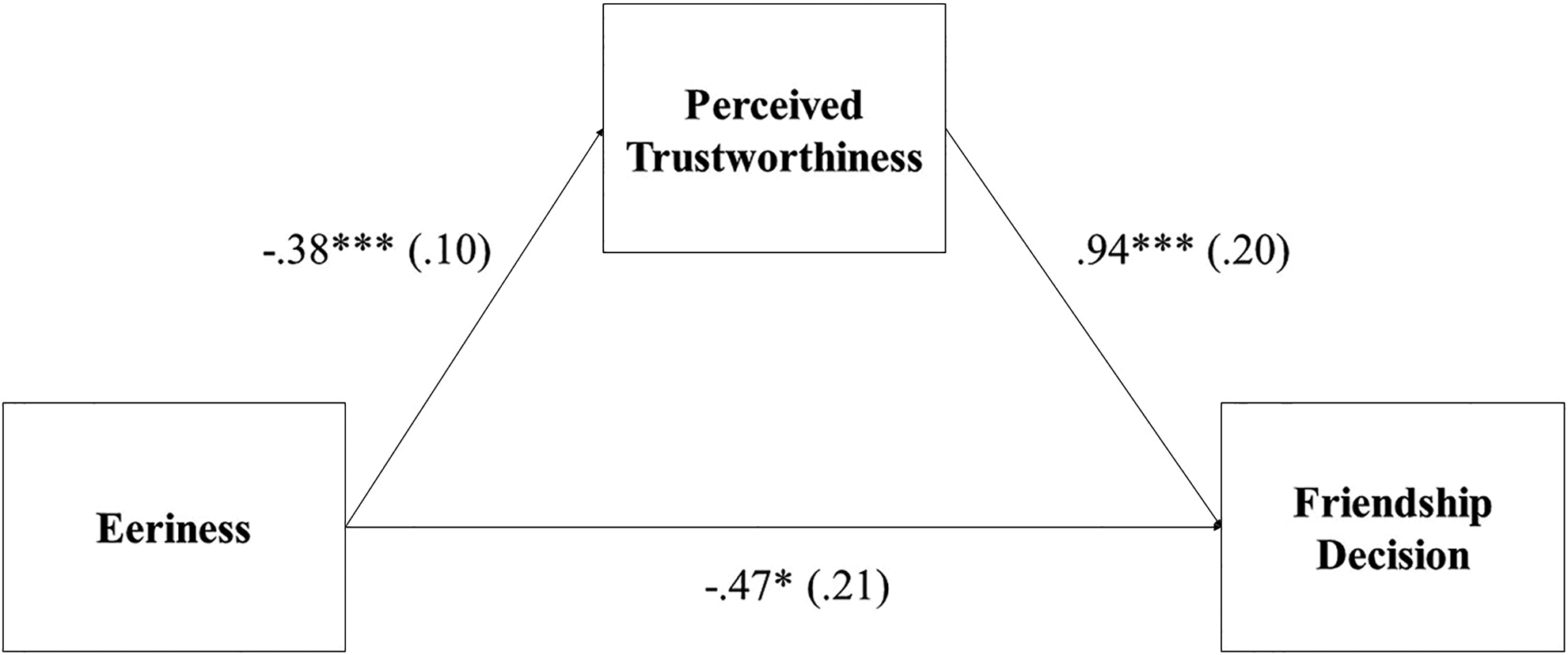
Standardized regression coefficients for the relationship between eeriness and friendship decision as mediated by perceived trustworthiness (Figures in parentheses denote standard errors). *p < 0.05; ***p < 0.001.
Mediation Effects
p < 0.001, two-tailed.
Unstandardized path coefficient.
Bias-corrected 95 percent confidence interval.
Discussion
This study investigated the potential negative impact of UVE on the PT of an avatar user and its subsequent effects on the friendship decision in a virtual SNS. While supporting UVE in the context of a 3D scanning technology, this study confirmed that UVE can negatively bias the PT of an avatar user. This finding adds much to the previous notion that avatar impressions can be extended to the evaluations of an avatar user, 10 and social judgments can be biased in the direction of prevailing affective states. 8 In addition, this finding suggests that UVE might have affected the results of the previous study, in which less human-like entities were perceived as more credible than more human-like entities. 9
Our study also found that the PT of an avatar user can directly determine avatar perceivers' decisions to befriend that user. This is in alignment with the previous notion that PT can play a pivotal role as a gating mechanism for future social interactions. 11 Moreover, results from a mediation analysis showed that UVE can lead people to reject a friend request sent from an unknown avatar user by biasing the PT of the user. Intriguingly, a recent study found that incorporating human-like warmth to a robot hand can negatively influence the likelihood of the acceptance of the robot when people feel unfamiliar or uncomfortable with a human-like entity. 33 This is in line with the notion that UVE is correlated with familiarity and psychological discomfort. 12 This research, together with our findings, suggests that UVE may intervene in the process by which the human-likeness of artificial entities negatively influence the likelihood of the acceptance of the entities.
Our research has theoretical as well as practical implications. Regarding the theoretical implication, our study advances existing scholarship by ascertaining that UVE may not only bias the social judgments of an avatar itself, but this also can be extended to the evaluations of the avatar user. Our study extends prior research on the effects of avatar realism on social judgments (e.g., credibility, likability)8,9 to the realm of social behaviors in SNS (i.e., befriending). Based on our findings, future researchers may further investigate whether UVE will also engender negative impacts on other social behaviors such as negotiation and philanthropic behaviors.
This study also has practical implications for the design of avatars in recent virtual SNSs. Specifically, our findings demonstrate that even rendering hyperrealistic avatars through recent 3D scanning technologies may not be effective for forging a successful social community in virtual SNSs as they were found to result in UVE. Unless avatar realism satisfies the expectation of perceivers, it may evoke an aversive response and reduce people's willingness to network with other unknown users. Therefore, virtual SNS platforms that aim to use photorealistic avatars for the construction of a successful social community using 3D scanning technologies should take a careful approach to designing avatars, as it may backfire upon the activation of UVE.
Limitations and Future Directions
This study has a few limitations that merit attention for future researchers. First of all, the fact that this research only used female avatars for the experiment raises a question whether the findings will remain consistent with male avatars. While we used female avatars to make our study design more conservative as people, in general, indicate greater likability (i.e., less negative feeling) toward female avatars than toward male avatars, 34 it merits further investigation whether the same effects will be found for male avatars. Women and men may differ in perceived trust and the likelihood of befriending male strangers online. However, UVE may have a similar type of effects on these factors.
Another limitation pertains to the fact that the current research did not measure participants' previous experiences with SNSs. Given that heavy users of SNSs more willingly share their information, 35 how heavily people use SNSs may moderate the influence of UVE on the friendship decisions. In this regard, we suggest that future researchers take into account the role of participants' previous experiences with SNSs to add much to the generalizability of our findings.
Although this study indicates that hyperrealistic avatars, rendered through a 3D scanning technology, may not be effective for enhancing social connections upon the activation of UVE, rendering certain features into hyperrealistic avatars (e.g., adding positive facial expression) may potentially compensate for such negative effects by making them deviate from the uncanny chasm hypothesized in the UVE model. For example, rendering smiles into hyperrealistic avatars may compensate for UVE as exhibiting smiles in synthetic facial stimuli (i.e., avatar faces) was found to induce favorable judgments 36 and greater likability from their perceivers. 34 Given the findings, we suggest that future researchers investigate the avatar features that could resolve UVE in virtual SNSs. In conclusion, our study provides insight into how future avatars should be designed in virtual SNSs.
Footnotes
Author Disclosure Statement
No competing financial interests exist.
Funding Information
No funding was received for this article.