




Abstract
Abstract
Previous research on cyberbullying has almost entirely focused on examining its prevalence among teens and young adults leaving it unclear how prevalent it is within the wider population. The present study used a New Zealand (NZ) national sample (N = 20,849) to examine gender, age, and ethnic differences in the experiences of cyberbullying victimization. On average, nearly 14.9 percent of respondents stated that they have ever been a target of cyberbullying before, with 2.2 percent respondents reporting such experiences within the past month. While young adults (18–25 years) experienced the highest levels of cyberbullying during both time frames (lifetime and past month), the prevalence of cyberbullying was lower among older age cohorts, with the lowest rate among the 66+ age group. Reports of cyberbullying slightly varied among men and women, with women overall reporting slightly greater levels of having ever experienced cyberbullying than men; however, this significant difference did not carry into reports of cyberbullying over the past month. On average, participants identifying as European reported lower levels of cyberbullying than Māori and Pacific Nations participants during both time frames, with Asian participants falling in the middle. Taken together, these findings provide a nuanced understanding of the prevalence of cyberbullying in a large national sample of NZ adults.
Introduction
Over the last decade, advancements in cyberspace have enabled greater connectivity between people across geographical divides. 1 While people certainly gain benefits from such technological advancements, 2 considerable attention has also been paid to the negative side effects of cyber activity. Cyberbullying, popularized as “virtual abuse,” is defined as intentionally aggressive behavior 3 that is implemented via digital communication such as e-mail, text messages, or mobile phone.4–6 Many studies note that it has been linked to a host of negative outcomes at both the physical and psychological levels. 7 One meta-analysis of 131 studies suggests that increased stress, loneliness, and dependence on alcohol were among the outcomes of such experiences. 7 A review of 36 studies investigating the health-related effects of cyberbullying found that as many as 2 percent of young victims had self-harmed after being bullied online.8,9 One longitudinal study looking at cyberbullying and depression also found youth reporting depression symptoms over time as a result of cyberbullying. 10
How prevalent is cyberbullying?a Some previous research suggests that cyberbullying has become commonplace since domestic digital technologies became indispensable to daily living. 3 A 2011 report found that ∼12 percent of European 9–16-year olds had been harassed online. 11 Similarly, the Cyberbullying Research Center started collecting data from more than 25,000 students across the United States in 2002, reporting a victimization rate of 33.6 percent in 2018. 12 Such work has been invaluable highlighting the widespread nature of cyberbullying among teens. However, it is less clear whether cyberbullying occurs among other age groups, and whether there are additional ethnic and gender differences in cyberbullying across one's life span.
As most research on the topic has focused on examining cyberbullying among children and teenagers, 7 with fewer studies looking at cyberbullying of adults (and even these have most specifically focused on cyberbullying in the workplace),13,14 here we utilize a nationally representative adult sample. To the best of our knowledge, only one study (N = 2, 515) has been undertaken on cyberbullying rates across the general population. 15 Using questionnaires in 2008, the study found that in the Czech Republic, adolescents (12–19 years) and young adults (20–26 years) were more often targeted by cyberbullying than 27–35, 36–49, and 50+ age groups. 15 While the study presents a statistically significant difference by age that someone is a target, cyberbullying rates are relatively similar between adolescents and young adults (e.g., percentage of participants who have ever been mocked, humiliated, or hurt on the Internet: 4.5 percent vs. 4.4 percent). 15 The present study will build upon this work by examining cyberbullying rates to gauge its overall prevalence in a national sample of adults across several age cohorts ranging from 18 to 97 years, shedding light on both people's lifetime experiences and their experiences with cyberbullying over the past month to assess both lifetime experiences and recent experiences within the same time frame.
Gender and ethnic differences in cyberbullying across the life span
In addition to examining cyberbullying across the life span, the present study also examines whether there are gender and ethnic differences in reported cyberbullying incidents. Past research on the topic has consistently yielded mixed results on gender differences in cyberbullying. 16 While one line of research presents no gender differences in the frequency of cyberbullying (see the cross-national survey by HBSC 2013–14), 11 others note that women are more likely to experience cyberbullying than men (see EUKO survey in 25 countries). 17 Moreover, gender differences may depend on the context of an online environment, with women reporting more abuse, via instant messages or social media, and men reporting more incidences during online gaming.18–20 With these considerations in mind, the present study compares the victimization of men and women across different age cohorts spanning adulthood by focusing on general experiences of cyberbullying via the Internet, mobile phone, or digital cameras in a large nationally representative sample.
Furthermore, beyond age and gender differences,7,16 little research has focused on ethnic differences (for details, see Kowalski et al. 7 ). The present study is the first to examine ethnic differences in cyberbullying within the general population of New Zealand (NZ), a small ethnically diverse nation in the South Pacific in which ∼70 percent of the population report European ancestry, ∼15 percent report Māori (indigenous) ancestry, another 13 percent report Asian ancestry, and ∼8 percent report non-Māori Pacific Island ancestry. 21 Existing research into bullying across ethnicities in NZ has mainly concentrated on traditional forms of harassment among teenagers.22–24 While some studies suggest that NZ Europeans experience the highest levels of offline bullying in school, 22 other studies suggest that Māori, Pacific Nations, and Asian adolescents are more likely to experience offline bullying than NZ Europeans.23,24 This leaves it unclear what to expect with regard to cyberbullying, especially when considering ethnic differences in a general adult population. The current study will therefore populate a large and diverse sample in terms of gender, ethnicity, and age to examine the incidence of cyberbullying in NZ and determine what differences, if any, exist among various subgroups.
Method
Sampling procedure and participants
We analyzed data from the 2017 (Time 8) New Zealand Attitudes and Values Study (NZAVS), a longitudinal study of a nationally representative sample of adult New Zealanders. The data set contained responses from 21,938 participants, of whom 20,849 completed the measures relevant to this study. Of these participants, 13,130 were female and 7,719 were male. Participant ages ranged from 18 to 97 years (M = 49:58 years;SD = 13:90) and were broken into six age cohorts initially at 18–25, then 26–35, 36–45, 46–55, 56–65, and 66+ years. Samples were collected using the NZ electoral roll, which lists all registered voters older than 18 years, where registration is compulsory for all NZ Permanent Residents and Citizens (for details on sampling procedure, see the NZAVS technical document). 25 Of these participants, 17,067 reported primarily European ancestry (81.9 percent), 2,400 Māori ancestry (i.e., indigenous New Zealander; 11.5 percent), 478 Pacific Nations ancestry (2.3 percent), and 904 Asian ancestry (4.3 percent). Note that as participants were able to identify with more than one ethnic group, the total adds up to more than 100 percent.
Analyses applied the standard NZAVS poststratification sample weights. These weights adjust for differences in expected response rates for gender, geographical region, and ethnicity. 25 Previous research has validated these weights and indicates, for example, that with weighting, the NZAVS provides reliable estimates of voting behavior and closely tracks independent random digit dial poll tracking change in vote intention over time. 26
Measures
Demographics
Participants provided their responses to a number of basic demographic information, including their age, gender, ethnicity, employment status, and socioeconomic status. However, the key variables of interest here were ethnicity, gender, and age.
Cyberbullying items
Participants responded “yes” or “no” to the following two consecutive items about cyberbullying: “Has someone ever used the Internet, a mobile phone, or digital camera to hurt, intimidate, or embarrass you?” and “… has this occurred in the last month?”
Results
Across the sample (
Overall rates by age cohorts
As Figure 1 presents, young adults (18–25 years) experienced the highest levels of cyberbullying, with 40.5 percent reporting that they had been cyberbullied before. However, cyberbullying also emerged across other age cohorts, with 24 percent reporting having experienced cyberbullying in the age group 26–35 years, 15.1 percent among those aged 36–45 years, 13 percent among those aged 46–55 years, and 6.5 percent in the 66+ age group, the lowest rate. These differences were statistically significant across age cohorts,
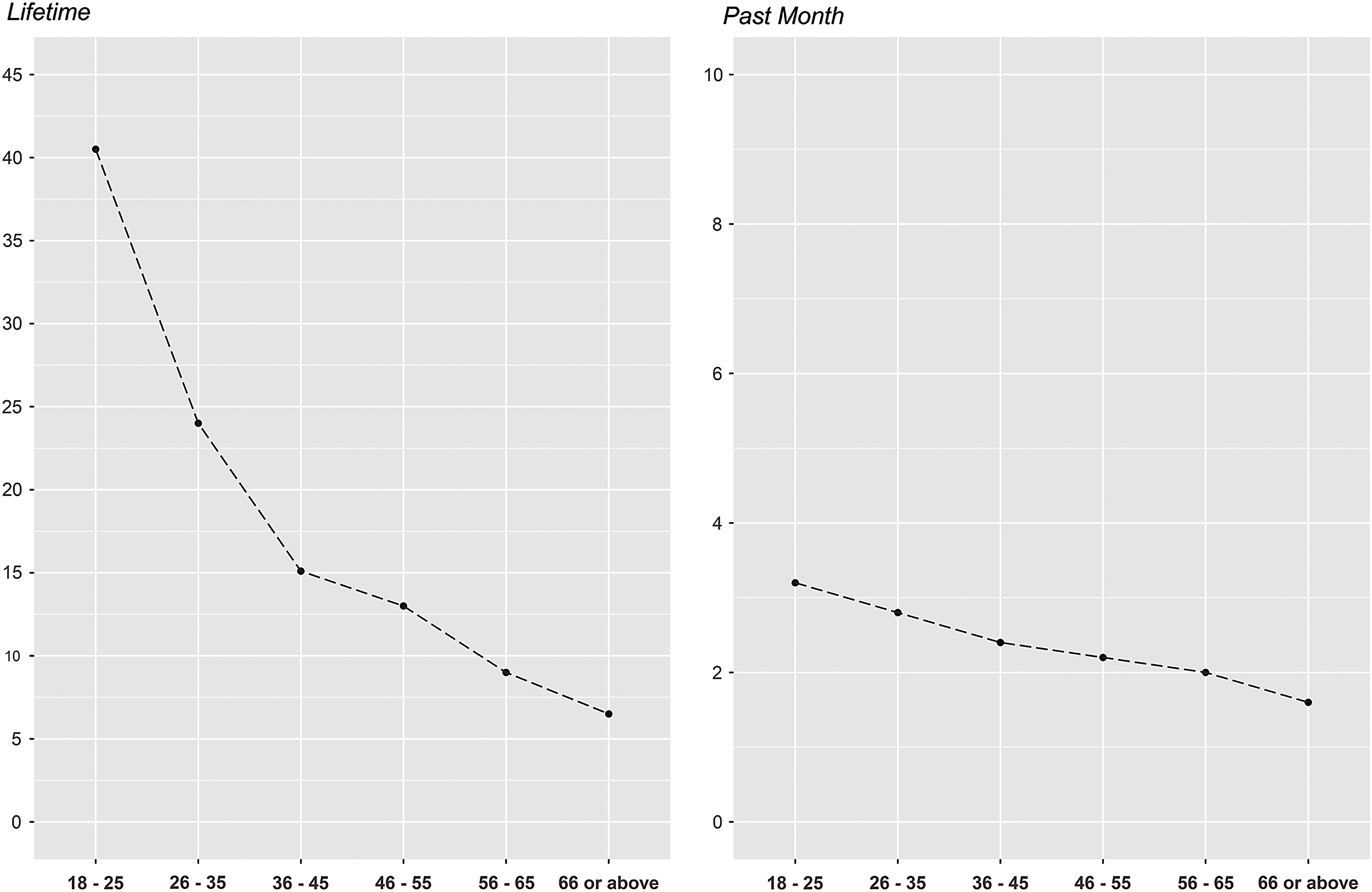
Percentage of respondents who reported “yes” to having experienced cyberbullying across age cohorts.
Concerning cyberbullying within the past month, the level of victimization was comparatively lower, but followed a similar pattern to that outlined above, with young adults (18–25 years) reporting the highest level of cyberbullying (3.2 percent), followed by a steady but small decrease among the older participants (e.g., 26–35 years: 2.8 percent; 36–45 years: 2.4 percent),
Gender and ethnic differences across the life span
Figure 2 illustrates that the rate of cyberbullying varies slightly by gender, with women (15.8 percent) overall reporting slightly greater levels of having experienced cyberbullying than men (13.7 percent),
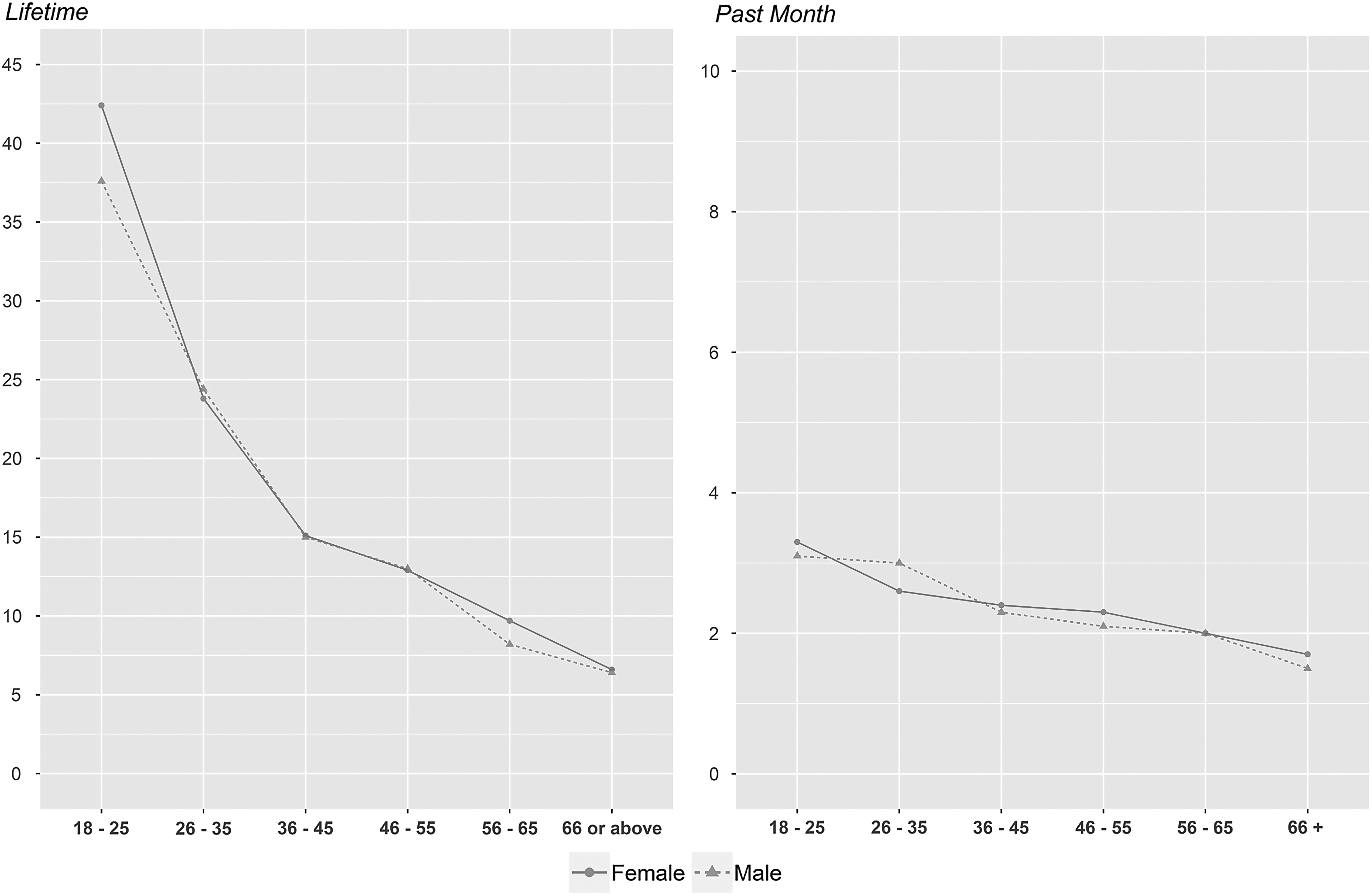
Percentage of respondents who reported “yes” to having experienced cyberbullying by gender across age cohorts.
Significant ethnic differences were found in reports of cyberbullying (
Number of Respondents in Each Subgroup Considering Age, Gender, and Ethnicity
NZ, New Zealand.
Percentage of Respondents Who Reported “Yes” to Ever Having Experienced Cyberbullying by Gender and Ethnicity Across Age Cohorts
Percentage of Respondents Who Reported “Yes” to Having Experienced Cyberbullying by Gender and Ethnicity Across Age Cohorts in the Past Month
There was a tendency for Māori women (22.8 percent) to more likely have encountered cyberbullying than men (16.4 percent), with the opposite trend found among Asians (female: 14.1 percent vs. male: 15.8 percent). European (14.5 percent) and Pacific Nations women (22.3 percent) were found to be slightly more likely to experience cyberbullying than European (12.5 percent) and Pacific Nations men (19.2 percent). Similar results remained when considering past-month experience, with Māori women (5.1 percent) reporting higher rates of cyberbullying than men (2.0 percent), and with opposite trends occurring among the Asian participants (female: 2.2 percent vs. male: 4.2 percent). However, as shown in Supplementary Table S3, gender only had a significant effect on cyberbullying among Māori relative to European participants.
Discussion
Literature on cyberbullying continues to grow, with rates varying according to a number of factors, including age, gender, and ethnicity.6–8 The present study used a large national sample of adult New Zealanders between the ages of 18 and 97 years, with a unique sampling of ethnic groups, contrasting men and women. With regard to age cohorts, the results indicate that cyberbullying is most prevalent among young adults (18–25 years), 40.5 percent of whom reported personal experience of this phenomenon during their lifetime. Although this finding exceeds the average rates reported by the Cyberbullying Research Center among teenagers 12 and also among college students in the context of Internet relay chat or text messaging (estimated at 10–40 percent), 7 the current work is the first to examine cyberbullying in a national sample of New Zealanders making direct comparisons difficult. Further research is therefore needed to clarify the phenomenon within an NZ context, and undertaken for the practical purpose of designing programs to help prevent cyberbullying.
Since cyberbullying began to be a common problem after related technology (e.g., Internet) became widely available in the early 21st century, 3 participants now in their 30s and 40s also reported a relatively high level of cybervictimization (lifetime rate: 24 and 15.1 percent), given that they were teenagers when the technology became more commonly available. However, the current study did not consider participants' age at the time of their first Internet use, which could be a confounding factor. 27 In this sense, future research investigating cyberbullying could focus on age at the time of first Internet use or a longitudinal approach could be applied to examine such experiences by the same participant.
The use of two separate cyberbullying items allowed us to assess both lifetime reports of cyberbullying and reports within a specific time frame, allowing us to compare frequencies across diverse age cohorts. The present findings indicate that on average, cyberbullying is indeed more prevalent among young adults than older age cohorts as evidenced by cyberbullying rates over the past month alone. However, with gender, the small differences observed over one's lifetime do not carry over when considering experiences over the past month.11,17 As gender differences may depend on the context of an online environment,18–20 future work would benefit from distinguishing between the media through which people were cyberbullied (e.g., via social media or online gaming). In addition, the present study reveals no interaction between age and gender suggesting that both men and women show similar decreases in cyberbullying experiences as they get older.
Consideration of ethnicity in the present work additionally provides a nuanced understanding of the prevalence of cyberbullying and notable differences among various subgroups. On average, participants identifying as European reported lower levels of cyberbullying than Māori and Pacific Nations participants during both time frames, with Asian participants falling in the middle. However, it is difficult to compare this finding with data gathered by other studies because previous research investigating ethnic differences in cyberbullying has largely been conducted in the United States among White European, Hispanic, and African American populations.28,29 Although there may be some shared experience among U.S. and NZ Asian/Pacific Nations participants, 24 too little data are available to draw a firm conclusion. Further research is therefore needed to clarify the ethnic differences in cyberbullying, particularly in Māori and Pacific communities, and to consider other factors such as socioeconomic status and religious affiliation. 11 Future research could also explore whether ethnic differences in cyberbullying reflect an extension of prejudice and discrimination in online settings.30,31
One limitation of the present study is that we rely on two single-item measures of cyberbullying that provide a less reliable measure of the phenomenon. However, as these data emerge from a national survey, space limitations create practical constraints that prevent the use of a more robust measure.25,26 Given these limitations, the present study provides a starting point for understanding the prevalence of cyberbullying among ethnically diverse male and female samples across all of adulthood. Practically, the present study reveals that cyberbullying is a concern among adults across one's life span that requires more attention.
Footnotes
Note
Author Disclosure Statement
No competing financial interests exist.
Funding Information
This research was supported by a grant from the Templeton Religion Trust (TRT0196). The funding source did not play a role in the study design, the collection, analysis, and interpretation of data, the writing of the report, or the decision to submit this manuscript for publication.

References
Supplementary Material
Please find the following supplemental material available below.
For Open Access articles published under a Creative Commons License, all supplemental material carries the same license as the article it is associated with.
For non-Open Access articles published, all supplemental material carries a non-exclusive license, and permission requests for re-use of supplemental material or any part of supplemental material shall be sent directly to the copyright owner as specified in the copyright notice associated with the article.
