




Abstract
The development of modern technologies has facilitated positive functioning in various aspects of everyday life. However, in addition to positive changes, there are also issues related to problematic behavior associated with new technologies and new media, such as problematic Facebook use (PFU) and problematic video gaming (PVG). Therefore, the purpose of this study was to present the specificity of these problematic behaviors in a group of gamers and determine their predictors and interrelatedness. In addition, the aim was to analyze the differences between male and female gamers. The study comprised 1,270 gamers (684 female gamers; age range from 15 to 34 years; M = 19.17 years; SD = 2.91 years). The intensity of PFU was assessed using the Facebook Intrusion Scale, and intensity of PVG was assessed using the Problem Video Game Playing Questionnaire. Results showed that 6.4% of females had high levels of PFU compared to 3.1% of males, and that 1.8% of females had high levels of PVG compared to 5.8% of males. Structural equation modeling showed different predicators for problematic internet use and PVG, despite the correlation between both problematic behaviors. These findings enable better understanding of the relationship between PVG and PFU among gamers and differences between female and male gamers.
Introduction
Over the past two decades, many scholars have been interested in the subject of problematic internet use (PIU), including (more recently) problematic social networking use. They have been especially interested in predictors of such behaviors (e.g., personal and motivational), trying to understand mechanisms underlying these behaviors and/or consequences for daily activities and health.
According to Social Media Update 2018, Facebook is the most popular social networking platform in the United States compared to Instagram, Pinterest, LinkedIn, and Twitter. Almost 80% of internet users in the United States use Facebook. 1 Video game playing is also very popular. According to a report from the Entertainment Software Association, 60% of the American population play video games daily. 2 According to the essential facts, the average age of gamers is 34 years and 45% of gamers are women. Most gamers are adults (39% men and 33% women; 17% boys and 11% girls). Given the number of users and the high popularity of Facebook and video games online, it is important to better understand the influence the internet has on individuals' behaviors.
Problematic use of video games was included in the latest (5th) edition of the Diagnostic and Statistical Manual of Mental Disorders (DSM-5) in Section III (Condition for Further Study) as internet gaming disorder. 3 Gaming disorder has also been included in the latest (11th) edition of the International Classification of Diseases (ICD-11) and defines the behavior as follows: “Gaming disorder is characterized by a pattern of persistent or recurrent gaming behavior (...) manifested by: 1) impaired control over gaming (…); 2) increasing priority given to gaming to the extent that gaming takes precedence over other life interests and daily activities; and 3) continuation or escalation of gaming despite the occurrence of negative consequences.” This more general definition concentrates more on mechanisms than on specific behaviors. No matter which definition is considered, it is still a matter of scientific debate as to whether gaming disorder should be classed as genuine mental disorder. 4 Some studies indicate that this type of problematic behavior is overestimated and that many gamers (who are in control of their gaming behavior) are considered to have gaming problems.5,6 Other scholars have argued that the criteria for gaming disorder should not necessarily be based on those for substance use and gambling criteria to explain the specificity of this problematic behavior.4,6 This study is therefore interested in better understanding mechanisms that may ease problematic use of online behaviors.
To better understand the complexity of these online phenomena, Brand and colleagues 7 proposed an Interaction of Person-Affect-Cognition-Execution (I-PACE) model of internet use disorder in which they try to sum up outcomes of different studies on mechanisms and predictors of these types of problematic online behavior. They postulate using internet-use disorder to name all types of problematic behaviors associated with internet use. The authors also suggested that other types of internet use disorders should be compared and referred to their mechanisms and profiles.
In this study, the mechanisms of two different types of PIU are compared—problematic Facebook use (PFU)—excessive Facebook engagement that causes severe interruption to day-to-day activities, occupational/educational duties, and social relationships 8 —and problematic video gaming (PVG). The aim of the study was to determine if the predictors are the same or there is some specificity of the mechanisms in both types of PIU. The study was also interested in the associations (if any) between the two problematic behaviors, should they be considered separate phenomena or should they be considered into a single model of PIU.
As mentioned above, PVG should not be treated as the only PIU. According to Brand and colleagues, 7 every type of PIU can be studied utilizing their model. However, the authors stressed that more studies were needed, especially those comparing different types of internet use. They also suggest that the mechanisms underlying different types of general use are similar. However, it is important to differentiate between general and specific problems regarding their predictors. Specific uses can be regarded as having different predictors regarding the type of fulfillment of individuals' needs. When considering general PIU, Facebook use and video gaming are conceptualized as parts of the same model. Research by Pontes shows that problematic social network site use and problematic gaming are positively correlated to one another and may simultaneously influence overall psychological health. 9 Moreover, there is empirical evidence, using a large nationally representative sample, that the behaviors are conceptually different and have different predictors. 10 Moreover, not every individual who was assessed as exhibiting PIU was also assessed as exhibiting PVG. Participants assessed as exhibiting PIU play games, chat, and build social networks online, while PVG predictably only correlated with online gaming. This suggests that there is some specificity in both types of behavior, so further studies are needed to help explain the types of interdependence between PFU and PVG.
Consequently, this study compared the predictors of PFU and PVG and examined the relationship between them. The study also examined if there are differences in models in relationship to the gender of individuals. In particular, taking into account previous research,11–14 the research question focused on gender differences for PFU and PVG predictors. In addition, another aim of the study was to examine the relationship between both types of problematic behaviors taking into account objective variables such as the frequency and duration of use, which have been identified as predictors of problematic behavior in previous studies.15–17 This study utilized a cross-sectional design; therefore, the analytic model in this study is unable to examine causal mechanisms. However, understanding the predictors of PFU and PVG is a way to better understand the mechanisms underlying such constructs. Also, in context of PFU, mobile phone app use and online relationship was considered predictors of this problematic behavior.17–19
Materials and Methods
Participants
The sample comprised 2,410 adolescents and young adults in various regions of Poland. Forty-nine individuals were eliminated from the study due to lack of data. However, only individuals who played video games were selected for further analysis (n = 1,270). Individuals were recruited in different types of educational institutions such as secondary schools as well as universities from four voivodships (administrative regions) of Poland. With the agreement of the educational institution, they were approached in their classes and asked to complete a questionnaire. The participants' ages ranged from 15 to 34 years (M = 19.17 years; SD = 2.91). The final sample for analysis comprised 684 female gamers (54%) and 586 male gamers (46%). All participants were volunteers, and received no monetary reward.
Materials
Problematic Facebook use
PFU was assessed using the Facebook Intrusion Scale, which comprises eight statements. 8 Participants are asked to rate the statements using a 7-point scale, from 1 (strongly disagree) to 7 (strongly agree). Higher scores reflect greater intensity of PFU. 20 The scale has good psychometric properties, with a Cronbach's alpha of 0.85 in this study.
PVG use
PVG was assessed using the Polish adaptation of the Problem Video Game Playing Questionnaire. 21 It comprises nine statements rated by participants on a dichotomous scale. A greater number of positive responses provided by a participant correspond to a stronger compulsion to play games. Because of its high clinical accuracy, the scale has been deemed one of the best scales currently applied for research into internet gaming disorder. 22 The scale has adequate psychometric properties,15,23 with a Cronbach's alpha of 0.62 in this study.
Demographics, Facebook use, and gaming variables
A number of questions in the survey related to demographics as well as the number of hours spent weekly using Facebook (FbHours) and playing video games were also used (VGHours). In addition, the participants were asked whether they played action games (AGUse) because previous studies have shown an association between this game genre and PVG.15,24 Moreover, the participants were asked whether they used Facebook apps on their smartphones (FbApps). The participants were also asked to indicate their number of friends on Facebook (FbFriends; using a 9-point scale, from 1 [0–100 friends] to 9 [over 800 friends]) and the number of years they had used Facebook (FbYears).
Statistical analysis
The arithmetic means and standard deviations were used for descriptive statistics. The differences between female and male gamers on the Facebook Intrusion Scale and on the Problem Video Game Playing Questionnaire were determined using Pearson's chi-squared test and Cramér's V test. 25 The relationships between PFU and PVG were calculated using Spearman's rank correlation coefficient. The estimate of a PFU and PVG regression model was carried out using structural equations based on the asymptotically distribution-free method. The following statistics were applied as measures of model fit: χ 2 , χ 2 /df, RMSEA, SRMR, GFI, CFI, IFI, TLI, and NFI.26,27 To examine potential differences in the model, pairwise parameter comparisons between female and male gamers were conducted. The critical ratios for differences between parameters, between groups with a z-score ≥1.96, were considered significantly different. 28 In addition, taking into account previous research pointing to both similarities and differences between PFU and PVG,9,10 this study examined two models: a model assuming a correlation between the two types of problematic use and a model making no such assumption. 28 All statistical analyses were performed using SPSS 21.0 and AMOS 22 software.
Results
Results showed that 6.4% of female gamers had high levels of PFU compared to 3.1% of male gamers. Based on the analyses, a statistically significant difference between female and male gamers in terms of the level of PFU was demonstrated (Table 1).
Frequencies and Percentages of Males and Females and Levels of Problematic Facebook Use (N = 1,270)
PFU, problematic Facebook use.
To examine the difference between male and female gamers regarding symptoms of PVG, the participants playing video games were divided according to the number of signs of PVG they presented. Results showed that 5.8% of male gamers had six or more symptoms of PVG compared to 1.8% of female gamers. The results of the analysis showed differences between the male and the female gamers in symptoms of PVG (Table 2).
Frequency and Percentage of Female and Male Gamers in the Number of Symptoms of Problematic Video Gaming (N = 1,270)
χ2(df=9) = 112.32; p < 0.001; Cramér's V = 0.30.
The findings showed a positive relationship between PVG and VGHours. In addition, there was a positive correlation between PVG and AGUse. Moreover, a negative relationship was observed between PVG and FbFriends, as well as FbApps. Likewise, the results showed a positive relationship between PFU and FbHours, FbFriends, FbApps, and FbYears. Furthermore, a statistically significant relationship was found between PFU and PVG. Detailed results are presented in Table 3.
Mean Values, Standard Deviations, and Correlation Coefficients Between the Analyzed Variables (N = 1,270)
p < 0.001; **p < 0.01; *p < 0.05.
PVG, problematic video gaming.
Based on the analyses, it was established that the model assuming a lack of relationship between PFU and PVG did not fit the data. However, the model assuming a relationship between PFU and PVG fitted the data well (Table 4). Consequently, the model assuming a relationship between PFU and PVG was further analyzed.
The Determinants of the Fit of Models
In the group of female gamers, the FbHours, the FbYears, FbFriends, and FbApps were positively and significantly related to PFU. Unsurprisingly, the VGHours and AGUse were positively and significantly related to PVG. Other paths between predictors and PVG were statistically insignificant. The findings also showed a significant correlation between residuals of PVG and PFU. There was a significantly positive correlation among the FbHours and FbFriends. In addition, the positive correlation between AGUse and the VGHours was significant. Furthermore, a significantly negative relationship was found between AGUse and FbFriends. An analogous relationship was also identified between the VGHours and FbFriends. The remaining findings are presented in Figure 1.
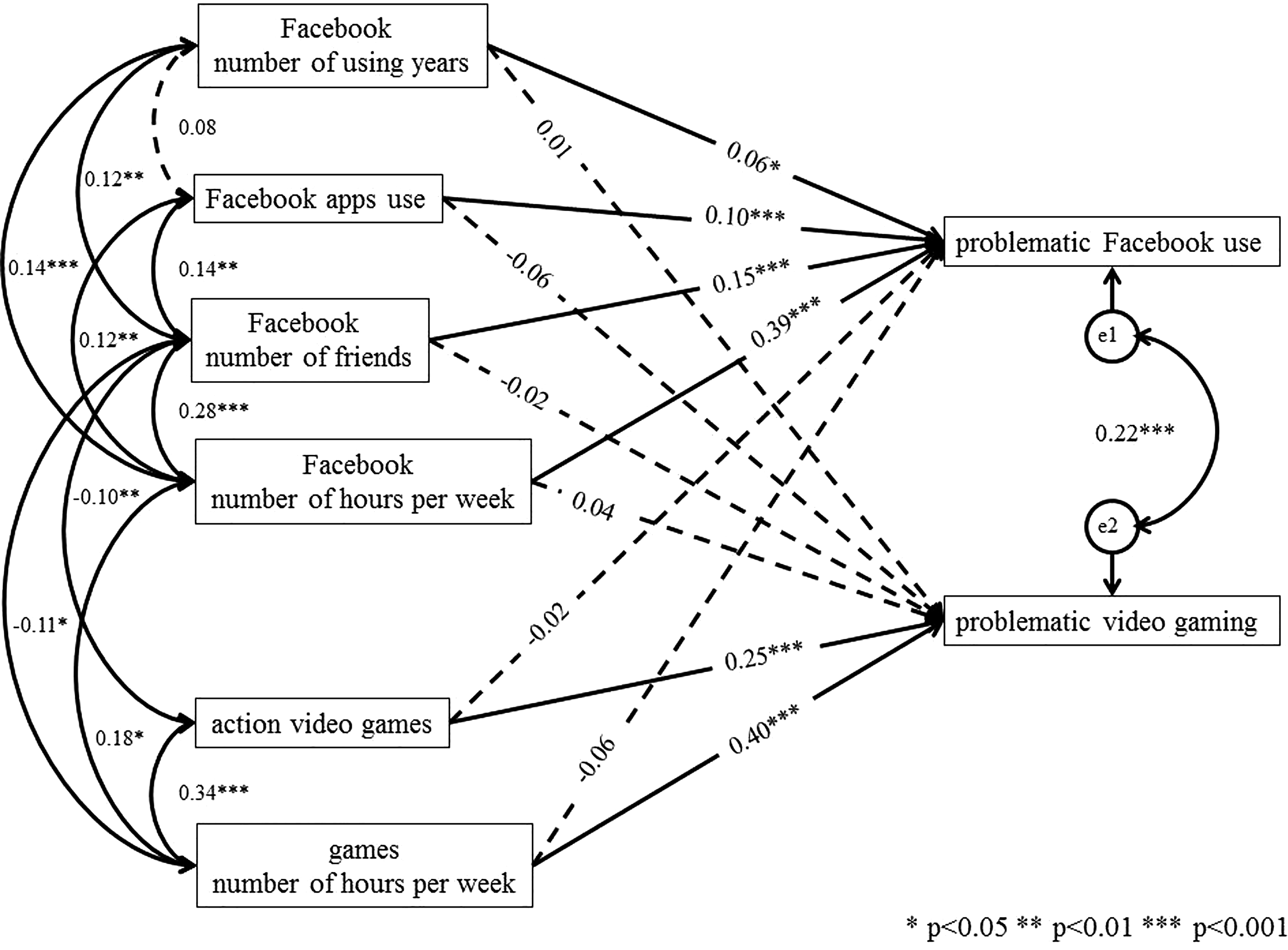
Structural model depicting predictors of PIU and PVG among female gamers. PIU, problematic internet use; PVG, problematic video gaming.
Among male gamers, significant paths were confirmed for the relationship between FbHours, the FbFriends, FbApps, and AGUse with PFU. Furthermore, the VGHours and AGUse were positively and significantly predicted to relate to PVG. Other paths between predictors and PVG were statistically nonsignificant. As in the case of female gamers, the findings showed a significant correlation between residuals of PVG and PFU. There was also a significantly positive relationship between engagement in the AGUse and VGHours. The remaining findings are presented in Figure 2.
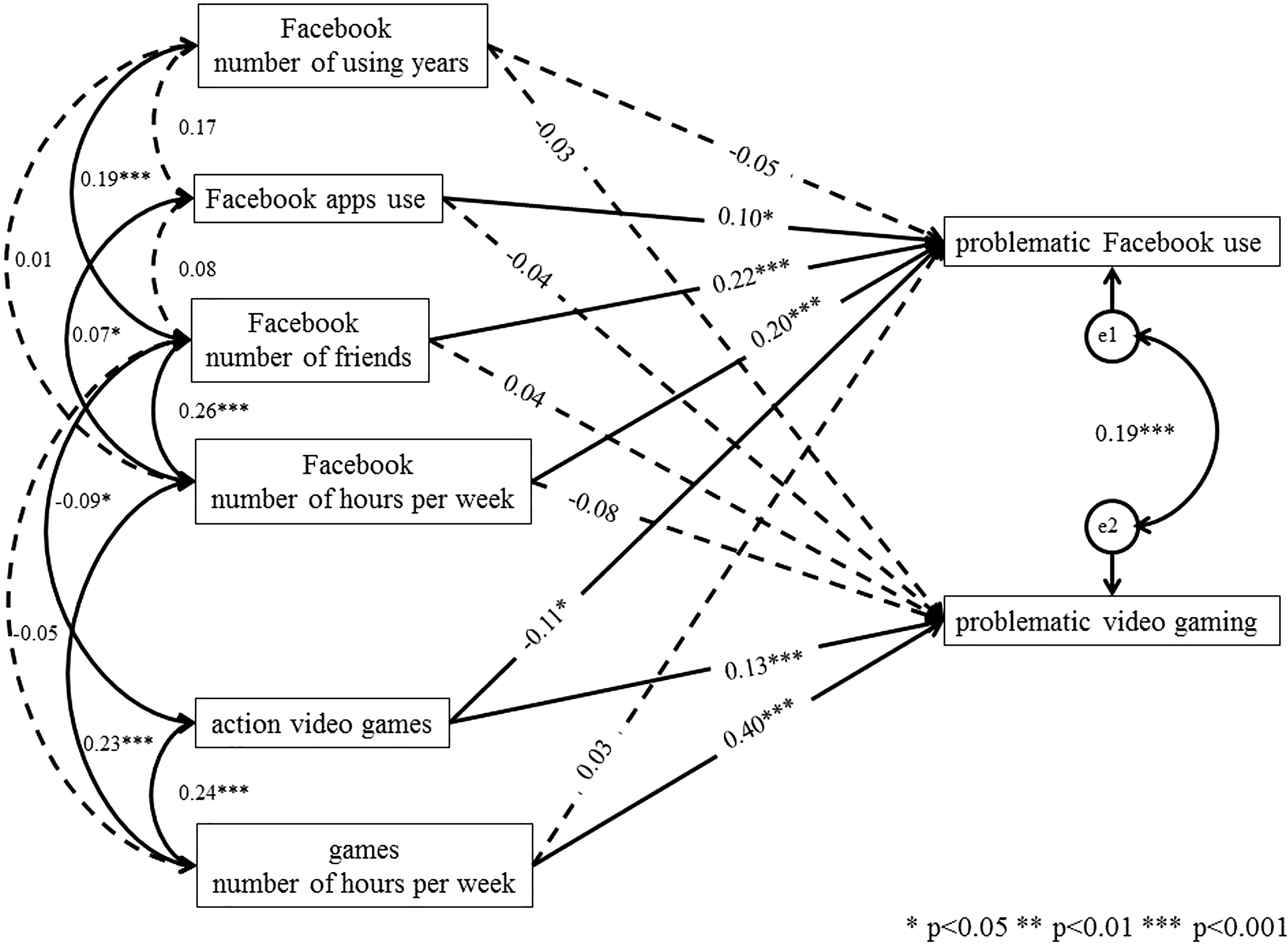
Structural model depicting predictors of PIU and PVG among male gamers.
Pairwise parameter comparisons showed regression weight differences between female and male gamers regarding the relationship between the FbHours and PFU (Table 5). The standardized regression weight was larger for female gamers than for male gamers. Regarding the relationship between the FbYears and PFU, significant differences were also found between the analyzed groups. The path was significant for female but nonsignificant for male gamers. There was also a difference between female and male gamers in terms of the FbHours and FbYears correlations. The correlation coefficient was significant in the group of female gamers, but nonsignificant in the group of male gamers.
Pairwise Parameter Comparisons Between Female and Male Gamers
ns, not significant.
Discussion
The results of this study showed that 4.9% of gamers have a very high level of PFU, and that more females (6.43%) than males (3.07%) presented a high level of PFU. The findings are similar to those of a German study, which found that between 2.5% and 6.2% of participants showed PFU. 29 The results are also in line with other studies20,30,31 and indicate that females have a higher level of PFU than males. these findings also show that 3.6% of gamers presented six or more symptoms of PVG (1.8% female gamers and 5.8% male gamers). PVG is reflected by no fewer than six symptoms identified with the Problem Video Game Playing Questionnaire. 23 Therefore, this group of gamers would meet the criteria defined for this problematic behavior. A previous study conducted in Poland also indicated that 3.6% of gamers had PVG. 15 The percentage of gamers with PVG reported in this study is also consistent with studies carried out in other countries. 16 As in previous studies, the results in this study showed that men are more vulnerable to PVG than women. 32
In addition, the results showed that the model assuming a correlation between PVG and PFU fitted the data, while the model assuming no correlation did not fit. This finding is in line with previous studies that have shown an association between the two types of problematic behavior. 9 Furthermore, the findings correspond with the model proposed by Brand and colleagues, 7 which indicates that PFU and PVG are a type of specific internet use disorder. Brand and colleagues also pointed out that specific motives may predispose individuals to choose specific forms of internet use, such as games, social networks, or pornography. 7 In line with this assumption, as in previous studies, 9 the results of this study also show the existence of separate predictors for PVP and PFU, despite the correlation between these problem behaviors. In this context, the results may suggest that PVG and PIU are different problematic behaviors, despite their similarities.
The results also indicated that the VGHours and AGUse are predictors of PVG, irrespective of the gamer's gender. Previous studies have also shown that VGHours15,33 and various genres of action video games24,34,35 are related to PVG. One possible explanation of these results may be related to greater engagement in action games than in other genres of games. 36 The design and structure of action games (e.g., focused goals, challenging task, clear and compelling standards, and option to create one's avatar) are conducive to greater engagement and longer game play.36–38 This explanation is all the more likely, as the results of this study showed a correlation between the amount of time spent on games and the playing of action video games. However, it should be noted that other studies found that the VGHours is a poor predictor of PVG 39 because both pathological and engaged gamers both play a lot of video games. 40 Therefore, the amount of time spent playing video games should be considered carefully as a predictor of PVG.
The results of this study showed that the FbHours, the FbFriends, and FbApps were related to PFU irrespective of the gamer's gender. In the group of female gamers, a positive correlation between the FbYears and PFU was also observed, while in the group of male gamers, a negative correlation between the AGUse and PFU was found. These results are in line with previous studies indicating a positive correlation between PIU and the frequency of Facebook use, the number of friends on Facebook, and the time spent using this social networking platform. 17 Other studies have shown an association between use of mobile social networking apps and problematic behavior.18,19 One possible explanation for the relationship between predictors shown in this study and PFU could be related to the transfer of social relationships from offline to online. 41 In this context, individuals may transfer their social contacts to the social networking platform as they increase their time of Facebook use. This may be especially possible when individuals use Facebook not only on a computer but also on a smartphone. Here, when individuals use a Facebook smartphone app, they may feel in constant contact with others and have less fear of missing out. 42
The results of this study showed that female gamers had a stronger relationship between the FbHours and PFU than male gamers. Furthermore, an analog difference was found between the analyzed groups in terms of the relationship between the FbYears and PFU. The results from other studies have shown that females, compared to males, spend more time on Facebook than they expected, feel closer to friends on social networking sites than in everyday life, feel more dependent on this medium, 11 spend more time at night on Facebook, 43 and spend more time liking, commenting, and messaging. 12 In addition, Haferkamp et al. showed that females use social networking sites primarily to compare themselves with others, while males were more likely to seek friends on social networking sites. 13 In addition, females pay attention to social relationships, while creating their image on Facebook, while males pay more attention to their economic status. 44 Taking into account these differences between males and females, it appears Facebook is a more important medium for females in social relationships and creating their image than for males. In this context, one possible consequence could be to shift from real life to online life, which becomes a determinant of social relationships, self-image, and important aspects of life such as intimate relationships and friendship. 41 Consequently, the risk of PFU is probably higher in females than in males, which is confirmed by the results of this study.
In particular, the results suggest that despite females more often playing casual games and playing games for less time than males, 14 action video game use and time spent gaming are predictors of PVG, irrespective of gender. However, in contrast to PVG, the results showed gender differences for PFU predictors, especially the relationship between FbHours, FbYears, and PFU. In the context of I-PACE model, 7 this suggests that usage time is not an equally important predictor for female and male in PFU compared to PVG. In addition, the study's findings have some practical implications for practitioners such as addiction therapists and psychiatrists. The findings indicate factors to be taken into account in assessing Facebook and game users, especially gender difference in PFU.
The results presented in this study should be interpreted in light of several limitations. For example, the study group was selected among Polish active gamers and is not representative of non-gamer groups or the Polish population more generally. In addition, limitations may be linked to cultural differences. More specifically, gender roles in European countries such as Poland could be very different from the Asian countries, which may further influence the gender differences in problem behaviors. 45 Moreover, it should be noted that nonproblematic behavior can be misidentified as problematic because criteria of PVG have been formulated on the basis of the criteria for substance addiction and/or pathological gambling. 39 Also, only action video games were included as a game genre variable related to PVG. Therefore, the results of the study cannot necessarily be generalized to other game genres. In addition, this study utilized a cross-sectional design; therefore, results do not allow conclusions on causality. Furthermore, the relationship between PFU and FbApps, FbYears, and AGUse may be related to large datasets. Therefore, caution is needed when considering these variables as predictors of PFU. Also, future research should not only focus on the analysis of isolated problematic behaviors but also on the analysis of their interrelationships, such as that between Facebook and problematic smartphone use. Taking into account the negative impact of PFU on mental health29,46,47 and the gender differences observed, future research should focus on whether there are gender differences in the relationship between PFU and health problems.
Footnotes
Author Disclosure Statement
The authors declare no conflict of interests.
Authors' Contributions
A.C.: substantial contributions to the conception of the work. A.C. and M.T.: substantial contributions to the design of the work. A.C. and T.M.: the data acquisition. A.C.: the data analysis. A.C., M.T., and T.M.: interpretation of data for the work. A.C., M.T., T.M., and M.D.G.: drafting the work. A.C., M.T., T.M., and M.D.G.: revising the work critically for important intellectual content.
Funding Information
This study was partly based on research project funded by the Gambling Problem Solving Fund (Polish: Fundusz Rozwiązywania Problemów Hazardowych), administered by the Minister of Health (Nos. 190/HM/2017 and 164/HBK/2018).