




Abstract
Hoarding disorder is characterized by difficulty discarding objects and excessive clutter. The relationship between hoarding and claustrophobia, reactions to severely cluttered spaces, and clutter preferences are all areas that are yet to be investigated. The present study used a novel virtual reality (VR) platform to examine these domains. Two groups (i.e., with hoarding disorder, n = 36; without hoarding disorder, n = 40) similar in age and gender were recruited from the community. There were no differences in subjective or physiological reactivity to increasing VR clutter levels. The hoarding group reported a preference for slightly more cluttered VR rooms; however, they also reported higher claustrophobic fear. Results from this research advance our understanding of the relationship between hoarding symptoms and subjective experiences of clutter and offer implications for future VR research and treatment initiatives.
Introduction
Hoarding disorder is characterized by persistent difficulty discarding possessions, leading to excessive clutter and impaired functioning within the home, with a lifetime prevalence of ∼2.3%. 1 There is an inherent assumption in hoarding treatment that less cluttered homes are preferable to cluttered ones. However, clutter does not decrease significantly following cognitive behavioral therapy (CBT) for hoarding. 2 There is yet to be any investigation into the subjective experience of clutter in individuals who hoard versus those who do not. As such, we do not currently know if setting a clutter reduction goal is in conflict with patients' preferences.
Most hoarding studies use self-report questionnaires, or sorting and discarding tasks using a small number of objects, 3 and have limited ecological validity. These methods do not allow for investigation into the subjective effects of exposure to extreme clutter. Virtual reality (VR) provides an innovative method to test hypotheses that were previously impossible to examine. It provides standardization of intricate visuospatial milieus and eliminates the physical risk with navigating cluttered spaces.
VR is growing in popularity in other similarly challenging domains, such as obsessive-compulsive disorder (OCD), which like hoarding disorder is classified as an obsessive-compulsive and related disorder. 4 Researchers have developed a virtual version of the multiple errands test (V-MET 5 ) to examine complex problem solving abilities. Participants with OCD completing the V-MET took longer to complete complex tasks 6 and were less efficient 7 than a healthy comparison group. The V-MET identified greater impairments in using complex strategies even when no differences were found using a standardized neuropsychological test battery. 8 Similarly, a recent study examined claustrophobic fear using VR. 9 Participants' anxiety ratings were highest when they perceived themselves to be in a virtual small closet with a closed door and knew that the closet they were actually in had a closed door. Anxiety was next highest when the virtual door was closed, even when the actual door was open. These studies demonstrate that VR can elicit similar behavioral and emotional responses to exposure to “real” stimuli.
Claustrophobia (i.e., fear of enclosed spaces, driven by risk of suffocation or physical restriction 10 ) is a well understood phenomenon and is theoretically opposite to hoarding. While individuals with claustrophobia are fearful of physically restrictive spaces, clutter in hoarding disorder is often so severe that it can make it nearly impossible to navigate through the home. 11 Higher trait anxiety 12 and higher levels of claustrophobic fears 13 have also been associated with requiring more personal space to feel comfortable. Claustrophobia was chosen for comparison to hoarding, as the two constructs overlap theoretically, and this choice may provide further understanding of the lesser-understood condition.
The purpose of this preliminary study was to examine group differences in subjective and physiological responses to VR cluttered spaces, preferences for clutter levels, and claustrophobic fears. To our knowledge, this is the first study to use VR to study hoarding.
Hypotheses and exploratory questions
Main hypothesis
VR is feasible (i.e., can be developed and implemented in a timely manner) and ecologically valid (i.e., participants will experience sufficient sense of presence and immersion) for studying subjective experiences of extreme clutter.
Secondary hypothesis
Claustrophobic fears are negatively associated with hoarding symptom severity.
Exploratory question 1
Do individuals with hoarding disorder prefer greater amounts of VR clutter than individuals without hoarding disorder?
Exploratory question 2
Do individuals with hoarding disorder demonstrate attenuated discomfort (e.g., emotional reactivity) in increasingly cluttered VR environments?
Methods
Participants
Adults between the ages of 18–65 were recruited from Toronto, Canada. Interested participants were screened online for sufficient English proficiency and contraindications for VR and medical exclusions for the present study (i.e., migraines, seizure disorders, blindness, deafness, neck injury, serious vestibular abnormalities, hypertension, or chronic obstructive pulmonary disease, 14 tendency to experience motion sickness). Participants completed the Saving Inventory-Revised (SI-R 15 ), the Clutter Image Rating (CIR 16 ), the Obsessive-Compulsive Inventory-Revised (OCI-R 17 ), and the Depression Anxiety Stress Scales–21 item version (DASS-2118). Individuals who scored above recommended clinical cutoffs for hoarding measures (i.e., 41 on the SI-R and 4 on the CIR16,19) were invited to the second screening phase for possible eligibility in the hoarding group. Individuals who scored below those cutoffs, as well as below recommended clinical cutoffs for OCD and depression screening measures (i.e., 21 on the OCI-R and 10 on the depression subscale of the DASS-2117,18), were invited to the second screening phase for possible eligibility in the nonhoarding group.
The second screening phase involved a telephone interview to collect demographic information (Table 1) and to complete the Diagnostic Assessment Research Tool (DART 20 ), a semistructured clinical interview. Exclusion criteria for both groups included: active psychotic symptoms within the past 6 months, significant alcohol or substance use problems within the past 3 months, uncontrolled manic or hypomanic symptoms within the past 3 months, and current high risk suicidal or homicidal ideation. Participants whose symptoms met diagnostic criteria for hoarding disorder were eligible for the hoarding group (n = 36). Participants without hoarding disorder, current major depressive disorder, or OCD were eligible for the nonhoarding comparison group (n = 40). This study was part of a larger study examining the cognitive behavioral model of hoarding using VR. 21 Power analyses were based on finding a large effect size for a t test in attention-deficit/hyperactivity disorder scores between a hoarding and community group (Cohen's d = 1.76) 22 and on finding a small effect size for interactions between cognitive and emotional factors in predicting hoarding symptom severity using regression (β = 0.12). 23 Power analyses suggested that 22–33 participants per group would be sufficient to detect significant results for the larger study (α = 0.05, power = 0.80). A chi-square analysis indicated that the two groups did not differ significantly on any demographic variables (Table 2). The hoarding symptom scores are similar to or well above those reported in other studies using Diagnostic and Statistical Manual of Mental Disorders (5th ed.; DSM-5) 4 clinical hoarding samples24,25 suggesting that the assessment tools successfully identified participants with hoarding disorder.
Participant Demographic Information
M, mean; SD, standard deviation.
Screening Measures
Indicates that scores were used to determine eligibility during online screening.
CIR, Clutter Image Rating; DASS-21, Depression Anxiety Stress Scales–21 item version; OCI-R, Obsessive-Compulsive Inventory-Revised; SI-R, Saving Inventory-Revised.
Measures
Diagnostic interview
The DART 20 is a new semistructured interview for assessing DSM-54 criteria for a variety of disorders. The following modules were administered: psychotic symptom screener, alcohol and substance use disorders, current and past major depressive disorder, suicidal and homicidal ideation screener, bipolar disorder, hoarding disorder, OCD, and other modules not relevant to the present study.
Clinical symptoms
The SI-R 15 is a 23-item measure using a 0–4 rating scale and measures difficulty discarding, excessive acquisition, and excessive clutter. Higher scores indicate more severe hoarding symptoms. Cronbach's alpha was 0.94 (nonhoarding group) and 0.87 (hoarding group).
The CIR 16 assesses clutter levels. Participants view nine images each of a bedroom, living room, and kitchen, with clutter increasing progressively. Participants select images that most closely resemble their own homes. A composite score is created by calculating mean ratings. Cronbach's alpha was 0.92 (nonhoarding group) and 0.81 (hoarding group).
The OCI-R 17 is an 18-item measure that assesses distress associated with obsessive-compulsive symptoms across six domains. Higher scores indicate more severe symptoms. Cronbach's alpha was 0.81 (nonhoarding group) and 0.94 (hoarding group).
The DASS-2118 assesses depression, anxiety, and general distress. Participants indicate how much each statement applied to themselves over the past week using a 0–3 point scale. The three subscales (i.e., depression, anxiety, and stress) have shown low to moderate intercorrelations and strong convergent validity and internal consistency. 26 Cronbach's alpha for the nonhoarding group was 0.70 (depression), 0.54 (anxiety), and 0.79 (stress) and for the hoarding group was 0.95 (depression), 0.90 (anxiety), and 0.93 (stress).
Clutter preferences
Subjective reports of discomfort were collected using the 0 (no distress) to 100 (extreme distress) Subjective Units of Distress Scale (SUDS 27 ). Participants verbally indicated which VR room they most preferred. Possible scores ranged from 1 to 9, with higher scores indicating preference for more cluttered VR rooms.
Claustrophobic fear
The Claustrophobia Questionnaire (CLQ 28 ) is a 26-item measure with two subscales, suffocation (SS) and restriction (RS), in which items are rated on a 5-point Likert scale. Cronbach's alpha for the nonhoarding group was 0.94 (total), 0.84 (SS), and 0.93 (RS) and for the hoarding group was 0.95 (total), 0.91 (SS), and 0.95 (RS).
VR experiential measures
The 18-item version of the Immersive Tendencies Questionnaire (ITQ 29 ) was used to assess participants' general abilities to become emotionally and cognitively immersed in experiences such as watching television or playing video games. Items are answered on a 7-point Likert scale with higher scores indicating greater immersion tendency. Cronbach's alpha was 0.84 (nonhoarding group) and 0.79 (hoarding group).
The 22-item version of the Presence Questionnaire (PQ29,30) measures sense of presence during a recent encounter with VR. Items are answered on a 7-point Likert scale with higher scores indicating greater sense of presence. Cronbach's alpha was 0.90 for both groups.
Adverse experiences during the VR task were assessed using the Simulator Sickness Questionnaire (SSQ 31 ), which measures severity of current physical symptoms similar to motion sickness on a 16-item 4-point Likert scale with higher scores indicating more severe physical symptoms. Scores are calculated by multiplying the sum of each subscale by appropriate weights put forth by the authors. Cronbach's alpha was 0.70 (nonhoarding group) and 0.90 (hoarding group).
Apparatus
Virtual reality
The VR environment was developed by an interdisciplinary team from Ryerson University. It included visual and auditory simulation (i.e., white room noise) and was pilot tested to ensure high immersion. Participants wore an Oculus Rift™ consumer-release version head-mounted display (HMD), model number 301-00200-03. This model has a 110° field of view with adjustable viewer/focus, 1,080 × 1,200 built-in resolution, 90 Hz refresh rate, and six degrees of freedom. It has built-in headphones, integrated controller connectivity, and is tethered to a personal computer (PC). The PC used to run the software was a Dell Alienware X51 running Windows 10, with an Intel Core i5-6400 (3.3 GHz speed) and 16GB DDR4 RAM. The video card was Nvidia GeForce GTX 970 with 4GB GDDR5 RAM. Participants viewed a series of 360° photographed environments of the same living room that became progressively more cluttered over nine images, mimicking the CIR (Fig. 1). When wearing the HMD, the clutter appears to encroach closer as the clutter builds.
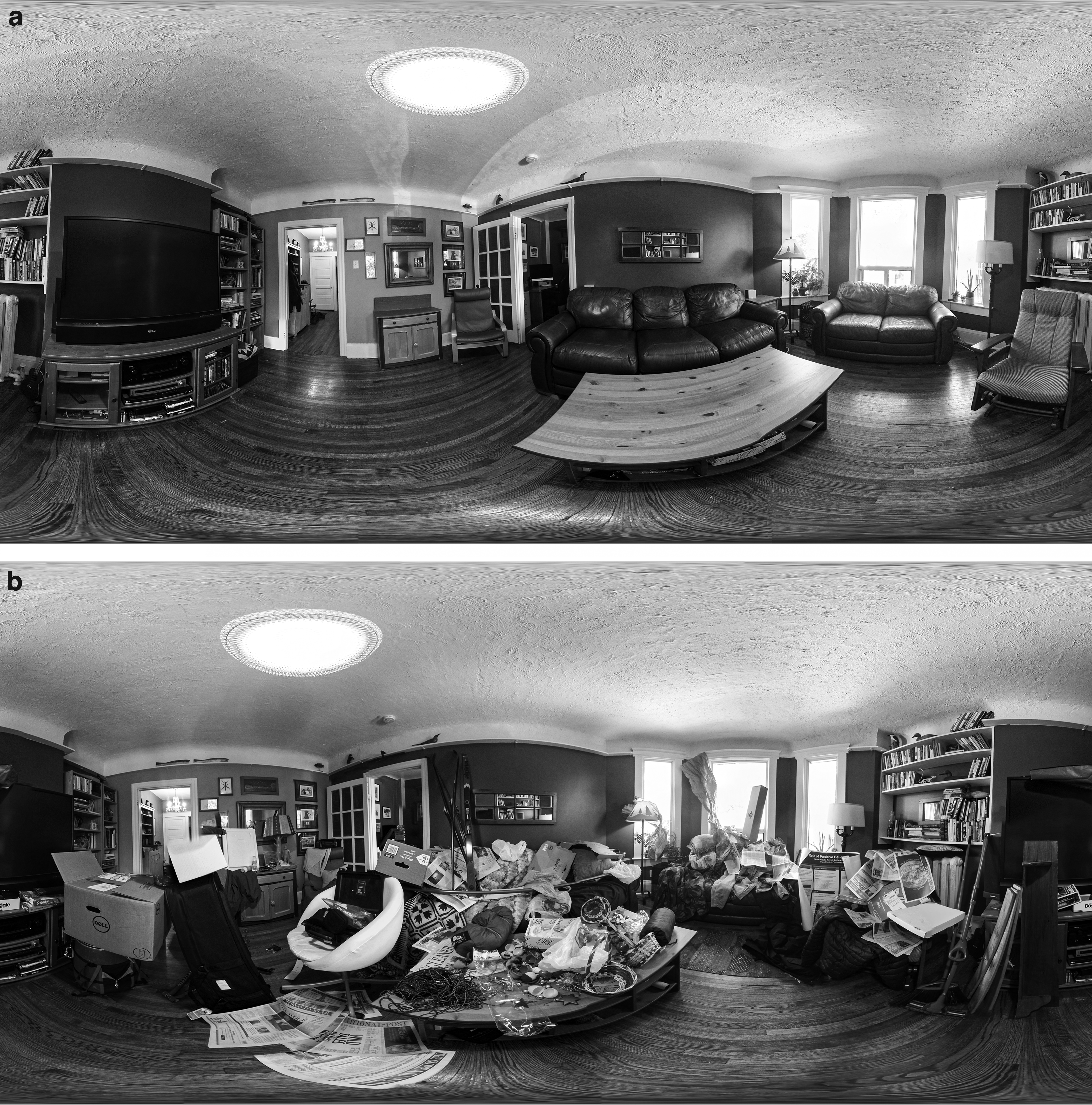
Examples of virtual reality environments: room 1
Psychophysiological measures
Heart rate (HR) and skin conductance response (SCR) were sampled continuously at 2,000 Hz throughout the experimental task using a Biopac MP150 system and were recorded and analyzed using AcqKnowledge 3.9.1 software. Data were visually inspected to ensure proper equipment functioning. HR was recorded using three pregelled Biopac 35 mm disposable electrodes (EL503) placed below the collarbone and below the ribs on each side. SCR was recorded using two pregelled Biopac 2.5 × 4.5 cm disposable electrodes placed on the palmar region of the distal phalanges of the second and third fingers of the nondominant hand. During data analysis, HR was defined as mean heartbeats per minute, and number of sweat response events (i.e., 0.02 μS phasic change in electrical skin conductivity) was used to determine SCR. 32
Procedure
All methods were reviewed and approved by the Ryerson University Research Ethics Board before the commencement of data collection. The Biopac equipment and HMD were donned, and participants were instructed how to report SUDS ratings. A baseline SUDS rating was obtained after spending ∼5 minutes acclimating to the VR while viewing a virtual room that was similar to those used in the subsequent testing phase. They then viewed each of the nine VR rooms described above in 20-second intervals and provided current SUDS ratings. They were then given the option to review the sequence of VR cluttered rooms and indicated which room they most preferred. Participants then completed the remaining measures.
Results
VR experiential and baseline measures
There were no group differences on sense of presence in VR. The hoarding group experienced significantly greater simulator sickness (mean [M] = 49.15, standard deviation [SD] = 40.75) than the nonhoarding group, M = 30.10, SD = 27.57, t(60.56) = 2.36, p = 0.022, Cohen's d = 0.55. After removing two outliers from the hoarding group and one outlier from the nonhoarding group, there were no significant differences between groups on baseline SUDS ratings, t(71) = 0.19, p = 0.85. There were no group differences on baseline HR, t(62) = −0.92, p = 0.36, or SCR, t(60) = 1.66, p = 0.10.
Additional analyses
An independent samples t test on CLQ total scores indicated that the hoarding group (M = 43.65, SD = 23.30) scored significantly higher than did the nonhoarding group, M = 23.15, SD = 16.65, t(58.42) = −4.28, p < 0.001, Cohen's d = −1.01. A multivariate analysis of covariance (MANCOVA) was then conducted controlling for the effects of DASS-21 scores. The MANCOVA maintained the overall difference between groups, F(2, 68) = 3.45, p = 0.037, ηp 2 = 0.09. Planned contrasts demonstrated that the hoarding group reported higher fear of SS (M = 18.91, SD = 11.82) relative to the nonhoarding group, M = 8.70, SD = 6.90, F(1, 69) = 6.76, p = 0.011, Cohen's d = 1.05. The hoarding group also reported higher fear of physical restriction (M = 24.74, SD = 13.44) relative to the nonhoarding group, M = 14.45, SD = 10.70, F(1, 69) = 4.65, p = 0.035, Cohen's d = 0.85.
An independent samples t test detected that the hoarding group preferred a more cluttered VR room (M = 1.89, SD = 1.09) than the nonhoarding group, M = 1.25, SD = 0.49, t(47.66) = 3.23, p = 0.002, Cohen's d = 0.76. This difference remained significant with an analysis of covariance controlling for DASS-21 subscale scores and SSQ scores, F(1, 70) = 7.92, p = 0.006, ηp 2 = 0.11.
A mixed-factor analysis of variance on group and VR clutter level on SUDS ratings revealed a significant main effect of VR clutter level, F(8, 64) = 52.03, p < 0.001, ηp 2 = 0.87. Tests of within-subjects contrasts demonstrated a significant linear trend to these data, F(1, 71) = 328.88, p < 0.001, ηp 2 = 0.82. There was no significant main effect of group, F(1, 71) < 0.001, p = 0.996, ηp 2 < 0.001, or group by VR clutter level interaction, F(8, 64) = 1.31, p = 0.256, ηp 2 = 0.14 (Fig. 2). With respect to HR and skin response, there were no significant main effects of VR clutter level or group and no significant group by VR clutter level interactions (all ps > 0.05).

SUDS ratings across time. SUDS, Subjective Units of Distress Scale.
Discussion
The purpose of this study was to introduce VR in hoarding research and to examine differences in experiences of and preferences for clutter. Both groups experienced a sense of presence and an increase in SUDS ratings as clutter increased, suggesting that the VR environment did elicit an emotional response. The hoarding group did report significantly higher levels of simulator sickness. Upon examining the specific SSQ items, it is possible that this questionnaire may also assess state anxiety (e.g., sweating, nausea, and dizziness). In addition, CLQ scores predict distress in enclosed spaces, 28 and the hoarding group scored higher on the CLQ; however, simulator sickness was not significantly correlated with the CLQ. It is possible that simulator sickness in the hoarding group may be accounted for by discomfort with the physical restriction from the HMD.
The hoarding group was expected to report lower claustrophobic fears than the nonhoarding group due to having a physically restricted living space, but the opposite was found. It is possible that higher levels of general distress account for higher claustrophobic fear in the hoarding group or that natural fears of SS and RS are frequently triggered in their homes. The hoarding group may have reported on realistic fears and concerns that they face on a daily basis.
The hoarding group preferred VR rooms with slightly more clutter than the nonhoarding group. Although this difference was statistically significant, it is likely not clinically significant (i.e., 1.89 vs. 1.25 out of a possible 9). Self-reported VR clutter preference was also notably lower than actual clutter levels (i.e., 1.37 vs. 5.29 on the CIR). This finding suggests that interventions targeting clutter reduction are likely consistent with patients' goals. It also highlights the discrepancy between preferences and actual living conditions. There were no group differences on psychophysiological reactivity nor subjective ratings of distress as virtual clutter increased. These findings suggest that individuals with hoarding problems are likely as bothered by clutter as are those without hoarding problems. Persistent clutter must therefore be explained by other mechanisms (e.g., personal attachment to items).
There are a number of limitations to this study. Although using VR provided an opportunity to examine responses to increasing clutter levels, this is not how clutter naturally develops. Future studies may investigate responses to clutter that accumulates over days or weeks. If the rate of exposure slowed, the hoarding group may have demonstrated the expected attenuated discomfort.
This was a preliminary study that introduced VR as a method that allows researchers to ask more nuanced questions. It is important to continue exploring innovations in treatment and research to increase our understanding of this complex problem. For instance, future research could investigate whether using VR photographs of one's own home can be used to help clients take a different perspective on their clutter. Future research may indicate the utility of motivational interviewing, which is designed to amplify discrepancy (e.g., between discomfort with clutter, but strong attachment to individual items) to resolve ambivalence and promote change as an adjunct to traditional CBT.
Footnotes
Acknowledgments
The authors thank Carson Pun, Joshua See, and Eric Karnis for their assistance in the technical aspects required for this study.
Author Disclosure Statement
No competing financial interests exist.
Funding Information
No funding was received for this article.