




Abstract
This study investigated whether abstaining from Instagram (Ig) affects subjective well-being among young men and women. By comparing an intervention group (40 participants who take a break from Ig for a week) with a control group (40 participants who kept using Ig), we found that women who quitted Ig reported significantly higher levels of life satisfaction and positive affect than women who kept using it. Whereas positive affect increment depended on social appearance comparison, life satisfaction rose independent of the tendency to compare one's own appearance with others. It is possible that users who are no longer exposed to direct evaluative feedback about their images on Ig—be it related to their appearance, habits, or opinions—can witness an increase in their global satisfaction levels. No significant effects were found among men.
Introduction
Research investigating the motivations and effects of social networking sites (SNSs) use on the mental and social health of young people has gained increasing attention for the past decade. Much of the research has focused on Facebook (Fb). A systematic review of 65 studies 1 has recently found positive associations between Fb use and key psychiatric disorders symptoms. On the contrary, previous results on the association between the frequency of Fb use and subjective well-being (SWB) are inconsistent. Some authors2–5 found that increased Fb use contributes to declines in an individual's moment-to-moment feelings of well-being and life satisfaction. However, there is also evidence of a positive association between Fb use and SWB,6,7 whereas other studies show no relationship at all.8,9
Two previous studies experimentally investigated the effects of giving up Fb on SWB. By comparing a group of participants who took a break from Fb with a control group (participants who kept using Fb), Tromholt 10 found that taking a break from Fb has positive effects on life satisfaction and positive emotions. A subsequent study 11 showed that participants instructed to give up Fb for 5 days reported lower SWB, but also an improvement in physiological stress compared with the control group.
Although there is significant evidence that Instagram (Ig) use has a negative impact on body satisfaction among women,12–15 very little research has investigated the effects of Ig use on SWB. Pittman and Reich 16 found that Ig use predicted an increase in happiness and life satisfaction, whereas de Lenne et al. 17 showed that the association between Ig use and poor mental well-being was significantly negative in South Korea but not significant (and positive) in Austria and Belgium. However, both these mentioned studies adopted a cross-sectional design.
The only experimental study in this field 18 has shown that the sign of the association depends largely on social comparison tendencies (i.e., positive Ig posts diminish positive affect only among individuals high in social comparison orientation). Social comparison, in fact, is likely to serve as moderating variable in the relationship between exposure to Ig images and well-being.19–22
Furthermore, since SNSs are predicated on positive self-presentation, Ig users are continuously exposed to the positive characteristics and qualities of others, which might evoke feelings of envy. Research has shown that individuals who consistently use Fb are more likely to agree that their peers are leading better lives 5 and envy has been found to mediate the association between Fb use and life satisfaction. 23 Moreover, Ig—but not Fb—allows users to manipulate their photographs in a more visually appealing manner by changing the colors through the choice of a filter. Noteworthy, different self-presentation strategies (i.e., positive vs. honest self-presentation) have a different impact on SWB6,24 and scholars have argued that Ig posts may be even more positively biased than Fb posts, as the photo-enhancing feature may create a culture of perfecting. 25
A recent study 26 showed that the tendency to present one's ideal self is more often associated with Ig use, whereas expressing one's true self is associated with other SNSs. In fact, most photos posted on Ig are filtered and manipulated to achieve the best results. 27 This implies that Ig users are not only more likely to promote an ideal self but are also more likely to be exposed to the ideal selves of others, thus enhancing the tendency to engage in upward (i.e., negative affect-inducing) comparisons.
Taken together, these results suggest that findings coming from the Fb literature might not be fully generalized to Ig users. Moreover, previous experimental studies about the effects of quitting Fb on well-being did not examine gender differences. However, women were found to use SNSs more than men28,29 and to be more active on SNSs in terms of frequency of uploading photos. 30 Barnes et al. 31 also found that women experience significantly greater levels of cognitive absorption than men when using SNSs (i.e., losing track of time, and spending more time than intended).
Pertinent to this study, girls are more likely to prioritize and compare themselves on dimensions of physical attractiveness online 21 and a stronger association between technology-based social comparisons and negative emotions for women has also been reported.32,33 For these reasons gender needs to be considered when studying the association between Ig use and well-being.
The current study
This study aims to investigate whether a short-term abstention from Ig affects the SWB of young women and men. The few empirical investigations focused on Ig reported a negative association with well-being levels and suggested to consider social comparison tendencies as a possible moderator. Therefore, we hypothesized as follows:
Methods
Participants and procedure
A power analysis was conducted using G*Power. 34 Assuming a medium-sized effect (partial η 2 = 0.06) and an alpha level of 0.05, results indicated that 36 participants (18 per group) would be necessary to achieve a power of 0.95. 35
Participants (n = 80) were recruited through an advertisement on SNSs and were informed that our research addresses psychological dimensions associated with Ig use. Inclusion criteria were having an Ig account for at least 1 year and using it systematically (i.e., daily) and being at least 18 years old.
Participants took the pretest and were then randomly assigned to the experimental or control group. The experimental group (ExG) was composed of 40 participants (50 percent women) who were instructed to take a weeklong break from Ig. The control group (CG) consisted of 40 participants (50 percent women) who kept using Ig. No significant differences between the experimental and the control group were found with regard to age both among female [MExG = 24.90 (SDExG = 3.08) and MCG = 25.20 (SDCG = 3.59), F(1, 38) = 0.080] and male participants [MExG = 25.45 (SDExG = 4.99) and MCG = 24.65 (SDCG = 4.99), F(1, 38) = 0.31].
To minimize any opportunities to visit Ig, members of the experimental group were asked to delete their Ig application on their tablets and/or smartphones and to provide researchers with their Ig username. Moreover, they were asked about their compliance at the post-test session. Four participants were found to be noncompliant, as they reported that they had visited Ig once during the experimental stage. In accordance with Tromholt's study 10 on quitting Fb, the noncompliers were kept in the statistical analyses to maintain the integrity of the random assignment, which in turn allowed us to offer conservative estimates of true effects. 36 The study was approved by the Director of the Department of Psychology at the University of Florence. Informed consent was obtained from all participants. The survey was readministered after 8 days to members of both the experimental and control group. Participants did not receive any compensation.
Measures
Previous Ig use
Participants were asked a few questions about their use of Ig, including frequency (0 = once in a month or less; 4 = every day), time spent (in hours) on Ig in a typical day, the types of images they tend to upload, and their favorite types of profiles (e.g., celebrities, travel).
Dependent variables: SWB
The Italian version 37 of the Satisfaction with Life Scale (SWLS) 38 was used. The SWLS is a five-item self-report scale measuring one's global life satisfaction. A sample item is “The conditions of my life are excellent.” Items are scored (7-point Likert scale ranging from 1 = strongly disagree to 7 = strongly agree). Higher scores point toward higher life satisfaction levels. Results confirmed the unidimensionality, good reliability, and concurrent validity of the Italian version of the SWLS. 37 The Cronbach's alpha in the current study was alpha = 0.86.
The Italian version 39 of the Positive and Negative Affect Schedule (PANAS) 40 was used to assess affective experience. The Positive Affect Scale is composed of 10 items that reflect pleasant engagement levels—the extent to which a person feels enthusiastic, excited, active, and determined during the previous week. The Negative Affect Scale is composed of 10 items reflecting a general dimension of unpleasant engagement and subjective distress that arise from several aversive affects, including nervousness, shame, guilt, and fear. The Italian version of the PANAS showed solid psychometric characteristics. The Cronbach's alpha in the current study was alpha = 0.83 for the Positive Affect Scale and alpha = 0.88 for the Negative Affect Scale.
Control variable (pretest): State Appearance Comparison Scale
At the pretest, we used the three-item State Appearance Comparison Scale 19 to assess how often Ig users engage in appearance processing and draw comparisons with other users on Ig. Using a 7-point Likert scale (1 = no thought about my appearance; 7 = a lot of thoughts about my appearance), participants rated the extent to which they thought about their appearance when viewing Ig and compared their appearance with other users. The Cronbach's alpha in the current study was alpha = 0.83.
Results
Preliminary analyses
Previous Ig use among members of both the experimental and control group were compared before the experiment began. Ninety percent of participants in both groups reported that they visited Ig daily. No significant differences were found between the experimental and control group in terms of the hours spent on Ig in a typical day both among women [MExG = 1.72 (SDExG = 1.75) and MCG = 1.68 (SDCG = 1.41), F(1, 39) = 0.010] and men [MExG = 2.36 (SDExG = 2.30) and MCG = 1.74 (SDCG = 1.86), F(1, 38) = 0.59]. The number of women who claimed to follow celebrities on Ig was identical (45 percent) in the experimental and control group. Similarly, no significant differences were found with respect to the number of celebrities followed on Ig among male participants in the experimental or control group [45 percent and 60 percent, χ2(1) = 0.34].
No significant differences were found in terms of the tendency to post selfies between the experimental and control group both among women (60 percent from both groups reported that Ig was used primarily to post selfies) and men (25 percent and 35 percent).
Effects of quitting Ig among women
The between-groups baseline comparisons (Table 1) showed that, despite the use of randomization, significant differences emerged in terms of the initial levels of negative affect [F(1, 38) = 6.29, p < 0.05, η 2 = 0.38].
Pre- and Post-tests Scores on the Study Variables by Experimental Condition Among Women
The repeated measure ANOVA showed a significant effect of time [F(1, 38) = 5.64, p < 0.05, η 2 = 0.12] on negative affect levels. However, no interaction between TimeXGroup was found [F(1, 38) = 3.64], and social comparison tendencies did not show a significant effect when added as a covariate.
A significant effect of TimeXGroup on life satisfaction levels was found [F(1, 38) = 6.16, p < 0.05, partial η 2 = 0.14]. Women in the experimental group reported significantly higher post-test satisfaction with life levels [F(1, 19) = 5.27, p < 0.05, partial η 2 = 0.21], whereas no significant differences were observed in the control group [F(1, 19) = 2.32]. When social comparison tendencies were entered as a covariate, the effect of TimeXGroup on life satisfaction levels remained significant [F(1, 19) = 5.04, p < 0.05, partial η 2 = 0.12] and no interactive effect with the covariate was detected.
A significant effect of TimeXGroup on positive affect was also found [F(1, 38) = 11.39, p < 0.01, partial η 2 = 0.23]. Women in the experimental group reported significantly higher post-test positive affect scores [F(1, 19) = 6.08, p < 0.05, partial η 2 = 0.24]. However, a significant decrease was observed in the control group [F(1, 19) = 5.57, p < 0.05, η 2 = 0.22]. When social comparison tendencies were entered as a covariate, the interaction between TimeXSocial comparison [F(1, 38) = 8.63, p < 0.01, partial η 2 = 0.19] was significant, whereas the effect of TimeXGroup lost significance [F(1, 38) = 0.38]. The effect of TimeXGroup was not significant [F(1, 16) = 3.84] among those who scored below the median on the Social Comparison Appearance Scale (Fig. 1). By contrast, the effect of TimeXGroup was statistically significant [F(1, 20) = 11.77, p < 0.01, partial η 2 = 37] among those who scored above the median [t(10) = −3.68, p = 0.004 Cohen's d = 1.29] (Fig. 2).

Effect of experimental manipulation on positive affect among women who score below the median on the Social Comparison Appearance Scale. Error bars indicate 95 percent confidence intervals.
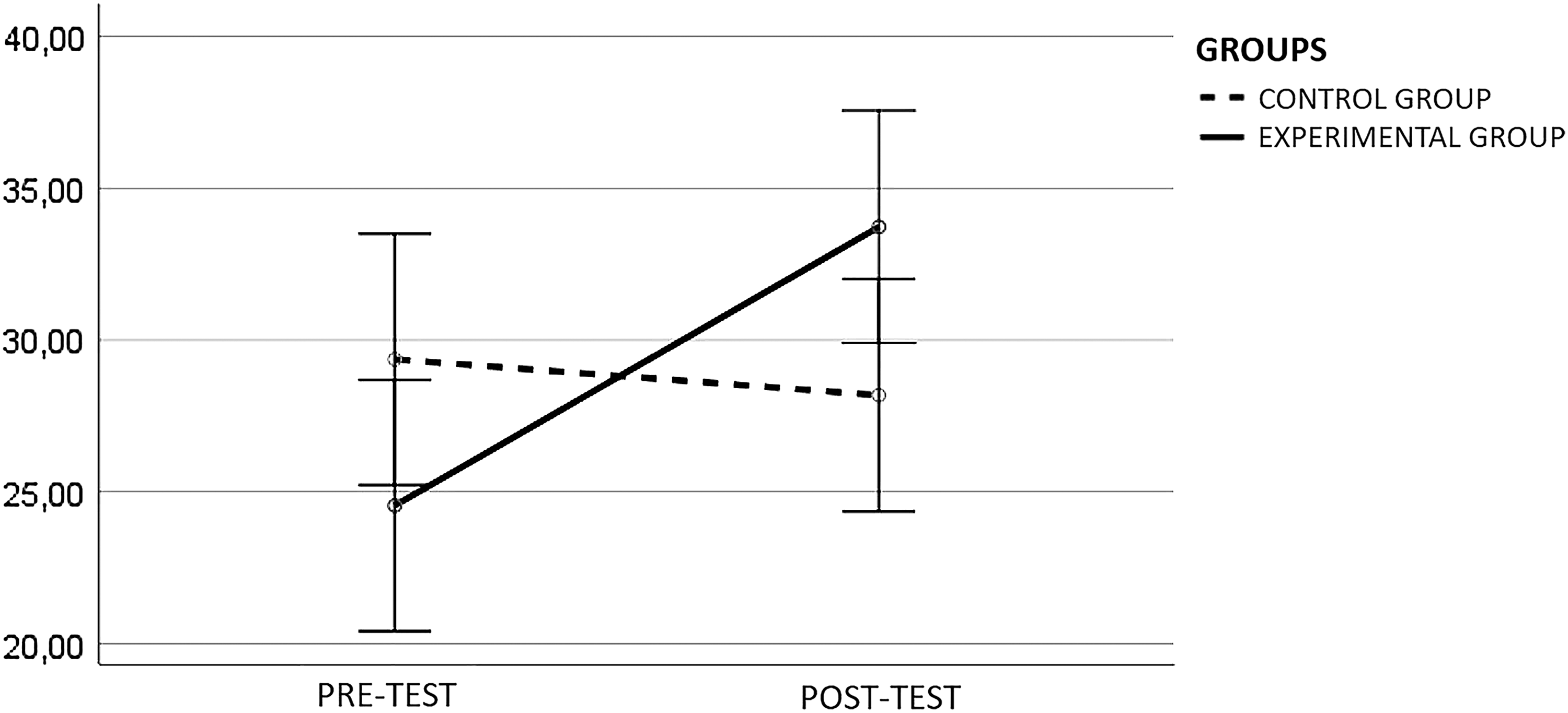
Effect of experimental manipulation on positive affect among women who score above the median on the Social Comparison Appearance Scale. Error bars indicate 95 percent confidence intervals.
Effects of quitting Ig among men
A significant effect of time [F(1, 36) = 5.60, p < 0.05, η 2 = 0.13] on life satisfaction was found. However, no interaction between TimeXGroup was detected [F(1, 36) = 2.29], and social comparison tendencies did not show a significant effect when added as a covariate. No variations in both positive and negative affect scores were found (Table 2).
Pre- and Post-tests Scores on the Study Variables by Experimental Condition Among Men
Discussion
This study aimed to examine the effects of short-term abstention from Ig on SWB. The effects of quitting Fb on well-being have been investigated by two experimental studies10,11 and conflicting results were reported. In any case, findings from Fb literature cannot be generalized to other SNSs because different social networks provide distinct technological features, which might reveal specific associations with SWB indicators. Ig use focuses much more attention on photo and video sharing than other SNSs, and previous studies 3 suggest that looking at the photos and videos of others tends to increase life dissatisfaction levels.
Our research shows that taking a short break from Ig use might have a positive effect on SWB among women, in terms of both satisfaction with life and positive affect. Women who quit Ig for a week showed significant growth in positive affect scores, whereas the control group witnessed a significant decrease. Variations on positive affect were mainly a product of social comparison tendencies, since quitting Ig had a positive effect only among women who report a tendency toward social comparison. Social comparison tendencies might provide not only the mechanisms by which exposure to images on SNSs induces body image dissatisfaction19,20 but also decrement of positive affect. The current findings support previous studies showing that the negative effects of viewing positive social media posts on mood depend on an individual's tendency to engage in social comparison. 18
It is also worth noting that the variations in life satisfaction levels cannot be explained by focusing solely on social comparison tendencies. Life satisfaction increased among women who quit Ig for a week, regardless of the extent to which they compared their overall appearance and specific body parts with other users. This is probably because we assessed social comparison in terms of appearance processing. Even though sharing appearance-related photos is very common on Ig, many users are exposed to a wide variety of images—for example, travel photos—that have nothing to do with one's personal appearance. Consequently, we cannot rule out the possibility that social comparison processes on Ig need to be addressed at a more general level—that is, as a general tendency to engage in social comparison—and might moderate the association between Ig use and life satisfaction.
It is also possible that the positive association between quitting Ig and life satisfaction is not related to social comparison. Indeed, people who quit Ig are no longer exposed to evaluative feedback about their images; we should not exclude that users who no longer receive feedback about their lives—be it their appearance, habits, or opinions—can witness an increase in their global life satisfaction. Future studies should pay greater attention to how receiving comments on Ig can affect one's well-being. Moreover, being an active user can be onerous because SNSs encourage continuous engagement 41 and women experience significant greater levels of cognitive absorption than men when using SNSs. 31 This might explain the positive effect of taking a break from Ig on life satisfaction regardless of appearance comparison. This might also explain why the experimental manipulation had no effect on SWB among men.
Noteworthy, men were not found to score significantly lower than women on appearance comparison on Ig. However, previous studies 42 have shown that body investment (i.e., the psychological importance one places on one's appearance) is lower for men relative to women. This might be another factor helping to explain why abstaining from comparing one's own appearance on IG might be more beneficial for women relative to men.
This study features a few limitations that need to be considered. First, we did not control for how women spent their time during the 1-week break from IG. As a consequence, we cannot rule out the possibility that the growth in positive affect scores might be consequence of the way they spent their time during the break rather than an effect of not being exposed to Ig. Second, the sample consisted of college students, which means that the results cannot be generalized to adolescents or older people who might have different patterns of Ig use. Third, future studies should investigate the effects of quitting Ig for longer periods and determine whether the effects found among women are stable across time. Moreover, we cannot rule out the possibility that longer periods are necessary to detect further effects on men. Despite these limitations, this study offers a novel take on Ig research by paying attention to well-being indicators that have been neglected by previous studies.
Footnotes
Author Disclosure Statement
No competing financial interests exist.
Funding Information
No funding was received for this article.