




Abstract
This study sought to examine whether interpersonal goals can help us understand who engages in social-capital-building responsive behaviors and envy-eliciting passive behaviors on Facebook. One hundred eighty-eight adults completed measures of interpersonal goals (compassionate and self-image), Facebook use (posting, responding, and searching), social capital sources and benefits, social comparison, and envy, along with various control measures. Serial mediation analyses revealed that compassionate goals significantly predicted four distinct social capital benefits (offline participation, emotional support, horizon broadening, and networking value) through greater Facebook responding and sources of social capital. Furthermore, self-image goals significantly predicted envy through greater Facebook searching and social comparison. These effects were significant with and without controlling for age, gender, Facebook friends, Facebook frequency, Facebook hours, self-esteem, attachment style, social desirability, and the other interpersonal goal and Facebook behaviors. Consistent with research on interpersonal goals in offline interactions, compassionate goals predicted more responsive behaviors and better social outcomes, while self-image goals predicted a competitive mindset and negative emotion. These findings extend the social networking site (SNS) literature by identifying a relevant new individual difference associated with SNS use and key outcomes related to well-being.
Introduction
Most adults use social networking sites (SNSs) such as Facebook on a regular basis.1,2 Distinguishing between active and passive use has advanced our understanding of how SNSs affect well-being. 3 Active SNS use involves communicating with others, whereas passive SNS use involves consuming information.3,4 Active SNS use can increase well-being by building social capital and connectedness.5–10 In contrast, passive SNS use can decrease well-being by eliciting social comparisons and envy.11–14 Within the active category, communicating with specific friends is distinct from broadcasting information to a wide audience, and the former is a better predictor of social capital.5,6 Furthermore, responding to friends on SNSs is a form of relationship maintenance associated with social capital. 8 Within the passive category, viewing content in one's newsfeed is distinct from searching for information, 9 although the differential effect on envy has not been tested. In sum, existing research suggests that active SNS use is beneficial and passive SNS use is detrimental for well-being, although the current active-passive dichotomy may be too simplistic.
Dispositional factors can influence SNS use. 15 Individual difference in Big Five personality traits,16–27 narcissism,19,20,23,28–35 shyness,23,35–37 loneliness,23,35,38 attachment style,39–41 and self-esteem,20,28 have been found to predict various aspects of SNS use. However, we do not yet have a clear sense of who is most likely to engage in social-capital-building active behaviors and envy-eliciting passive behaviors on SNSs. We propose that examining interpersonal goals could provide such insight.
Compassionate and self-image goal are distinct interpersonal goals that predict people's offline relationship experiences. 42 When compassionate goals are active, people want to contribute to others' well-being. They consider other people's needs and have a cooperative mindset.42,43 Stronger compassionate goals are associated with feeling connected, being more responsive to others, having higher quality relationships, and being held in higher regard by others.44–48 When self-image goals are active, people want others to view them positively. They feel competitive and think in zero-sum terms, whereby someone else's success would undermine their own.42,47 They prioritize their own needs and try to control the impression others form of them. Stronger self-image goals are associated with feeling afraid, being less responsiveness to others, having lower quality relationships, and being held in lower regard by others.44–47
This research aimed to identify the relationships between interpersonal goals, SNS behaviors, and outcomes. We conducted an online survey of adult Facebook users that included measures of interpersonal goals, 47 Facebook behaviours, 9 social capital (sources and benefits), 9 social comparison, 49 and envy. 11 We hypothesized that interpersonal goals would predict outcomes indirectly, through type of Facebook use.
To address potential alternative explanations, we assessed demographic factors (age and gender), other aspects of Facebook use (friends, frequency, and hours), and individual differences related to interpersonal goals (self-esteem, social desirability, and attachment style).45,47 Furthermore, even though compassionate and self-image goals tend to have opposing effects, they are positively correlated with each other, and need to be examined as simultaneous predictors to isolate unique effects. 47 The same is true of types of Facebook use. 9
Methods
Participants
One hundred eighty-eight participants completed the study: 143 were recruited through an Australian university subject pool and received course credit, and 45 were recruited through SNSs and were offered a chance to win a gift card. Participants were mainly female (82%), with ages ranging from 18 to 73 (M = 25.10, SD = 10.64). Eligibility criteria were being at least 18 years old and having an active Facebook account.
Measures
Interpersonal goals
The Friendship Compassionate and Self-Image Goals Scale 47 asks participants to rate the extent to which they held seven compassionate (α = 0.79, e.g., “be supportive of others”) and six self-image (α = 0.81, e.g., “convince others that you are right”) goals in the area of friendships for the past week on a 5-point scale (1 = not at all and 5 = extremely).
Facebook use
Participants indicated how often they engaged in 18 actions on Facebook 9 on a 5-point scale (1 = never, 2 = monthly or less, 3 = 2–4 times a month, 4 = 2–3 times a week, and 5 = 4 or more times a week). 50 Past research 9 combined posting and responding behaviors, so we conducted our own factor analysis to see if they could be separated. A parallel analysis 51 indicated that three factors should be extracted, which was done using principal components extraction with a varimax rotation. Factor loadings revealed a 4-item (α = 0.86) posting factor (e.g., “post something” and “share something you are interested in”), an 8-item (α = 0.87) responding factor (e.g., “like what friends post” and “look through the Newsfeed”), and a 6-item (α = 0.88) searching factor (e.g., “search for people to add” and “look at profiles of people not in the list”).
Participants also indicated how many friends they had on Facebook (0–5,000), how many times per day they accessed Facebook (0–100), and how many hours they spent on Facebook in a day (0–24).
Social capital
Participants rated their agreement with 32 items related to social capital sources and benefits on Facebook on a 7-point scale (1 = strongly disagree and 7 = strongly agree). 9 Because we obtained a different factor structure than Koroleva et al. on their Facebook use scale, we also examined the factor structure of their social capital scale in our sample. Our parallel analysis suggested extracting only five factors, with the factor loadings indicating that their two sources of social capital (social connectedness, e.g., “interact with my friends more” and network structure, e.g., “communicate with a broader range of people”) could be combined (10 items, α = 0.92), excluding one item (“feel close to the people in my contact list”) that loaded equally on two factors. The four social capital benefit factors were the same as in the original study: offline participation [six items, α = 0.91, e.g., “I take part in more social events (parties, concerts, etc.)”], emotional support (five items, α = 0.90, e.g., “I have a feeling that my Facebook friends are there for me”), horizon broadening (five items, α = 0.91, e.g., “makes me curious about other places in the world”), and networking value (five items, α = 0.85, e.g., “I can easily ask people in my contact list for a small favor”).
Social comparison
Participants indicated their agreement with three social comparison items [α = 0.81, e.g., “I often compare how I am doing socially (e.g., social skills and popularity) by watching others' Facebook profiles”] on a 5-point scale (1 = strongly disagree and 5 = strongly agree). 49
Envy
Participants indicated how often they caught themselves envying various aspects of others on Facebook (four items, α = 0.93, e.g., “how happy others are”) on a 7-point scale (1 = almost never and 7 = almost always). 11
Self-esteem
Participants completed the 10-item Rosenberg self-esteem scale 52 (α = 0.92) using a 4-point scale (1 = strongly disagree and 4 = strongly agree).
Attachment style
Participants completed the close relationships version of the Revised Adult Attachment Scale, 53 indicating the extent to which 6 anxious (α = 0.89) and 12 avoidant (α = .83) statements described them on a 5-point scale (1 = not at all characteristics of me and 5 = very characteristic of me).
Social desirability
Participants rated 33 statements 54 as true or false, and we counted the number of socially desirable, yet improbable responses (α = 0.75).
Demographics
Participants indicated their age and gender (1 = female and 0 = male).
Procedure
Participants completed the online survey in their own time. It included an information sheet, the questionnaires in a randomized order, the demographic questions, a written debriefing, and an option to withdraw their data.
Data analysis
We used Hayes' process macro (model 6) 55 to test the serial mediation models proposed in H1 and H2. Five thousand bootstrap samples were used to estimate the indirect effects, which are significant when the 95% confidence intervals do not include 0.
For the H1 models, the independent variable was compassionate goals, the first mediator was Facebook responding, the second mediator was social capital sources, the outcome variable was one of the four social capital benefits, and covariates included self-image goals, Facebook posting, Facebook searching, self-esteem, attachment anxiety, attachment avoidance, social desirability, age, gender, Facebook friends, Facebook frequency, and Facebook hours.
For the H2 model, the independent variable was self-image goals, the first mediator was Facebook searching, the second mediator was social comparison, the outcome variable was envy, and covariates included compassionate goals, Facebook posting, Facebook responding, self-esteem, attachment anxiety, attachment avoidance, social desirability, age, gender, Facebook friends, Facebook frequency, and Facebook hours.
Results
After ensuring that missing data were missing completely at random and excluding participants who answered less than half of the items on one or more scales, missing values (<1%) were imputed using expectation maximization. 56 For all measures, we identified outlying values (>3 SD from the mean) and recoded them to 3 SD from the mean to minimize their influence. 57
On average, participants had 566.42 Facebook friends (SD = 444.95), checked Facebook 14.39 times per day (SD = 13.74), and spent 2.52 hours on the site per day (SD = 2.27). Correlations among the variables are provided in Table 1.
Correlations Among the Variables
Gender is coded such that 0 = male and 1 = female. N = 188.
p < 0.05, **p < 0.01.
The H1 serial mediation analyses revealed significant indirect effects of compassionate goals on each of the four social capital benefits through Facebook responding and social capital sources (Figs. 1–4). For horizon broadening, there was an additional indirect effect through Facebook responding alone. None of the direct effects was significant. In terms of covariate effects, Facebook searching, attachment anxiety, gender, and Facebook frequency positively predicted Facebook responding. Social desirability and Facebook friends (positively) and age (negatively) predicted offline participation. Facebook posting and searching positively predicted emotional support. Facebook posting (negatively) and self-esteem (positively) predicted horizon broadening. When we reran the H1 serial mediation analyses without the covariates, we obtained the same direct and indirect effects, with one exception: there was an additional indirect effect of compassionate goals on offline participation through Facebook responding alone.

Serial mediation model testing compassionate goals, Facebook responding, and social capital sources as predictors of offline participation. Numbers represent the standardized regression coefficients, *p < 0.05. Indirect effect through Facebook responding = 0.03, 95% CI [−0.003 to 0.07]. Indirect through social capital sources = −0.02, 95% CI [−0.08 to 0.04]. Indirect through Facebook responding and social capital sources = 0.03, 95% CI [0.01 to 0.06]. CI, confidence interval.
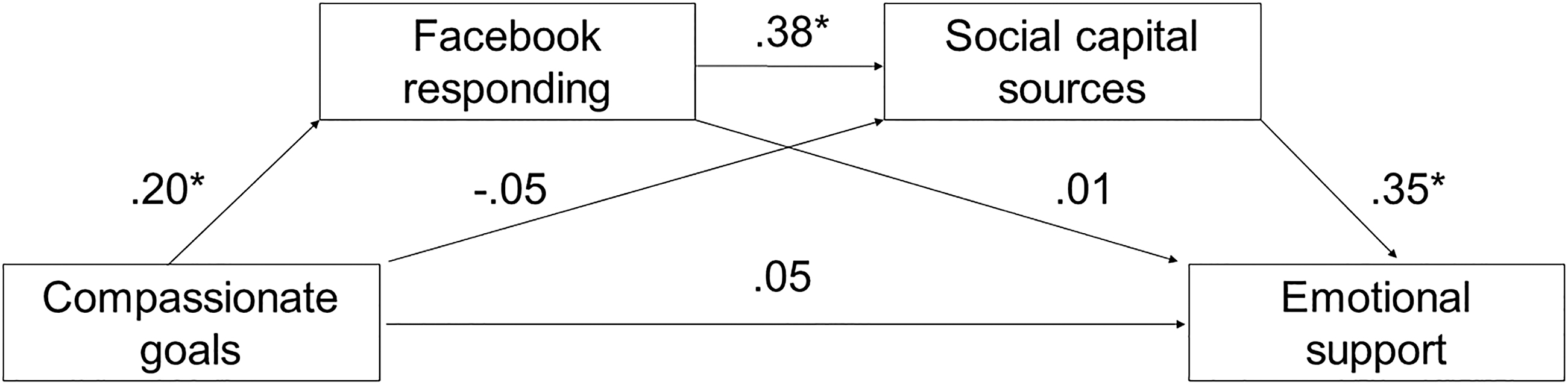
Serial mediation model testing compassionate goals, Facebook responding, and social capital sources as predictors of emotional support. Numbers represent the standardized regression coefficients, *p < 0.05. Indirect effect through Facebook responding = 0.003, 95% CI [−0.04 to 0.05]. Indirect through social capital sources = −0.02, 95% CI [−0.08 to 0.04]. Indirect through Facebook responding and social capital sources = 0.03, 95% CI [0.01 to 0.05].
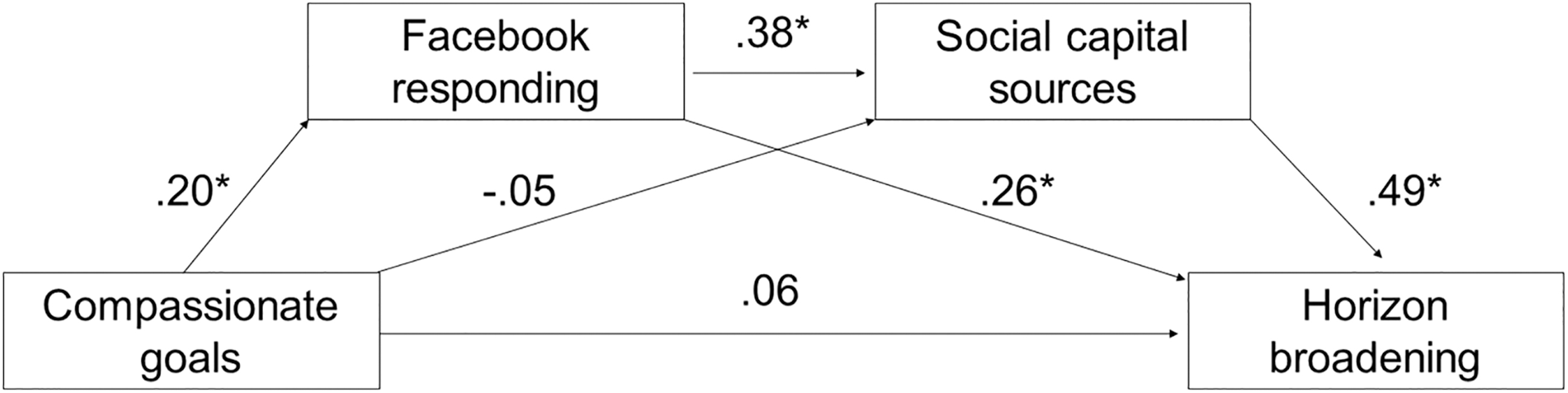
Serial mediation model testing compassionate goals, Facebook responding, and social capital sources as predictors of horizon broadening. Numbers represent the standardized regression coefficients, *p < 0.05. Indirect effect through Facebook responding = 0.05, 95% CI [0.01 to 0.10]. Indirect through social capital sources = −0.02, 95% CI [−0.10 to 0.05]. Indirect through Facebook responding and social capital sources = 0.04, 95% CI [0.01 to 0.07].

Serial mediation model testing compassionate goals, Facebook responding, and social capital sources as predictors of networking value. Numbers represent the standardized regression coefficients, *p < 0.05. Indirect effect through Facebook responding = −0.004, 95% CI [−0.04 to 0.03]. Indirect through social capital sources = −0.03, 95% CI [−0.10 to 0.06]. Indirect through Facebook responding and social capital sources = 0.04, 95% CI [0.01 to 0.08].
The H2 serial mediation analysis revealed a significant indirect effect of self-image goals on envy through Facebook searching and social comparison (Fig. 5). There was an additional indirect effect through social comparison alone, and the direct effect remained significant. In terms of covariate effects, Facebook posting and responding (positively) and age (negatively) predicted Facebook searching, compassionate goals (negatively) and attachment anxiety (positively) predicted social comparison, and attachment anxiety positively predicted envy. When we reran the H2 serial mediation analysis without covariates, we obtained the same direct and indirect effects.
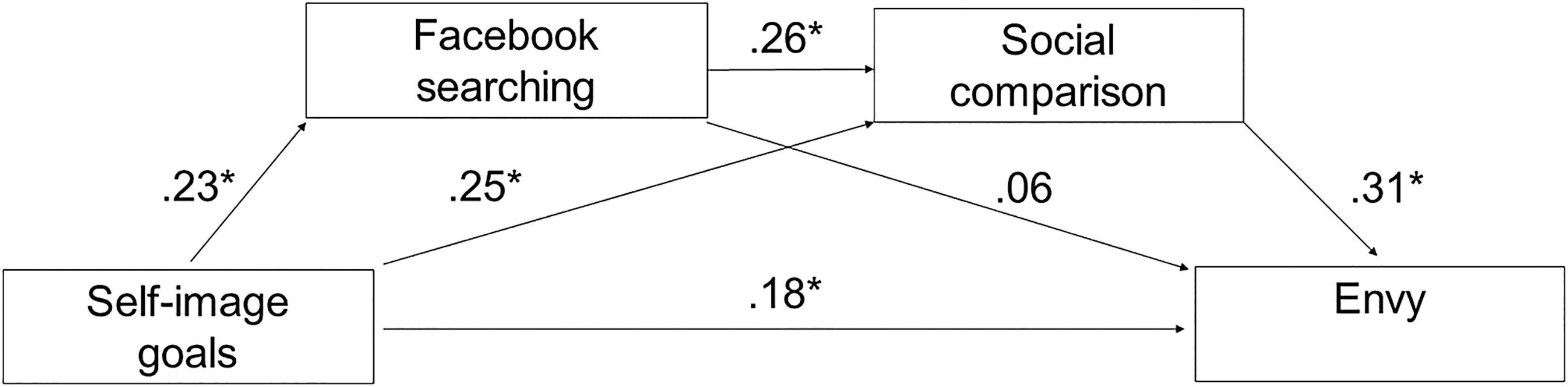
Serial mediation model testing self-image goals, Facebook searching, and social comparison as predictors of envy. Numbers represent the standardized regression coefficients, *p < 0.05. Indirect effect through Facebook searching = 0.01, 95% CI [−0.02 to 0.05]. Indirect effect through social comparison = 0.08, 95% CI [0.02 to 0.15]. Indirect effect through Facebook searching and social comparison = 0.02, 95% CI [0.004 to 0.04].
Discussion
Supporting H1, higher compassionate goals were associated with more responsive behaviors on Facebook, and in turn, greater social capital sources and benefits. The association between Facebook responding and social capital is consistent with past research on active Facebook use, 3 and supports the distinct role of responsive behaviours 8 and directed communication on Facebook in building social capital.5,6 The association between compassionate goals and Facebook responding extends the SNS and interpersonal goal literatures. It helps us understand who is likely to engage in responsive behaviors on SNSs and is consistent with the positive effects of compassionate goals offline. 42
Supporting H2, higher self-image goals were associated with more searching behaviors on Facebook, and in turn, more social comparison and envy. The associations between passive use, social comparison, and envy are consistent with past research on passive Facebook use.11–14 The associations between self-image goals, Facebook searching, social comparison, and envy extend our knowledge of who is most vulnerable to envy on SNSs and is consistent with findings that suggest self-image goals are associated with a competitive orientation and negative emotions.46,47
Our cross-sectional, correlational design does not allow us to draw causal inferences about the effects of interpersonal goals or Facebook behaviors on our outcomes of interest. Indeed, it is likely that goals, behaviors, and outcomes form reinforcing cycles.42,58 Furthermore, our sample was predominantly female, so the findings may not generalize to males. However, we did control for a number of potential alternative explanations: individual differences related to interpersonal goals, demographic factors, and other aspects of Facebook use.
Our research is an important first step in understanding how interpersonal goals may shape behaviors and experiences on SNSs. The broader question of how to engage with SNSs in a way that promotes well-being is of growing concern in today's increasingly online society. 3 Our findings suggest it is worth considering how people are thinking about others: whether they are focused on what other people need (compassionate goals) or what other people think of them (self-image).
Footnotes
Author Disclosure Statement
No competing financial interests exist.
Funding Information
Australian Catholic University provided funding to support the gift card drawing.