




Abstract
Although the American Academy of Pediatrics recommends not to heavily rely on screen media devices to regulate children's distress, many parents often resort to this regulatory strategy. However, little is known about the long-term implications of using this strategy for children's emotional functioning. To address this issue, this study examined the longitudinal links between the use of media to regulate distress and children's negative emotionality (NE) during toddlerhood, a period in which children strongly rely on external regulation. We also examined whether children with initially high NE were more sensitive to the effects of this regulatory strategy on subsequent NE. Participants were 207 mothers who completed questionnaires assessing child NE, use of media to regulate distress, child screen time, and demographic covariates at 2 time points: 18 months (T1) and 26 months (T2) of children's age. Use of media to regulate child distress at T1 did not directly predict child NE at T2, and vice versa. However, there was a significant interaction between child NE and use of media to regulate distress at T1 in predicting NE at T2. Simple slopes analysis indicated that maternal use of media to regulate distress was positively related to increases in children's NE, but only for children with initially low NE, and not for children with initially high NE. Our findings can inform family-based prevention initiatives that may be delivered in community pediatric settings, aiming at promoting thoughtful use of media in young children's everyday lives.
Introduction
The use of mobile digital media devices has become deeply embedded in the lives of young children.
1
Recent nationally representative data from the United States indicates that infants younger than 2 years of age are exposed to ∼1 hour of media per day, whereas 2- to 4-year-old children are exposed to more than 2 hours per day.
2
Previous research mainly focused on the implications of the amount of exposure to media on children's developmental outcomes.3–5
However, attention has recently been drawn to broader aspects of media use such as family media ecology, focusing on how media is used in the household and in children's daily routines such as play, discipline, meals, and bedtime.6–9
This line of work points to the negative associations between technoference (i.e., the interruptions in interpersonal interactions that occur owing to the use of digital and mobile devices) and children's social
The majority of research on technoference has focused on the implications of background television and parental mobile phone use for parent
Although parents often report using screen distractions as a regulatory strategy,9,19 little is known about the implications for children's social
An additional goal of this study was to examine whether some children are more susceptible than others to the implications of parental use of media to regulate distress. Theories of differential susceptibility (DS) propose that a subset of individuals with specific genetic, physiological, or behavioral characteristics are prone to heightened sensitivity to both negative and positive environmental conditions.26,27 This line of work has demonstrated that children who are prone to NE are more vulnerable to negative contextual factors, but may also have greater capacity to benefit from positive environments than children who do not carry these temperamental susceptibilities. 27 For example, infants prone to NE had lower self-regulation abilities when they were in unresponsive parent–child relationships, but higher regulatory capacities when in responsive relationships, compared with infants not prone to NE. 28
The DS theory has been recently applied to the field of media research in the differential susceptibility to media effects model (DSMM).29,30 Specifically, the DSMM suggests that there are three types of susceptibility variables that determine an individual's responsiveness to media: dispositional (e.g., temperament), developmental (i.e., developmental stage), and social (e.g., family, peers). For example, higher media violence exposure has been related to adolescents' increased subsequent aggression, but only when family conflict was high, supporting the notion that not all children are affected by media violence in the same manner.
31
To the best of our knowledge, to date there is no empirical evidence for DS to media in early childhood. Identifying specific child characteristics that render increased sensitivity to problematic media use can contribute to a more nuanced understanding of the effects of family media ecology on children's development, and promote targeted intervention efforts. In this study, we build on the developmental psychology literature26,27 to examine whether children with heightened NE are more strongly affected by parental use of media to regulate child distress. We propose the following hypothesis:
Methods
Participants and procedure
The initial sample at T1 consisted of 207 mothers of children whose age ranged from 17 to 19 months (mean child age = 17.71, SD = 0.83; 60 percent male). Twenty-four participants were excluded from the analysis due to child health and developmental problems (n = 3), maternal health problems (n = 4), answering wrongly the attention verifying items (“If you read this please mark 4”; n = 3), child age outside the range of 17–19 months (n = 2), or participants who reported aberrantly high child screen time (+2 SD above the mean, above 447.62 minutes per day; n = 9). Thus, 183 participants composed the final sample for this study. Demographic information is reported in Table 1.
Demographic Characteristics of Participants
The study protocol was reviewed and approved by the Human Subjects Research Committee at Ben Gurion University of the Negev. Data were collected from January 2018 to January 2019 through Prolific®, an online research platform. 32 Mothers of children between the ages of 17 and 19 months were initially approached via Prolific and offered to participate in the study. Online consent forms were obtained from mothers willing to participate. The same participants were approached again via Prolific 8 months later to participate in T2. Mothers were requested to complete a set of questionnaires at both time points. Participants received 1.3 GBP for participating in T1 and 3 GBP for participating in T2.
Measures
Child NE was assessed at both time points by using the Frustration subscale from the Early Childhood Behavior Questionnaire–Short Form (ECBQ-SF). 33 The Frustration sub-scale is composed of six items (e.g., “When s/he asked for something and you said ‘no,’ how often did your child have a temper tantrum?”) that were rated on a scale ranging from one (never) to seven (always). Higher scores indicate higher levels of child NE (α = 0.76, 0.81 for T1 and T2, respectively).
Use of media to regulate distress was assessed at both time points by using a version of the “Coping with Toddlers' Negative Emotion Scale” (CTNES) 18 that was modified for this study. The CTNES consists of 12 different scenarios in which children exhibit distress (e.g., parent prohibits an activity). Mothers were asked to rate the likelihood to respond in seven different ways to children's distress (e.g., minimizing the child's distress, encouraging emotional expressiveness, punitive reactions) that were rated on a scale ranging from one (very unlikely) to seven (very likely). In this study, four distress scenarios were presented to mothers to reduce participant burden, and an additional strategy was added: the likelihood of responding with the provision media to calm the child's distress (e.g., “If my child becomes angry because s/he is not allowed to have a snack when s/he wants it, I would offer to let my child play or watch something on my phone/tablet/computer/TV”), which was the only scale used in the current analysis. Higher scores on this scale indicate higher provision of media to regulate child distress (α = 0.78, 0.79 for T1 and T2, respectively).
Covariates
Maternal education was controlled for based on previous studies linking child screen time and difficult temperament to maternal education level. 34 Maternal education was rated on a scale from one (“less than a high-school diploma”) to six (“graduate degree”). Child average daily screen time was also controlled for to examine the unique role of use of media to regulate distress. Child average daily screen time was assessed at both time points by using maternal report of average screen time (i.e., watching TV, watching videos on a handled device, or playing games) during weekdays and weekends. Finally, we controlled for child sex to account for possible sex differences in NE and media use.
Statistical analysis
We used path analyses to test our hypotheses by using Mplus version 7.31. 35 To test H1, we estimated a model in which child NE and use of media to regulate distress at T2 were regressed on the study covariates, child NE and use of media to regulate distress at T1. To test H2, we added the interaction term “T1 child NE × T1 use of media to regulate distress” to the model. Independent variables were mean-centered. Significant interactions were probed by estimating simple slopes at average and ±1 standard deviations of child NE. 36
Of the 183 participants who composed the sample of this study, 73 participants did not participate in the T2 assessment. No significant differences were found between participants who completed only T1 and participants who completed both assessments regarding demographics, child screen time, media to regulate distress, and NE. To account for missing data, we utilized a full maximum likelihood (FIML) estimator for all analyses. FIML is well recognized as an effective method for analyzing longitudinal data with moderate to large amounts of missing data and has been demonstrated to provide less biased parameter estimates than other commonly used techniques, such as listwise deletion.37,38 Because FIML procedures allow for the use of all available data from each participant, the full sample of n = 183 was retained in all primary analyses.
Results
Preliminary analyses
Table 2 presents unweighted means, standard deviations, and correlations among all study variables. Child NE at T2 was positively associated with media to regulate distress at T2 and child average screen time (at T1 and T2), and negatively associated with maternal education. Media to regulate distress were positively associated with child average screen time at both time points.
Unweighted Means, Standard Deviations, and Correlations Among All Study Variables
Child sex: 0 = female, 1 = male.
*p < 0.05 **p < 0.01.
Path models
First, to test H1, child NE and maternal use of media to regulate distress at T2 were regressed on study covariates, T1 child NE and T1 use of media to regulate distress. T1 child NE (β = 0.55, SE = 0.06, p < 0.001), and maternal education (β = −0.19, SE = 0.07 p = 0.01) were significant predictors of NE at T2. Moreover, T1 use of media to regulate distress (β = 0.46, SE = 0.08, p < 0.001) was a significant predictor of T2 use of media to regulate distress. No cross-lagged associations were found between use of media to regulate and child NE.
Next, to test H2, the interaction term was entered (Fig. 1). The significant links from the initial model remained significant. In addition, a significant interaction was observed between child NE and use of media to regulate (β = −0.23, SE = 0.06, p = 0.001) in the prediction of NE at T2.

A path model predicting auto-regressive, crossed-lagged, and interactive effects between maternal use of media to regulate child distress and child negative emotionality at T1 and T2. *p < 0.05, **p < 0.001.
To probe the significant interaction effect, simple slopes were estimated for low (−1 SD), average, and high (+1 SD) levels of child NE (Fig. 2). The positive association between T1 use of media to regulate and T2 NE was significant only for children with low initial NE (B = 0.37, SE = 0.10, p < 0.001), but not for children with average (B = 0.13, SE = 0.07, p = 0.06) or high (B = −0.10, SE = 0.10, p = 0.27) initial NE.
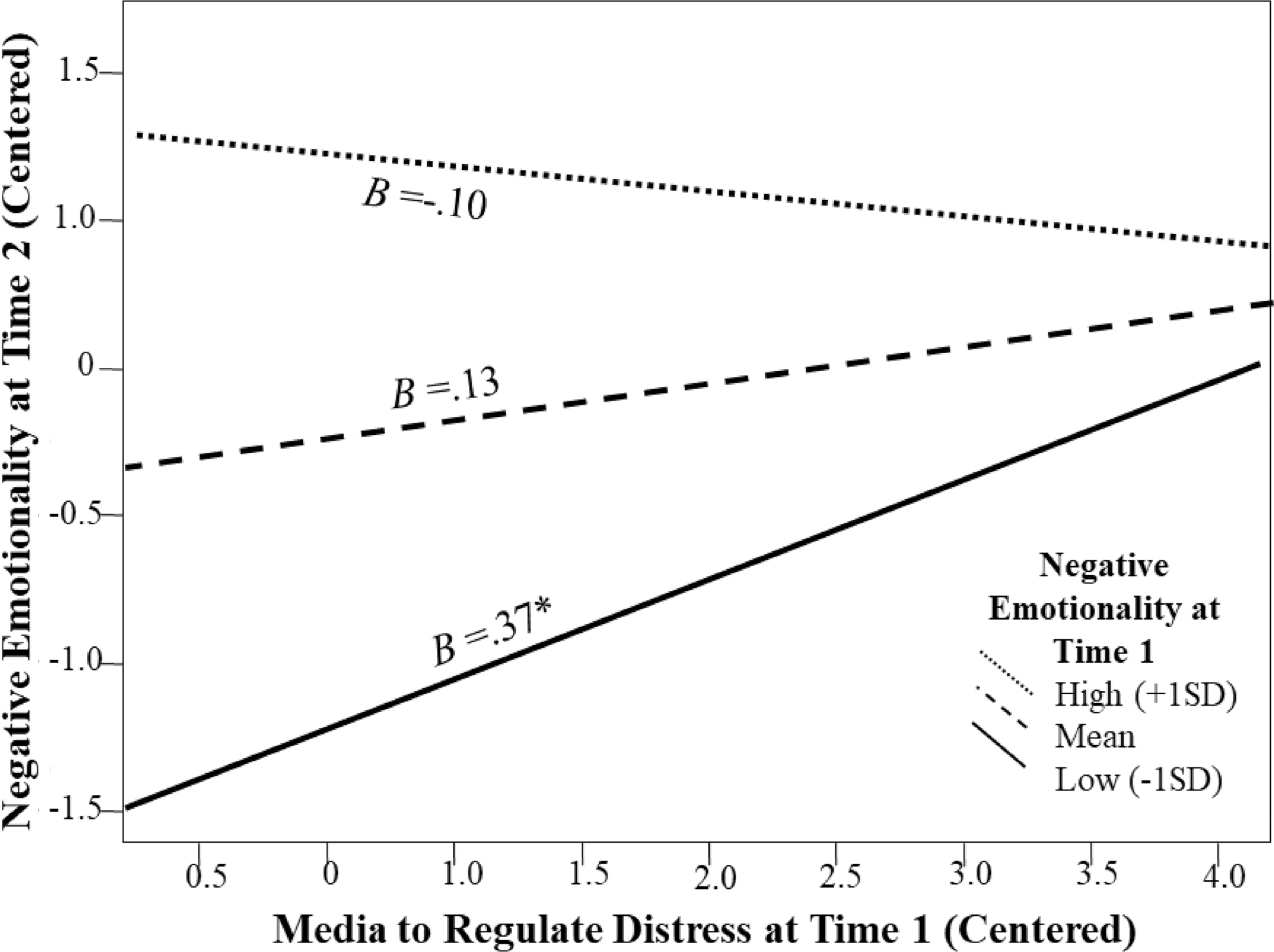
The links between maternal use of media to regulate child distress and T1 child negative emotionality T2 at different levels of child negative emotionality at T1.
Specificity analysis
Because child screen time was significantly correlated with both child NE and maternal use of media to regulate distress, we estimated a competing model in which use of media to regulate was replaced by child screen time (Fig. 3). In this model, T1 child screen time (β = 0.47, SE = 0.09, p < 0.001) and maternal education (β = −0.21, SE = 0.08, p = 0.01) predicted T2 child screen time. In addition, T1 child NE (β = 0.55, SE = 0.06, p < 0.001) and maternal education (β = −0.19, SE = 0.07 p = 0.01) predicted T2 NE. Neither T1 child screen time, nor the interaction of child NE and child screen time predicted T2 NE.
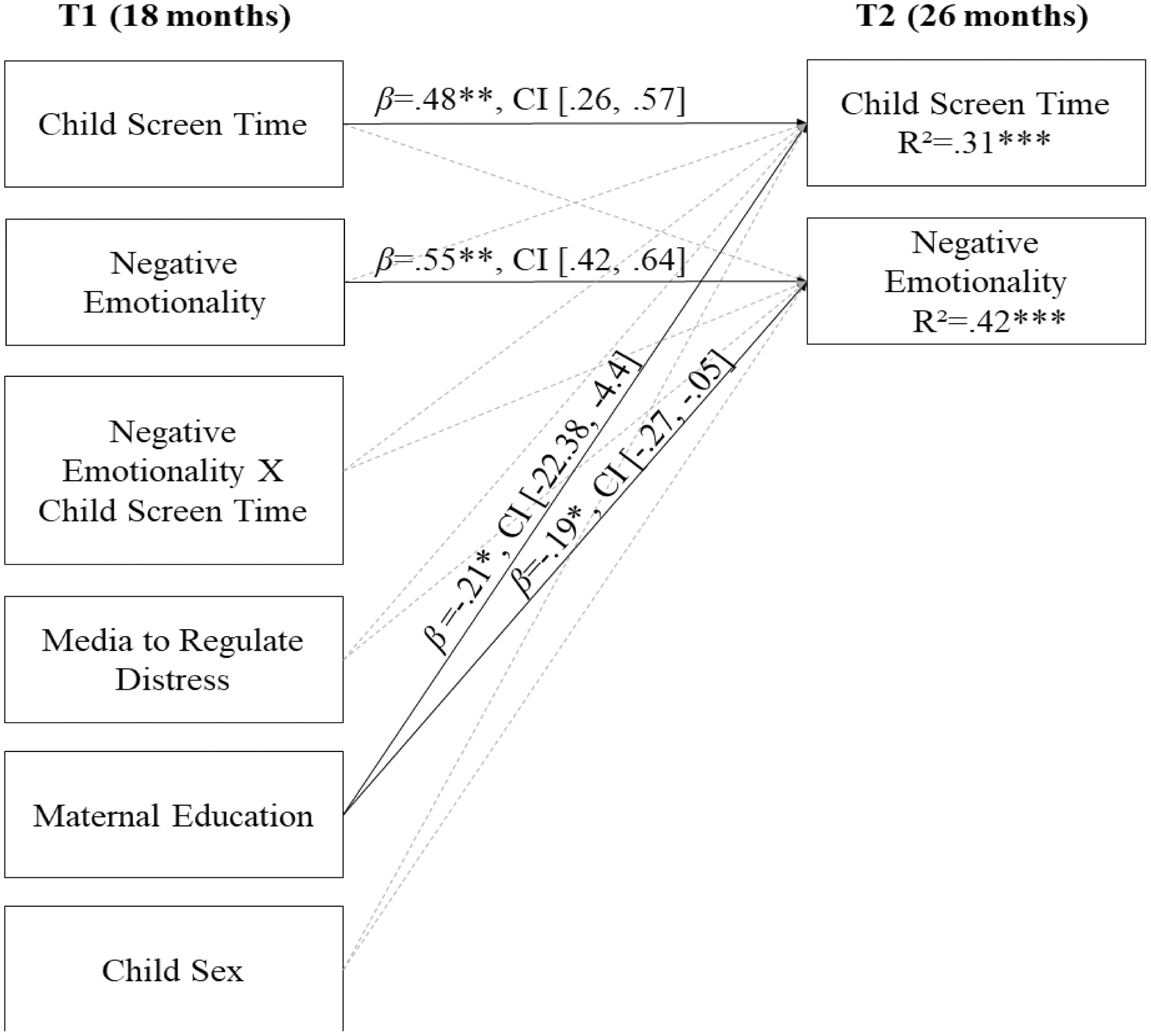
A path model predicting auto-regressive, crossed-lagged, and interactive effects between child screen time and child negative emotionality at T1 and T2. *p < 0.05, **p < 0.001.
Discussion
This study investigated the bidirectional longitudinal links between maternal use of digital media to regulate child distress and children's NE during toddlerhood. Building on the DSMM,29,30 we also examined whether children with heightened NE are more strongly affected by maternal use of media to regulate child distress. Because heightened NE in early childhood represents a risk marker for behavioral and physiological dysregulation in later childhood and young adulthood,23,24 it is important to understand how parental media use in this context shapes trajectories of NE.
To our knowledge, this is the first longitudinal study that investigated whether use of media to regulate child distress is associated with increases in young children's NE over time, or whether children with high NE increase mothers' use of digital media as a regulatory strategy. Contrary to H1, use of media to regulate distress at age 18 months was not directly related to child NE at age 26 months, and child NE at 18 months was not related to subsequent use of media to regulate distress at age 26 months. Our specificity analysis further demonstrated that child screen time also did not predict subsequent child NE, and vice versa. These findings are consistent with a recent study by Cliff et al.
39
that showed only negligible longitudinal links between child total media exposure at 4 years of age and self-regulation at 6 years of age. The authors suggested that additional media-related factors might have a more prominent role in shaping children's self-regulation abilities than media exposure, such as media use context and content.
39
This study shows that one media use context that in theoretically relevant to emotion regulation, namely use of media to regulate, was also unrelated to later emotional reactivity. Radesky et al.
9
have previously shown positive cross-sectional associations between parental use of media to calm their children and social
An additional explanation for the lack of bidirectional links between use of media to regulate and child NE is that some children may be more susceptible to the effects of media.29,30 Accordingly, based on the DSMM29,30 and previous research,26,27 we examined whether children with heightened NE are more strongly affected by parental use of media to regulate child distress. We found a significant interaction between child NE and use of media to regulate distress, but not in the hypothesized direction. Specifically, use of media to regulate distress predicted increases in NE from age 18 to 26 months only for children with initially low NE. One explanation for these findings might be that mothers of children with initially high NE use multiple strategies to regulate their children's distress, resulting in children being exposed to a wider range of regulatory efforts, such as emotion and problem-focused strategies, that also have a role in shaping their NE tendencies. On the contrary, mothers of children who are low on NE may not use a variety of strategies, and mainly rely on media distractions as an immediately efficient strategy. From a social-learning perspective, 40 it is also possible that the provision of media in reaction to the child's distress may become a reward rather than a regulatory strategy, and thus increase children's NE to receive this incentive.
Findings from this study should be considered in light of several limitations. First, an online-recruited sample might not be representative of the general population. Mothers using the Prolific platform may have different attitudes toward media use compared with mothers who do not use this platform. Also, the majority of our sample identified as white European, limiting generalizability of the findings to other ethnic groups. An additional limitation is the exclusive focus on maternal use of media. Including fathers' and additional caregivers' reports in future research will result in a more compressive assessment of children's exposure to media regulatory strategies. Finally, the focus of this study was on early toddlerhood (ages 18–26 months), a period in which media use patterns and child self-regulatory abilities begin to emerge. However, family media ecology changes as a function of child age, 41 and self-regulatory abilities continue to develop rapidly during the preschool period. 42 Thus, examining the links between use of media to regulate and child NE later on in development is an important next step.
Despite the aforementioned limitations, this study has several strengths, including the longitudinal design, the inclusion of a novel measure to assess use of media to regulate distress, and the use of a repeated-measures approach that enables the examination of transactional links. Findings from this study contribute to the understanding of media use during early childhood, not only in terms of amount, and highlight the importance of media use context and practices. Our finding that media use to regulate distress predicted increases in NE only for children with initially low levels of NE supports the DSMM,29,30 suggesting that the use of a DS approach in media research can result in more nuanced conclusions. Findings from this study can inform family-based prevention initiatives that can be delivered in community pediatric settings, that can address the important role of media use context, and promote the use of more adaptive regulatory strategies that help children understand and cope with the source of distress, and teach them to deal with future similar situations. 18
Footnotes
Author Disclosure Statement
No competing financial interests exist.
Funding Information
No funding was received.