




Abstract
The majority of youth fail to get the recommended amount of physical activity (PA), and there is a precipitous decline in PA among children as they get older. Guided by self-determination theory and social cognitive theory, we designed an interactive, mixed reality PA intervention for 6–10-year-old children. Capitalizing on the features of consumer-grade interactive communication technologies, the intervention features a kiosk-based system that houses a virtual agent programmed to encourage children to set self-determined PA goals. This intervention aims to resolve many practical challenges in designing and administering a personalized, intrinsically motivated PA intervention for this age group. We pilot tested the feasibility of this kiosk across 6 weeks with n = 42 child/parent dyads. The kiosk tracked and logged children's daily PA and engagement with the intervention without having to rely on human reporting, provided tailored evaluation and feedback whenever children requested it, informed parents about their child's PA progress, and employed a virtual agent (a dog) to offer social support to children. The virtual agent prompted users to set PA goals, and as children met these goals over time, their personalized dog became happier, more fit, and better at tricks. Each time a child engaged with the kiosk the system automatically sent a text message to his/her parent with details about the child's PA progress. The current study demonstrated the kiosk's feasibility in the field over 6 weeks, illustrating the potential of using interactive technologies as tools for disseminating self-sufficient, and truly self-determined health interventions for children at scale.
Introduction
With over one in three children diagnosed as overweight or obese, scholars have identified childhood obesity as one of the most serious public health challenges in the 21st century. 1 Childhood obesity is a strong predictor of obesity in adulthood,2,3 leading to depression 4 and chronic diseases, such as type 2 diabetes, heart disease, and many cancers. 5 Excess calorie intake and low levels of physical activity (PA) are often identified as major contributors to child obesity.6–8 Relative to nutritional issues, obesity and related chronic diseases resulting from physical inactivity are largely preventable through systematic increases in PA, which is the focus of this project. The majority of youth fail to get the recommended amount of PA9–12 with children between the ages of 6–10 years experiencing a precipitous decline in PA. 9 Because interventions are less successful once obesity is established in childhood, 6 children between the ages of 6–10 provide a critical window for PA interventions to motivate and sustain healthy PA habits. 3
Guided by the self-determination theory (SDT) 13 and social cognitive theory, 14 we pilot tested the feasibility of an interactive PA intervention for children that uses consumer-grade communication technologies to connect children and parents when they are not physically together. By leveraging features of interactive technologies, the intervention was designed to be largely self-sufficient and autonomous, that is, administered with only limited involvement from human supervisors. Even with minimal human involvement, the PA intervention was tailored to each child's progress while also providing on-demand evaluation, feedback, and social support from a friendly virtual agent who vicariously demonstrated the benefits of PA. Because the intervention proposes novel methods of implementation and measurement, this study was designed to assess its feasibility in the field over 6 weeks.
Self-determination theory in physical activity interventions
SDT posits that lasting behavior change results from intrinsic, autonomous choices; individuals are motivated to engage in behaviors that are inherently enjoyable rather than externally enforced.13,15 This motivation arises from three basic, crossdevelopmental psychological needs, 13 including autonomy, or the desire to engage in behaviors of one's own volition rather than being driven by external regulations; competence, or the feeling of efficacy in carrying out an action; and relatedness, or a desire to feel connected to others.
SDT predicts that encouraging children to make self-determined choices for their PA goals increases their intrinsic motivations to engage in PA. 16 However, the bulk of research on SDT in a PA context has adopted cross-sectional and correlational, rather than longitudinal and experimental, approaches. 17 When experimental methods have been adopted to test the efficacy of a PA intervention, participants were often given externally determined PA goals set by researchers.18–20
An autonomously driven PA intervention is critical as it allows children to feel empowered and become agents of health behavior change, a key underlying mechanism of SDT.21,22 In the course of setting and meeting autonomous PA goals, children gain the experience of mastering goals and feel competent in posing greater PA challenges for themselves. 23 Other studies have emphasized the importance of relatedness as well as peer and parental social support for children struggling to adhere to PA interventions.24,25 Although simple in principle, designing an autonomous PA intervention that integrates self-determined PA goals, promotes competency, and provides timely social support to children presents practical challenges because it requires a highly customized and tailored intervention that is labor and resource intensive.
Interactive communication technologies as novel tools for physical activity interventions
Features of interactive communication technologies may be leveraged to resolve many practical challenges in designing and administering an autonomous and personalized PA intervention to enhance intrinsic motivation. We developed a kiosk-based system, guided by the frameworks of SDT and social cognitive theory that houses a virtual agent programmed to allow children to set self-determined PA goals, provide accurate feedback, and positively reinforce PA behaviors (Fig. 1).
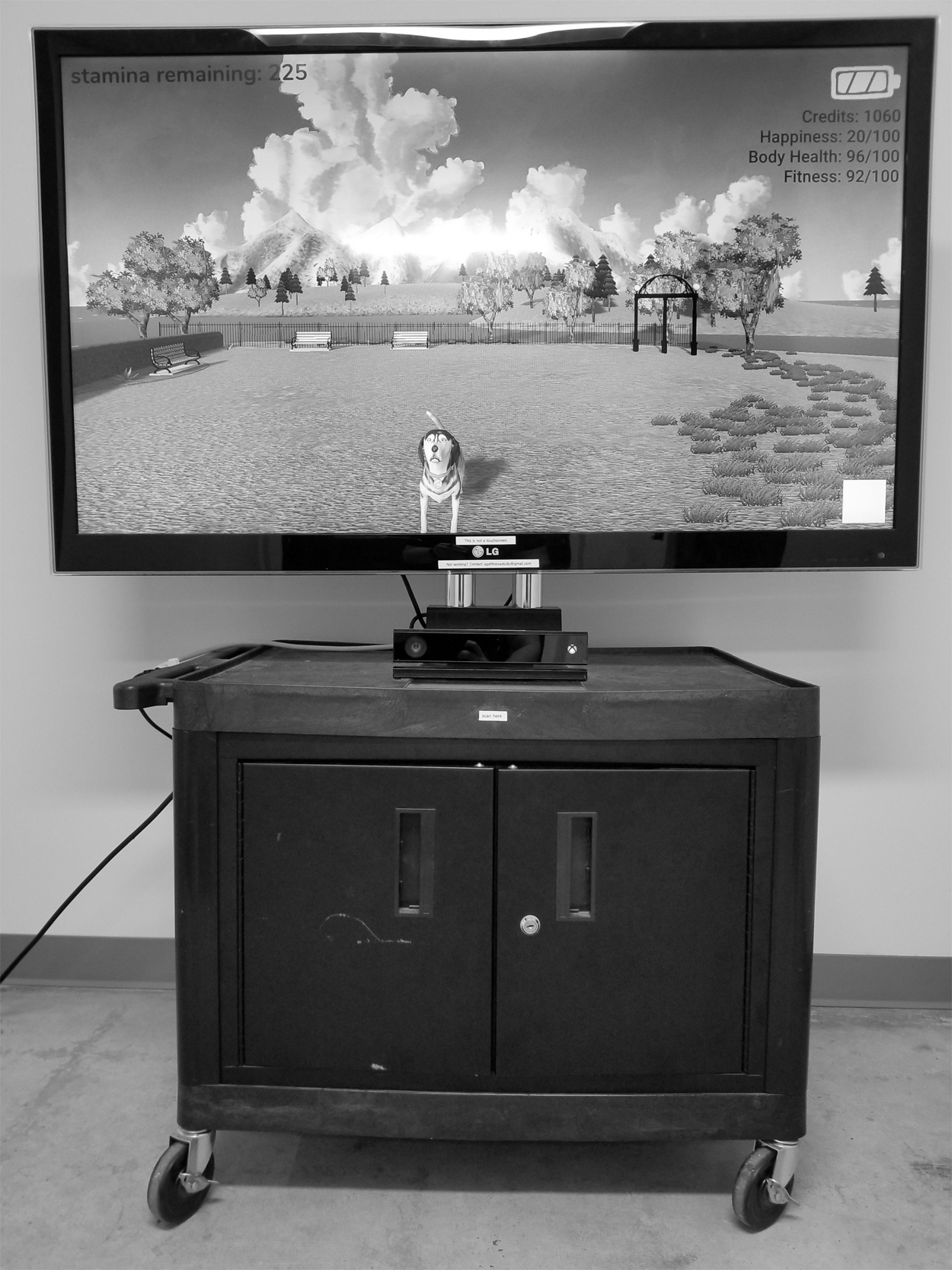
The Virtual Fitness Buddy kiosk.
Tracking/monitoring
Consumer-grade PA monitors (e.g., Fitbit) have become popular in recent years, allowing researchers to reliably track PA in the field. 26 Although affordable and valid, there are still major hurdles in using these monitoring devices for long-term PA interventions due to issues of battery life and syncing PA data. Many devices require charging every 3–7 days, which means either participants or researchers must diligently monitor devices' battery power. Even then, many devices only hold PA data for 1–2 weeks, meaning that participants or researchers must download the PA data regularly to ensure continuous measurement. As a result, many studies limit the PA assessment period to 1 week at a time27,28 or rely on participants or researchers to regularly collect PA data from the devices. 29 With young children, it is especially challenging to keep devices charged and download PA data regularly without involving adults. In the current study, children wore Fitbits while performing PA. Whenever the child's device was detected in its vicinity, the kiosk we designed automatically downloaded PA data from children's Fitbits, assessed battery levels, and sent a text message to parents of children whose devices needed recharging.
Evaluation/feedback
In line with social cognitive theory, accurate evaluation and feedback on performance are important motivators for high competency30,31 and PA self-efficacy. 32 However, PA intervention studies for children often test the efficacy of health education programs developed by researchers, 33 and interactive feedback is typically not incorporated as it requires extra human resources. Interactive communication technologies enable participants to receive objective, reliable, and on-demand evaluation and feedback on PA progress.
Social support
Prior studies have demonstrated the importance of social support for children to adhere to a PA intervention program over time.34–36 On their own, children may not have the resolve or resources to overcome various hurdles during the PA intervention, leading to premature noncompliance. A growing number of studies point to the potential of virtual agents to provide health information and encouragement to adults37,38 but very few have been tested in the context of PA interventions for children.39,40 We envisioned a virtual agent that functions as a personalized fitness buddy to encourage children to set and meet self-determined PA goals, promote PA self-efficacy, and nurture mutually supportive relationships between the child and the agent, thereby fostering the perception of relatedness. This will be particularly helpful for children who have insufficient levels of PA social support at home. In accordance with social cognitive theory, the virtual pet was designed to vicariously demonstrate the benefits of PA. Pets, in particular dogs, have been found to promote PA as a lifestyle change, 41 and the virtual agent in our kiosk-based system was modeled to take the form of a mid-sized customizable dog (e.g., choice in breed, name, dog-related items).
Study Overview
We designed a kiosk that is self-sufficient, substantially reducing the burden of in-person interactions necessary to administer the intervention. It autonomously tracks and monitors children's daily PA without having to rely on human reporting, provides tailored evaluation and feedback whenever children request it, and employs a virtual agent to offer PA social support. Overcoming drawbacks of previous health interventions, this design enables implementation of a long-term PA intervention for young children with daily tracking of PA data, leverages feelings of mastery and competency each time children reached a self-determined PA goal,23,42 and fosters mutually supportive relationships between children and their virtual dogs.
To test the feasibility of the proposed kiosk-based PA intervention, a pilot study was conducted at two YMCA afterschool sites in the Southern U.S. across 6 weeks. Reported analyses focus on demonstrating the feasibility and potential challenges of a longitudinal field study on children and parents using interactive communication technologies rather than testing the efficacy of the intervention itself.a Our primary feasibility criteria were: (a) recruit over 20 parents and their 6–10-year-old children in each site, and that participants should (b) wear Fitbits at least half of the days throughout the study period, and (c) meet at least one PA goal using the kiosk. As qualitative evaluation, we sought open-ended feedback from participants about the intervention.
Methods
Sample
In partnership with a local YMCA administration, the feasibility study was carried out at two sites identified as candidates to pilot test our intervention based on their directors' receptivity to the project. Sites were assigned to treatment and control groups based on the sites' relative abilities to host the virtual reality kiosk. Forty-nine child/parent dyads (ncontrol = 15; ntreatment = 34) were recruited for participation, thereby fulfilling the first feasibility criterion. Seven families (ncontrol = 3; ntreatment = 4) dropped out midway, leaving 42 child/parent dyads over 6 weeks. Parents reported basic demographics for both themselves and their child (Table 1).
Parent and Child Demographics (n = 42)
Kiosk
The kiosk comprised a rolling cabinet with a television stand. The cabinet encased a small computer equipped with a Microsoft Kinect motion capture device (Fig. 1). Capitalizing on the Bluetooth capabilities of Fitbit Flex 2, the kiosk was able to detect the Media Access Control address of each child's Fitbit when they were within a 20-foot radius of it. When the kiosk recognized a child's Fitbit, it displayed his/her name and simultaneously synchronized the PA data from the child's Fitbit to our server.
All children were asked to customize and personalize their unique virtual dog. When children approached the kiosk, their virtual dog appeared in a park, prompted them to set a new PA goal (25–120 active minutes), and displayed progress toward their existing PA goal. The progress display featured a graph of their active minutes and PA goal progress over the last 7 days. After setting a new PA goal, children could teach their dog tricks (sit, rollover) and play games with their dog, such as piñata or fetch. The more PA goals children met over time, the happier, more fit, and better at tricks their dog appeared to be. When a child interacted with the kiosk, the system automatically sent a text message to the parent containing a link to a website detailing the child's PA progress. Automatic text messages were also sent to parents when their child's Fitbit battery was low. In addition to PA data obtained from the child's Fitbit, the system would unobtrusively log each PA goal that the child set and achieved, as well as the amount of playtime spent with their virtual dog.
Procedure
Interested families from the two sites attended separate orientation sessions where we explained the procedure and (if applicable) kiosk, and obtained parental consent/children's assent. We gave every child participant a Fitbit Flex 2 to wear for the duration of the study and told parents that at the study's end, they could keep the Fitbit or return it for a $25 gift-card. Children were instructed not to take off their Fitbit except to charge it every 3–5 days.
The orientation acted as the beginning of a baseline measurement week for both groups. The intervention subsequently lasted 25 days (18 weekdays) and was followed by a postintervention measurement week for both groups. During the intervention, children at the treatment site had access to the kiosk during the hours they attended their afterschool program. At the beginning of both the baseline and postintervention weeks, we obtained survey responses from parents and children, and children's body composition measurements (height, weight, body fat percentage, waist circumference).
Measures
Self-report surveys
Parents' surveys were designed to assess their intrinsic motivation toward PA, 43 PA parenting style, 44 and basic demographics. Children's self-report surveys were designed to assess their intrinsic motivation toward PA, 43 as well as the PA social support they perceive from their peers and parents (both critical moderators of health behavior change), 45 as well as the virtual pet (if applicable). 46 In addition to the survey, parents and children completed open-ended questions asking for feedback on the intervention.b
Physical activity
Children wore their Fitbits on their nondominant hand for 43 possible valid wear days (25 during the intervention, 18 days among the baseline/postintervention weeks).c Daily Fitbit wear times were estimated using a modification of Choi's algorithm, 47 under which intervals of 90 or more consecutive minutes with zero steps were defined as nonwear time. Because we wanted to separately assess the feasibilities of (a) requiring children in the treatment group to wear Fitbits to interact with the kiosk (kiosk-wear criterion) and (b) using Fitbits to accurately estimate daily PA across the treatment and control conditions (PA-wear criterion), we set two separate criteria for what constituted a valid wear day. For the kiosk-wear criterion, we defined valid wear days as any weekday in which children wore the device for at least half of the time that they were able to interact with the kiosk; that is, the 2 or more hours between 2:30 and 6:30 p.m. when they were at their afterschool program. For the PA-wear criterion, we defined valid wear days as those in which children wore the device for 10 or more hours.48,49
Results
Survey compliance
Of the 49 initial child participants, n = 48 completed the baseline survey, and n = 40 completed the postintervention survey, suggesting a child survey compliance rate of 81.63%. Of the 49 initial parent participants, n = 42 completed the baseline survey, and n = 38 completed the postintervention survey, suggesting a parent survey compliance rate of 77.55%. A total of n = 40 children and n = 35 parents completed both the baseline and postintervention surveys.
Fitbit wear
Of the 31 possible weekdays throughout the study, and using the kiosk-wear criterion (>16 days), n = 32 children in the treatment group wore their Fitbits for an average of 17.06 days (standard deviation [SD] = 9.91). As this indicates a Fitbit kiosk-wear compliance rate of 55.04%, we considered our second feasibility criterion met.
Applying the PA-wear criterion across all 43 study days, n = 44 child participants with complete Fitbit data across conditions recorded a mean of 20.71 valid wear days (SD = 14.01), indicating Fitbit PA-wear compliance for 48.16% of days in the study. There was weak but not significant evidence (p = 0.08) that compliance was greater in the treatment group (mean [M] = 53.34%; standard error [SE] = 5.62%) than in the control (M = 34.30%; SE = 9.18%). The mean number of steps on PA-wear days was 13,853 (SD = 5,143; range: 2,633–34,409).
Kiosk logs
We obtained kiosk log data from every participant in the treatment group who completed the study (n = 29). Participants interacted with the kiosk for an average of 4.40 days (SD = 2.85; median = 3.5) throughout the 18 weekdays in which they had access to it. On average, each participant in the treatment condition used the kiosk to set 3.62 PA goals (SD = 2.40) to an average of 55.52 minutes (SD = 22.88). Based on the number of minutes participants were fairly/very active (measured by their Fitbit; M = 66.07; SD = 34.82; range = 29.47–147.26), participants achieved, on average, 3.28 PA goals (SD = 2.37; median = 3 goals; range = 0–9 goals). This fulfills the study's third feasibility criterion. The total amount of time participants spent playing with their virtual pets throughout the study ranged from 3 to 59 minutes (M = 20.35, SD = 13.89).
Open-ended feedback
Participants responded positively to all components of the intervention. They mentioned several areas they appreciated about the study as well as some areas for improvement (Table 2).
Open-Ended Feedback Results
PA, physical activity.
Discussion
Composed of consumer-grade interactive technologies, the proposed kiosk-based system provided a PA intervention tailored to the pace of individual children, complemented with feedback and social support from a virtual agent and minimal supervision from researchers. The kiosk offers the ability to implement a health intervention that is truly self-determined, yet largely self-sustaining; two qualities that have been particularly onerous for previous health researchers and practitioners to achieve with young children. Overall, the current study demonstrated the kiosk's feasibility in the field over 6 weeks, illustrating the potential of using interactive technologies as a method for disseminating health interventions at scale.
Benefits of using interactive technology include validating parent-reported PA with more objective and continuous measures of children's PA that are logged from the Fitbit/kiosk. This reduces the burden on participants, parents, and researchers looking to assess children's PA “in the wild.” Additionally, because data are continuously logged whenever a participant interacted with the kiosk, measurements obtained from the kiosk were not subject to decreased compliance with measurements over time. That is, as long as the participant was (a) still enrolled in the study and (b) interacting with the intervention, measurements of their progress with the intervention system were still ongoing. This underscores one of the most important advantages to using interactive technologies to employ health interventions, as ecologically valid observational assessments can continue with minimal participant and researcher effort.
The feasibility study also demonstrated the potential of actively involving parents in the intervention when they are not colocated with their children through real-time text messages sent to the parents' mobile phones. Future iterations of the study will aim to allow parents to provide additional social support to children and interact with them from afar by texting words of encouragement that will be displayed on the kiosk.
This study is not without limitations. First, convincing child participants to wear their Fitbits proved to be more difficult than anticipated. Nevertheless, participants across conditions wore their Fitbits for approximately half of the days in the study period. Second, the successfulness of this intervention hinges on fast, reliable wireless Internet access, which could act as a barrier to scaling up the intervention in the future, especially to sites that are more rural or which have limited technology infrastructure.
With the increasing prevalence of interactive media exposure in children's everyday lives, the bulk of the research to date has focused on the entertainment value of these technologies. The current study provides preliminary evidence that the features of popular interactive and wearable technologies to track and monitor user behaviors may be harnessed to design powerful interventions for children and their families that are tailored yet scalable, and ecologically valid yet nonobtrusive.
Footnotes
Acknowledgments
The authors would like to thank the following team members for their help in developing the kiosk and collecting data (appearing in alphabetical order): Catherine Ball, Benjamin Bordeaux, Zhixuan Chu, David DiGioia, Danielle Garcia, Neila Grimsley, Derek Huynh, Gopi Mamidi, Dylan Ogle, Simin Savani.
Disclaimer
The content is solely the responsibility of the authors and does not necessarily represent the official views of the National Institutes of Health.
Notes
Author Disclosure Statement
No competing financial interests exist.
Funding Information
Research reported in this publication was supported by the National Heart, Lung, and Blood Institute of the National Institutes of Health under award no. 1R01HL135359.