




Abstract
Immersive storytelling is widely considered to have a great potential to foster empathy toward suffering people, as well as to provide enjoyable experiences able to attract wider audiences. This article examines how the immersive presentation of 360-video nonfiction contents impacts both empathy toward the characters and enjoyment of the experience and the interplay between these two psychological outcomes. Participants watched a series of 360-video stories presented either on a virtual reality headset or a screen, and measures of spatial presence, empathy (in terms of perspective taking and empathic concern), and enjoyment were collected. Mediation analyses and structural equation models showed a direct positive effect of spatial presence on perspective taking and empathic concern, and an indirect negative effect of immersive presentation on empathic concern through enjoyment. These findings indicate that enjoyment of pleasurable aspects of the experience may hinder the affective dimension of empathy toward the characters, and point out to the need to carefully consider the targeted reactions from the audience, since different intended psychological outcomes may not be fully compatible.
Introduction
Throughout the last few years, developments in the field of virtual reality (VR) systems have fostered the emergence of the so-called immersive journalism, that is, the use of immersive technologies to give the viewer a “first-person experience” of the facts.
1
Major news outlets have started exploring the possibilities of these immersive stories, mainly in the form of 360-video,2,3 and practitioners have pointed out several possible benefits of immersive content compared with more traditional formats.
4
Among them, one of the most argued is the potential of immersion within the story world to enhance empathy toward the suffering of disfavored people (see, for instance, the United Nations VR program,
However, not only have some voices called into question the ability of immersive storytelling to elicit actual empathetic responses, 7 but it has also been stressed that the impression of being within the story world could lead the viewer to focus more on his or her own immersive experience than in the narrated events,8,9 therefore, hindering emotional involvement with the story.
Existing empirical research on the actual potential of nonfiction immersive narratives for stimulating empathy is scarce and has led to mixed results.10–13 Moreover, the interplay between different psychological outcomes of immersion in a narrative world has been hardly examined. The current research aims to start filling this research gap by exploring how the immersive properties of a story may impact both empathy and enjoyment, and conflicting relationships between these two elements in the context of nonfiction stories reception.
Immersion, presence, and empathy
Immersion and presence are controversial terms, and various divergent definitions and operationalizations of them coexist in the literature (e.g., IJsselsteijn et al., 14 Jennett et al., 15 Lampton et al., 16 and Skarbez et al. 17 ). In this article, we follow the approach by Slater and colleagues,18,19 which defines immersion as a technical property of the medium, related to its capacity to provide natural sensorimotor contingencies to the user (e.g., a wide field of view, or a quick update of the visual field when the user turns his or her head). Within this approach, spatial presence, also called place illusion, is the strong illusion of actually being situated in the virtual environment, which emerges as a consequence of immersive properties of the system.18,19 Previous research has demonstrated that 360-video, when delivered through a VR headset, elicits feelings of spatial presence in users (e.g., Vettehen et al. 20 ).
There are reasons to think that immersive media experiences, and the subsequent feelings of presence, may boost empathetic responses on viewers. Empathy involves a cognitive component, related to the ability to adopt the view of the world of another person (“perspective taking”), as well as an emotional response to such view (“empathic concern”).21–23 According to construal level theory (CLT), 24 events that are perceived to be psychologically close (in terms of spatial, temporal, or social distance, or in terms of certainty) are represented in more concrete and detailed ways than distal events. Hence, by making the user feel as if he or she is in the place where the events are happening, and sharing the same space and time with the characters, immersive journalistic stories should allow the user to elaborate more concrete representations of the characters' perspective of the world, thus facilitating perspective taking. Moreover, research on CLT has shown that a close psychological distance to events also contributes to more pronounced emotional responses to them,25,26 suggesting that the empathic concern facet of empathy may also be enhanced by spatial presence. Therefore, the first hypothesis of our study is as follows:
The possible conflict between enjoyment and empathy
Media enjoyment, a concept mostly investigated within the domain of entertainment research, has been conceptualized in several ways: as an attitude, 27 as positive affect, 28 or as an intuitive assessment of the mediated experience, 29 among others. Despite their differences, most of these approaches agree on considering enjoyment as a consequence of the hedonic properties of media stimuli.29,30
Immersive storytelling presents some properties that contribute to enhancing enjoyment in users. Previous evidence suggests that when the user feels present in a virtual environment, he or she shows a natural tendency to explore it.31,32 Indeed, viewers may feel curiosity about elements of the environment, regardless of whether they are central or not to the narrated story. 31 Curiosity is intrinsically rewarding and pleasurable,33,34 and it can contribute to making the experience more fun and playful, thus boosting enjoyment. 35 Moreover, presence also makes the experience more exciting, thus helping the viewer to reach optimal levels of arousal, which also favors enjoyment. 20 Consistently, some studies have reported increased enjoyment for journalistic content when presented through VR systems, compared with less immersive displays.13–20 Thus, we forecast the following:
However, whereas both enhanced enjoyment and higher empathy may be beneficial properties of immersive storytelling, it is likely that both outcomes are incompatible to some extent. Some of the mechanisms underlying enjoyment of the immersive experience (e.g., curiosity for exploring the environment) involve drawing attention from the character's story to the participant's own experience of being in the virtual scene, which may hinder the adoption of the characters' perspective. Moreover, immersive journalism and documentaries are more commonly used to depict the reality of disfavored people, with the implicit intention of fostering empathy and compassion. This involves sharing negative emotions such as sadness or frustration, which may contrast with the hedonic experiences associated with enjoyment. Hence, our third hypothesis is:
Method
Design
To address these questions, we relied on data, not reported previously, from the experiment conducted by Barreda-Ángeles et al., 36 which focused on other aspects of the psychological processing of immersive contents. In this within-subject experiment, each participant watched eight 360-videos, four of them presented in a VR headset, and the other four presented on a screen. The grouping of videos within each mode of presentation varied across participants, following a Latin-square design. Half of the participants watched the block of four videos in VR first, followed by the block of four videos presented on the screen, and it was the opposite for the other half of the participants. The order of presentation of the videos within each block was balanced across participants. In both the VR and screen presentations, participants were able to modify the perspective, in the case of the headset by looking around, and in the case of the videos presented in the screen, by dragging the mouse on the screen. The authors collected psychophysiological measures (electrodermal activity and heart rate) during the viewing, as well as several self-reported measures after viewing each video. In this article, we focus on a subset of these measures (presence, enjoyment, and empathy).
The use of a within-subject design, a common approach in media psychology research, was mainly motivated by the level of control that it provides over the effects of individual variability in the results, as well as by the lower number of participants required compared with between-subjects designs. 37
Measures
Short questionnaires, widely used in this research field, were chosen to limit the duration of the experiment. These were as follows:
Presence: Presence was measured using the four-item spatial location subscale from the short spatial presence scale by Hartman and colleagues. 38
Empathy: The two dimensions of empathy were measured with an adapted version of the perspective taking and the empathetic concern subscales (four items each) used in previous research in the domain of immersive journalism, 10 which are a short version of these subscales from the interpersonal reactivity index by Davis. 21
Enjoyment: Enjoyment was measured through a three-item scale proposed by Oliver and Bartsch. 28
All these measures were implemented using five-point Likert-type scales.
To control for the effects of cybersickness, which may distort the experience, participants' feelings of cybersickness for each video were collected using an adapted version of the 11-point scale by Bos and colleagues. 39
Materials
The materials were eight stories originally produced by major media companies, all of them originally produced in 360-video and freely available on the Internet. The clips were edited to reduce their duration, which was adjusted between 150 and 190 seconds per clip. Descriptions of the materials and links to the original videos are given in Table 1.
Description of the Sample of Videos Used in the Study
Participants
Thirty-seven volunteers (17 males and 20 females) aged between 19 and 43 years old (M = 24.51; SD = 6.12) were recruited through an ad in a university campus in Barcelona (Spain) to participate in the experiment and received a small monetary compensation for their participation. Inclusion criteria included normal or corrected-to-normal vision and hearing, not having antecedents of epilepsy or frequent sickness, and not being pregnant or under the effects of alcohol or drugs.
Procedure
After giving informed consent and checking that all the inclusion criteria were met, participants received instructions on the use of the VR headset and the possibility of switching the point of view for the videos presented on the screen. Then electrodes for the psychophysiological measures were placed on the participant's arms and dominant hand. After that, the viewing of one block of videos (either the VR or the screen block) started. The viewing was conducted for each participant individually in an isolated room. At the end of each video, a researcher entered the room, and the participant responded to the questionnaire related to that content.
The videos were presented using a Samsung Gear VR headset (VR condition) with a Samsung Galaxy S6 smartphone or in a 17″ laptop screen (screen condition)
Data processing and analysis
Data from viewings in which the participants reported some degree of cybersickness were removed, leaving a final sample of 259 viewings. The scales used in the experiment showed good reliability (Cronbach's α = 0.96 for presence, 0.88 for perspective taking, 0.87 for empathic concern, and 0.80 for enjoyment).
Considering the within-subject experimental design and the focus of the hypothesis on the relationships between the variables and not on their absolute values, scores were standardized within subjects. For each variable, the mean of the subject was subtracted to each score, and the result was divided by the standard deviation of that subject.
Since H1 and H2 focus on the effects of immersion on empathy and enjoyment, and they forecast a mediation effect of presence, mediation analyses 40 were conducted to address H1 and H2. To examine together the predicted relationships between immersion, spatial presence, enjoyment, and the two dimensions of empathy (H3), two structural equation models were fitted, since this approach allows us to test theoretical models of relationships between several variables. 41
The analyses were conducted using the lavaan 42 package in R 43 (with bootstrap standard errors with 5000 samples). Both models showed acceptable fitting (x 2 (2) = 3.26; p = 0.19; comparative fit index [CFI] = 0.98; root mean squared error of approximation [RMSEA] = 0.05, 90 percent confidence interval [CI, 0.00–0.14]; standardized root mean of the residual [SRMR] = 0.03, for perspective taking, and x2(2) = 6.35; p = 0.04; CFI = 0.96; RMSEA = 0.09, 90 percent CI [0.02–0.17]; SRMR = 0.04, for empathic concern).
Results
H1 predicted positive effects of immersive presentation on perspective taking and empathetic concern, mediated by spatial presence. The results of the mediation analyses (Table 2) showed a significant indirect effect of immersive presentation on both perspective taking and empathic concern. However, the total effect of immersion was not significant in either case. A significant negative direct effect of immersive presentation was observed on empathic concern, whereas a similar effect was also found in perspective taking, but it only reached marginal statistical significance (p = 0.056). These results provide partial support to H1, specifically regarding the mediation of presence on the effects of immersion over the two dimensions of empathy.
Summary of the Mediation Analysis of the Effects of Immersion on Perspective Taking, Empathic Concern, and Enjoyment, Including Presence as Mediator
p < 0.05.
p < 0.01.
p < 0.001.
CI, confidence interval.
Our second hypothesis (H2) forecasted a positive effect of immersive presentation on enjoyment, mediated by spatial presence. The results (Table 2) showed a positive indirect effect of immersive presentation on enjoyment through presence, but not significant direct or total effects. H2 was, therefore, partially supported, for the mediation of presence on the effects of immersion on enjoyment.
Finally, we hypothesized (H3) that enjoyment would negatively mediate the effects of spatial presence on both dimensions of empathy. The structural equations model points in this direction (Fig. 1), but only in the case of empathic concern, whereas no effect of enjoyment was found for perspective taking. Thus, H3 was only partially supported with regard to empathic concern.
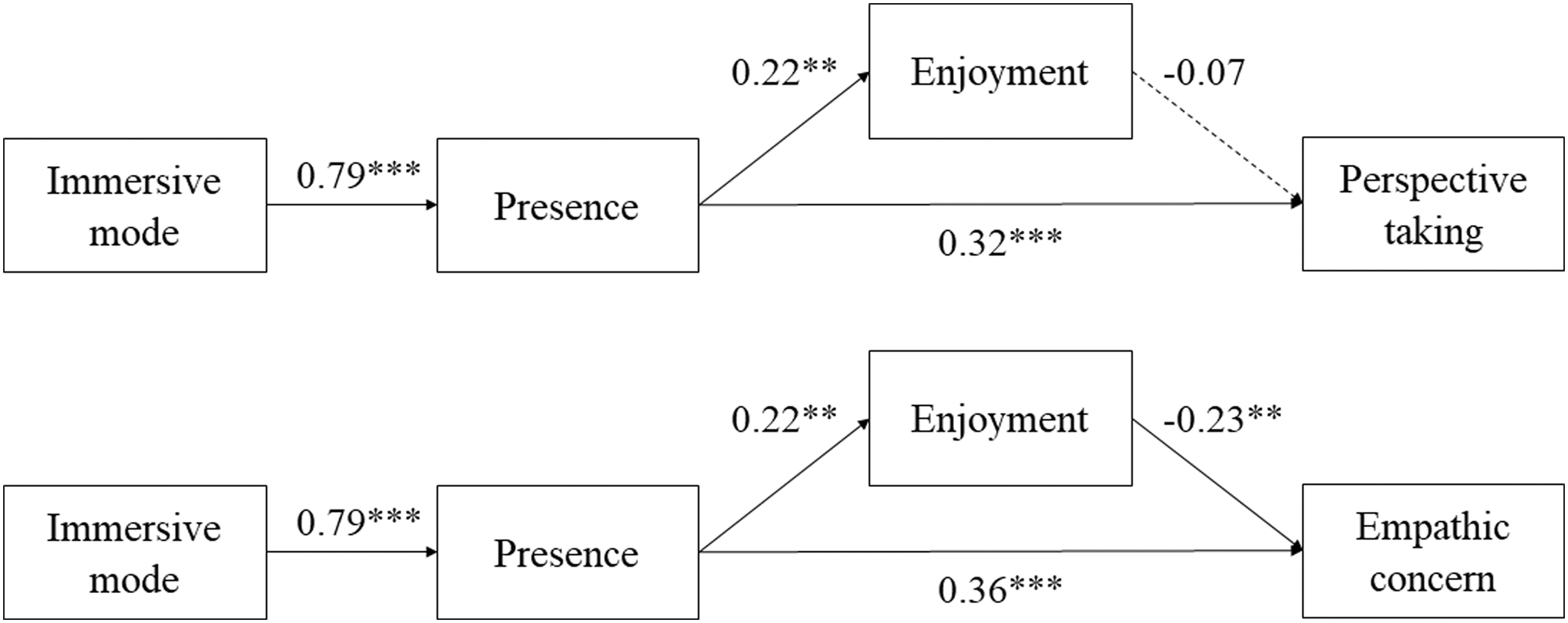
Graphical representation of the structural models, including coefficients, for perspective taking and empathic concern. **p < 0.01; ***p < 0.001. Solid lines represent statistically significant paths; dashed lines represented nonsignificant paths included in the models.
Discussion
The results support the overall claim that the immersive presentation of journalistic stories conveying feelings of spatial presence may be beneficial for enhancing both empathy and enjoyment in the audience, but that these two outcomes are, to some extent, incompatible. Remarkably, the lack of significant total effects of immersive presentation on empathy suggests a cancellation between (indirect) positive and (direct) negative effects. This could be interpreted as an instance of the so-called competitive mediation, which suggests that other mediation factors could be involved in the direct path. 44 A possibility in this regard is that the immersive presentation triggers other aspects not related to spatial presence (e.g., a “bells and whistles heuristic” 11 ) that negatively impact empathy.
Contrary to our hypothesis, enjoyment is only negatively associated with empathic concern, and not with perspective taking. This suggests that, rather than precluding the adoption of the characters' point of view, enjoyment primes a more positive affect that hinders sharing the negative emotions of people struggling with war or poverty. Therefore, practitioners interested in eliciting empathetic reactions in this type of stories should focus more on reinforcing the emotional aspects of the story than on facilitating cognitive perspective taking.
Our results also contribute to a better understanding of the consequences of enjoyment in immersive nonfiction. Although enjoyment has been studied mainly in the context of entertainment, it is also considered important for news consumption, 45 and the enjoyable experience of immersive stories may be a way to attract and engage audiences. 3 However, the design of enjoyable experiences that are attractive for the audience may come at the cost of hindering emotional involvement with the characters. How to keep higher levels of both enjoyment and empathy toward characters is certainly a complex problem, but possible solutions might involve developing techniques to direct viewers' attention (e.g., Nielsen et al. 46 ) toward the central emotional aspects of the story without distorting the enjoyable exploration of the environment.
These results are also of interest to fields of research other than journalism. For instance, VR has been used for empathy training in multiple and disparate contexts (e.g., education of medical students, 47 school bullying prevention 48 [Barreda-Ángeles M, Serra-Blasco M, Trepat E, et al. Development and experimental validation of a dataset of 360°-videos for facilitating school-based bullying prevention programs. Unpublished work 2020], or rehabilitation of domestic violence offenders 49 ). Our findings are aligned with existing evidence supporting the potential of VR for boosting empathy, but they also stress the possible interference of factors such as enjoyment of the virtual experience with empathetic reactions. Taking this into account may thus help contribute to more effective design of interventions in these areas.
Among the limitations of this study, there is the fact that other aspects that can play a determinant role for empathetic reactions, such as the similarity with the characters, or the type of emotions depicted in the stories, were not considered here. Further research should examine the psychological response to nonfiction narratives in a more nuanced way. Another limitation regards the sample of contents and the number of participants in the research. Although our sample of (eight) videos is considerably larger than the samples used in existing similar studies (e.g., Schutte and Stilinović, 10 Sundar et al., 11 and Shin 12 ), they may certainly not represent all the spectra of immersive nonfiction stories. In contrast, although our sample of participants is somewhat limited, the within-subject design and the number of viewings included in the analyses (259) provide robustness to these results. Further research, however, should replicate and extend these findings with larger samples. Moreover, we did not test participants for possible health conditions (e.g., vestibular disorders) that may affect the results. This is something to be considered in future studies. Finally, another limitation is that we did not include a text condition in our design, which would have informed us about how the stimulus modality (written vs. audiovisual) affects the targeted variables. Although some research has already shown positive effects of immersive displays compared with text on empathy, 11 further research should examine with more details which psychological mechanisms (e.g., narrative engagement 50 ) may mediate them, and how they operate in VR compared with other media.
Despite its limitations, these results strongly suggest that, rather than viewing immersive storytelling as a pure “empathy machine,” it is necessary to understand how different narrative and technological factors interact to elicit psychological responses on users. Since immersive storytelling is still in its infancy, empirical research may be especially valuable for the production of more effective contents with higher chances to achieve their goals.
Footnotes
Author Disclosure Statement
No competing financial interests exist.
Funding Information
This research received financial support from ACCIÓ-Agència per a la Competitivitat de l'Empresa, Grant No. VR360.