




Abstract
In this study, we examined how playing a violent video game affected aggressive cognition and aggressive behavior. A total of 300 children (Mage = 6.38, SD = 0.25) were randomly recruited to play a violent or a nonviolent video game. Results revealed that briefly exposing children to a violent video game increased aggressive cognition and aggressive behavior. In addition, a significant game × sex interaction showed that this effect was larger for boys than for girls. Mediational pathways were found such that aggressive cognition mediated the relationship between violent video games and aggressive behavior, especially for boys. Findings were interpreted within and supported the framework of the general aggression model. Violent video game effects remain a societal concern, and boys should be regarded as a special group for aggression intervention.
Introduction
Aggression refers to any behavior directed toward another individual that is carried out with the immediate intent to cause harm. 1 In this study, aggression consists of aggressive cognition (implicit) and aggressive behavior (explicit). Aggressive cognition is operationally conceptualized as the reaction time (RT) to aggressive pictures, whereas aggressive behavior is operationally conceptualized as the noise intensity set for the opponents.
Skepticism about violent video game effects
Controversy over violent video games surfaced in the 1990s. Whether or not violent video games lead to aggressive behavior is still hotly debated. Cross-sectional evidence shows a positive correlation between the amount of violent video games and increased aggression. 2 Longitudinal evidence demonstrates that violent video games predict aggression. 3 Experimental evidence reveals that violent video gameplay is causally associated with aggression. 4 Meta-analysis indicates that violent video games increase aggressive thoughts, aggressive affect, and aggressive behavior. 5 Conversely, other researchers fail to find violent video game effects and oppose the general aggression model (GAM).6,7 Given that the effect of violent video games on aggression is controversial, we investigate how this effect is mediated and who is prone to be influenced.
Sex and aggression
Previous research has found that boys show perceptual bias toward direct aggression words and display more aggressive behavior than girls.8–10 However, other scholars have not found significant sex differences in aggression.11,12 In this study, sex is considered as a potential moderator for the effects of violent video games on aggression.
Theoretical perspective of GAM
The GAM details how situation and person factors affect aggressive cognition, hostile feelings, and aggressive behavior. 13 An extension of the GAM illustrates that increased aggression caused by previous violent video gameplay may trigger an aggression escalation cycle. 14 In this study, we attempt to test key issues derived from the GAM, that (a) violent video games affect aggressive cognition and aggressive behavior, (b) sex moderates the violent video game effects, and that (c) aggressive cognition mediates the violent video game effects.
Relative lack of research on violent video games from Eastern cultures
With the rapid development of social media, video games have become a popular entertainment for children. The use of violent video games is a timely and important topic. It is necessary to initiate conversations with children about health matters of video games to help mitigate potentially harmful effects. However, little experimental study has been conducted on violent video game effects from Eastern cultures. Therefore, it is necessary to test whether the violent game effects found in Western nations apply to Eastern nations.
The present experiment
One goal is to test whether the video game manipulation produces significant effects on aggressive cognition and behavior, and whether there is an interaction between video games and sex. The other goal is to test the mediation effect of aggressive cognition on aggressive behavior. Thus, the hypotheses are the following:
H1:
H2:
H3:
Methods
Participants
The researchers' university Institutional Review Board (IRB) and Ethics Committee approved the study. All procedures performed in studies involving human participants were in accordance with the ethical standards of Southwest University Ethics Committee and with the 1964 Helsinki declaration and its later amendments or comparable ethical standards. Children and parents signed the informed consent forms prior to the experiment. Three hundred children (Mage = 6.38, standard deviation [SD] = 0.25) were randomly chosen from four kindergartens in Southwest China. Specifically, 150 children (boys = 75, girls = 75) were randomly assigned to play a violent video game, and 150 children (boys = 75, girls = 75) were randomly assigned to play a nonviolent video game. The group sample does not affect the main patterns of results to perform the analyses.
Design
A 2 (video game: violent vs. nonviolent) × 2 (sex: boys vs. girls) experimental-control between-group design is employed. The independent variables are video game and sex. The dependent variables are aggressive cognition and aggressive behavior.
Materials
Street Fighter II and Tetris were used as a violent video game and a nonviolent video game, respectively. Street Fighter II is a fighting game among characters from different countries. Street Fighter II includes many violent contents. Tetris is a puzzle game to move, rotate and place all kinds of squares of the game's output automatically, so that it can be arranged into a whole line or rows and obtain points. Tetris includes no violent contents.
Aggressive cognition
A semantic classification task (SCT) is used to assess the RT to aggressive pictures, which is a measure of aggressive cognition. 15 A total of 15 aggressive pictures (e.g., scissor, knife) and 15 nonaggressive pictures (e.g., frog, carrot) were randomly presented in the screen center. Children were required to judge whether the picture was aggressive or nonaggressive. If an aggressive picture appears, press “1,” if a nonaggressive picture appears, press “2.” After instructions appeared, a small fixation “+” emerged for 300 mseconds, and each picture was presented for 2,000 mseconds. After children pressed the button, the program entered into a blank screen for 100 mseconds. If children did not press within 2,000 mseconds, the program automatically proceeded to the next trial. The children could quit at any time if they felt uncomfortable. The SCT includes two sessions: (a) practice session with 10 trials (not used in formal session), and (b) formal session with 30 trials of three blocks, each consisting of 10 trials (5 aggressive vs. 5 nonaggressive).
Aggressive behavior
A competitive reaction-time (CRT) task is widely accepted as a valid measure of aggression. 16 Participants competed with “virtual opponents” to see who reacted first upon presentation of a tone, and participants who reacted more slowly were “punished” by a loud noise. After each trial, the “loser” received a loud noise, and the noise intensity was set by the “virtual opponent.” The pattern of wins/losses and the noise intensity were predetermined (13 wins vs. 12 losses). The CRT includes two steps. In Step 1, there are 25 trials, in which the “virtual opponent” sets noise (70–100 dB, weak–strong) for the participant on “loss” trials, but the participant does not set noise for the “virtual opponent.” Trial 1 is a “loss” and the other 24 trials are divided into three blocks, 8 in each block. The trials include 4 wins and 4 losses in block 1, 4 wins and 4 losses in block 2, 5 wins and 3 losses in block 3. Each participant receives the same 13 wins and 12 losses in Step 1. The participant can select one of the four-rank noises (70, 80, 90, and 100 dB) to punish the “virtual opponent” if he/she is judged to be a winner. The participant's noise settings (CRT score: 70–100 dB) delivered to the “virtual opponent” represent a measure of aggressive behavior. A “no” noise option (0 dB = no aggressive behavior) is also available.
Procedure
Participants and their parents signed the written consent forms first. Then participants played a randomly assigned violent or nonviolent video game for 15 minutes, and did the SCT and the CRT successively. Finally, each participant received a gift as a reward.
Results
Descriptive statistics
Descriptive statistics of all measures are shown in Tables 1 and 2, including means, SDs, and cell sample sizes for each of the four conditions.
Descriptive Statistics for Aggressive Cognition
Aggressive cognition = RT to aggressive pictures.
RT, reaction time; SD, standard deviation.
Descriptive Statistics for Aggressive Behavior
Aggressive behavior = noise intensity.
Analysis of variance on aggressive cognition
The results revealed a significant main effect of video game, and children in the violent video game condition displayed higher aggressive cognition than those in the nonviolent video game condition, F(1, 296) = 5.26, p = 0.02, d = 0.27; M = 758.62 (SD = 5.74) versus M = 777.23 (SD = 5.74). However, the main effect of sex was not significant, F(1, 296) = 1.47, p = 0.23, d = 0.14. Besides, a significant video game × sex interaction emerged, F(1, 296) = 5.17, p = 0.02, partial η 2 = 0.02. A simple effect analysis suggested that boys displayed a small but significant higher aggressive cognition than girls in the violent video game condition, F(1, 296) = 6.07, p = 0.01, partial η 2 = 0.02; M = 744.48 (SD = 8.12) versus M = 772.76 (SD = 8.12), 95% confidence interval (CI) [−50.87 to −5.69], whereas no significant sex effects in aggressive cognition were found in the nonviolent video game condition, F(1, 296) = 0.57, p = 0.45, partial η 2 = 0.002, 95% CI [−13.96 to 31.22] (Fig. 1).

Interaction between game and sex on aggressive cognition. Error bars represent SDs. *p < 0.05. ms, milliseconds; RT, reaction time; SD, standard deviation.
Analysis of variance on aggressive behavior
The results revealed a significant main effect of video game, and children in the violent video game condition displayed higher CRT score than those in the nonviolent video game condition, F(1, 296) = 6.40, p = 0.01, d = 0.29; M = 84.22 (SD = 0.46) versus M = 82.57 (SD = 0.46). However, the main effect of sex was not significant, F(1, 296) = 0.66, p = 0.42, d = 0.09. In addition, there was a small but significant video game × sex interaction, F(1, 296) = 5.11, p = 0.02, partial η 2 = 0.02. A simple effect analysis demonstrated that boys showed a small but significantly higher CRT score than girls in the violent video game condition, F(1, 296) = 4.72, p = 0.03, partial η 2 = 0.02; M = 85.22 (SD = 0.65) versus M = 83.22 (SD = 0.65), 95% CI [0.19 to 3.81], whereas no significant sex effects in CRT score were found in the nonviolent video game condition, F(1, 296) = 1.05, p = 0.31, partial η 2 = 0.004; 95% CI [−2.76 to 0.87] (Fig. 2).
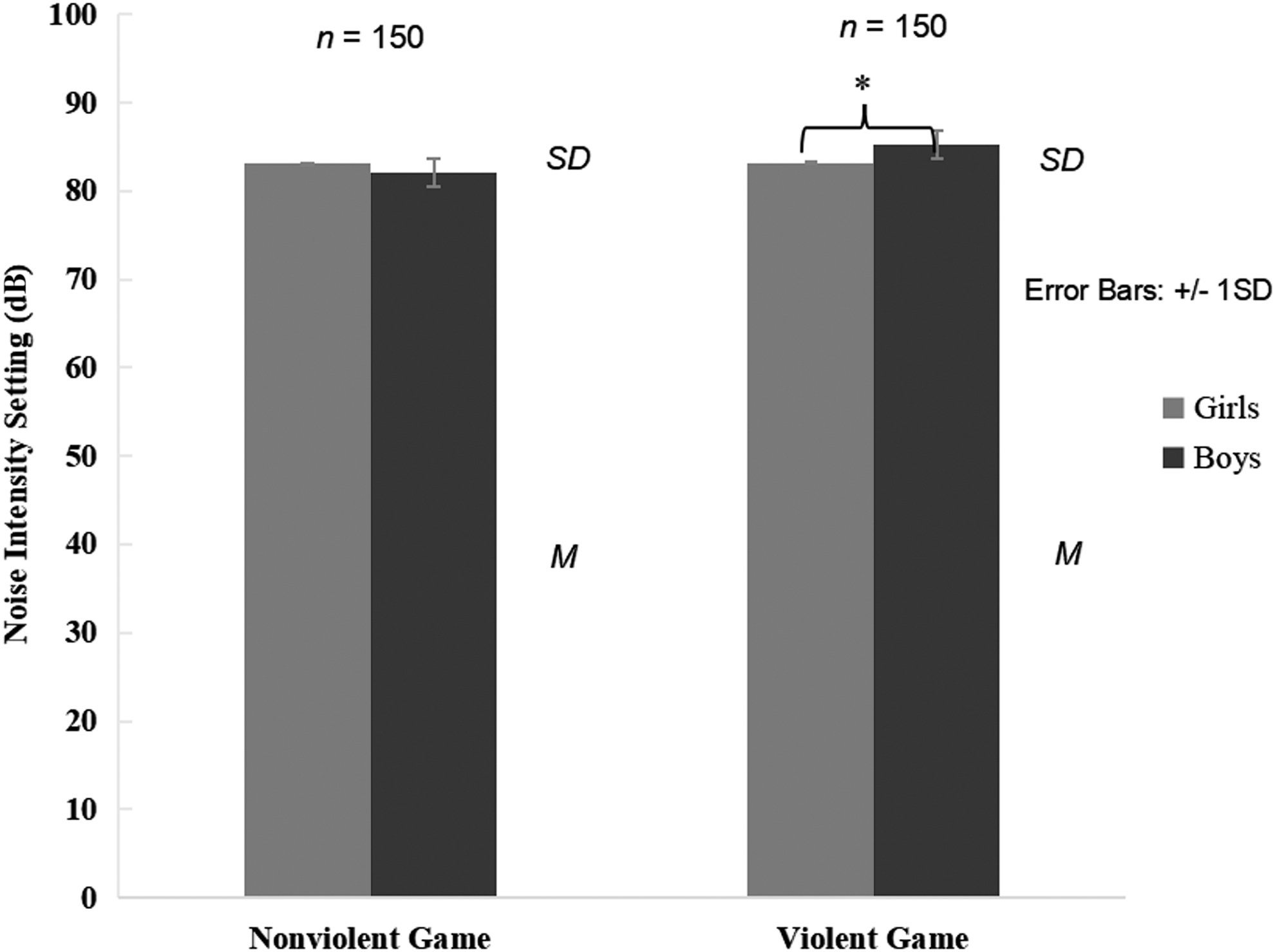
Interaction between game and sex on aggressive behavior. Error bars represent SDs. *p < 0.05. dB, decibel.
Aggressive cognition as a mediator of aggressive behavior
Given that violent video games significantly increased aggressive cognition and behavior, we further tested whether aggressive cognition mediated the violent video game effects on aggressive behavior. Sex was controlled as a covariate because of a significant video game × sex interaction. Single-mediator models and bootstrapping were used to evaluate the indirect effect. 17 Overall, the direct effect of violent video games on aggressive behavior was not significant, β = 0.09, standard error (SE) = 0.05, 95% CI [−0.01 to 0.20]. Violent video games significantly predicted aggressive cognition, β = −0.13, SE = 0.06, 95% CI [−0.24 to −0.02]. Aggressive cognition significantly predicted aggressive behavior, β = −0.38, SE = 0.05, 95% CI [−0.48 to −0.27]. Aggressive cognition significantly mediated the relationship between violent video games and aggressive behavior, β = 0.05, SE = 0.02, 95% CI [0.007 to 0.10] (Fig. 3).
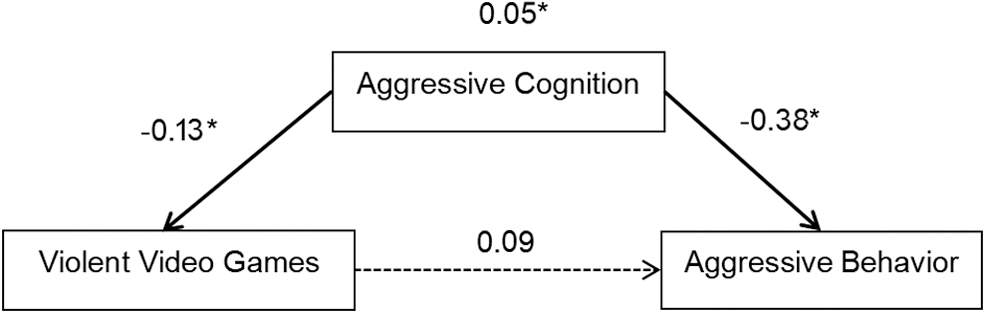
Mediation model of violent video games on aggressive behavior through aggressive cognition. Video game is coded as nonviolent = 0, violent = 1; standardized path coefficients; solid lines represent significant paths, dotted line represents a nonsignificant path. *Statistically significant.
Furthermore, we ran a mediational analysis on the effect of violent video games on aggressive behavior for boys and girls. The direct effect of violent video games on aggressive behavior was significant for boys, β = 0.19, SE = 0.07, 95% CI [0.04 to 0.33], but not for girls, β = 0.01, SE = 0.08, 95% CI [−0.14 to 0.17]. Violent video games significantly predicted aggressive cognition for boys, β = −0.26, SE = 0.09, 95% CI [−0.44 to −0.08], but not for girls, β = −0.001, SE = 0.07, 95% CI [−0.13 to 0.13]. Aggressive cognition significantly predicted aggressive behavior for boys, β = −0.33, SE = 0.06, 95% CI [−0.45 to −0.21] and for girls, β = −0.44, SE = 0.10, 95% CI [−0.64 to −0.25]. Violent video games significantly increased aggressive behavior through aggressive cognition for boys, β = 0.09, SE = 0.03, 95% CI [0.03 to 0.16], but not for girls, β = 0.0005, SE = 0.03, 95% CI [−0.06 to 0.06] (Fig. 4). It should be noted that the analysis found a significant mediation effect but not a significant main effect of sex. Thus, we had a power analysis using G*Power for the sex main effect. The Power (1 − β err prob) of sex main effects on aggressive cognition and behavior were 0.30 and 0.19, respectively. Thus, the power of sex main effects were small (power value <0.80).
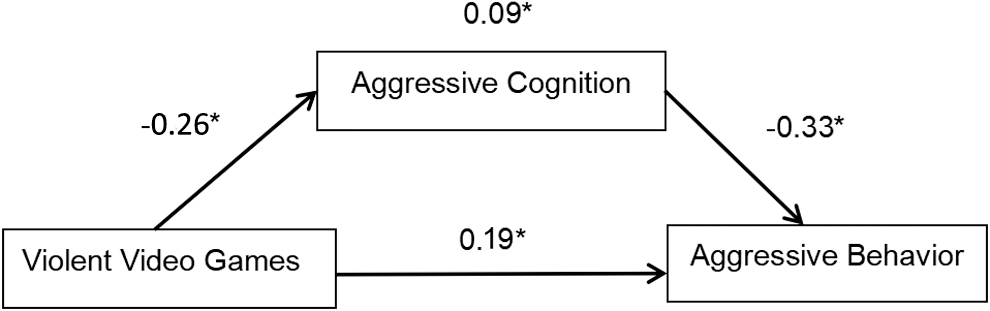
Mediation model of violent video games on aggressive behavior through aggressive cognition for boys. Video game is coded as nonviolent = 0, violent = 1; standardized path coefficients; solid lines represent significant paths. *Statistically significant.
Discussion
Consistent with Hypothesis 1, briefly exposing Chinese children to what were considered age- and culture-appropriate violent video games fuels the accessibility of aggressive cognition and aggressive behavior. Also, the result is in accordance with previous research that violent video games increase player's aggressive thoughts and aggressive behavior.18,19 Violent video games may activate children's aggressive cognitive networks and knowledge rehearsal structures of aggression, and, therefore, cause an increase in aggressive cognition and aggressive behavior. 20 The study provides evidence for the hypothesized effect that violent video games are associated with increased aggression.
Consistent with Hypothesis 2, sex moderates the relationship between violent video games and aggression. Specifically, boys show significant higher accessibility to aggressive cognition and more aggressive behavior than girls in the violent video game condition, but no significant sex effects in aggressive cognition and behavior is found in the nonviolent video game condition. Perhaps boys' aggressive cognitive networks can be easily activated when exposing to a violent video game and thus they are more aggressive than girls. The results confirm the findings that males demonstrate higher aggression than females in a violent video game context.21–23 The results may further explain the specific violent game contents that make males be more aggressive than females.24,25 Why do boys show higher accessibility to aggressive cognition and more aggressive behavior than girls in the violent video game condition? The reason may be attributed to the similar age of the children, or the type of games that were used, or cultural differences. We found a mediation effect for boys but not a significant main effect of sex on aggressive behavior. Maybe this is because of lack of power and because the aggression effect only worked on some individuals (e.g., aggressive boys). Boys may be identified as the key group for aggression prevention in comparison with girls after violent video game exposure.
With regard to Hypothesis 3, mediation analysis explains the reason why violent video games directly or indirectly lead to aggressive behavior, especially for boys. As predicted, aggressive cognition mediates the relationship between violent video games and aggressive behavior, which replicates research finding that the violent video game effects are mediated by aggressive cognitions. 26 Also, the result supports the GAM that game violence increases aggressive behavior through aggressive thoughts and the social learning theory that children learn aggressive behavior by imitating from aggressive role models.27,28 Perhaps violent video games predict increased moral disengagement and decreased empathy.29–32 Violent video games may provide a context to cultivate aggressive cognition first, and subsequently cause aggressive behavior outcomes. In this study, we include aggressive cognition and aggressive behavior as dependent variables to make a great impact by showing that even age- and culture-appropriate violent video games can increase aggressive cognition and behavior. It also shed light on how sex moderates the violent video game effects and how aggressive cognition mediates violent video game effects. Noticeably, it would help to have a bigger sample in terms of providing more power. Our study has found a mediation effect for boys but not a significant main effect of sex. The power of sex main effect on aggressive cognition and behavior is small (lack of power) and the effect may only work on some aggressive boys. In this sense, educators should decide which type of video game is suitable for their children rather than uphold the idea that “violent video games are no big deal,” because violent video games lead to aggressive behavior by enhancing aggressive cognition.
Limitations and implications
This experimental study expands previous literature by generalizing the violent video game effects to Chinese children and exploring aggressive cognition as a potential mediator. The randomized controlled trial does allow us to draw causal inferences, which is a strong point of the experiment. However, several limitations should be noted. First, the samples come from the nearly same age group as a whole, so the evidence may not be valid for other age groups. Future research should use other age samples to improve the generalizability. Second, we do not assess how playing a violent video game affects children and their friends based on the fact that many children play video games together with their friends, either cooperatively or competitively.33,34 To this end, we may examine more closely whether participants play video games on their own, competitively or cooperatively. Third, we found a mediation effect of boys but not a significant main sex effect, and this was because of lack of power and the effect only worked on some aggressive boys. Thus, we should recruit a larger sample to providing robust evidences in future. Finally, the measure of aggressive cognition does not rule out the possibility that the violent video game effects are not specific to the aggressive pictures although previous researchers used the RT to aggressive words as aggressive cognitions in a lexical decision task. 35 A difference RT score between the two types of pictures would control for this possibility, which should be considered in future study.
The study has the following implications. On the one hand, educators may restrain aggressive cognition to reduce children's aggressive behavior. On the other hand, boys are a key group for aggression prevention and intervention in comparison with girls in the violent video game condition. Drawing upon this, the effect of violent video games may be a risk factor for aggressive cognition and behavior among Chinese children. The finding provides topical insights into the contagious effects of violent video games. The raw data and analyses to support the article are available in the Supplementary Material section.
Footnotes
Acknowledgments
The authors thank Principal of Bauhinia Kindergarten Ling Xie, Dr. Lun Chao Chen, and graduate students Yan Li and Yanlin Long for their help as research assistants.
Author Disclosure Statement
No competing financial interests exist.
Funding Information
This project has received funding from the National Social Science Foundation of China (17CSH006), the Central University's Fundamental Grant (SWU2009201), the QingMa Project of Social Sciences in Chongqing (2020QM06), and the Basic Grant of Educational Science from the Ministry of Education (2020).

References
Supplementary Material
Please find the following supplemental material available below.
For Open Access articles published under a Creative Commons License, all supplemental material carries the same license as the article it is associated with.
For non-Open Access articles published, all supplemental material carries a non-exclusive license, and permission requests for re-use of supplemental material or any part of supplemental material shall be sent directly to the copyright owner as specified in the copyright notice associated with the article.
