




Abstract
The amount of online messages that are personalized based on people's characteristics and interests is growing. Due to technological advancements, it has become possible to personalize messages across media in real time. However, little is known about people's perceptions of these different personalization techniques, while this can have important implications for message effectiveness and the privacy debate. A survey with U.S. adults (N = 1,008) showed that in the context of real-time personalization, all personalization techniques are seen as unacceptable and they are all associated with perceptions of surveillance. This applies to all generations, but younger generations are more likely to accept and to perceive less surveillance than older generations. Furthermore, we found that, of all predictors, perceived surveillance and attitudes toward personalization were the strongest predictors of acceptance of all personalization techniques. The results advance theory by differentiating between personalization techniques and introducing privacy cynicism and mobile device dependency as factors that positively relate to acceptance of personalization techniques. Practically, the results contribute to the debate on consumer agency related to people's personal data and inform media literacy programs.
Introduction
An increasing amount of messages is personalized based on people's characteristics and interests.1,2 Because personalized messages are more relevant to people and generate less waste (i.e., reach less people outside the target group), they are perceived as an effective messaging strategy.3,4 Personalized messages are realized using available personal data about individuals to create messages that align with their characteristics and interests. However, previous surveys showed that U.S. adults are concerned about ways companies use their personal data 5 ; they experience data mining practices as creepy, 6 and they feel being watched (i.e., perceived surveillance). 6 However, at the same time research indicates that people are often unaware of how personalization works 7 and also with regards to the types of data that could be used as input for personalized messages. People seem to have a general awareness about the existence of cookies and about the usage of browsing activity data as input for personalized messages.7,8 However, when people are asked about their acceptance of personalized messaging (i.e., advertisements), they generally are aware that personalization occurs, but they do not seem to make any distinction between personalization techniques. 8
Personalization based on concurrent media usage is currently developing in fast pace, for which increasingly sophisticated and distinctive personalization techniques are being used (Table 1). Due to technological advancements, it has become possible to personalize messages across media in real time, known as synced advertising (i.e., receiving ads on a mobile device based on TV viewing habits). 9 Yet, little is known about the extent to which people accept the techniques to make this form of personalization happen. Especially when personalization occurs in real time across media or devices, the extent to which some personalization techniques elicit feelings of being watched might increase. Furthermore, in line with developments in privacy regulations, such as the General Data Protection Regulation 10 and the California Consumer Privacy Act, 11 in which it is aimed to give people more control over their data, 12 it is important to study people's perceptions of these personalization techniques. Therefore, the aim of the current study is to examine people's perceptions (i.e., acceptance and perceived surveillance) of personalization techniques utilized to personalize message across media in real time and the predictors of acceptance.
Overview of Personalization Techniques Used to Personalize Across Media in Real Time (i.e., Synced Advertising)
IP, Internet protocol.
The results advance theory by differentiating between personalization techniques. Although these personalization techniques are used to personalize messages across media in real time (i.e., synced advertising), some of these techniques are also used for other types of personalization (e.g., behavioral or demographic targeting). Therefore, the findings are relevant to the personalization literature in general. Moreover, we study predictors of acceptance, which will provide a better understanding of why people are more likely to accept certain personalization techniques. In addition, insights into people's perceptions of personalization techniques will contribute to the debate about consumer agency and ethical questions related to collection of people's data. Finally, insights into the predictors of acceptance will help to identify potential vulnerable groups that may need to be protected or informed. Hence, the results may inform literacy programs.
Perceptions of personalization techniques
To personalize messages across media in real time, data on people's current media usage are collected or purchased. Research into personalized message strategies showed that people have an aversion to their information being collected online 13 and they are concerned about the ways companies use their personal information to personalize advertising messages. 5 These privacy concerns often result in advertising avoidance, especially when people have higher levels of persuasion knowledge. 14 Because synced advertising, like other personalized message strategies, makes use of personal data, and it happens in real time, it could evoke perceived surveillance (i.e., feeling of being watched 6 ). 9 The current study further explores people's perceptions of personalization techniques by examining to what extent the different personalization techniques are considered as acceptable and to what extent they evoke perceptions of surveillance (RQ1 and RQ2; Table 2).
Overview of Research Questions and Hypotheses
p < 0.001.
Moreover, these perceptions may differ depending on generation or gender. Different generations (e.g., Gen X, Baby boomers) grew up under different circumstances, such as having varying adoption rates of media, 15 which affect (media) behavior later in life. 16 For example, previous research has found that older people were more negative about personalized advertising and more inclined to protect themselves than younger people. 7 Regarding gender, some studies found that women are more concerned17–20 and more inclined to protect their privacy, 20 while other studies found that men were more inclined to protect their privacy 21 or found no differences. 22 Therefore, we ask (RQ3) to what extent do acceptance and perceived surveillance of personalization technologies differ per generation and gender?
Predictors of acceptance
To get a better understanding about real-time personalization techniques' acceptance, it is important to study predictors of acceptance. The personalization paradox and privacy trade-off may shed some light on this. According to the personalization paradox, personalized messages could have both costs and benefits. 23 Costs include, for example, perceived surveillance,6,9,24 privacy concerns, 25 and privacy infringement.24,26 In addition, benefits include personal discounts 27 and receiving more relevant messages.25,28,29 According to the privacy trade-off, people balance potential costs and benefits in light of possible outcomes when making decisions on, for example, sharing of personal data.30–33 By doing this, people want to maximize positive and minimize negative outcomes.31,32 In line with this trade-off, it is expected that costs lead to less acceptance of personalization techniques. For example, the more people have the feeling of being watched by devices that collect and process their data, the less likely they will accept a personalization technique. 9 Conversely, potential benefits will lead to more acceptance of the personalization techniques. For example, when people have more positive attitudes toward personalized messages because it could lead to personal discounts 27 and more relevant messages25,28 (Table 2).
The privacy trade-off assumes that people make rational decisions and weigh potential costs and benefits. However, this would not explain the contradicting relationship between people's privacy concerns but lack of protection behaviors 34 —also known as the privacy paradox.33,35–37 Two factors that may provide an explanation for the privacy paradox are privacy cynicism and mobile device dependency. First, privacy cynicism is defined as “an attitude [toward online privacy] accompanied by frustration, hopelessness, and disillusionment,” 38 with the sense of cynicism mainly generated from unmet expectations. Privacy cynicism represents “a cognitive coping mechanism for users, allowing them to overcome or ignore privacy concerns and engage in online transactions and self-disclosure without ramping up privacy protection efforts”. 34 Thus, we argue that privacy cynicism could lead to more acceptance of personalization techniques because people feel cynical to what extent they can do anything to protect their personal data.
Second, previous research into the privacy trade-off found that perceived value of an object, person, or activity can trump the costs when it comes to sharing personal data. 33 In line with this finding, we argue that people, who value their mobile device, are more willing to accept personalization techniques because not accepting it may have consequences for people's mobile device use. Therefore, we expect that the more dependent people are on their mobile device, the more likely they are willing to accept personalization techniques (Table 2).
Method
Participants and procedure
An online survey was distributed between March 31 and June 8, 2019. A request, with a link to the survey, was sent to an online panel of Dynata. Informed consent was needed to progress to the survey. The respondents received an incentive through the panel company for completing the questionnaire. A total of 1,008 respondents (55.8 percent female, Age: M = 50.26, standard deviation [SD] = 17, range 18–94 years) participated and passed at least three of the four attention checks (Table 3). We recoded the variable age in line with previous research to create generations. 15
Demographics of the Sample (N = 1,008)
Note: aThree participants did not indicate their age.
Percentages do not add up to 100 percent because people could check multiple boxes as an answer to the ethnicity/race question.
M, mean; SD, standard deviation.
The respondents were shown descriptions of the different personalization techniques, representing the techniques in Table 1. Then, they were asked to fill out whether they accept each personalization technique (1 = Totally unacceptable, 7 = Totally acceptable), and perceived surveillance of each technique was measured with four items generated based on previous research. 6 We asked the participants “To what extent do you believe that [technique] to sync advertisements stimulates the feeling that companies are… (a) looking over your shoulder, (b) entering your private space, (c) watching your every move, and (d) checking up on you”.
In addition, the questionnaire asked about people's privacy concerns (e.g., “I am concerned about misuse of my personal information”; Cronbach's α = 0.87, M = 5.58, SD = 1.09),39,40 privacy cynicism (e.g., “I doubt the significance of online privacy issues more often”; Cronbach's α = 0.76, M = 3.50, SD = 1.33), 34 attitudes toward personalization (e.g., “I prefer that ads shown on my devices are personalized to my interests”; Cronbach's α = 0.80, M = 3.32, SD = 1.15), mobile device dependency with the Extended Mind Questionnaire (e.g., “I am very dependent on my smartphone, tablet, or computer”; Cronbach's α = 0.91, M = 4.67, SD = 1.38), 41 and privacy infringement (e.g., “How often have you personally been victim of what you felt was an improper invasion of online privacy?”; Cronbach's α = 0.76, M = 4.09, SD = 1.49). 42
Results
People's perceptions of the personalization techniques
First, a repeated measure analysis of variance with the personalization techniques as within factor, and generation and gender as between factors, was conducted to test to what extent respondents accept the personalization techniques. We found a main effect of personalization techniques, F(1, 989) = 113.67, p < 0.001, η 2 = 0.10. Overall, social media analytics (M = 3.47, SD = 1.70) and segmentation (M = 3.47, SD = 1.69) are the most accepted personalization techniques, and the least acceptable is watermarking (M = 2.43, SD = 1.66). Moreover, One-Sample t-tests show that all acceptance scores were significantly below the midpoint of the scale (p's < 0.001), indicating that none of the personalization techniques was perceived as acceptable to the respondents. In addition, we found a main effect of generations, F(4, 988) = 35.10, p < 0.001, η 2 = 0.12. Younger generations find the personalization techniques more acceptable compared to older generations. We did not find a main effect of gender (p = 0.412) nor any interaction effects (Fig. 1; Table 4).
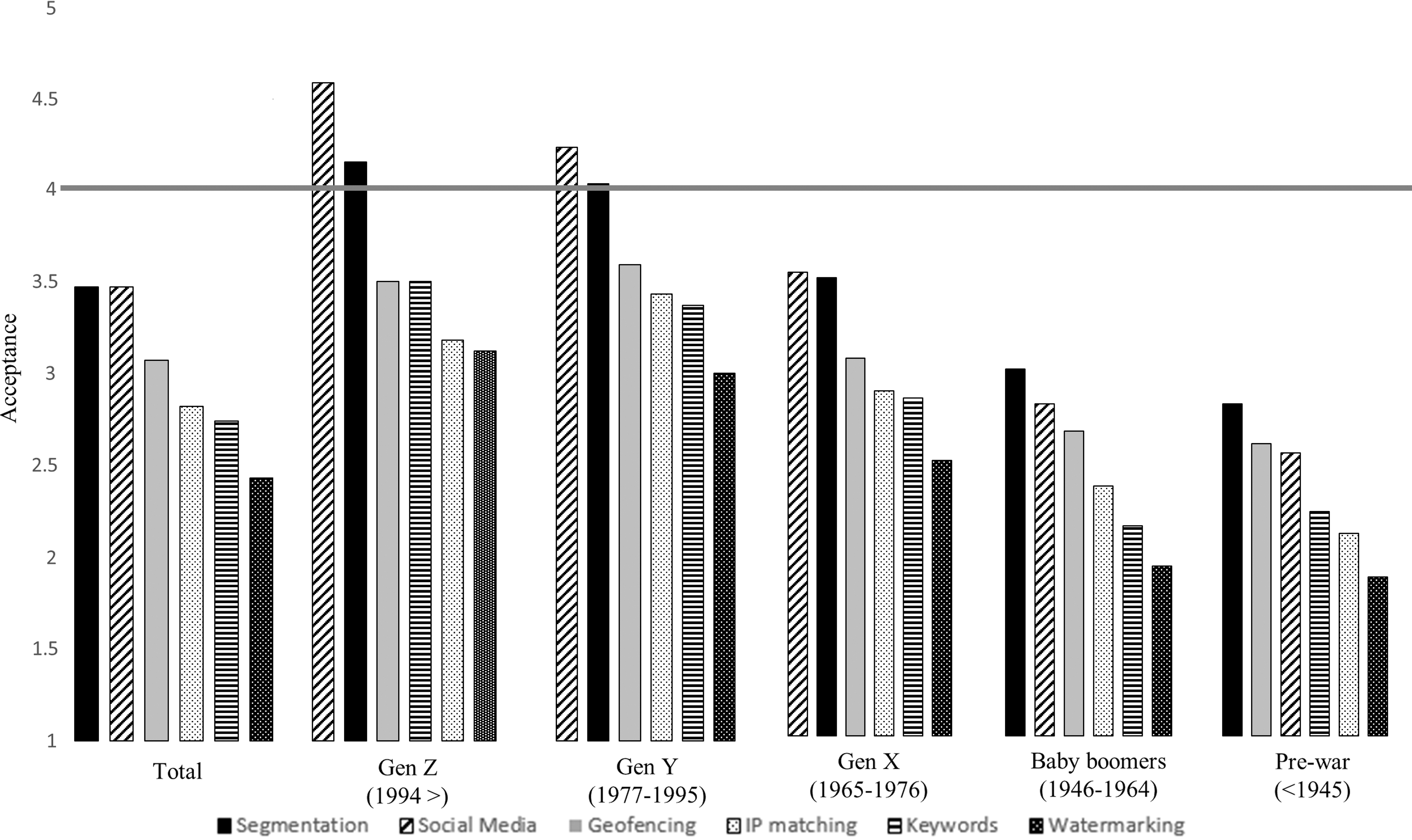
Perceived acceptance of real life personalization techniques per generation.
Acceptance and Perceived Surveillance Per Personalization Technique Across Generations
Note: The M and SD are presented in the table.
Different superscripts indicate significant differences between personalization techniques within one generation.
Second, we conducted the same analysis for perceived surveillance. We found a main effect of personalization techniques, F(1, 988) = 63.36, p < 0.001, η 2 = 0.06. Overall, perceptions of surveillance are the highest for watermarking (M = 5.83, SD = 1.45) and the least for segmentation (M = 5.03, SD = 1.69). Again, One-Sample t-tests show that all personalization techniques score significantly above the midpoint of the scale (p's < 0.001), which indicates that all personalization techniques increase the feelings of being watched. In addition, we found a main effect of generation, F(4, 988) = 11.45, p < 0.001, η 2 = 0.04. Younger generations experienced lower levels of perceived surveillance compared to older generations. We did not find a main effect of gender (p = 0.381) nor any interaction effects (Fig. 2; Table 4).
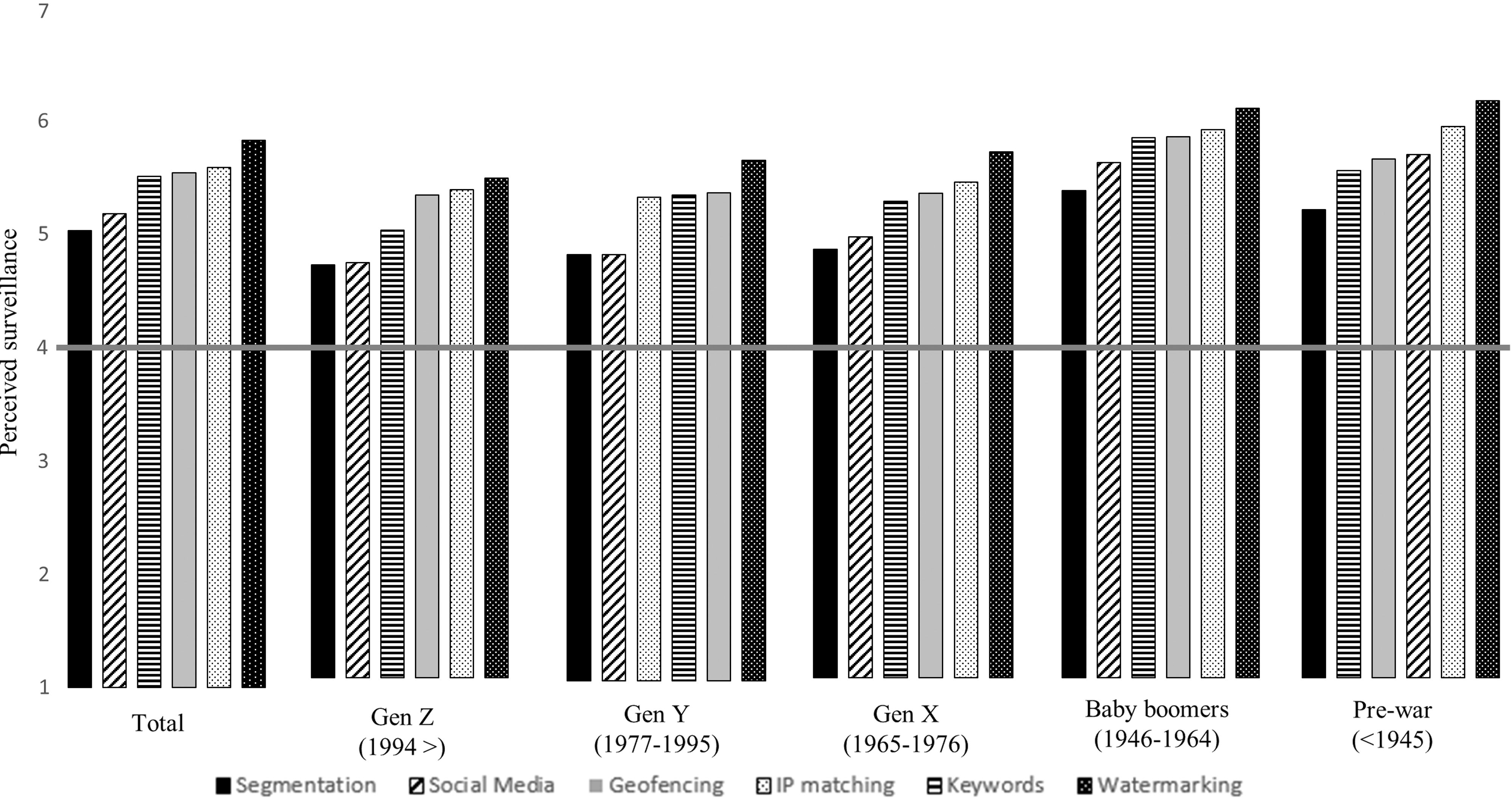
Perceived surveillance of real life personalization techniques per generation.
Predictors of personalization technique acceptance
A regression analysis per personalization technique was conducted with acceptance as the dependent variable (Table 5). In addition, a correlation matrix of all variables is presented in Table 6. The regression models explain 35.0 percent–39.9 percent of the variance in acceptance. The strongest predictors of acceptance of all personalization techniques are perceived surveillance and attitude toward personalization. As predicted, the higher the perceived surveillance, the less likely people are willing to accept the personalization technique (βs = −0.23 to −0.34, p's < 0.001), and the more positive people are toward personalization, the more likely they are willing to accept the personalization technique (βs = 0.22–0.035, p's < 0.001). Furthermore, the results show that people are more willing to accept the personalization technique when they are younger (βs = −0.08 to −0.21), are more dependent on their mobile device (βs = 0.07–0.13), are more cynical about privacy issues (βs = 0.07–0.17), or score higher on perceived privacy infringement (βs = 0.08–0.12). The latter is contrary to the expectations. Finally, education level is a positive predictor of social media analytics acceptance (β = 0.05, p = 0.042) and geofencing acceptance (β = 0.07, p = 0.006).
Multiple Regression Analysis Showing the Predictors of Acceptance of Each Personalization Technique
Note: The model shows standardized regression coefficients (b * ). VIF diagnostics showed no multicollinearity issues (VIF's <1.45).
Perceived surveillance of the corresponding technique (e.g., perceived surveillance of segmentation for model 1, perceived surveillance of social media analytics for model 2, and so on).
p < 0.05, **p < 0.01, ***p < 0.001.
VIF, variance inflation factor.
Correlation Matrix
p < 0.05, **p < 0.001, ***p < 0.001.
Privacy concerns did not appear to be a significant predictor of acceptance for most personalization technique except for acceptance of Internet protocol (IP) matching (β = −0.06, p = 0.036); the more concerned people are, the less likely to accept IP matching. A closer look at the data showed that privacy concerns are correlated with perceived surveillance (r = 0.35–0.43, p's < 0.001). Privacy concerns is a significant predictor in all models when removing perceived surveillance (Segmentation β = −0.07, p = 0.025; social media analytics β = −0.07, p = 0.023; geofencing β = −0.09, p = 0.005; IP matching β = −0.14, p < 0.001; keywords β = −0.08, p = 0.006; watermarking β = −0.15, p < 0.001). Then, the more concerned people are about their privacy, the less likely they will accept the personalization techniques.
Discussion
The aim of the study was to examine people's perceptions of personalization techniques used to personalize messages in real-time across media or devices, namely psychographic segmentation, social media analytics, geofencing, IP matching, keywords, and watermarking. First, the study found that people did not perceive any of the personalization techniques as acceptable, and all personalization techniques evoked perceived surveillance. Moreover, we found that younger generations were more willing to accept personalization techniques and perceived less surveillance compared to older generations. Furthermore, we found that perceived surveillance and attitudes toward personalization were the strongest predictors of acceptance. All predictors showed relationships in the expected direction except for privacy infringement. The results showed that more negative past experiences led to more acceptance of personalization techniques. Future research is needed to further examine this.
The results of the current study have important implications for theory and practice. Theoretically, the study advances our knowledge on people's perceptions of personalization techniques. Previous research showed that most people feel uncomfortable and concerned that personal data are utilized to personalize messages. 13 The current study extends this work by showing differences per personalization technique, differences among generations, and by taking a closer look at predictors of acceptance. Although we focused on techniques of synced advertising, some of the techniques included are also used for other personalized advertising strategies (e.g., behavioral or demographic targeting). Therefore, the results of the study are relevant to a broader stream of literature as well. Furthermore, the results indicate the importance of concepts that are relatively understudied in this context, namely privacy cynicism and mobile device dependency. These concepts provide us with more insights in people's perceptions, as well as offer a possible explanation for why people with high privacy concerns do not behave accordingly (i.e., privacy trade-off). Future research should further examine the relationship of these concepts and personalized advertising strategies.
Practically, the results help us to identify vulnerable groups. For example, younger generations and people who are more dependent on their mobile device are more likely to accept the personalization techniques. This information helps us to identify high priority groups when it comes to educating media literacy. Furthermore, the high scores on perceived surveillance on all personalization techniques and the role of privacy cynicism is a reason for concern; people experience feelings of being watched but at the same time they give up because they experience a lack of agency. The results of this study contribute to the societal debate on the topic of ethics, user agency, and empowerment.
Although the study has valuable contributions, the results need to be carefully interpreted because survey data do not allow us to make causal inferences. Furthermore, synced advertising is still relatively unknown. Perceptions may change with more information available. It would be interesting to examine whether people would become more or less acceptable over time, for example, because they know more about the topic or because it is no longer new and therefore less creepy. In addition, the lack of knowledge could have resulted in respondents not clearly understanding the difference between personalization technologies. Although the correlation matrix indicated moderate relationships among personalization techniques, future research (e.g., focus groups) is necessary to further examine people's perceptions of personalization technologies.
In sum, this is the first study to examine people's perceptions of techniques to personalize messages across media in real time. Overall, these personalization techniques are perceived as unacceptable and increase perceived surveillance (i.e., the feeling of being watched) in people across generations.
Footnotes
Acknowledgment
The authors thank Nathan Casper for his help designing the survey.
Author Disclosure Statement
No competing financial interests exist.
Funding Information
No funding was received for this article.