




Abstract
To what extent does exposure to cyberterrorism arouse negative emotions? Cyberterrorism has developed the potential to cause similarly lethal consequences to conventional terrorism, especially when targeted at critical infrastructures. But like conventional terrorism, cyberterrorism aims to terrorize, and exposure to cyberterror attacks can affect emotional responses. This article is based on an experiment that explores emotional responses to cyberterrorism using specially designed news reports showing major cyber attacks against critical water infrastructure. Our findings indicate that cyberterrorism arouses heightened reactions of anger and stress (measured physiologically through cortisol levels, and through self-report measures). Our findings also reveal that (a) exposure to cyberterror attacks is associated with higher levels of stress than of anger; (b) that these emotional responses do not differ from the emotions triggered by conventional terrorism; and (c) these responses are not dependent on the lethality of the attack. Finally, cortisol levels remained constant across conditions. This study covers new ground as it explores the distinctive role of anger after cyberterrorism, while affirming studies that describe the presence of stress.
Introduction
The use of cyberspace by terror organizations has been rising rapidly over recent years, 1 to the point where the Information Security Forum forecasts that cyberterrorism will be the greatest terrorism threat by 2020. 2 Recent cyberterror attacks have sought to target vulnerable critical infrastructures, with potentially life-threatening and economically devastating consequences. Notable recent examples include the 2017 ransomware WannaCryattack, where hackers encrypted data files across 150 countries in demand of a ransom payment, crippling vital systems, such as hospital operations in the United Kingdom, trains and railways in Germany and Russia, 3 and several attacks that originated from Russia on European and American nuclear, hydro, and electric systems. 4
Cyberterrorism aims to further political, economic, religious, or ideological goals by causing physical or psychological harm to civilians, much like conventional terrorism, but they do differ in means. Terrorism employs hijackings, mass shootings, and bombings, whereas cyberterrorism utilizes malware, viruses, and other computer-based technologies to achieve its goals. Numerous studies have explored the effects of conventional terrorism on individuals and communities. We know that both the act and threat of terrorism can result in post-traumatic stress disorder, heightened stress, anxiety disorders, a sense of helplessness, and physical symptoms such as inflammation.5–11 Yet, although scholars have explored the effects of exposure to conventional terrorism, it remains unclear what emotional and physiological responses are elicited by cyberterrorism. This study seeks to redress this gap by focusing on the effect of cyberterrorism on anger and stress.
Understanding the emotional response of exposure to cyberterrorism is important for two reasons. First, both anger and anxiety can have negative repercussions on the health of individuals. Long-term increased levels of cortisol, a hormone termed the stress hormone for its role in our body's functioning during flight or fight situations, are associated with serious mental health outcomes, such as major depression disorder, 12 generalized anxiety disorder, 13 and with physical health risks such as cardiovascular disease. 14 Although no study has yet examined long-term cortisol release after acts of terrorism, Holman found that acute stress after the 9/11 attacks in the United States were associated with increased cardiovascular ailments, such as heart problems, hypertension and strokes up to 3 years later. 15 Second, anger and anxiety tend to shape preferences in antiterrorism policies. 16 For example, levels of anxiety correlate with less support for military action, whereas anger is associated with prejudice against Muslims.17,18 Hence, studying the role emotions play in the presence of cyberterrorism is essential to understanding factors that influence the attitudes and behaviors of affected populations.
In the following controlled randomized experiment, we test emotional and physiological responses to a series of professionally simulated television news updates purporting to report on different types of attacks on critical infrastructure. In this way, we can compare the physiological and emotional effects of exposure to lethal cyberterror attacks, nonlethal cyberterror attacks, and conventional terror attacks. In light of prior research that suggests that uncertainty and novelty are the main triggers of stress in the presence of terrorism,19,20 we propose that even nonlethal cyberterrorism may evoke negative emotions with similar intensity as conventional terrorism.
Emotional Reactions to Cyberterrorism
Stress as a response to terrorism
The stress response has both emotional and physiological manifestations. The primary emotion resulting from stress is anxiety, defined as a future-oriented emotional state “characterized by feelings of apprehension and tension, accompanied by or associated with activation or arousal of the autonomic nervous system.”21,22 Anxiety is a product of monitoring for potential threats, and the more novel or uncertain the threat, the greater the anxiety.22–24 To this end, anxiety centers on the uncertainty and unpredictability of a threat more than its potential outcome. Terrorist acts in general are by definition uncertain and unpredictable. Extensive research on conventional terrorism has established that levels of anxiety a rise in affected populations after terrorist attacks—an effect we expect will persist in response to cyberterrorism.8,10,25,26
Physiological manifestations of the stress response include modifications in the hypothalamic-pituitary-adrenal (HPA) axis, leading to release of the stress hormone cortisol. Individuals exposed to conventional terrorism show greater levels of reactivity, as measured by cortisol, compared with nonexposed individuals.27,28 In a meta-analysis, Denson et al. found that the two properties of stressors that contribute to an increase in cortisol levels are novelty and threat, just as with anxiety. 20 Both anxiety and cortisol also vary between the genders.29,30 Hence, examining cortisol as a measure of acute stress after exposure to (simulated) terrorism, while controlling for gender, can contribute to our general understanding of emotional and stress reactions to cyberterrorism.
Anger as a response to terrorism
Stress after exposure to terrorist attacks is often accompanied by anger.7,19,31 Anger is “an emotional state that consists of feelings that vary in intensity, from mild irritation or annoyance to intense fury and rage.” 32 Researchers have investigated the presence of anger in reaction to the threat of conventional terrorism.18,33,34 For instance, based on public opinion polls within the United States after the 9/11 terrorist attacks, Smith et al. found that as much as 65 percent of the population experienced anger. 34
Anger is part of the disposition system, providing guidance for action based on a subconscious set of emotions and habits. However, the determinants of anger remain unclear. 35 One proposed explanation argues that anger emerges when people are threatened, especially when the threat is familiar to them. 23 Thus, anger appears to arise from a different source than anxiety—namely, from a familiar threat rather than an unfamiliar one.
Stress and anger in response to cyberterrorism
Although little research has examined anxiety as a response to cyberterrorism, none at all (to our knowledge) has examined anger in this context. However, the few studies that exist point to a clear link between cyberterrorism and negative emotional reactions identified increased anxiety and insecurity among participants exposed to politically motivated cyberattacks.36–39 As a first attempt to measure cortisol levels after exposure to cyberterror attacks, one experiment exposed participants to a simulated nonlethal cyberterrorist act supposedly perpetrated by the cyberactivist group Anonymous, and found increased cortisol levels in exposed participants. 38 However, the results of this study were inconclusive.
In this study, we hypothesize that cyberterrorism will arouse stress and anger compared with a control condition (H1a). We anticipate that the manipulations will provoke both stress and anger; however, we expect that the unpredictable nature of terrorism will override this familiarity, such that stress levels will be greater than anger (H1b). We further suggest this will hold true for both cyberterrorism and conventional terrorism (H1c). Finally, we expect that the results for cyberattacks will be similar regardless of whether the outcome is lethal or nonlethal, because both forms of cyberattacks are equally uncertain and unpredictable (H1d).
Altogether, we hypothesize
The experiment
To test whether cyberterrorism (lethal and nonlethal) evokes emotional reactions, we conducted an original randomized controlled experiment. The experimental framework exposed participants to cyber and conventional terror attacks against water infrastructure in Israel. Attacks against water infrastructure were selected for these simulated reports for a number of reasons. First, the risk posed by targeting water infrastructure uniformly threatens all experimental participants. Second, the water sector has become a prime target for cyberattacks, recognized internationally as posing a concrete national security threat.40–43
Procedure and sample
A sample of 231 Jewish-Israeli university students participated in the experiment (38 percent male, mean [M]age = 26.02, standard deviation [SD] = 4.17). Participants were recruited from various fields of study at the humanities and social sciences at a public university in Israel. They were bachelor and masters students, who were offered either extra credit or a small monetary compensation for participation. Owing to ethical considerations, individuals who had experienced any kind of trauma within the preceding 2 years were precluded from participation. After providing informed consent, participants reported prior exposure to cyberattacks and Internet proficiency. Participants were then randomly assigned to one of four treatment conditions (lethal cyberterrorism; nonlethal cyberterrorism; conventional terrorism; control). Table 1 presents the statistics of the sample and balance checks across the groups. Overall, when comparing the age, gender, marital status, education, religiosity, ideology, income, previous exposure to cyberterrorism, trust in government and web knowledge (familiarity), we see that the groups are fairly balanced across all four conditions.
Descriptive Statistics by Condition
M, mean; SD, standard deviation; STAI, State-Trait Anxiety Inventory; STAXI, State-Trait Anger Expression Inventory.
After being randomly assigned to one of the four conditions, participants were shown a video clip tailored to their assigned condition. Immediately after watching the clip, participants were asked to rate their levels of anger and anxiety. Unimportant items were then introduced to bridge the time (20–25 minutes) between exposure to the video clips and collection of the cortisol (to accommodate peak release of the stress hormone). b The cortisol was obtained by asking participants to deposit saliva into a test tube. Demographic details were collected at the end of the experiment.
Stimulus materials
The manipulation involved a professionally produced television news report purporting to show a breaking news report (Mtime = 1 minute 43 seconds) describing one of four scenarios. In scenario 1, lethal cyberterrorism, the staged report described a cyberterror attack on a regional water plant that led to two fatalities and 43 people injured. In scenario 2, nonlethal cyberterrorism, the report described a cyberterror attack on a regional water plant that compromised customers' private details and led to funds being illegally transferred to foreign bank accounts. In scenario 3, conventional terrorism, the scenario involved a suicide bombing at a regional water plant, resulting in the same number of fatalities and injuries as the lethal cyberattack in scenario 1. In all three terror scenarios, the perpetrator was identified as Hamas. The control group was shown a staged report about the dedication of a new water desalinization plant (Table 2).
Short Description of Video Manipulations
As seen in Figure 1, all news reports begin with a similar live field report (A1, B1), followed by neutral images from the water plant (A2, B2) as the reporter updates on one of the four scenarios. In the lethal attacks (scenarios 1 and 3) the clip shifts to images from the hospital, where people are being admitted and treated in the emergency department (ER) (A3), whereas in the nonlethal scenarios (scenarios 2 and 4), the viewers see the water plant's infrastructure and computers (B3). In all four scenarios the chyrons reflect the scenario's main story. See Table 2 for a description of the scenarios, and Supplementary Appendix SA1 for full scripts of the videos.

The video scenarios.
Measures
Self-reported stress (anxiety) was assessed using a shortened version of the State-Trait Anxiety Inventory (STAI).44,45 Anxiety was rated on a scale from 1 (“Not at all”) to 6 (“Very much so”). The scale was labeled with a range of negative emotions (e.g., “I feel worried,” “I feel upset”) and positive emotions (e.g., “I feel calm,” “I feel content”). Positive items were reverse-coded, and all items were then averaged to create a single anxiety score (Cronbach's α = 0.87).
Physiological stress (cortisol) was measured with salivary cortisol. Although the glucocorticoid hormone cortisol is necessary for the functioning of various bodily systems, stressful situations trigger a cascade of events in the HPA axis that ends in release of higher than normal levels of the hormone. The hormone is released at levels commensurate with the severity of the stressor and enables the organism to prepare for, respond to, and cope with the acute physical and emotional demands of a stressful situation. Cortisol reactivity (i.e., release of cortisol) generally peaks 20–25 minutes after exposure to a stressor. 46 Testing saliva samples has become a valuable way to measure levels of free (i.e., active) cortisol in the body. 46 Participants were asked to provide a 50-μL saliva sample by spitting into a small test tube. Enzyme immunoassay kits (Arbor Assays, Michigan) were used to perform the necessary biomedical analysis, in accordance with the manufacturer's instructions. The saliva assays were stored at −20°C.
Levels of anger were measured using the State-Trait Anger Expression Inventory (STAXI). 47 The STAXI inventory contains 44 items, of which 10 items relevant to state anger were employed for this study (e.g., “I am mad,” “I am furious”). Participants were asked to indicate the extent of their anger on a scale from 1 (“Not at all”) to 6 (“Very much so”). Responses were averaged to create a single anger score (Cronbach's α = 0.91).
Covariates and demographics were further assessed. As described earlier, uncertainty and lack of knowledge about the source of a stressor may play an important role in the emotions experienced. To assess the possibility that the lack of knowledge about the web influenced the experienced emotions, participants were asked about their familiarity with the online realm.
Findings
Stress and cyberterrorism
As anticipated, exposure to cyberterrorism increased stress measured by self-reported anxiety (lethal: M = 3.48, SD = 1.04; nonlethal: M = 3.511, SD = 1.07; control: M = 2.31, SD = 0.8; see the dark gray bars in Fig. 2). The results of an initial one-way analysis of variance (ANOVA) test confirmed that participants reported higher anxiety in the lethal and nonlethal cyberterrorism groups than participants in the control group [F(1, 168) = 56.84, p < 0.001]. A subsequent analysis of covariance (ANCOVA) test indicated that the effect held when taking into account potential covariates [F(4, 165) = 16.39, p < 0.001]. The mean web knowledge score did not differ from the scale midpoint [t(165) = −0.6, p = 0.682], nor did the mean political position score [t(165) = −0.03, p = 0.978]. By contrast, gender proved a significant covariate [t(165) = 2.64, p = 0.009]. Men in the cyberterrorism groups reported higher levels of anxiety than women.
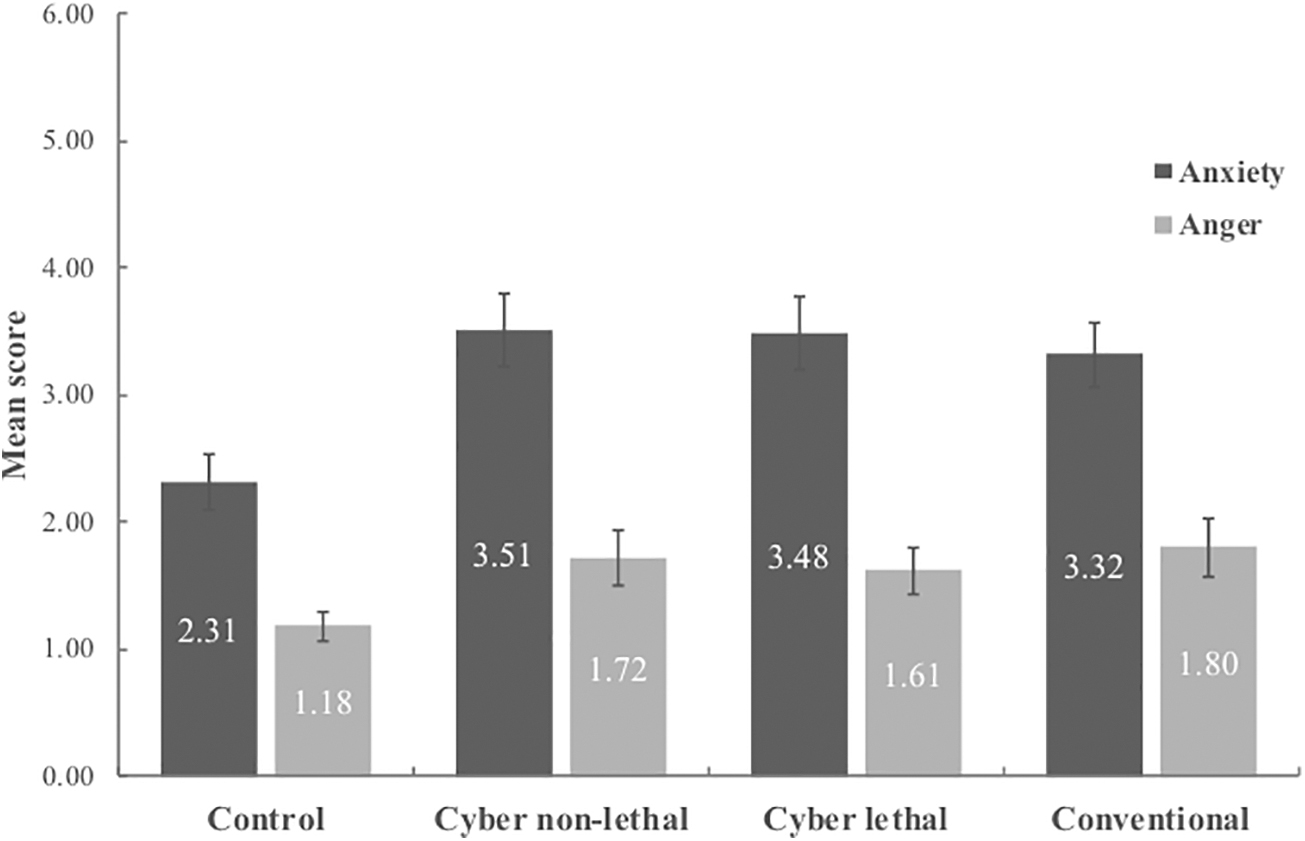
Means of anxiety (stress) and anger between groups with confidence intervals (CI = 95). CI, confidence interval.
Differences in cortisol values between the four groups were tested through ANOVA. Cortisol values were higher in the terrorism conditions (cyber and conventional) than in the control condition, as can be seen in Table 3 and Figure 3. However, these differences were not significant [F(1, 168) = 0.87, p = 0.353]. It should be stressed that in this study, participants were asked to provide one saliva sample 20–25 minutes after watching the relevant video clip for their assigned group. Previous studies examined not only interparticipant coefficients, as in this study, but also intraparticipant results, comparing values before and after exposure to a stressor. In this study, randomization and group size could not rule out high individual variability between participants in levels of cortisol, which potentially masked differences in cortisol values between the groups.

Mean scores of cortisol between groups with CIs = 95.
Mean Scores for Cortisol (pg/mL)
Anger and cyberterrorism
Participants exposed to cyberterrorism reported more anger than participants in the control group. Mean anger scores were higher in the lethal (M = 1.61, SD = 0.7) and nonlethal cyberterrorism groups (M = 1.72, SD = 0.82) compared with the control group (M = 1.18, SD = 0.44; see the light gray bars in Fig. 2). ANOVA tests supported the expectation that cyberterrorism would evoke anger in participants [F(1, 168) = 19.89, p < 0.001]. In an ANCOVA on anger using gender, web knowledge, and political position as covariates, gender, and political position proved significant [gender, t(165) = 2.61, p = 0.01; political position, t(165) = −2.34, p = 0.02], but not knowledge of the web [t(165) = 0.76, p = 0.589]. Men in the cyberterrorism groups reported higher levels of anger. Participants who rated their political position as right reported higher scores of anger in the cyberterrorism conditions. The effect of condition was reduced but remained highly significant [F(4, 165) = 8.35, p < 0.001; t(165) = 4.71, p < 0.001]. Overall, our findings on stress and anger support Hypothesis 1a. Post hoc analysis aimed at comparing anxiety and anger revealed that, across all terrorism conditions, anxiety scores were significantly higher than anger scores (Z = −13.08, p < 0.001). These findings support Hypothesis 1b.
Comparisons between conventional and cyberterrorism
Analyses of variance yielded no significant difference between the cyberterrorism and conventional terrorism groups in terms of their effect on anxiety [F(1, 171) = 1.21, p = 0.273], cortisol [F(1, 171) = 0.30, p = 0.587], or anger [F(1, 171) = 1.03, p = 0.311]. Thus, Hypothesis 1c is supported. Finally, we compared the intensity of stress and anger produced by exposure with clips describing lethal versus nonlethal outcomes of cyberterrorism. As predicted, no differences were detected between lethal and nonlethal cyberterrorism in terms of expressed anxiety [F(1, 110) = 0.02, p = 0.881], cortisol [F(1, 110) = 0.30, p = 0.584], or anger [F(1, 110) = 0.54, p = 0.463]. Hence, Hypothesis 1d was also supported.
Discussion and Conclusion
This article demonstrates how even nonviolent forms of cyberterrorism have a considerable impact on the emotions of affected populations. Using staged television news reports depicting cyberterrorist attacks on a critical infrastructure facility in Israel, we found that participants exposed to a potential cyberterrorism scenario were significantly more likely to experience stress in form of anxiety and, to a lesser degree, anger, compared with participants in a control group who were not exposed to terrorism scenarios of any kind. Importantly, participants' reactions were the same across the three treatment conditions—conventional terrorism, cyberterrorism with lethal consequences, and cyberterrorism with only financial outcomes. Notably, stress—as measured by self-reported anxiety—affected participants in all three treatment conditions more severely than anger. The findings indicate that, if cyberterrorism like conventional terrorism is aimed at creating a climate of fear among ordinary citizens, it is likely to be successful. This is especially the case for men.
Previous research suggested that, due to shared characteristics with conventional terrorism, cyberterrorism may have the same impact on affective reactions.31,48 Despite some limited research on emotions aroused by criminal cyberattacks, 49 and an extensive amount of research on emotions in response to conventional terrorism,10,33 studies focusing on emotional reactions after cyberterrorist attacks have been scarce. This study helps fill the resulting lacuna in our knowledge by specifically highlighting the impact of cyberterrorism on anxiety, physiological stress, and anger.
Interestingly, differences in the outcome of the simulated cyberterrorism scenario—a lethal attack versus one with only financial effects—did not affect levels of the negative emotions examined, namely stress and anger. In both cases, as with conventional terrorism, levels of anxiety rose while levels of anger were less affected by the manipulation. This might be explained by the fact that anxiety tends to be triggered by uncertainty and unpredictability, whereas anger is more likely to be elicited by familiar situations. 23
The present findings have several implications for the study of cyberterrorism. The findings provide grounded evidence that cyberterrorism is a dangerous phenomenon not only because of its potential direct consequences, but also because it can cause significant negative emotions in affected individuals. The specific emotions that aroused are critical in that they are related to different political behavior. Anxiety enhances support for precautionary actions, whereas anger is associated with proactive responses, heightened risk-seeking behavior, and demands for retaliatory strikes against an enemy. Understanding the relative effect of these emotions after exposure to cyberterrorism will help model political outcomes.
The current findings should be considered with a certain degree of caution. On the one hand, the salience of terrorism in Israel may have elevated our subjects' responses beyond levels that would be observed in other countries. On the other hand, it is also plausible that this saliency generates a communal detachment or even immunity, to a point where Israeli respondents may be on the lower end of the scale. Moreover, our study design did not permit us to examine variability between participants in cortisol values. Therefore, this study could not confirm more than a general trend of physiological stress reactions to terror attacks. We encourage future study to utilize designs that collect pre- and postmeasurements of cortisol to more accurately detect physiological changes between treatment and control groups, and do so across national settings where terrorism is not prevalent.
Footnotes
Notes
Acknowledgment
The authors thank Nehemia Geva for his helpful advice on various technical issues examined and his constructive comments that greatly contributed to improving the final version of the article.
Author Disclosure Statement
We hereby confirm that none of the authors possess any commercial associations that might create a conflict of interest in connection with this submitted article.
Funding Information
This study was made possible, in part, by grants from the Israel Science Foundation to the second (1SF: 156/13) and last authors (1SF: 594/15), and grants from the Minerva Research Initiative (49490) to the last author.

References
Supplementary Material
Please find the following supplemental material available below.
For Open Access articles published under a Creative Commons License, all supplemental material carries the same license as the article it is associated with.
For non-Open Access articles published, all supplemental material carries a non-exclusive license, and permission requests for re-use of supplemental material or any part of supplemental material shall be sent directly to the copyright owner as specified in the copyright notice associated with the article.
