




Abstract
This study was primarily aimed at identifying classes of adolescents in relation to their probability of endorsing several risks associated with the Internet (cyberbullying victimization and perpetration, cyberdating abuse victimization, and perpetration, sexting, and grooming). The second objective was to examine a mediational model linking dispositional mindfulness, risk perception, exposure to antisocial content in the media, Internet-risk classes of adolescents, and health-related quality of life (HRQL). The sample comprised 3,076 adolescents (46.2% boys, ages between 12 and 21). Latent class analyses indicated the existence of five classes related to the probability of endorsing Internet risks: No risk (60.75%), only cyberbullying (25.5%), cyberbullying and cyberdating abuse (6.7%), all risks (4.3%), and sexual risk (2.9%). Three mindfulness facets, namely, acting with awareness, nonreacting, and nonjudging, were associated with all the classes of risks. This association was partially explained by the degree of exposure to antisocial content in the media and risk perception. Finally, membership in the Internet-risk classes was associated with a lower HRQL.
Introduction
The Internet contains several risks, such as cyberbullying, cyberdating abuse, grooming, and sexting, which may have a negative effect on adolescents' health-related quality of life (HRQL).1,2 Cyberbullying is the use of electronic and online communication technology to harass, threaten, and/or socially exclude a targeted individual.3,4 Cyber aggression may also be aimed at dating partners. 5 Sexting refers to the creation and exchange, through the digital media, of messages, pictures, and/or videos of sexual content.6,7 Online grooming is a process by which an adult tricks a minor through the use of new technologies to obtain sexual material of the minor and/or to sexually abuse her/him.8,9
Unfortunately, many Internet risks do not take place in isolation; instead, there is a tendency for them to occur in conjunction with each other.4–13 Therefore, it is important to study how several Internet risks combine and negatively affect adolescents' HRQL. Furthermore, protective factors against involvement in Internet risks need to be identified.
Dispositional mindfulness (DM) may be postulated as a relevant protective factor against Internet risks. Mindfulness is a way to attend to present experience, deliberately and without judging, moment by moment. 14 DM has been proposed to comprise five facets: Observing sensations, thoughts, and feelings (OB); describing feelings and thoughts with words (DES); acting with awareness (AA); nonjudging of inner experience (NJ); and nonreacting to inner experience (NR). 15 DM is positively associated with well-being and quality of life. 16 Furthermore, DM may contribute to an understanding of risk-taking behavior on the Internet. Some studies have found an inverse relationship between AA and problematic gaming, 17 problematic smartphone use, 18 and the problematic use of the Internet19,20 and cyberbullying.21,22
Several conceptual approaches have proposed the mediational mechanisms through which mindfulness reduces emotional and behavioral problems. According to these proposals, mindfulness enhances self-regulation23–26 and increases prosocial characteristics through a positive relationship between the self and the other, which transcends self-focused needs. 25 Thus, adolescents who are high in some DM facets, such as AA, may pay more attention to scenarios on the Internet, and, accordingly, be less likely to become involved in risky behaviors. Self-regulation could lead to a higher risk perception of some behaviors, such as giving personal data to strangers. Moreover, adolescents are great antisocial media consumers, 27 and this exposure is associated with being implicated in cyberbullying behaviors. 28 Adolescents with high DM are more motivated toward prosocial behavior and avoiding antisocial media content and, therefore, may be less likely to be implicated in cyber risks.
Research objectives
Research objective 1 (RO1) was to identify classes of adolescents in relation to their probability of endorsing several Internet risks, including cyberbullying victimization and perpetration, cyberdating abuse victimization and perpetration, sexting, and grooming.
RO2 was to examine a mediational model linking DM, risk perception, exposure to antisocial content in the media, Internet-risk classes of adolescents, and HRQL. We hypothesized that (a) DM would explain belonging to classes through the mediation of higher Internet-risk perception and less exposure to antisocial content in the media; (b) DM would be associated with HRQL, whereas Internet-risk classes that accumulate several risks would be associated with lower HRQL.
Materials and Methods
Participants
The sample included 3,076 students (1,422 boys, 46.2%; 1,654 girls, 53.8%; mean age = 13.97 ± 1.45). The participants came from 22 high schools in seven regions of Spain. Data were collected between April and June 2018 by means of convenience sampling.
Instruments
A revised version of the Cyberbullying Questionnaire, 29 which comprises nine items for the cybervictimization dimension and another nine for the cyberaggression dimension was employed. The response scale ranged from 0 (never) to 4 (almost every week). Omega: 0.88 (Victimization) and 0.86 (Perpetration).
An adapted version of the Cyberdating Abuse Questionnaire 30 was administered. It comprises 22 parallel items, 11 for victimization, and 11 for perpetration, and includes behaviors such as mobile phone control behavior and insults. The response scale ranged from 0 (never) to 3 (almost always). Omega: 0.90 (Victimization) and 0.91 (Perpetration).
The Sexting Questionnaire, which was an adaptation from the original questionnaire 31 comprised three items related to sending information such as pictures and videos with sexual content to one's partner, an acquaintance, or someone the respondent had met online but did not yet know in person. The items were rated on a five-point response scale ranging from 0 (never) to 4 (7 or more times). Omega: 0.86.
The Online Sexual Solicitation and Interaction of Minors with Adults Questionnaire, 32 which contains 10 items that assess the sexual interactions that are part of the initiation, process, and/or result of online grooming, was employed. Items are rated on a four-point response scale ranging from 0 (never) to 3 (6 or more times). Omega: 0.93.
The Five-Facet Mindfulness Questionnaire-Adolescents-Short Form, 15 short version for adolescents (FFMQ-A-SF 33 ), was used to measure five facets of DM: OB, DES, NJ, AA, and NR. The FFMQ-A-SF comprises 25 items; each facet is assessed by five items answered on a five-point scale ranging from 1 (never or rarely true) to 5 (very often or always true). Omega: 0.80 (OB), 0.78 (DES), 0.85 (AA), 0.84 (NJ), and 0.76 (NR).
Exposure to media with antisocial content was measured by means of the 12 items of the Antisocial Content subscale of the Content-based Media Exposure Scale 2. 34 It includes exposure to direct and relational aggressive behaviors, use of drugs and alcohol, and explicit sexual behaviors in the media. Respondents assess the items on a five-point scale (0 = never, 4 = very often). Omega: 0.94.
Risk Perception was assessed with four items: 35 Posting personal photos, publishing your real name, your phone number, and the name of your school. Adolescents rated how risky these behaviors were on a 10-point response scale, ranging from 1 (not at all) to 10 (a lot). Omega: 0.83.
We employed the Spanish version of KIDSCREEN-1036 to assess HRQL. The items are assessed by means of a five-point scale, ranging from 1 (never) to 5 (always). Omega: 0.85.
Procedure
The participants completed the measures through Qualtrics©. Participation was voluntary. Parents were given the option to decide whether their children could participate; less than 2% who did not want their children to participate returned the consent form. The project was approved by the (masked for review) Ethics Committee (Ref.231/17).
Statistical approach
We used latent class analyses (LCA) with the maximum likelihood (ML) estimator in MPLUS 837 to identify classes of adolescents according to their involvement in several Internet risks. We followed several criteria to determine the optimal number of classes.38,39 We employed the Akaike information criterion, the Bayesian information criterion, the sample-size adjusted Bayesian information criterion, the entropy index, and the Lo/Mendell/Rubin adjusted likelihood ratio test as indicators to evaluate and compare the models. 39
We used path analysis with LISREL 10.2 with the robust ML method, which includes the Satorra/Bentler scaled χ 2 index 40 (S-Bχ 2 ) to examine associations between DM, antisocial media exposure, risk perception, latent classes of adolescents according to Internet risks, and HRQL. Fit of the model was evaluated by means of the comparative fit index (CFI), the Tucker/Lewis fit index (TLI), the root mean square error of approximation (RMSEA), and the standardized root mean square residual (SRMR). CFI and TLI values of 0.95 or greater and RMSEA and SRMR values of 0.06 or lower indicate that the model adequately fits the data. The significance of mediational paths was tested by means of bootstrapping with 5,000 samples.
Results
Descriptive statistics and correlations between variables
Table 1 presents the descriptive statistics and correlation coefficients between variables. With the exception of OB, all DM facets were positively correlated with HRQL.
Descriptive Statistics and Correlation Coefficients
p < 0.05, **p < 0.001.
SD, standard deviation.
RO1: classes of adolescents in relation to their involvement in internet risks
Table 2 presents the results of the LCA. The indicators improved from the one-class model to the five-class model and were reduced with the six-class model. These results suggested that the five-class latent model was the optimal LCA model for the sample. Posterior probabilities were used to assign each participant to a single class. Figure 1 displays the solution of five classes. The first class (no risk) presents low probabilities in all categories of risks. The second class (only cyberbullying) presents a high probability of reporting cyberbullying victimization and perpetration and low probabilities in the other risks. The third class (cyberbullying and cyberdating abuse) presents moderate-high probabilities of perpetration and victimization of both cyberbullying and cyberdating abuse. Although the fourth class (all risks) was very similar to the third class, the probabilities for cyberbullying and cyberdating abuse were higher. Furthermore, the fourth group had moderate probabilities of grooming and sexting. The fifth class (sexual risk) presents the highest probabilities of reporting grooming and sexting.
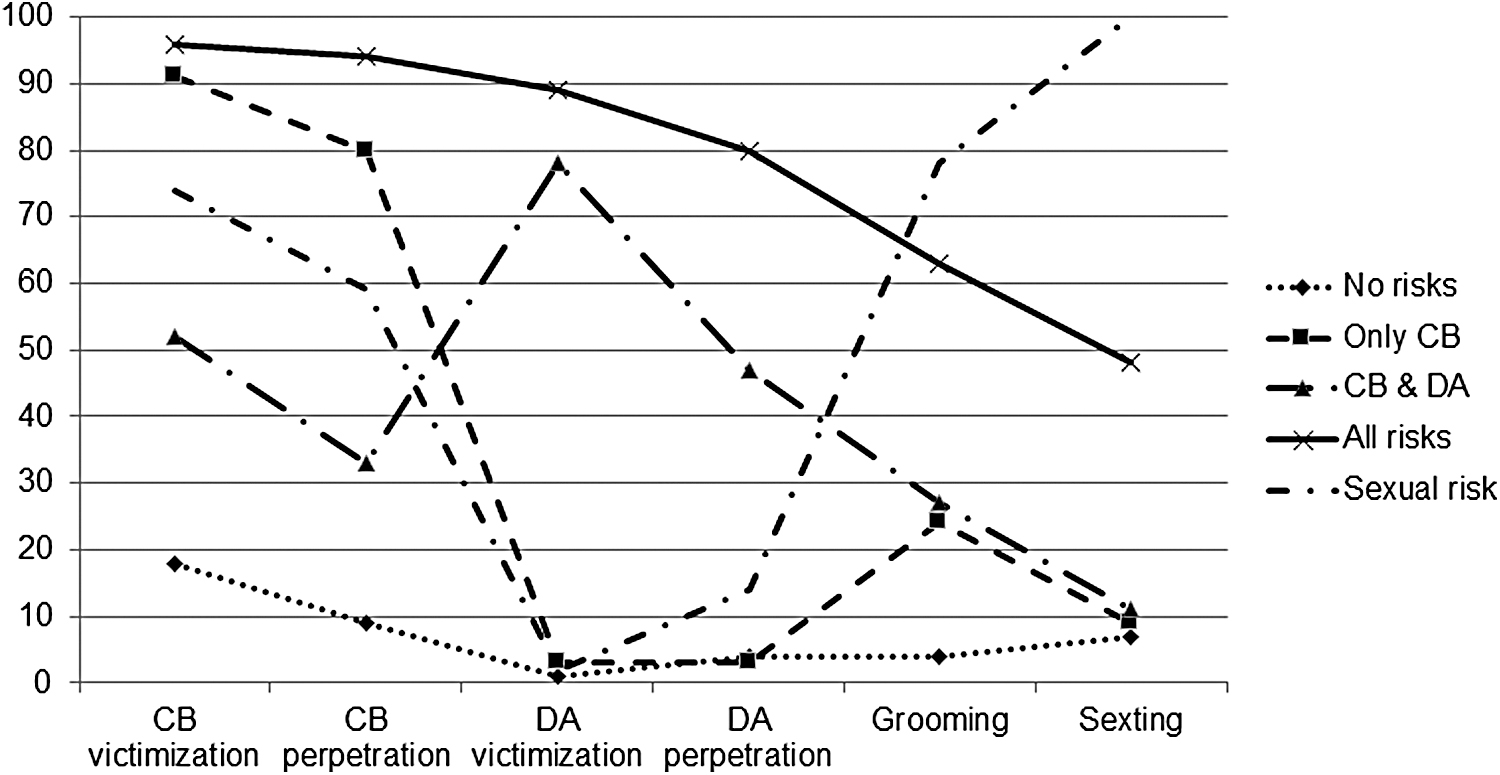
Latent classes for Internet risks. Conditional risk probability plot. The probability of endorsing each risk was provided by class membership. CB, cyberbullying; DA, dating abuse.
Results of the Latent Class Analyses
AIC, Akaike information criterion; BIC, Bayesian information criterion; SABIC, sample-size adjusted Bayesian information criterion.
Table 3 displays the results of the analysis of variance (ANOVA) for the differences between classes in all the study variables. According to multiple comparisons (Bonferroni method, p < 0.05), several statistically significant differences between the classes emerged. The adolescents in the no-risks class scored higher on Internet-risk perception than the other classes, except the sexual-risk class. The lowest scores on antisocial media exposure were presented by those in the no-risk class while those in the all-risks and sexual-risk classes presented the highest scores. The participants in the cyberbullying and cyberdating abuse-risk class scored the lowest on OB. They also scored the lowest on NR together with those in the all-risks class. Those in the no-risk class scored the highest on AA and NJ. Those in the all-risks class, together with the sexual-risk class, scored the lowest on AA and NJ. Finally, the adolescents in the no-risk class scored the highest on HRQL.
Mean Differences Between Classes of Adolescents
a,b,c,d,eMeans sharing a subscript in a row indicate means that are not significantly different from each other.
Overall, the girls had higher prevalence rates in all the classes except for the sexual-risk class in which the rates for the boys and girls were both 2.9%. The membership in the no-risk class was higher for boys than for girls (64% vs. 57.6%), χ 2 (4, n = 3,076) = 27, p < 0.001. There were significant differences in age, F(4, 3,071) = 47, p < 0.001). The youngest participants were in the no-risk class, and the oldest adolescents were in the sexual-risk class (Table 3).
RO2: mediational model
We used the no-risk class as the reference class. Dummy variables were used to include membership within the other classes. DES and OB were not associated with any class and were eliminated from the model. Figure 2 displays the significant paths of the model. AA and NJ were negatively associated with antisocial media exposure and this, in turn, was positively associated with all the classes. AA and NR were positively associated with risk perception, whereas NJ was negatively associated. Risk perception was, in turn, negatively associated with only cyberbullying and risk of cyberbullying and cyberdating abuse classes.
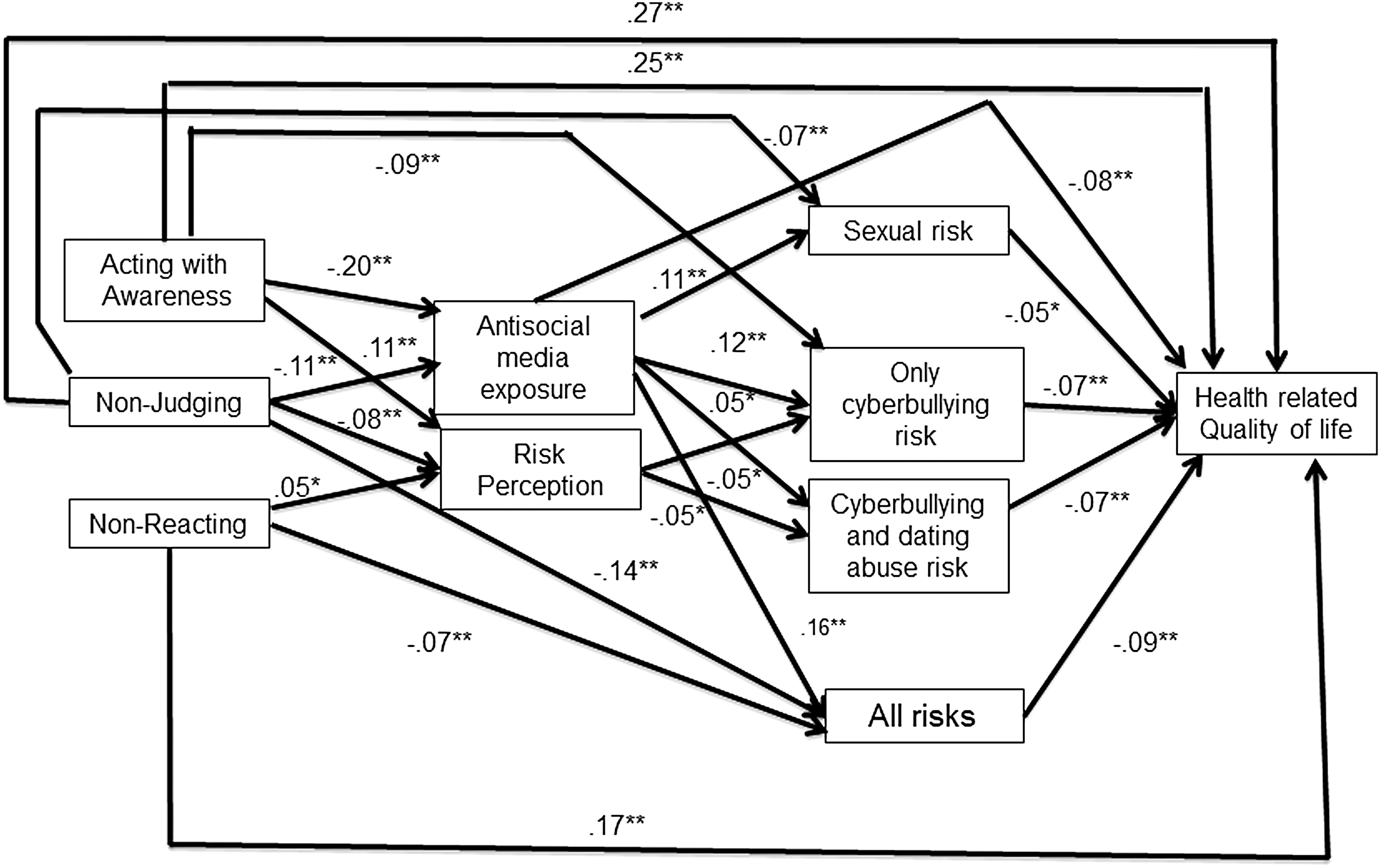
Mediational model between mindfulness, cyber risks, and health-related quality of life. *p < 0.05, **p < 0.001.
Bootstrapping results displayed that the above mediational paths linking DM with classes were significant, as the confidence interval (CI) did not include zero (Table 4). Moreover, DM facets were positively associated with HRQL, whereas all the classes were negatively associated with HRQL. NJ and NR were directly and positively associated with the all-risks class, and exposure to antisocial media was associated with lower HRQL. Bootstrapping results indicated that the indirect effects from DM facets to HRQL through antisocial media exposure, risk perception, and classes were significant. Indirect effects were more prominent for AA. The fit indices of this model were excellent, S-Bχ 2 (1, n = 3,076) = 0.47, RMSEA = 0.00 (90% CI [.00 to .044]); non-normed fit index = 0.999, CFI = 0.999, SRMR = 0.0023, S-Bχ 2 /df = 0.47.
Mediational Paths Between Dispositional Mindfulness and Internet Risk Classes
All the mediational paths are statistically significant at p < 0.001, as their 95% CIs do not include zero.
CI, confidence interval; HRQL, health-related quality of life.
Discussion
This study contributes to demonstrating that many of the risks on the Internet for adolescents do not occur in isolation, but cumulatively. Five classes emerged as the best solution to explain the involvement of adolescents in risks on the Internet. Most of the adolescents were classified in the no-risk class. They displayed an almost zero probability of presenting Internet risks. Furthermore, they were the youngest adolescents in the sample and had the highest scores in HRQL, AA, and NJ, and the lowest scores in exposure to antisocial content in the media. There were more boys than girls in this class.
The only cyberbullying class included those with a very high probability of presenting victimization and perpetration of cyberbullying, but very low scores in the other Internet risks. This class concurred with the often reported category of cyberbullying perpetrator/victim. 10 The third class, the all-risks class, displayed high probabilities of most of the Internet risks, especially cyberbullying and cyberdating abuse. Furthermore, those in this class scored high on exposure to antisocial content in the media and low on the DM facets of AA, NJ, and NR. The fourth class, cyberbullying and cyberdating abuse class, presented a high probability of cyberdating abuse victimization, and a moderate probability of cyberdating perpetration and cyberbullying victimization and perpetration.
The final class, the sexual-risk class, displayed the highest probability of performing sexting (100%) and of being a victim of grooming (78%). Furthermore, those in this class had a high probability of being involved in cyberbullying behavior, either as victims or as perpetrators. This group, together with the all-risks class, presented the highest scores in exposure to antisocial content in the media. Furthermore, it included older adolescents and had an equal number of boys and girls. It is noteworthy that those in the sexual-risk class scored high on the perception of Internet risks; the latter may have been a result of the negative experiences of grooming that they had experienced.
We also tested the potential beneficial role of mindfulness facets against Internet risks. AA, NR, and NJ were negatively associated with belonging to these classes. This finding concurs with the results of previous studies, which indicated that DM is associated with less problematic Internet behaviors.17,18,22 Our study enhances information about the associations between specific DM facets and classes of adolescents that integrate several modalities of Internet risks.
Furthermore, this study contributes to clarifying some mechanisms through which DM is associated with fewer cyber risks. Exposure to antisocial content in the media played a relevant role. AA and NJ, to a lesser extent, were associated with less exposure to antisocial content. This exposure, in turn, was significantly associated with belonging to Internet-risk classes, and, in particular, the all-risks class. Theoretical proposals suggest that mindfulness increases prosocial behaviors through the focus on positive relationships between the self and the others. 25 Thus, adolescents who are high in these DM facets could avoid antisocial content in the media, especially content displaying aggressive behaviors. Lower exposure to negative content, in turn, decreases the probability of becoming involved in Internet risks. 28
The mediating role of risk perception was modest. On the one hand, AA and NR were associated with higher scores in risk perception. Contrary to our expectations, NJ was negatively associated with risk perception. This facet involves accepting things as they are and could result in young people becoming more confident on the Internet and not avoiding risky behaviors such as sharing their contact details with strangers on the Internet.
Finally, DM was associated with better HRQL, and part of this association was explained by a reduced involvement in Internet-risk classes. AA was the facet that displayed a more prominent indirect effect on HRQL through a lower involvement in Internet risks.
This study had various limitations that provide challenges for future studies. First, the study was cross-sectional and, therefore, future longitudinal studies should examine directional relationships between variables. Second, the exclusive use of self-reports may have increased associations between variables and should have been completed with peer reports. Finally, the sample was not random and therefore, the classes obtained in this study should be replicated in different samples.
Despite the limitations, the findings have implications for interventions. When educators and parents detect that an adolescent is involved in problematic Internet behavior, they should explore the co-occurrence of other risks, as suggested by the classes identified in this study. This approach could better inform the interventions by including specific strategies to cope with the various risks in which the adolescent is involved. Furthermore, the results suggest that risks tend to increase with age. Therefore, preventive interventions should be implemented early. Some mindfulness facets, namely, AA, NJ, and NR, have shown a beneficial role against Internet risks. Therefore, mindfulness-based interventions may promote safe and healthy behaviors on the Internet through the training of awareness and acceptance. These characteristics have been theoretical and empirically associated with self-regulation and prosocial behavior,25,27 which are important to prevent risk behaviors on the Internet.
In conclusion, findings display five classes of adolescents according to their involvement in Internet risks. Some DM facets reduce the probability of being involved in classes characterized by Internet risks, in part through lower exposure to antisocial media and higher perception of risks. DM is associated with better HRQL, in part through lower involvement in Internet risks.
Footnotes
Author Disclosure Statement
No competing financial interests exist.
Funding Information
This research was supported by a grant from the Basque Country (Ref. IT982-16) and the BBVA Foundation (PR[18]_SOC_0096).